Day 1156: Bramton Wick

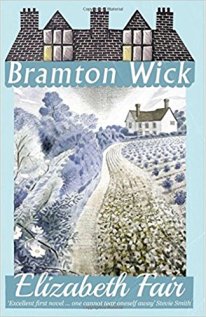
Cover for Bramton WickI so enjoyed A Winter Away that I looked for more novels by Elizabeth Fair immediately. I found that they are being reprinted in a nice edition by Furrowed Middlebrow. Bramton Wick is Fair’s first novel, set in a village in post-World War II England. It is a gentle domestic novel with a bit of an edge.

Although the novel features several eccentric denizens of the village, it centers around Laura and Gillian Cole. Mrs. Cole and her family used to be the owners of Endbury, one of the large homes in the area, until Mr. Cole died and they had to sell. Mrs. Cole, although she dislikes the current owner of Endbury, Lady Masters, has begun to notice that Lady Masters’ son Toby has a liking for Laura.

Neighbors Miss Selbourne and her friend “Tiger” Garrett raise dogs in a cheerfully disordered household. Miss Selbourne has noticed, though, that whenever there is something unpleasant to be done, Tiger gets ill.

The neighborhood isn’t short of elderly women, for the Miss Cleeves are also nearby. The Miss Cleeves are penniless and dependent upon their landlord, Miles Corton, for help. Miss Cleeve is profoundly deaf, one sister is a religious fanatic, and the other sister sprinkles her malicious gossip with untruths.

Gillian, Mrs. Cole’s other daughter who is a war widow, has decided to take under her wing the wealthy new resident of the village. Mr. Greenley is from new money. He dresses like a parody of an English country gentleman and has not been welcomed to the village. Gillian thinks he just needs a little help fitting in.

This novel is gently comic, reminding me of Angela Thirkell without quite so much sharpness and snobbery. As Laura tries to figure out what she wants from life, we are greatly entertained by the antics of her neighbors.

Related Posts

A Winter Away

Wild Strawberries

Money to Burn

Day 1153: Bleak House

Cover for Bleak HouseBest of Five!
I just love Bleak House. I hadn’t read it for years, so I was happy to pick it up as one of the last books on my first Classics Club list. Note: with this book, I have finally posted my last review for my first Classics Club list. I will soon have my second list posted at the link above.

At first, the novel appears to follow two distinct stories, that of the orphan Esther Summerson and that of the household of Lord and Lady Dedlock, but we find that these stories are entwined. Peopling the novel are countless other unforgettable characters.

Esther has had a sad childhood, but her life begins to improve when an unknown benefactor first takes her education in hand by sending her to school and then employs her to be the companion of Ada Clare. Ada, with her cousin Richard Carstone, is another orphan, and both are parties to the famous lawsuit of Jarndyce and Jarndyce. As they are wards of the court, a distant cousin, Mr. John Jarndyce, has agreed to be their guardian.

Dickens was famous as a social activist, and one of his targets here is the Courts of Chancery, where wills are proven. Jarndyce and Jarndyce is a famous case in Chancery that has been going on for years and has driven countless possible legatees to ruin. Mr. Jarndyce refuses to deal in this case and hopes to encourage Richard and Ada to leave it alone.

Esther makes a happy home for herself and Richard, Ada, and Mr. Jarndyce at Bleak House, Mr. Jarndyce’s home. But as Richard grows older, he fails to settle to a profession and devotes more and more time to the lawsuit. He is sucked in. And that is more a shame because Ada, whom Esther calls her darling, is in love with Richard.

At the Dedlock’s, a mystery begins that eventually takes up much of the novel. Lady Dedlock is beautiful and stately but deeply bored. However, one day when the Dedlock lawyer, Mr. Tulkinghorn, comes with papers to sign, Lady Dedlock glimpses some handwriting and promptly faints. Lady Dedlock has a secret, and Mr. Tulkinghorn is determined to find it out. Mr. Tulkinghorn is inexorable.

As with any Dickens novel, Bleak House is filled with entertaining characters. There is Mrs. Jellyby, who is so taken up by a charity for Africans that her children are neglected and her house is a disaster. Her unfortunate daughter, Caddy, covered in ink when we first meet her, becomes an important secondary character. One of Mr. Jarndyce’s friends is Harold Skimpole, who professes himself a mere child in worldly ways and proceeds to leech off his friends. There are many other notable characters, but one of the most interesting is the detective, Mr. Bucket. At first he seems rather sinister, but we soon change our minds about him.

Above all, there is Dickens’ style, which carries you along with the story. He makes you laugh, he makes you cry, and as always, he shows sympathy for the unfortunate, especially for children. It is easy to see from Bleak House, which many consider his masterpiece, why he was the most popular writer of his time.

Related Posts

David Copperfield

Great Expectations

Oliver Twist

Day 1151: Henry VI, Part III

Cover of Henry VI Part IIIHenry VI, Part III must have been a difficult play to write, because it telescopes the major events of years into five acts. Its action is a little tiresome, as one side of the conflict is in the ascendent, then another. However, the longer speeches in this early play are beginning to show Shakespeare’s stuff. And certainly, for audiences of the day, who didn’t know their history, it was probably exciting.

The play opens where Part II left off. Henry has just been defeated by the Yorkists at the first battle of St. Albans. Shortly thereafter, he makes a deal with York that allows him to rule during his lifetime but makes York his heir. But both York and Queen Margaret soon break the vow. York is preparing to resume conflict so that he can be king when Queen Margaret attacks in an effort to protect her son’s rights.

What was most interesting to me in this play is the depiction of several of the main characters. Queen Margaret is a real viper and is reviled by several characters, even though she is just trying to protect her son. In fact, I believe it was this play in part that was responsible for her reputation in history.

Although Henry is depicted as saintly and all for peace, he is not shown as mentally incapacitated, as he was for much of his life. Warwick, despite changing sides and being ultimately on the wrong one (as far as the Tudors are concerned), is rather heroic. And Gloucester, later Richard III, is set up beautifully for the subsequent play, Richard III.

All in all, I thought that the second play moved along better. I was glad to contrast this trilogy with the other reading I have done on the Wars of the Roses.

Related Posts

Henry VI, Part I

Henry VI, Part II

Margaret of Anjou

Day 1146: Birdcage Walk

Cover for Birdcage WalkBest of Five!
Lizzy Fawkes has a close relationship with her mother, Julia, who has worked all her life for the rights of common men. She revolted against her family’s guidance, though, in the choice of her husband, John Diner Tredevant, a property developer. Julia thinks him too concerned with money, while he thinks Julia’s support of the French revolution is naive. Unfortunately, because Lizzy was so adamant to have John, or Diner as he prefers to be called, she cannot confide to her mother her occasional doubts, as Diner behaves in a controlling manner.

Readers already know that at the beginning of the novel, a man murdered a woman and buried her in the woods near the gorge of the Avon River. Diner is building his homes in Bristol overlooking that gorge, and we slowly come to fear that he may have murdered his first wife, Lucie.

link to NetgalleyWith the success of the revolution comes the threat of war with France, and buyers back out of their agreements to purchase Diner’s houses. Diner’s behavior becomes erratic.

This novel is a real page turner. It makes the fourth Dunmore novel I’ve read, each one better than the last. It builds up a lot of suspense as you wonder what Lizzie’s fate will be.

Related Posts

The Lie

Exposure

The Greatcoat

Day 1145: By the Pricking of My Thumbs

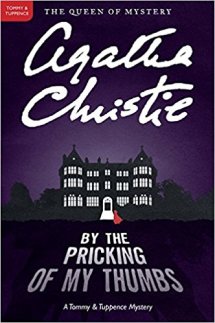
Cover for By the Pricking of My ThumbsBy the Pricking of My Thumbs is one of the books I read for the 1968 Club. It is one of Agatha Christie’s Tommy and Tuppence novels.

Tommy and Tuppence are a witty and urbane middle-aged couple who used to be involved in some sort of secret service organization.  The novel begins with a visit to Tommy’s Aunt Ada at a retirement home, where Tuppence makes the acquaintance of a Mrs. Lancaster. Mrs. Lancaster asks Tuppence if it was her child and talks about a child hidden behind a fireplace.

After Aunt Ada dies a few weeks later, Tuppence asks after Mrs. Lancaster only to learn that she was abruptly removed from the home. Before she left, she gave Aunt Ada a painting of a house that seems familiar to Tuppence, and she uses the excuse of trying to return the painting to find Mrs. Lancaster. For some reason, she fears that the woman is in danger.

1968 club logoTommy is away at a conference when Tuppence begins trying to track down Mrs. Lancaster. The address left for her at the retirement home is a hotel, which has no record of her. All inquiries seem to dead end, so Tuppence begins looking for the house.

Although Tommy and Tuppence are vibrant, I did not feel that the other characters showed Christie’s usual talent for adroit characterization. Even though they eventually connected, the two strands that the investigation uncovers make the novel overly complicated. I could have done without the crime syndicate angle and thought it was unnecessary to the story. Besides, the other thread was much more chilling. Still, I enjoyed reading this Tommy and Tuppence novel.

Other Books for the 1968 Club

Aside from the reviews I’ve published this week, here’s a list of other books published in 1968 that I previously reviewed:

Related Posts

Appointment with Death

At Bertram’s Hotel

Death on the Nile


Day 1144: The Victorian Chaise-Longue

Cover for The Victorian Chaise LongueThe Victorian Chaise-Longue is a short little tale of the macabre in honor of the season. Its plot is simple.

Wealthy Melanie Langdon is recovering from tuberculosis, complicated by recent child birth. When she is finally recovered enough, she is carried to lie on a Victorian chaise-longue that she bought in an antique store. There she falls asleep.

When Melanie awakens, she has returned to Victorian times and is locked in a Victorian body. When she is alarmed at her situation, she is thought to be hysterical.

logo for RIPI did not find the novel terrifying, but perhaps that is my own lack of imagination. I felt I needed to care for the character more before she was put in her dilemma. I understand from the introduction that Laski moved to a remote house to induce in herself a sense of fear, just to write this novel.

This is the final book I read for the R.I.P. challenge. Happy Halloween!

Related Posts

Sleep, Pale Sister

The Solitary House

The Sleep Room

Day 1143: Cousin Kate

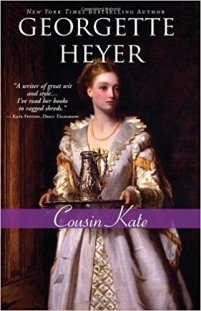
Cover for Cousin KateCousin Kate was one of the novels that I could read for the 1968 Club, during which we read books for the year chosen. Since I love Georgette Heyer, I was delighted to reread it.

Heyer’s Regency romances usually fit into one of two categories—straight romance or romantic suspense—both laced with humor and wit. Cousin Kate fits in the latter category.

Kate Malvern returns with some dismay to the home of her nurse, Sarah Nidd. She has lost her position as governess, because her employer’s brother made an offer of marriage. As she continues looking for a new position, she realizes her lack of success is due to both her lack of credentials and her good looks. She begins to talk wildly of taking a job as an abigail or a seamstress.

Kate’s mother’s family cut her mother off when she married Kate’s ramshackle father. But Kate’s father had a half-sister whom Kate has not met, Lady Broome. Unbeknownst to Kate, Sarah writes to Lady Broome hoping she will offer Kate a home.

She does, but shortly after arriving at the stately Staplewood, Kate realizes it is not a happy home. Sir Timothy is in frail health and lives in his own wing. Nineteen-year-old Torquil is also subject to headaches and extremely volatile in his behavior. He is constantly attended by either his man, Badger, or Dr. Delabole. Lady Broome claims to have work for Kate, but the household runs smoothly, and Kate, used to being active, is soon bored. Lady Broome also showers her with gifts, which makes her uncomfortable.

1968 club logoSir Timothy’s nephew, Philip, arrives. At first, he seems disdainful of her, but soon he is urging her to leave. She does not see how she can do so without seeming ungrateful and hopes there will be something she can do for Lady Broome. Little does she know that there is.

As I’ve gotten older, I’ve appreciated the truly silly humor of some of Heyer’s funnier novels most. So, Cousin Kate is not one of my favorites. That being said, it still features an engaging heroine, witty dialogue, and an interesting plot. It is hard to go wrong with Heyer for a light, cozy read.

Related Posts

Sylvester, or The Wicked Uncle

The Convenient Marriage

Friday’s Child

Day 1142: Bloodline

Cover for BloodlineI have to admit that my attention span wavered during parts of Bloodline, Conn Iggulden’s third Wars of the Roses novel. I found the emphasis on war in the first half of the book less interesting than the political maneuvering that occupied most of the first two novels. And a good portion of the middle of the novel is just about one battle, which, even though some interesting and important things happened during it, was still a battle, related in too much detail. It was only the last section, after the crowning of Edward IV, that somewhat reignited my interest.

The novel begins with Margaret of Anjou, King Henry VI’s wife, in ascendance, even though Henry is a captive of the Yorkists. She has gathered together a huge army, even bringing in Scots from up north. But she has made a mistake in letting her army loot every town and village they’ve passed on the way to London. For, when she gets to London, the city won’t let her in.

The Yorkists, now led by Richard of Warwick, are gathering their forces to fight her. Meanwhile, Edward of York, the young man whose father was made the heir to the throne by Parliament, is both goofing off and grieving for his father. But Edward finally decides to pull himself together, and when he does, he declares himself king.

Towton is a decisive battle in this segment of the Wars of the Roses. After it, Margaret has to flee, and Edward begins his reign. Ironically, his choice of bride in the rapacious Elizabeth Woodville creates the same problems for him as Margaret of Anjou’s favoring of the Percys did for Henry VI.

Like the other novels, this one shifts its viewpoint from one character to another, but it is mostly from the point of view of Richard of Warwick. I had some sympathy for Richard, but I missed Derry Brewer, who fades out of the novel in the middle after being a major character in the other two books.

All in all, I think this novel could have been much shorter. It flagged in several places. Despite the roving narration, you don’t really get to know any characters well. If there is going to be a fourth book in the series (the wars aren’t over, after all), I think I’ll skip it.

Related Posts

Stormbird

Margaret of Anjou

Henry VI, Part II

Day 1141: The Moonstone

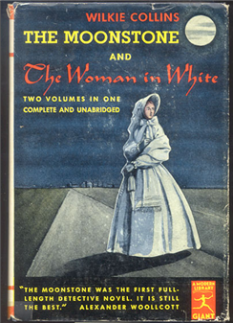
Cover for The MoonstoneBest Book of Five!
Although the first mystery stories are credited to Edgar Allen Poe, The Moonstone is widely regarded as the first ever mystery novel. It is not a murder mystery (although it includes a murder), but is instead about the mysterious disappearance of a valuable diamond.

Rachel Verinder inherits the moonstone from her uncle on her 19th birthday. Since the diamond was ruthlessly stolen by her uncle in India and is rumored to be cursed, this gift is meant maliciously, because Rachel’s mother wouldn’t have anything to do with him.

Rachel’s cousin Franklin Blake acts as courier of the diamond, and only his decision to travel early, we learn later, may have saved his life while the stone is in his possession. The Verinder’s house is visited twice by three mysterious Indians.

The night of Rachel’s birthday dinner, the moonstone disappears from a cabinet in her sitting room. Rachel’s subsequent behavior is inexplicable. She declines to be interviewed by investigators trying to find the diamond and is uncommonly offended by Franklin’s attempts to help solve the mystery.

A house maid named Rosanne seems to be involved in some way in the crime. But perhaps she is being unfairly judged, as she has a criminal past and is trying to reform.

The Woman in White is certainly Wilkie Collins’s most famous novel, but The Moonstone has always been my favorite. An epistomological novel, it is made vibrant by the distinctive and sometimes amusing voices of the various characters, who are requested to submit their testimonies of events. I especially enjoy the sections written by Gabriel Betteridge, the house steward with a fascination for Robinson Crusoe.

logo for RIPThis reread for my Classics Club list has not changed my opinion. The Moonstone has a complicated, but not absurdly so, plot and an exotic element. Although it occasionally contains comments, especially about women and Indians, that are no longer politically correct, they reflect the novel’s time and the attitudes of the narrators.

P. S., I am also reading this for the R.I.P. challenge.

Related Posts

Hide and Seek

Basil

Diana Tempest

Day 1139: Framley Parsonage

Cover for Framley ParsonageIn the fourth of the Barsetshire Chronicles, we meet some old friends and make some new ones. Of particular interest to Framley Parsonage are two occupants of the parsonage, Mark Robarts and his sister, Lucy.

Mark Robarts is a young clergyman who has been remarkably lucky and successful because of his friendship with Lord Lufton and his patronage by Lord Lufton’s mother, Lady Lufton. Instead of slaving away at a curacy like most clergymen of his age, he has the living at Framley, given to him by Lady Lufton, at a very good income. His lovely wife, Fanny, was chosen for him by Lady Lufton and makes him very happy.

Perhaps Mark has been too lucky, for he begins to think that his good fortune is due to his own efforts. He is a good man, but he is still only twenty-six. In any case, he ignores Lady Lufton’s prejudices against a set of people headed by Lord Omnium, her particular enemy, and accepts an invitation to Gatherum Hall. He believes he can better himself through acquaintance with the politicians he will meet there.

At this gathering, he is befriended by Mr. Sowerby, an insolvent member of parliament. Mr. Sowerby talks him into signing a bill for him for 500 pounds, promising repayment (reminding us of a similar subplot in Middlemarch). But Sowerby has no means by which to pay. Later, Sowerby talks Mark into compounding his error by signing another bill for £400. Mark is now in debt for his entire yearly salary.

Lucy Robarts, Mark’s sister, comes to live at Framley Parsonage after her father’s death. Lady Lufton has been trying to match her son with the beautiful Griselda Grantly, daughter of archdeacon Grantly, but Lord Lufton falls in love with Lucy. Lady Lufton is not at all in favor of the match.

Among these new acquaintances are old friends and acquaintances. The wealthy Miss Dunstable, whom Frank Gresham’s family wanted him to court in Doctor Thorne, is now being sought in matrimony by Mr. Sowerby. Doctor Thorne and his niece, Mary, also make an appearance. And the Grantly’s were, of course, prominent characters in the first two novels. We also see a lot more of Bishop and Mrs. Proudie than we have since The Warden.

I am really enjoying this series, and I like how Trollope ties in all of the characters so that some who are important to one book appear as minor characters in another. Trollope examines in this novel the standards of behavior expected of a gentleman, particularly a clergyman. Mark Robarts has broken with those standards, and as slight as his offence may seem, is forced to pay the consequences.

Related Posts

Doctor Thorne

Barchester Towers

The Warden