Day 1131: A Winter Away

Cover for A Winter AwayA review of A Winter Away tantalized me enough to make me order the book, a reprint from Furrowed Middlebrow. Much to my delight, the novel resembled, in different ways, those of two of my favorite authors for light, amusing reading.

Maud feels she has been too long at home, where she has always been regarded as delicate. Learning of an opportunity where she can live with Cousin Alice and her friend Miss Conway, thus satisfying her family’s demand about not moving to London, Maud has taken a job as a secretary to Marius Feniston of Glaine. Maud is at first terrified of making a mistake, for she knows her boss, called Old M. by Miss Conway, fired his last secretary. But she comes to like the old man and enjoy working in the crumbling but romantic mansion.

Marius Feniston is feuding with this nephew, Charles, who keeps a garden within Glaine’s grounds and operates greenhouses. At first, Maud is inclined to romanticize Charles and think that Oliver, Marius’s son, is demanding and boring. But sometimes Maud is prone to jump to conclusions.

A Winter Away is full of amusing situations and insights about people. Maud helps her neighbor Ensie in her romance with the curate. Miss Conway is jealous of Maud and tries to drive her away by sabotaging objects around the house, while Cousin Alice observes passively and Maud doesn’t even notice she’s doing it. Maud tries to discover the roots of the feud with Charles and prevent Oliver from arguing with his father every time he visits.

Fair’s observations about people are amusing and insightful, reminding me of Angela Thirkell but without its occasional class snobbery. Fair’s novels are a little more recent, and her situations and characters remind me of the best of Elizabeth Cadell. I enjoy both writers, so this novel was a pleasant discovery for me.
Related Posts

Northbridge Rectory

Wild Strawberries

Money to Burn

Day 1124: The Ivy Tree

Cover for The Ivy TreeThe Ivy Tree is the first book I’m reading for R.I.P.

Mary Grey is a Canadian who has recently moved to Northumberland when she encounters Connor Winslow on the Roman Wall. Connor mistakes her for his long-lost cousin Annabelle and seems so angry to see her that Mary is frightened. She has some difficulty convincing him of his mistake.

Later, Connor’s half-sister Lisa locates Mary at her workplace in Newcastle. Connor and Lisa want Mary to impersonate Annabelle to help insure that Con will inherit the family farm, Whitescar, from his great-uncle Matthew, who is in poor health. If Mary as Annabelle inherits the farm, she will give it to Con in exchange for a small income that will save her from poverty.

Mary agrees to the job because it doesn’t seem as if it will hurt anyone. The only other interested party, Annabelle’s cousin Julie, views the farm simply as a holiday home. But the impersonation may turn out to be more difficult than anticiapted, for Annabelle had her secrets. And Mary has some, too.

I have long been a huge fan of Mary Stewart. Recently, I turned a friend on to her, and our discussions made me eager for a Stewart fix. The Ivy Tree is one of her best, particularly because, on reread, when you understand a secret of the plot, almost every scene in the novel turns out to have a double meaning.

Stewart is known for her convincing characters and her gorgeous descriptions of the setting. This novel is lush with descriptions of the plants and rural geography of Northumbria. It has a great plot and is truly suspenseful. If you have never read anything by Mary Stewart, I can’t recommend her highly enough, particularly those of her novels written before the 1980’s and her Merlin series.

Related Posts

This Rough Magic

Wildfire at Midnight

Touch Not the Cat

Day 1122: Lolly Willowes

Cover for Lolly WillowesThe two novels I’ve read by Sylvia Townsend Warner are as different as they can be. The True Heart is a historical novel about a woman who lives through great troubles to be with the man she loves. Lolly Willowes is a feminist novel about a spinster who tires of her life dedicated to her family.

The Willowes family doesn’t go in much for change. They have lived in the same house for years, and even after they move, they bring all their possessions, which are never moved from their set positions. Lolly Willowes grows up loving the countryside around her home, and she is so comfortable with her family that she never considers marriage. When her mother dies, she takes over running the house, and neither she nor her father want her to go.

But when her father dies, her wishes are not consulted. Her older brother Henry is more willing to have her in London than her younger brother at the family home. So, she moves to London to be of service to her family.

Twenty years later, she’s had enough. Without seeing it first, she decides to move to a rural village named Great Mop. Her family is very much against this plan, and it is only then that she finds out her brother has mishandled her money and there is very little left. She can’t have the house and donkey she planned on, but she plans to move, and move she will.

It is after Lolly moves that the novel takes a decidedly eccentric turn. Some readers will appreciate it more than others, and I’m not sure how much I do. I’m also not going to tell you what happens. But the message of the novel, though playfully told, is that women are not just adjuncts to their families, to have their lives plotted out for them just because they’re single. There were plenty of women in Lolly’s position in the 1920’s, when this novel was written, and that is probably the reason that the novel became an unexpected best seller in its time.

Related Posts

The True Heart

The Land of Green Ginger

The Daylight Gate


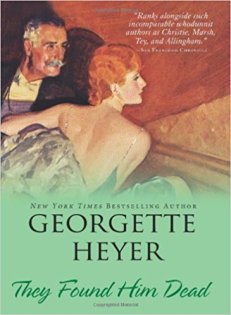
Day 1120: They Found Him Dead

Cover for They Found Him DeadThe wealthy Silas Kane is celebrating his sixtieth birthday, but the party is anything but jolly. His business partner, Joe Mansell, is trying to talk him into a deal with an American company for Australia, but he thinks it’s too big a risk. His cousin Clement’s self-obsessed wife, Rosemary, is considering leaving Clement for Trevor Dermott. Betty Pemble, Joe’s daughter, can only talk about her obnoxious children.

That night Silas goes for his customary walk along the cliff top. The next morning it is clear that his bed was never slept in. He has apparently fallen off the edge of the cliff.

Clement Kane is now the heir to the estate and company, but he doesn’t seem to be any more inclined to the business deal than Silas. His wife, however, decides to stay with him because she needs money. Emily Kane, Silas’s mother, is angry that the property is going to Clement rather than to her grandson, Jim Kane.

As the businessman from America, Oscar Roberts, appears on the scene, Joe Mansell and his son Paul pressure Clement to agree to their deal. But soon Clement is also dead, shot in his office just as Patricia Allison, Emily’s companion, was about to show in Oscar Roberts for an appointment. To Jim’s surprise, he is the next heir, not his female cousin in Australia, as the estate is entailed to the male heir.

No one knows whether Silas was murdered or not, but Clement certainly was. And soon someone appears to be trying to murder Jim.

Detective Inspector Hannasyde has a plethora of suspects and doesn’t even know how many deaths to look into. Could the Mansells have committed murder for a business deal? Is someone really trying to kill Jim, or is it a blind?

I guessed the murderer and the motive almost immediately, but the puzzle isn’t the point of an Heyer mystery. Instead, it’s the characters and the amusing dialogue. This mystery isn’t very mysterious, but it’s a pleasure to read.

Related Posts

Behold, Here’s Poison

Death in the Stocks

Black Sheep

Day 1118: Henry VI, Part II

Cover for Henry VI, Part IIJust by coincidence, I began reading Conn Iggulden’s Wars of the Roses series right around the same time as I started reading these three plays about Henry VI. I found it interesting that Iggulden’s first book, Stormbird, begins almost exactly in the same place as does Henry VI, Part II. Suffolk has brokered Henry’s marriage to Margaret of Anjou, but Henry’s nobles are shocked to learn that the price is to return the provinces of Maine and Anjou to France. Further, the French are not even paying a dowry.

As with Part I, Henry isn’t much of a character in this play, the intent of which is to tell the events of his reign. But whereas he was a child in the first play, this absence in Part II helps to signify his ineffectuality as a ruler. When we see him, he is kindly, but he is unable even to keep his nobles from fighting in his presence.

Besides the struggle for power among the nobles, we are witness to some of the important events in the King’s reign. These include the disgrace of the Duchess of Gloucester and the murder of her husband, the disgrace and murders of Suffolk and Somerset, and Jack Cade’s rebellion.

This play is supposed to be the best of the three Henry VI plays, and apparently Shakespeare’s contemporaries found it exciting because they were unaware of their history. Especially at the beginning, it certainly provides a cogent explanation of the problems of Henry’s realm. Unfortunately, he was not the man to handle them.

Related Posts

Henry VI, Part I

Stormbird

The Wars of the Roses

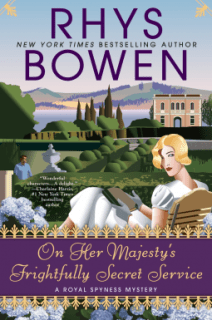
Day 1113: On Her Majesty’s Frightfully Secret Service

Cover for On Her Majesty's Frightfully Secret ServiceI had never read anything by Rhys Bowen, but recently I noticed reviews of her books popping up here and there. When Netgalley offered On Her Majesty’s Frightfully Secret Service, I was intrigued. What I found was a frothy story of intrigue. This novel is the 11th in her “Her Royal Spyness” historical mystery series.

Bowen’s heroine is Georgie Rannock, the sister of a duke and 34th in line for the throne. She is on the impoverished side of the family, though. It is 1935, and Georgie is staying at the ancestral home of her fiancé, Darcy, at Kilkenny Castle in Ireland while they plan their wedding. Since Darcy is Catholic, Georgie may not marry him unless she renounces all claim to the throne, and to do so, she must have permission from the throne.

Darcy is employed by the government in some secret capacity, and he is called away. In his absence, Georgie decides to pop over to London after receiving a belated summons by Queen Mary. In her late mail, she also finds a plea from her friend, Belinda, who is in Italy. Belinda has gotten pregnant and is hiding out in Italy until she goes across the lake to Switzerland to have her baby. She wants Georgie to stay with her.

Summoned to tea at Buckingham Palace, Georgie goes to discuss her wedding difficulties with Queen Mary. When the Queen learns her immediate destination in Italy, she proposes getting Georgie invited to a swank house party there. The Prince of Wales and Mrs. Simpson will be attending, and the Queen wants to know if Mrs. Simpson has her divorce.

link to NetgalleyAt the house party, Georgie finds herself enmeshed in more than one drama. Her mother, the famous actress, is there, and she is being blackmailed. Some of the party are German generals, and something seems to be going on with them. And soon there is a murder.

I mildly enjoyed this little romp, although I knew who the murderer was even before the murder (if that makes sense). That is, I noticed something immediately and once there was a murder, knew who it was as a result. Perhaps I would have enjoyed the novel more if I had started with the beginning of the series. Georgie gets herself into some ridiculous situations, the murder is worked by a bone-headed Italian policeman, and the novel is just silly fun.

Related Posts

Pigeon Pie

As Chimney Sweepers Come to Dust

The Iron Clew

Day 1110: Margaret of Anjou

Cover for Margaret of AnjouMargaret of Anjou, the second book of Conn Iggulden’s Wars of the Roses series, begins in 1454 with an ambush. Angry at the lands that have been going to the Nevilles, York’s allies, Henry Percy, Earl of Northumberland, attacks a Neville wedding party on its way home from the wedding. York has been acting as Protector and Defender of the Realm while King Henry VI is suffering from mental illness. Although York has ruled well, he has favored his own allies over the friends of the King, even to murdering or imprisoning some, and has earned the enmity of the Queen, Margaret of Anjou.

But the tide is about to turn. Henry awakes from his stupor, amazed to find that Margaret has borne him an heir. He immediately dismisses York and Salisbury, Richard Neville, from his court. Soon after, he and his allies ride out to bring them to heel, starting the battles of the Wars of the Roses.

While the Yorkists reluctantly turn to treason, this book seems a little more balanced than the first between the two sides. Salisbury and York clearly have their reasons for resentment of the king’s favorites, and it is true that Henry is not an effective ruler. Still, no one hesitates in plunging the country into years of uproar and instability.

Margaret of Anjou

Like the first novel, this one switches point of view between the main characters, including Derry Brewer, the king’s spymaster, who is one of the few fictional characters. This technique allows us to understand the various positions, for some are self-righteously explaining away their own treachery. York is presented as a tragic character, while Margaret, who has often been reviled in history, is treated sympathetically. After her husband sinks back into his stupor, she does everything she can to protect her son.

I am continuing to enjoy this series, which, although it simplifies the many conflicts of this time, brings clarity to the main figures and events.

Related Posts

Stormbird

The Wars of the Roses

Henry VI, Part I

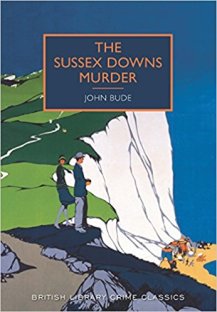
Day 1109: The Sussex Downs Murder

Cover for The Sussex Downs MurderJohn Rother sets off from Chalklands Farm for a holiday, but later his car is discovered not far from home. There is evidence of a struggle, and his bloody cap is found next to the car. But has John been kidnapped, attacked? There is no way to know.

Superintendent Meredith can’t help suspecting that John’s brother, William, had something to do with John’s disappearance. The two brothers co-own the farm and a lime-burning concern on the property, and rumor has it that John was flirting with William’s wife, Janet. But Meredith can’t prove John has been harmed.

Then one of the Rothers’ lime customers reports finding a bone in the lime. The bone is found to be a human tibia. When Meredith’s men go through the lime shipped since the murder, they find more bones. Moreover, Janet was spotted taking a package out to the lime kilns.

From the minimal information they start with, the police begin to collect more, but it doesn’t make sense. A strange man is seen fleeing the area where John’s car was found. Was he an accomplice? A bogus message lured William out on the night of his disappearance. Still, it looks like William murdered his brother, and Meredith is about to arrest him when he is found dead, an apparent suicide.

This mystery is fairly complicated, but I had an inkling of what was going on almost from the beginning and never changed my mind. I turned out to be right. As with the other Bude mysteries, the emphasis is on the puzzle. The characters, except for Meredith, are cyphers.

Related Posts

The Cornish Coast Murder

Death on the Riviera

The Lake District Murder

Day 1102: The Essex Serpent

Cover for The Essex SerpentBest Book of the Week!
In 1885, Cora Seabourne is a recent widow and is happy to be so, as her husband abused her. For the first time, she feels free and is not eager to remarry, even though surgeon Dr. Luke Garrett is in love with her.

Cora is interested in fossils and has made a heroine of the early fossil finder Mary Anning, so she moves with her son Frankie and her friend Martha to Essex, where she can explore the sea coast. Soon after arriving, she hears rumors of the Essex serpent, a monster that has been supposedly terrorizing the area. There are rumors of slain farm animals and lost children. Cora hopes to find a living prehistoric animal. The villagers are more superstitious, and an aura of dread soon develops.

Cora finds happiness rambling around the countryside, so she delays introducing herself to the Ambroses, Reverend William and his wife Stella. But when she finally meets them, they become fast friends. In particular, Will and Cora enjoy debating such subjects as science versus religion, a topic made even more controversial since Darwin’s discoveries. Sadly, it soon becomes obvious that Stella has tuberculosis.

This novel evokes the ideas and preoccupations of the Victorian age. Although it has quite a few characters, they are all convincingly portrayed. I was deeply interested in the novel. It presents a fully realized world, vividly imagined and described.

Related Posts

Remarkable Creatures

The Signature of All Things

Ulverton

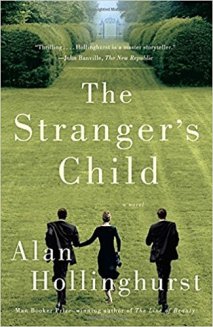
Day 1100: The Stranger’s Child

Cover for The Stranger's ChildI had the oddest experience with The Stranger’s Child. Although it was well written and sounded like something I would be interested in, for a while every time I started to read it, I fell asleep. There is very little movement to this novel, which isn’t necessarily a bad thing, but the end of it had me wondering what the point of it was.

The novel is multigenerational, beginning in 1913 and ending in 2008. In 1913, Daphne Sawle, who is 16, is attracted to her brother George’s friend, Cecil Valance, down for a visit from Cambridge. Cecil is an aristocrat and a poet. Unbeknownst to naive Daphne, he and George are having a wild affair.

The next section of the book takes place ten years after World War I. Cecil died in the war, and the family is dedicating a memorial to him. The family includes Daphne, as she has married Cecil’s younger brother, Dudley, and they have two children. However, she is in love with Revel Ralph, a set designer for the theater.

By far the bulk of the novel is set in the 1960’s and 70’s and is from the point of view of Paul Bryant. In the 1960’s, he is a shy bank clerk. He has become involved with the family through his boss, who has married into it, and through his affair with Peter Rowe, a schoolteacher at Corley House, which used to be the Valance home. Cecil is now regarded as one of England’s minor poets.

Ten years later, Paul is a biographer, determined to out Cecil as a gay man despite the claims of Daphne to have been his fianceé. It is unfortunate that I found this main character of the longest section to be so unappealing and completely focused on who was or was not gay, although I realize that the 1970’s was the time for that kind of revelation.

Part of my problem with the novel may have been the blurb, which really oversells aspects of the plot. For example, it says, “Over time, a tragic love story is spun . . . .” Well, there are several love stories that come out, but I wouldn’t call any of them tragic, and it’s actually difficult to tell which of them this comment refers to. One of the secrets is so understated during the novel that even though it is the last revelation, it seems anticlimactic. I suppose it’s supposed to be ironic that Paul is so focused on the possibility of one affair that he completely misses another.

Finally, this is a novel so focused on the sexuality of its characters that it gives the impression that the entire upper class male population of England is gay. We see a little into Daphne’s infatuations, but otherwise, only from the point of view of various gay men trolling for sex or obsessing about it. Those of you who know me will realize that I would have the same complaint if the sole focus was on heterosexual sex. So, not one of my favorites for my Walter Scott prize project.

Related Posts

Arctic Summer

A Place Called Winter

The Summer Before the War