Day 1099: The Moving Toyshop

Cover for The Moving ToyshopI am sure I previously read one of Edmund Crispin’s Gervase Fen mysteries and was not impressed, but lately several bloggers I enjoy have recommended The Moving Toyshop. So, I decided to try him again.

Richard Cadogen has decided to give himself a holiday in Oxford. When he ends up stranded partway because of the cancellation of a train, he decides to hitchhike the rest of the way. So, he arrives in the outskirts of Oxford at 1 AM.

Curiosity makes him investigate a toy shop that he finds unlocked. Upstairs in the living quarters, he discovers the dead body of an older woman, strangled. Then someone hits him on the head.

When he awakens, he is locked in a closet. He gets out by the window and reports the crime to the police. However, when they arrive at the store, it’s a grocery. The apartment is different than the one he remembers and there is no body. The police think he is crazy.

Cadogen turns to his friend, the eccentric Oxford don, Gervase Fen. Their inquiries begin to turn up a plot to defraud the victim of her inheritance. The problem is, first they have too many suspects and later too few.

This novel has a complicated, fairly unbelievable plot, but it is characterized by a wacky sense of humor, as Gervase and his pals chase bad guys all over town. At one point, he is assisted by a hoard of undergraduates, and the novel ends with an exciting chase on a fast-moving carousel, a la The Third Man. I found the novel fun to read and the characters engaging.

Related Posts

The Iron Clew

Silent Nights

4:50 from Paddington

Day 1093: Pomfret Towers

Cover for Pomfret TowersSomeone once remarked to me that the Angela Thirkell novels set before or during World War II are the best, and so it seems to me, reading this one. Pomfret Towers is set before the war.

Timid young Alice Barton is terrified when she learns she must accept an invitation for a weekend at Pomfret Towers along with her brother, Guy. Lady Pomfret is home on one of her infrequent visits from Italy, and Lord Pomfret wants some young people around to entertain her.

But she needn’t have worried: almost everyone is kind to Alice. Phoebe Rivers, a cousin of the family, has made sure Alice’s room is next to hers and helps her pick out her outfits for dinner. Alice’s good friends, Roddy and Sally Wicklow, are there, Roddy being the junior estate manager. Gillie Foster, Lord Pomfret’s heir, is extremely kind and fetches her shoes for her from the servants. Even Lord Pomfret, who is known for his rudeness, is kind.

One figure who continues to be terrifying is Mrs. Rivers, a best-selling author. Although Alice’s mother is also an author (a better one, we suspect), she is modest about it, unlike Mrs. Rivers, who constantly talks about herself and tries to arrange things for everyone, as if she were the hostess.

Another egoist is Julian Rivers, but Alice only sees how handsome he is and how wonderful he seems to be. His behavior is sometimes unusual, but he is an artist.

One of the things Mrs. Rivers is trying to manage is a marriage between her daughter Phoebe and Gillie Foster, but Gillie seems to prefer talking to Alice or working in the office with Sally. And Phoebe keeps running off with Guy to look at buildings he and his father are restoring.

Pomfret Towers is another romance by Angela Thirkell, full of delightful characters and slightly winking at society. This novel is one I particularly enjoyed. Alice is a little silly, but she is young and lovable, and we are sure everything will come out all right.

Related Posts

Wild Strawberries

Miss Bunting

Vittoria Cottage

Day 1090: The Vicar of Wakefield

Cover for The Vicar of WakefieldI originally selected The Vicar of Wakefield for my Classics Club list because I was trying to choose a few works from different centuries. For the 18th century, I selected this novel and a few others.

Apparently, there is some debate among scholars about whether to take this novel straightforwardly as a sentimental work or to view it as a satire of sentimental novels. Since it reminds me of nothing so much as Candide, I take it as a satire. Even the title is confusing, since the vicar leaves Wakefield for another town early in the novel.

Reverend Primrose leads a comfortable life with his family as the Vicar of Wakefield. His own private fortune is enough that he has made over his salary to various charities. However, early in the novel, he loses his fortune when the merchant he has invested it with runs off. At that point, he leaves Wakefield and his considerable salary for a much smaller salary in another town. Why he does this instead of using his salary for himself is unclear.

Although the family is now poor, Primrose is determined that they can still live happily if they simplify their lives. However, some of his family are not willing to simplify, and their troubles are not over. His oldest boy, George, has had his engagement broken off by his fiancée’s father. And things even get worse. From here on, every decision they make turns out poorly, touching everyone in the family. In fact, though trusting and ready to see the good side of everyone, Primrose shows himself to be remarkably poor in judgment. The family is cheated, deceived, and persecuted by enemies. All the time, though, Primrose tries to see the good in every situation.

This short novel moves along nicely and has a charming though inconsistent narrator in Reverend Primrose. Its narrative is occasionally interrupted, though, by philosophizing and sermonizing, which I found tedious. Some of the plot twists and masquerades are easy to predict, but overall the novel is lively and a bit silly.

Related Posts

Robinson Crusoe

The Antiquary

The Necromancer

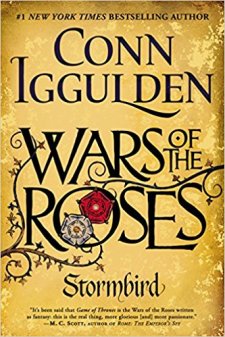
Day 1087: Stormbird

Cover for StormbirdBased on the recommendation of Helen of She Reads Novels, I decided to try Conn Iggulden’s series Wars of the Roses. This period of British history has always been fascinating to me, yet confusing, and I have read several nonfiction books about it, as well as a few stand-alone novels about major players in the wars.

When I picked up what I thought was the first book in the series, Margaret of Anjou, I realized it was the second. So, I had to hurriedly get a copy of Stormbird. This accident assures that I will be reading at least the first two of the series.

The novel begins in 1437. King Henry VI, who is clearly not the warrior his father was, has been ceaselessly praying for an end to the Hundred Years War with France. He commands his spymaster, Derry Brewer, to find a way to a truce.

The agreement made with France is that Henry will marry Margaret of Anjou in exchange for the lands of Anjou and Maine, which Henry’s father won back from the French. At no time does Henry give thought to the countless English families who will be displaced in these two provinces.

The point of view moves from person to person throughout the novel, but no one character is central to the story. Some of these characters are the young Margaret of Anjou; Derry Brewer; the loyal William de la Pole, Earl of Suffolk; Richard Plantagenet, Duke of York; Thomas Woodchurch, a former longbowman who is displaced from his farm by the truce and decides to fight; and Jack Cade, a resentful renegade who leads a band of Kentish men against London. Most of these characters were actual historical people, with the exception of Derry Brewer.  At first, I thought this constant shift in point of view would become annoying, but I finally realized it allowed me to get to know those characters better.

Iggulden admits to compressing time, making a period of almost 20 years seem like months. I think he could have just as easily indicated some passing of time, because it is occasionally jarring to think only a few months have passed, only to be brought up short by remarks, for example, that the king and queen have been married for years without issue.

Although most of the books I’ve read agree that toward the end of the wars, anyway, the Yorkists had the better claim to the throne, in this preamble to the wars, the Duke of York is definitely the villain. Although he is in charge of Normandy at the time of the truce, he does nothing to protect the fleeing English from the French armies and actively works to blame his inaction on Suffolk, who does the best he can when he takes over York’s position. I notice that the novel is dedicated to a descendant of John of Gaunt, whose immediate descendants made up the Lancastrian side of the conflict.

Overall, I found the novel quick moving and suspenseful, with interesting characters. I’ll be happy to read the second book in this series.

Related Posts

Henry VI, Part I

The Wars of the Roses

Richard III: England’s Black Legend

Day 1082: Revelation

Cover for RevelationIn C. J. Sansom’s fourth Matthew Shardlake novel it is 1543. Matthew’s experiences working for Thomas Cromwell have driven him away from his former Reformist religious views, and he has been avoiding becoming involved in political cases. He has never been happier working for ordinary people in the Court of Requests.

But soon his friend Roger Elliard is murdered in a most peculiar way, and Matthew vows to Roger’s widow Dorothy that he will find the killer. This purpose forces him to work for Archbishop Cranmer, along with the Earl of Hertford and Thomas Seymour, who are all worried that Roger’s death has something to do with Lady Latimer, Catherine Parr, whom the king is courting. Their fears are because of a similar murder of Dr. Gurney, who attended Lord Latimer during his final illness. They appoint Matthew to work with Coroner Hartsnet to find the murderer.

Of course, their fears are political. Henry VIII has been turning more and more back to conservative religious views, away from the Reformists. The Seymours and Cranmer see a marriage to Catherine Parr as the only hope for Reform. The English are more and more polarized by religion, with fanatical Reformists ranting in the street on the one hand while Bishop Bonner cracks down on them on the other.

Soon Matthew is convinced that there have actually been three murders. Further, they are modeled after passages in Revelation that detail seven ghastly visitations.

Although Sansom’s Shardlake mystery novels create a fully realized world with highly developed, convincing characters, there is something about them that holds me back from complete attention. I am always mildly interested but not absorbed. In this case, the novel took me an unheard of twelve days to read. That makes me happy that I have only one more to read, the one for my Walter Scott Prize project, although since I understand there is only one more after that in the series, I may choose to finish the series.

Don’t misunderstand me. These novels have complex mysteries that are difficult to guess and are well researched and interesting. I think lots of people would and do love them. I have personally not been able to decide why I’m not that involved. Perhaps Matthew Shardlake is too depressive for me.

Related Posts

Sovereign

Dark Fire

Dissolution

Day 1076: Money to Burn

Cover for Money to BurnIt may be difficult to find a book by Elizabeth Cadell these days (it was when I wrote this, but I find now that someone is republishing them), but if you want something that is totally light and fluffy, a gentle, amusing romance with funny characters and a hint of a mystery, you can do no better than this author, whose heyday was in the 1950’s-70’s. Money to Burn features the vague young lord Raymond Trysting and his sister Auriol, their Canadian cousin Leigh Anderson, and three eccentric aunts.

When Leigh comes to the village of Cammertree to visit, he finds all of his relatives impoverished and Raymond and Auriol living in primitive circumstances. The odd old aunts are obsessed by their own interests and Auriol is disorganized and incompetent in the housekeeping department. She only knows how to cook eggs. Raymond is mild-mannered and seemingly lazy, but he has a shadow hanging over him. Trysting Mansion, the family seat, has just burnt down, and no one knows what happened to the £13,000 of insurance money the family received. Raymond and Auriol’s father has recently died and with him the secret of the money. And whatever happened to the historic family silver, which has also disappeared?

Leigh finds himself attracted to the beautiful Auriol, but the family problems are almost too difficult to contemplate. And Auriol has already rejected three suitors, so there’s no telling if she will accept Leigh.

With lots of fun, amusing dialog, and eccentric characters, Cadell’s books offer a refreshing change of pace.

Related Posts

Friday’s Child

Pigeon Pie

The Diary of a Provincial Lady

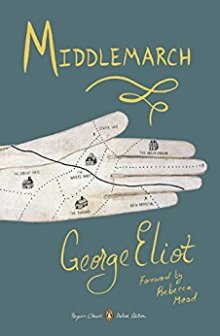
Day 1073: Middlemarch

Cover for MiddlemarchBest Book of the Week!
The first section of Middlemarch is concerned with Dorothea Brooke, an ardent but naive young woman who only wants to take part in something good. She thirsts for knowledge and wants to help with something important.

One trait of Dorothea’s that is physical as well as metaphorical is her shortsightedness. As her sister Celia tells her, “I thought it right to tell you because you went on as you always do, never looking just where you are and treading in the wrong place. You always see what no one else sees; it is impossible to satisfy you; yet you never see what is quite plain.”

Dorothea in her youthful ardor and intelligence attracts the attention of Mr. Casaubon, a cleric and scholar in his fifties who has been laboring for years on a work he calls “The Key to All Mythologies.” Dorothea decides it would be an honor to marry Mr. Casaubon and help him with his great work. And she does so, despite the admonitions of her friends and family.

It is while Dorothea is on her honeymoon in Rome that we meet other important characters in the novel, for Eliot subtitled her novel “A Study in Provincial Life.” There are the young Vincys, Fred and Rosamund, who have both been indulged by their wealthy parents. Fred has been raised to expect a fortune from his crusty old uncle, Peter Featherstone. Concerned at first only with leading the life of a gentleman, he has quit his university studies and fritters away his time. He would like to marry his childhood friend Mary Garth, but she won’t have him until he sticks to something.

Mr. Lydgate is a new doctor in town. He hopes to reform medical practices and make some significant discovery in medicine. Although he feels he cannot afford to marry for some years, he has not reckoned with Rosamund Vincy, a beautiful but self-centered young woman.

He also starts out by harming his chances through some outspoken comments and a too close relationship with Mr. Bulstrode. A wealthy businessman, Bulstrode is involved with the local hospital. But he likes to be in control of all his charities and is inflexible in his religious views.

In Rome, Dorothea and Mr. Casaubon re-encounter Will Ladislaw, Mr. Casaubon’s second cousin. Mr. Casaubon has been supporting Will financially through his studies after Will’s grandmother was disinherited from her family because of her choice in husband. Dorothea, in trying to befriend Will, does not see how much Mr. Casaubon dislikes him. That dislike is to have repercussions for Dorothea’s future life.

Eliot masterfully acquaints us with the problems and politics of this provincial area. Her characters are unforgettable, rich and human. There is a strong feminist sensibility, as Dorothea finds that everything she tries to do is balked because she’s a woman. And class is also an important theme. I continue to feel that Middlemarch is one of the best books ever written and was happy to have it chosen for me by the Classics Club spin.

Related Posts

My Life in Middlemarch

Miss Marjoribanks

Barchester Towers

Day 1066: The Lake District Murder

Cover for The Lake District MurderIf I was thinking ahead, I would have read something for today that commemorated the Norman Invasion, but oh well . . .

The Lake District Murder is John Bude’s first mystery featuring Inspector Meredith. Golden Age mysteries seem to be divided between adventure novels and novels that focus on the puzzle. This one focuses on the puzzle.

A farmer stopping for gasoline finds the gas station owner, Clayton, an apparent suicide, with a mask over his face where he has funneled carbon monoxide from the engine of his car. But Meredith sees discrepancies at the scene. Why would the man have fixed himself a tea but not eaten it before committing suicide? And how could his hands be clean after he affixed the dirty hose?

Moreover, the victim was engaged to be married and had plans to emigrate to Canada with his bride. These plans are ones his partner in the garage, Higgins, claims not to know about.

Meredith’s investigation leads him to surmise that something illegal is going on involving the oil company and a chain of garages. As a result, the book focuses on this problem for most of the time, and it involves examinations of tank trucks, calculations of pumping speed and tank capacity, timetables, and lots of other details that are, frankly, boring.

When the solution comes, both to the illegal activity and the murder, it is so overly complicated that it’s hard to believe anyone would think of it. This is not one of the classic mysteries that I enjoyed. It focuses almost exclusively on the puzzle with little bother toward characterization or other literary elements.

Day 1065: Diana Tempest

Cover for Diana TempestThe plot of Diana Tempest depends on the actions of our heroine’s weak, selfish, and amoral father, Colonel Tempest. He runs off with his older brother’s young and foolish fiancée, only to tire of her after a few  years. When Diana’s mother dies shortly after her birth, he hands his daughter over to her grandmother, as he is only interested in his son, Archie.

The novel begins a few years later with Colonel Tempest rushing to the side of his dying older brother, hoping to reconcile. But his brother is so full of hatred that he formally recognizes his wife’s son John as his heir, even though he knows John is the issue of an affair between his wife and her cousin.

When John is a young man, Colonel Tempest drunkenly makes a bet that has major ramifications for his family. Even though he repents, he is unable to get out of the wager.

As a young woman, Diana and her grandmother manage to get by but have no extra resources. When Diana meets John, he falls in love with her, but she does not realize this and thinks they are friends. Later she understands she loves him, but it is after he makes a fateful discovery.

This novel fits very well into the sensationalist genre Cholmondely is known for. Its heroine and hero are likable, and it was enjoyable to read.

Related Posts

Red Pottage

Basil

Hide and Seek

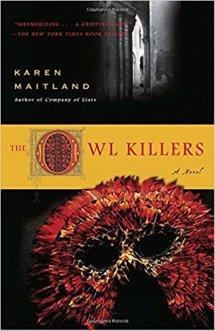
Day 1056: The Owl Killers

Cover for The Owl KillersIn the 1321 village of Ulewic, England, a group of women have settled into a beguinage, a community of women who are committed to a life of celibacy and service but not one sanctified by the church. Some of them are from Belgium, and they are led by Servant Martha.

The village is experiencing dark days and some of the villagers are returning to a pre-Christian cult called the Owl Killers. When the beguinage takes in a leper and then the daughter of a lord, who has been raped, the villagers and the Owl Killers begin to turn against them.

Although this novel is atmospherically dark and seems well researched, I had a hard time sticking with it. This problem may have more to do with the fact that we were moving cross-country while I was reading it than with the book itself. But I frankly found few of the characters sympathetic. The village priest is so terrified that the truth of his affair with a man will come out that he is led into dastardly acts. Servant Martha seems completely blind to what is going on with some of the members of the beguinage. Beatrice is jealous and bitter. Osmana is sympathetic but one-dimensional.

I may try another Maitland novel at a better time. The novel blends a bit of the supernatural with a fairly straight historical narrative, which combination is interesting.

Related Posts

The Daylight Gate

Harvest

The Chalice