Day 934: One Fine Day

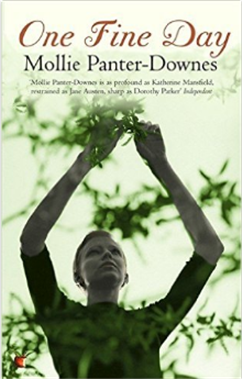
Cover for One Fine DayBest Book of the Week!
It is shortly after World War II, and Laura Marshall and her family are trying to return to normal life during the privations of post-war England. With only one part-time housekeeper, Laura is struggling with unaccustomed chores. The house and garden are beginning to look shabby, which bothers Laura’s husband Stephan, who struggles with the lawn every weekend.

The family is also having to accustom itself to living together again. Through the war, Laura and her daughter Victoria shared the house in a relaxed way of life with various female friends and children. Stephan is inclined to be more fastidious, while Laura is dreamy and untidy.

This novel takes place over the course of a fine summer’s day as Laura does her chores and thinks about a way of life that is disappearing. It is beautifully written, with evocative descriptions of nature. Barrow Down, which looms over the landscape, is an important feature of this novel.

This is a lovely short novel.

Related Posts

Enter Sir Robert

Greenbanks

Wild Strawberries


Day 932: Black Swan Green

Cover for Black Swan GreenJason Taylor is thirteen years old in 1982, the beginning of Black Swan Green. He is somewhat of a misfit, obviously bright and interested in poetry, a stutterer, but he spends most of his time hiding his true self to be more acceptable to his schoolmates. Still, acceptance is fleeting. One year he is on the margins of popularity; the next, he’s a pariah.

His parents have some problems he doesn’t understand. His older sister Julia can’t wait to leave home for university. The economic climate is grim in the wake of Thatcherism.

Black Swan Green seems to Jason to be the most boring village imaginable. Still, he manages to have some adventures, visiting a strange old lady in the depths of the woods, taking poetry lessons from Madame Eva von Outryve de Crommelynck, literally dropping in on Gypsies, all the while trying to avoid the popular bullies in his class.

Although I sometimes wondered where this novel was going (and for a while wondered if any time travelers were going to appear), it eventually got there. More importantly, it features a distinctive voice of a bright, funny, sometimes naive boy. It has a unique notion of character that to me makes the novel stand out.

Related Posts

The Bone Clocks

Slade House

The Brief, Wondrous Life of Oscar Wao

Day 931: Horses of the Night

Cover for Horses of the NightHorses of the Night seemed like a good choice for me, because it’s about Christopher Marlowe, and I do enjoy novels about literary figures. I just never developed much interest in this novel, however, and gave it up after 100 pages or so.

The novel concentrates on Marlowe’s spying career, involving him right away in the Babington Plot. Although Marlowe is alleged to have been a spy, nothing is known of his activities. At least as Aggeler depicts it, Marlowe seems to have little role in the case, sent in at the end of the plot with only a few lessons in how to be a Catholic. He is involved long enough, however, to become sympathetic with one of the alleged plotters, Margaret Copley.

link to NetgalleyAggeler appears to be previously an academic writer. For this novel, he has adopted a pseudo-Elizabethan writing style throughout, even for descriptive passages. This is an interesting approach, and it is not inherently irritating, but I found the writing overblown at times.

I also felt as if I was seeing a Marlowe who was not the actual person I would expect from my admittedly limited reading, a man more conventionally likable than Marlowe probably was.

Related Posts

The Secret Life of William Shakespeare

The Marriage Game

The Tudor Secret

Day 929: The Railway Children

Cover for The Railway ChildrenThe Railway Children is a classic British children’s story, written in 1906. At the beginning, Roberta (Bobbie), Peter, and Phyllis live a happy and comfortable life with their parents in a suburb of London. Then one evening two men come to see their father, and they hear angry voices. Their father goes away with the men, and shortly afterward they move with their mother to a cottage in the country.

Here things are a bit more primitive. They only have one servant, a housekeeper, and a pump in the yard for water. They have to help their mother more, and Peter can’t go to school. Their mother can’t play with them, because she is busy writing stories for money. They are poor and have to be careful how much coal they use and what they eat.

Near their house is the railway, and they find lots to entertain themselves watching the trains and getting to know the men at the station. They wave to an old gentleman on the morning train every day, and they have adventures related to the railway.

I can see why children would love this story. Although the children’s adventures are all realistic, they would be exciting reading for children. There is also the mystery about their father. Character development is not a strong suit of the novel, but the children and their mother are sympathetic and the children behave like actual children.

Perhaps the novel does not have as much to offer adults, especially those who didn’t read and love the book as children. Still, it’s easy to see why the book is still popular.

Related Posts

The Secret Garden

Anne of Green Gables

Charlotte’s Web

Day 923: The Road to Little Dribbling

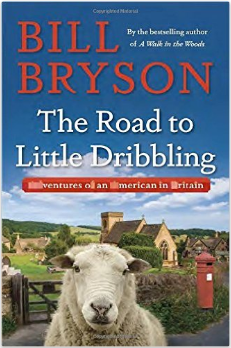
Cover for The Road to Little DribblingBest Book of the Week!
The Road to Little Dribbling is only the third book I’ve read by Bill Bryson, but it is the one I’ve most enjoyed. It is a follow-up to one of Bryson’s most popular books, Notes from a Small Island (which I have intended to read but have not), upon its 20-year anniversary. Both are about travels in Britain.

In The Road to Little Dribbling, Bryson draws an imaginary line between the two farthest points on mainland Britain and takes expeditions to some of the places on either side of the line. His line begins in a minor southern seaside town named Bognor Regis (where, oddly, I began my first visit to that country) and ends in northern Scotland at Cape Wrath.

The things that make Bryson’s books stand out are that he has many humorous observations to make and he is endlessly curious about everything. So, he has lots of stories to tell about the places he passes through, some of them personal, some historic, some scientific. He is also skillfully descriptive of beautiful scenery.

A recurring theme in the book is the impact of austerity measures on national landmarks and scenery. Also related to the economy is the growing dereliction of some of the towns he passes through. But he makes it clear that there is still much of charm and beauty to be seen and that many places are thriving.

I always enjoy Bryson’s comments about the lack of basic knowledge among some of the general public, because I have observed indications of that with dismay. I just recently viewed a video of Texas college students who were unable to answer basic history and political questions such as “Who won the Civil War?” or “Who did we get our freedom from?” but could answer every question about celebrities. I suppose this should not be surprising, since for the past couple of years my husband and I have observed that watching “NBC Nightly News” is now more like watching “Entertainment Tonight” than actually watching news.

Related Posts

A Walk in the Woods

The Life and Times of the Thunderbolt Kid

A Time of Gifts: On Foot to Constantinople

Day 920: Sidney Chambers and the Dangers of Temptation

Cover for Sidney Chambers and the Dangers of TemptationSidney Chambers and the Dangers of Temptation is the fifth book in the series known as the Grantchester Mysteries, even though Sidney no longer lives in Grantchester. I have only previously read the first book, and much has changed in Sidney’s life since then. It is 13 years later, Sidney is married to Hildegard and has a four-year-old daughter Anna, and he is an archdeacon.

Like the first book, this Sidney Chambers book is also presented as a set of short stories, but this is a bit of a misnomer. The mysteries are contained within a story, and many of them are very slight, but the back story and the other events continue through the book as if it were a novel. Consequently, the focus has moved from solving mysteries to the discussions of various spiritual issues. I believe the Father Brown mysteries touched lightly on similar issues, but Runcie is much more heavy-handed.

In “The Dangers of Temptation,” Sidney is drawn back to Grantchester by a former parishioner, Mrs. Wilkinson. Sidney both does not like her and is attracted to her. She has asked him to do what he can to extract her teenage son Danny from a commune run by Fraser Pascoe. Sidney is unsuccessful, but then Pascoe is murdered.

In “Grantchester Meadows,” young Olivia Randall loses a valuable family necklace while she is fooling around in a meadow during a drunken party for May Week. At the same time, there is a general panic because a young man across the field is nearly trampled by cows.

Sidney’s good friend Amanda’s marital troubles come to the fore when her husband’s first wife is murdered. The murder is secondary to the plot about what will happen with Amanda’s marriage.

link to NetgalleyIn other stories, Sidney and his family travel to East Germany to vacation with Hildegard’s family, and an arson and blackmail force Sidney’s ex-curate Leonard to consider his sexuality. “The Return” has a plot suspiciously similar to a Father Brown story.

For the most part, these stories devolve into discussions of a spiritual nature. In fact, the mysteries started to seem like excuses to springboard these musings. I, for one, did not find it interesting. Further, I prefer the 50’s setting of the older mysteries to the 60’s setting.

Related Posts

Sidney Chambers and the Shadow of Death

The Tuesday Club Murders

Dandy Gilver and a Bothersome Number of Corpses


Day 919: The Cellar

Cover for The CellarI have been reading and enjoying Minette Walters’ chilling thrillers and mysteries for years, ever since her spectacularly creepy novel, The Ice House. But The Cellar is something else again. Walters’ vision has become even darker with this short novel, about what happens when a person is abused for too long.

The Songolis are an African family living in England. One day their youngest son Abiola disappears, and it takes a while before the family notifies the police. This time is taken up with trying to hide evidence that 15-year-old Muna is a slave who sleeps in the cellar. The family presents Muna to the police as their daughter and tell them she has brain damage and cannot speak English.

Muna does speak English, though. She has learned it through watching television and listening to Abiola’s lessons with his English tutor. Her situation improves as the investigation goes on, because the Songolis are afraid to abuse her when a police officer may come to the door at any time. It is quite obvious that the police suspect the father, Ebuka, but for some time we do not learn what happened to Abiola.

We do slowly learn that Muna was removed from an orphanage in Africa under false pretences when she was eight. Yetunde Songoli arrived with forged papers showing that she was Muna’s aunt. Ever since then, Muna has worked and slaved for the family. Physically abused by Yetunde and Abiola and sexually abused by Ebuka, she suspects she will soon also be sexually abused by the older son Olubayo. But with this dischord of Abiola’s disappearance already in their midst, Muna finds ways to create uncertainty within the family and drive them apart.

This novel is a difficult one to read. I can’t say more without giving too much away, but I can’t imagine a novel being much darker. I actually have to recommend one of Walters’ earlier novels if you haven’t read her yet. The Ice House is an excellent start.

Related Posts

Dark Places

The Dead Lie Down

Into the Darkest Corner

Day 911: A Place Called Winter

Cover for A Place Called WinterI read A Place Called Winter for my Walter Scott Prize project, the second book I’ve read for the 2016 list. Like one of the other books I read recently for that project, Arctic Summer, it has as a major theme the main character’s homosexuality. However, I found myself feeling much closer to the characters and more interested in the plot of this novel than I did for Arctic Summer.

At the beginning of the novel, Harry Cane is being treated, or rather mistreated, in an asylum in Canada. Shortly thereafter, he is transferred to an experimental center that treats the patients much more humanely. We understand that Harry has committed a crime, but we don’t know what it is. Between short chapters about his life at the center, we learn what brought him there.

The story of Harry’s life begins when his wealthy father dies. His brother Jack is still in school, and Harry undertakes his education and expenses. Harry is a man of no occupation who feels that he would like one, but he doesn’t know what to do about it. He feels vaguely that he would like to work an estate or a farm but thinks he has to be born to it. A shy man with an occasional stammer, he likes reading and horses. Eventually, he marries a shy woman, Winnie, who informs him on their wedding night that she loves someone else. Nevertheless, he cares for his wife and loves his daughter.

An investment recommendation by his brother-in-law takes a large part of Harry’s inheritance, and Harry and his family are forced to move in with his in-laws. He is an innocent-minded person, so it is not until he meets an actor named Browning that he realizes he is homosexual. He begins an affair with Browning, but then disaster strikes. His affair is exposed to his in-laws by a blackmailer and Harry is forced out of the family. Even his brother Jack, whom he loves, is pressured by his wife not to correspond with him.

Now totally alone, Harry emigrates to Canada and ends up in Saskatchewan, which is just being opened to settlement by the arrival of the Grand Trunk Railway. On shipboard, he meets Troels Munck, who finds him a position where he can learn farming and then helps him purchase a homestead. Munck, though, is a bully, and from the moment Harry meets him, we know that relationship will not end well.

link to NetgalleyHarry finds that a farmer’s life suits him. He settles in, works hard, and makes friends. But we know where he is at the beginning of the book, so the tension builds as we find out how he got there.

Although the time spent to get him to Canada, where the book really captured me, seems a little long, by the time he gets there, we know Harry very well. He is a kind and polite person, but he earns our respect when he finds his niche. Eventually, I became deeply involved in his story. It was also interesting in its details of early homesteading and treatment of mental illness.

Related Posts

Arctic Summer

This Godforsaken Place

Giants in the Earth


Day 904: Some Must Watch

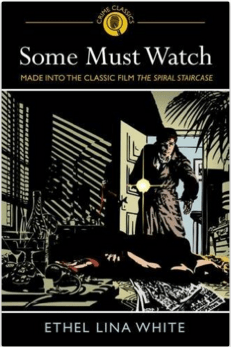
Cover for Some Must WatchSome Must Watch is the novel that inspired the thrilling old movie The Spiral Staircase. Ethel Lina White, the author, was one of the early women mystery writers, another novel of hers being the basis of the movie The Lady Vanishes.

This novel centers around an isolated country house, the home of Professor Sebastian Warren, his mother, sister, son, and daughter-in-law. The main character is Helen Capel, a servant in the household.

At the beginning of the novel, Helen is coming back to the house at dusk. She is worried because she must pass through a desolate landscape and young women have been murdered in the district. Her way takes her through a plantation, but she changes direction because she thinks she sees a man lurking among the trees.

The novel takes place in the space of one night during a violent storm. At the beginning of the evening, everyone becomes alarmed because another dead woman is found dead near the local pub and Dr. Parry thinks she was killed in the same plantation where Helen saw someone. The house is full of people, so the Professor decides that they should all stay inside during the storm and not admit anyone, and they will be safe.

However, as the evening continues, one incident after another occurs that causes the people to leave the house. After a while, it seems to Helen as if some intelligence is working so that she will be alone to face the killer.

In some ways, this novel seemed rather crude, especially in the interactions between characters and the dialogue. I have run into this before with novels of a certain vintage and am not sure if it reflects people’s actual behavior and way of speaking at the time, the expectations of the genre, or simply the ability of the writer. Not very much attention is given to character development either. The focus is squarely on the plot. Still, I think the novel is interesting as representative of an early thriller.

Occasionally I comment on the publication quality of a book. I believe that my copy is an on demand publication by Between Things (not the one pictured above). Its biggest eccentricities are the starting of chapters on the left page and a typographic oddity of placing an underscore before and after phrases that I assumed were in italics in the original. There were a few other careless errors but not as many as I have noticed lately in some other regular press runs. Still, I am beginning to avoid on demand printing, if I recognize it ahead of time.

Related Posts

Murder at the Manor

The Z Murders

The Tiger in the Smoke

Day 903: Some Do Not

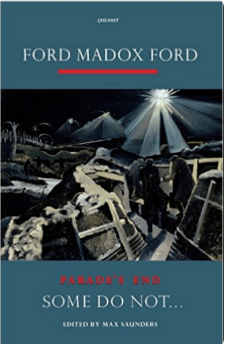
Cover for Some Do NotBest Book of the Week!
Some Do Not is the first volume of Ford Madox Ford’s tetrology “Parade’s End,” which is considered one of the great novels about World War I. For those who are interested, an excellent TV series came out a few years ago starring Benedict Cumberbatch (or maybe for those who are interested in Benedict Cumberbatch).

When we first meet Christopher Tietjens in 1912 or so, he is separated from his wife Sylvia and on a golfing trip with MacMaster, his coworker and friend from school days. We eventually learn that Sylvia was having an affair with a married man when she met Tietjens, and the paternity of their son is in question. Sylvia has run off to Europe with a lover, but Christopher has just received a letter from her asking to come back.

Christopher Tietjens is a big clumsy man who is a sort of genius with facts and figures and works for the government. (That was the one weakness of the casting of Cumberbatch, who is neither big nor clumsy, in the part, as several times he is forced to refer to himself that way, which struck me as odd before I read the book.) He is also absolutely principled and honest. He agrees to take Sylvia back because that is how a gentleman behaves.

On this golfing trip, though, complications begin that are to affect the rest of his life. A member of the golfing party is General Campion, an idiotic but well-meaning man who likes Sylvia and so thinks that any problems in the marriage must be Christopher’s fault. When Christopher helps a couple of suffragettes escape from the police, the General immediately concludes that one of them, Valentine Wannop, must be Christopher’s mistress, even though Christopher has never met her before. Later on, similar misunderstandings contrive to blacken his reputation.

Egging everyone on is Sylvia, who takes a long time to understand the character of her husband. She believes he and Valentine must be lovers and even spreads the rumor that he is sharing a mistress with MacMaster. Mrs. Duchemin, whose husband is an academic with mental issues, is indeed having an affair with MacMaster, but Christopher’s only crime is to help MacMaster financially. Some of Sylvia’s ex-lovers or would-be lovers are also eager to harm him.

Christopher does fall in love with Valentine, but he doesn’t act on it because he is incapable of treating her dishonorably. With social ruin threatening him, he goes to war.

I tried out this first volume to see if I would like it after having watched the TV series. As soon as I finished it, I ordered the other three volumes. This is a great novel, about how a completely honorable but reticent man is misunderstood and dishonored by almost everyone around him.

Related Posts

Goodbye to All That

The Summer Before the War

The Happy Foreigner