Review 2539: A Morbid Taste for Bones

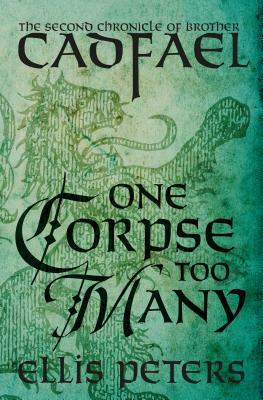
I didn’t really like the Cadfael series on TV, and I thought I had read at least one book long ago and decided not to pursue it. However, I saw that the first book filled a hole in my A Century of Books project, so I thought I’d give it another try. Now, I’m not sure I ever read any, because this book is pretty good!

In 1137, Brother Cadfael is a Welsh monk in a Benedictine order in Shrewsbury. He has led an exciting life, but now a quiet one taking care of the monastery garden suits him. He has two young assistants. Brother Columbanus is from a family of high Norman blood who seems almost too devout and eager to please. Brother John is practical and full of mischief.

Brother Columbanus is stricken with something that seems like epilepsy, so Prior Robert, an ambitious, proud man, suggests sending him to the Shrine of Saint Winifred in nearby Wales. When Brother Columbanus is miraculously cured, Prior Robert suggests that what the order needs are some relics, and Saint Winfred’s bones may answer the case.

Although Prior Robert wouldn’t normally include Cadfael in his expedition to get the bones, he needs him as a translator. Brother Columbanus is allowed to go as the subject of the miraculous healing, and Brother John offers to take care of the livestock. After getting permission from the Welsh authorities to remove the bones, the party encounters opposition from Rhisiart, the major landowner in the area, and thus from the rest of the locals.

Prior Robert meets with Rhisiart to try to talk him around, but he mishandles this discussion badly by trying to bribe him. They schedule a second meeting, but Rhisiart never arrives. Once they learn he left home for the meeting and never returned, everyone goes out to look for him. They find him shot in the chest with an arrow that belongs to Engelard, a Saxon boy who wants to marry Sioned, Rhisiart’s only child and his heir.

Suspicion immediately focuses on Engelard, but to Cadfael that doesn’t make sense. Even though Rhisiart opposed the marriage, he has treated Engelard like a son since he arrived, in a country where you usually must belong to a family to get work.

Does the murder have to do with the marriage? with Sioned? a love triangle? the monk’s expedition?

I enjoyed this mystery. It seems well-researched and is written with a wry sense of humor. Although I did guess the murderer, Peters tricked me enough to move my guess to two other people before I returned to my original suspect just about the time Cadfael did.

Related Posts

A Murderous Procession

Grave Goods

The Serpent’s Tale

Review 2534: #ReadingAusten25! Sense and Sensibility

My original intention for ReadingAusten25 was to reread only the books I hadn’t reviewed yet. But I can’t resist Austen, so here I am reviewing Sense and Sensibility. I am not going to repeat my review of 2022, though, so you can find it here. Instead, I thought I’d look at whether the book struck me differently this time and a little at Claire Tomalin’s point of view (the wobble), as cited by Brona.

It did strike me differently. Although Elinor is still my favorite of the two sisters, they both struck me more extremely this time. Marianne seemed like a true modern teenager, not as much for her reactions to Willoughby but more in her sulking (call it what it is), her rudeness to various kind characters whom she thinks ill-bred, and so on. But the thing is, 16 in the early 19th century meant she was supposed to be an adult, or almost. (Of course, she is also under the influence of the Romantic movement in art, literature, and music.)

As for Elinor, sometimes I felt she carried her comments a little too far, into preachiness. I got a little tired of her dissections of other people’s behavior.

I also appreciate the wit of the novel more. Although I always find Austen witty, she has drawn us some priceless characters and written quite a few zingers.

I am not so sure about Tomalin’s “wobble.” I looked for it but didn’t find much evidence for it unless you count Elinor’s dash out of the room after she finds out Edward isn’t married. I’d like to hear if anyone was struck differently. I remember not agreeing with some of Tomalin’s interpretations when I read her biography of Austen.

Related Posts

Jane Austen: A Life

Jane Austen at Home

Persuasion

Review 2532: Beauvallet

I am fairly sure I read Beauvallet to fill a hole in my A Century of Books project, but as has happened too many times already, once I had read it, I saw that I had already filled that hole. This book is one of Heyer’s earlier novels, and it is more of a swashbuckler than her other ones, showing a possible influence of writers like Dumas, Rafael Sabatini, or Baroness Orczy.

In 1586, Beauvallet is a privateer like his colleague Drake, a daring, laugh-in-the-face-of-death type guy. His ship is fired on by Don Juan de Narvaez, who wants to show off for his lovely passenger, Doña Dominica de Rada y Sylvan, who is traveling with her father, the ailing late governor of Santiago. They are returning to Spain because of his health.

Beauvallet takes their ship and puts the crew into a boat for shore. However, he promises to take Doña Dominica and her father to Spain, because of her father’s illness. Beauvallet immediately begins to court her. Dominica is at first hostile but eventually falls in love. When he drops them at a smuggling port in Spain, he vows to come get her within a year and make her his wife. Obviously, this poses difficulties because England and Spain are at war. Once Dominica’s father dies, things become worse because her relatives, into whose custody she falls, want her to marry her cousin for her fortune.

I don’t think this is one of Heyer’s best. Her main characters aren’t as appealing as usual, and I think her social comedies are more effective than her adventure novels. However, it’s always worth it to read Heyer. If you haven’t read her, I suggest you start with one of her Regency romances.

Related Posts

An Infamous Army

The Talisman Ring

The Toll-Gate

Review 2529: Sparkling Cyanide

This novel begins in an unusual way for Christie, with sections on six people, each of whom had a motive to kill Rosemary Barton. There’s her younger sister, Iris Marie, who would inherit a fortune. There’s her husband George’s secretary, Ruth Lansing, who would like to take her place. There’s Anthony Browne, whose secret Rosemary has discovered, that he is really Tony Morelli. There’s Stephen Faraday, whose career as a policeman will be finished if his wife learns of his affair with Rosemary. There’s Sandra Faraday, who already knows about the affair. Finally, there’s her husband, George Barton, who also knows about the affair. Almost a year ago, these six were together at a party when Rosemary suddenly died from cyanide poisoning.

Rosemary’s death was ruled a suicide. Now, nearly a year later, someone has mailed George letters saying that Rosemary was murdered, so George decides to set a trap by reconvening the same people at the same table. But first, he asks in his friend, Colonel Race. Race things it’s a foolish idea, and it is—for George dies that night, also poisoned.

Colonel Race teams up with Inspector Kemp to try to figure out what happened. Was Rosemary poisoned? Who wrote the letters? How could anyone have poisoned George without touching his drink?

I don’t think the approach used in this novel was very successful. The writing seemed oddly static. It is only when we leave the character bios that the novel snaps back to life, with Christie’s usual clever dialogue and interesting action. Then, it’s quite good and makes you forget the first part.

Related Posts

The Mirror Crack’d from Side to Side

The Man in the Brown Suit

Death on the Nile

Review 2528: The Home

Eleanor is moving. She’s doing this because after 26 years of marriage, her husband is leaving her. Their marriage had been an open one, which translated to her husband Graham being serially unfaithful while she had two affairs that ended in friendship because she loved Graham. The last few years have not been happy, but still it’s hard for her to accept that he has left her—without really talking about it—for a woman who is younger than her oldest daughter.

Now she is trying to make a home for children who, all but one, are adults living on their own. Nevertheless, they return in ones and groups to stay with her.

Eleanor struggles in this novel with the idea of what home is, with loneliness, with her desire to mother children who don’t really need it anymore, with desire and love for Graham, and with the need for someone to take care of her. The novel looks unflinchingly at the situation that many middle-aged women found themselves in beginning in the 1970’s, when divorce rates began to rise. For example, Graham (who in my opinion is an unrelenting jerk) supposes Eleanor can get a job when she has been trained for nothing and has no work experience for the last 26 years except being a wife and mother.

This is sometimes a rough read but always an insightful one. Mortimer has an unfailingly observant eye.

Related Posts

The Pumpkin Eater

A Separation

The Women’s Room

Review 2527: The Whole Art of Detection: Lost Mysteries of Sherlock Holmes

I knew this book might not be a good fit for me, because I usually feel that mystery short stories are too short to do much but pose puzzles, but more importantly, because I usually think it is unsuccessful when an author continues another author’s work. However, I have generally enjoyed Lyndsay Faye’s books, so I tried this one.

Purporting to be lost stories, notes, and diary entries, most by Dr. Watson but some by Holmes, this book’s 15 stories span the time from before the two met until 1902.

I am not going to run through a description of each story. Instead, I’ll comment on how authentic Faye’s stories seemed as stories about Holmes, keeping in mind that I haven’t read a Holmes story in years.

First, how much like the originals are Faye’s Holmes and Watson? Faye clearly is very familiar with the books (this applies to pretty much all the things I’ll look at, not just this one) because she makes lots of references to other cases and certainly has down Holmes’s characteristics. However, it seemed to me that her Holmes is more of a Benedict Cumberbatch Holmes than an Arthur Conan Doyle one. For one thing, he is much more expressive of emotions, more so even than Cumberbatch, especially as the book goes on. Watson seems himself, only even more flowery of description, but smarter. Also, like in the B. C. version mentioned above, his war service is stressed a lot more.

What about the mysteries? Well, you’re reading the words of a person who never once guessed the solution of a Sherlock Holmes story—until now. On the one hand, Faye’s stories are not nearly as ridiculously overcomplicated and unlikely as Doyle’s (spoilers for ACD!)—teach a snake to crawl down a rope? while dying, say “the speckled band” instead of “a snake bit me”? On the other hand, it seemed ridiculously easy to guess at least portions of the solution for most of the stories (unlike in Faye’s other mysteries—this is what I mean by mystery short stories—they’re either totally opaque or too easy). For instance, in “The Case of Colonel Warburton’s Madness,” I guessed immediately that (spoilers) gaslighting was involved and who was doing it. I just didn’t know how. Later in a story about identical twins, I knew immediately that the twins had switched.

Faye writes well and keeps up the interest. I just wish she’d write more of her own stuff.

Related Posts

Seven for a Secret

Back to the Garden

The Edinburgh Mystery and Other Tales of Scottish Crime

Review 2524: I Capture the Castle

It was with delight that I noticed I Capture the Castle would help me with my Century of Books project, because I liked it so much when I read it years ago. It had an ending that was completely different from what I remembered, though, my memory having possibly been polluted by seeing a couple of TV versions of it.

Cassandra lives with her family in a house attached to a ruined castle. The house, which was purchased during the heights of her father’s success as a writer, is now woefully decrepit. Her father has not produced anything since his initial success, and the money ran out long ago. Now their clothes are shabby, and they can barely afford to eat. Rent hasn’t been paid for months, and they’ve sold all the good furniture.

There is exciting news, though. Their landlord having died, new occupants of the estate, which includes their home, have arrived. They are American brothers, Simon and Neil Cotton.

The brothers arrive when Cassandra is taking a bath in the kitchen. She keeps quiet and they go away, but they return so she has to announce herself. They take her for a child. Her sister Rose, who is beautiful, decides that she will marry Simon, the heir, no matter what, even though she hates his beard.

Cassandra likes both men at first but then overhears them talking about Rose, who has been behaving affectedly. With a little advice, Rose begins to act naturally, though, and soon she has accomplished her goal. She is engaged to Simon, although Neil seems to hate her. The only trouble is, Cassandra is in love with Simon.

This sounds like a straight love story, but it isn’t. There are lots of terrifically eccentric characters and subplots to go with them. There is the issue of whether their father will write again. And will Topaz, their stepmother, who sees herself as an artist’s muse, leave him for someone who is working? What can Cassandra do about Stephen Colley, a devastatingly handsome young man who lives with and basically supports the family and copies out poems to give to her?

This novel is charming. Its narrator mixes wit with naiveté and wisdom, and the novel is written in a sprightly, entertaining manner. It’s a lovely light read.

Related Posts

It Ends with Revelations

A Pink Front Door

The Weather at Tregulla

Review 2519: Murder after Christmas

There’s nothing like a nice, cozy mystery to read at Christmas time. This one is so cozy, in fact, that you don’t want any of the characters to be murderers. And what better day to post the review of a book called Murder after Christmas than New Year’s Eve?

When Rhoda Redpath invites her eccentric, elderly, very wealthy stepfather to spend Christmas, none of the Redpaths expect him to come. After all, he has never come before. Uncle Willie is nearly 90 and has lived a rambunctious life, so there are lots of people who want to meet him. Thus, when he agrees to come, the Redpaths decide to throw a real blowout, a Christmas Tree on Boxing Day, and invite everyone.

Once he arrives, his behavior is a bit odd. He eats a lot, stuffing down loads of mince pies and chocolates even though it is wartime. He gets the order of his wives mixed up, and all the Christmas packages disappear. He also starts writing his memoirs, so they have to hire a secretary.

During the party, he is hardly to be seen except when he appears dressed as Santa to pass out the packages. Frank Redpath, the host, also appears as Santa, but having been upstaged by Uncle Willie, his appearance is a bust. Then the next morning, Uncle Willie is found frozen stiff out by the snowman, still in his Santa suit. Was it a natural death or did someone murder him? When everyone learns that his wife died on Christmas day, the timing becomes very important.

Uncle Willie is found to have laudanum in his system. Nevertheless, the coroner’s hearing finds the cause of death accidental, assuming the batty old man took an overdose. Inspector Culley isn’t quite sure, so when Frank and Rhoda Redpath ask him to stay and figure out what really happened, he agrees.

Inspector Culley’s clue collection involves lots of mince pies—sewn into a chair cushion, eaten before Christmas, eaten after Christmas, packages hung from the ceiling, chocolates hidden in the snowman, and a turkey in the wardrobe—among other things. The whole thing is ridiculous and hard to keep track of, so I just went along for the ride.

Lots of fun, this one. I’ll never look at mince pies the same again.

Related Posts

The Iron Clew

Who Killed Father Christmas?

Silent Nights

Review 2516: The Fountain Overflows

Rebecca West based The Fountain Overflows on her chaotic family life when she was a girl. I understand it is the first of an unfinished trilogy. If so, I’m interested in reading all of it.

Rose Aubrey is a daughter of an unusual couple. Her father Piers is a writer and editor whom many consider a genius, but he is a gambler who continually impoverishes his family. He has a pattern of collecting followers or benefactors who at first seem to worship him, but eventually they break with him, usually after lending him money. However, his family adores him. Her mother is a gifted pianist, formerly a famous concert performer, who is teaching Rose and her sister Mary with the expectation that they will become concert pianists, too. Their oldest sister, Cordelia, has no talent for music but doesn’t know it. She takes up the violin. Their younger brother Richard Quin is adored by all, a toddler at the beginning of the novel.

The novel covers about ten years of the family’s life. There is plenty of incident, from Mrs. Aubrey’s struggles to keep the family financially afloat to the girls’ struggles at school because they’re considered peculiar but also because they hate wasting time at school when they could be playing piano. Cordelia finds a mentor in one of her schoolteachers who encourages her in the idea that she is talented, which Mrs. Aubrey and the other girls deplore. Rose and Mary meet poltergeist activity at a friend’s house, and the family gets involved in a murder case. Also of importance is the girls’ cousin Rosamund.

It’s difficult to summarize this novel, but this family is so interesting, brilliant, chaotic, well-intended, and right behaving. I found the novel delightful.

Related Posts

Little Women

Apricot Sky

The Pursuit of Love

Review 2515: Dean Street December! The Late Mrs. Prioleau

Here’s another one for Dean Street December!

Because of the war, Susan Prioleau never meets her mother-in-law before she dies. Mrs. Prioleau seems to have kept an unhappy home, with children who left it as soon as they could, excepting Austin, her oldest son. She adored him but convinced him he is an invalid with a bad heart, which his doctor says is not true. He is immensely fat and makes his heart an excuse for doing nothing.

Susan hears stories about Mrs. Prioleau that don’t agree. She was adored by her servants of long ago, but she has written people cruel, vindictive letters. Both her daughters say she never gave them any attention, although the oldest, Nonnie, remembers a time when things were different. Her daughter Melissa disliked her, and she was estranged from her sister, Catherine, for years.

As Susan gets to know the family and helps Austin clear the house (although he won’t let her remove much), she begins to learn more about her mother-in-law’s life. Eventually, she learns about events that turned her from a selfish but warm-hearted girl to a spiteful old woman.

It’s a pity Monica Tindall only wrote one novel, because this is a good one. Although some of its secrets are easy to guess, the journey was absorbing.

Related Posts

Expiation

Which Way?

The Awakening