Day 876: The Diary of a Provincial Lady

Cover for Diary of a Provincial LadyBest Book of the Week!
The Diary of a Provincial Lady was popular again quite a few years ago, but I didn’t read it then. Now that I have read it, I wish I’d read it earlier.

Considering that I have little in common with a 1930’s suburban upper-class English housewife and mother struggling with servant problems, I found this novel very funny.

The novel begins with a visit from Lady B., for whom the narrator’s husband Robert works as a land agent. Lady B. is in turn patronizing and demanding, first nearly sitting on the indoor bulbs, then questioning where the narrator got them and telling her where she should have got them, then telling her it’s too late to plant them anyway. The bulbs appear throughout the novel as a running joke. They get moved to the basement and then to the attic, are over-watered and under-watered, get stepped on by Robert when he is bringing down the suitcases, and are nibbled by mice. What they don’t do is bloom.

The house is made lively by a constant stream of visitors, including Our Vicar’s Wife, who always must be getting along but stays another hour. Another less pleasing visitor is the hearty Miss Pankerton, who barges her way into invitations and thinks nothing of bringing along an extra three people and two dogs on what was supposed to be a family picnic.

The narrator has two lively children—Robin, who makes frequent visits from prep school, and Vicky, who is at  home with a very French governess, Mademoiselle. I had to break out Google Translate for Mademoiselle, who continually manages to insult her employer and persists in being overly dramatic.

The narrator’s husband is taciturn except when complaining about expenses or the condition of the house, but he never denies her and is often kind. Many paragraphs, though, end with “Robert said nothing,” which begins to be very funny after a while. In fact, there is a lot that Robert finds nothing to say about. Meanwhile, the poor narrator is constantly scrambling for money, hocking her grandmother’s jewels and so on, to be able to keep up a decent appearance.

To some extent Delafield is depicting types but they also seem like real people, very funny real people. Delafield’s sense of humor is dry. Particularly amusing are her memos to herself and her queries. For example, after arguing with the children about washing up for tea:

(Mem: Have sometimes considered—though idly—writing letter to The Times to find out if any recorded instances exist of parents and children whose views on this subject coincide. Topic of far wider appeal than many of those so exhaustively dealt with.)

All I can say is, I can’t tell you how many times a page I chuckled, or just plain laughed out loud.

Related Posts

Where’d You Go, Bernadette?

Love in a Cold Climate

The Pursuit of Love

Day 875: The River of No Return

Cover for The River of No ReturnThe River of No Return was popular a few years ago, but I didn’t get around to reading it until now. The plot combining time travel and romance reminded me of The Time-Traveler’s Wife, which I loved. I found Ridgway’s book not nearly as interesting, though.

Nick Davenport appears to be a wealthy dilettante dabbling in cheese making in 2013, but in 1810, he was Nicholas Falcott, Marquess of Blackdown. While fighting in the Peninsular Wars, he was suddenly thrust forward in time to 2003. There he was picked up by a society of time travelers called the Guild, trained to live in modern times, and given a potload of money to live on. Now, the Guild wants him to travel backward to 1815, something he didn’t even know could be done, and resume his earlier life to carry out a mission for them.

Back in 1815, Julia Percy’s grandfather has just died, leaving her at the mercy of an unknown cousin. Since she was a child, Julia has watched her grandfather play little tricks with time. She is just beginning to realize that she can do it, too. Then her cousin Eamon arrives and begins looking for something, a talisman. Julia eventually realizes that she herself is the talisman.

When Nick arrives back in time, he learns he is to find a representative of a rival time-travel society called the Ofan and kill that person. The Guild has learned that the time period within which they can go forward is moving backward in time, and they think the activities of the Ofan have affected the river of time. The Guild thinks this Ofan member lives in a house neighboring Nick’s, the home of Julia Percy.  But Nick has no intention of killing anyone.

A portion of this novel is more romance novelish than I like, a fairly standard romantic plot with unlikely (for the time) sex scenes. Since I am not a fan of the standard romance novel, this was not a plus for me.

Worse, though, is the theory of time travel and its link with human emotions and monetary exchange, which is scientifically absurd. Audrey Niffenegger’s genetic abnormality is at least faintly believable.

All in all, my reaction was fairly meh. The novel is well written, but I wasn’t particularly interested in most of the characters. I thought Nick was incredibly naive about the Guild and went along with it far too long. An alternate explanation of the moving time horizon seemed immediately obvious to me, although it is not addressed in this novel. Because this novel is clearly designed for a sequel, only the romance plot is resolved.

Related Posts

The Bone Clocks

The Shining Girls

1Q84

Day 872: Elizabeth Is Missing

Cover for Elizabeth Is MIssingBefore I begin my review, here is a little bit of news about the Walter Scott Prize for Historical Fiction. Some of you may know that, along with Helen of She Reads Novels, I am attempting to read all the short-listed novels. Today the short list for 2016 was released. To see the list, check out my Walter Scott project page. I have only read one of the novels, but was disappointed, along with other readers, to see that A God in Ruins, which was on the long list, didn’t make the short list.

* * *

Elizabeth Is Missing is—I won’t disguise it—the third book about Alzheimers I’ve read in the last six months. When the book blurb says Maud is forgetful, that’s putting it mildly. After only a few pages of this novel, I wondered why Maud was living alone.

Maud is an old lady who is having trouble keeping track of just about everything. She writes herself reminder notes but loses them. She makes endless cups of tea and forgets them. Her caregiver comes in every morning and makes her lunch and she has eaten it by 9:30. She remembers occasionally that her friend Elizabeth is missing. Elizabeth doesn’t answer her phone and she isn’t home. But no one pays attention to a dotty old lady.

Of course, we realize fairly quickly that Elizabeth isn’t missing, but Maud has a more important mystery in her life. When she was a young girl just after World War II, her older sister Sukey disappeared, never to be seen again. Although Maud’s short-term memory is inconsistent, there’s nothing wrong with her long-term memory, at least not at first, so the more coherent narrative is the time around Sukey’s disappearance. Maud finds the boundaries between the past and present blurring.

I found this novel extremely painful to read at times, even more so than Still Alice. However, it is certainly compelling although not perhaps as realistic as Still Alice is.

One thing that bothered me, although only a bit, is that Maud clearly has all the information she needs to solve her sister’s disappearance, if only she can make sense of it. But she tried to investigate when she was young, and she had the same information then. That she would finally solve it in her current condition is a bit hard to buy. We’re to understand that she found something before the action of the novel, though. At least, that’s what I think happened, since sometimes the narration from the point of view of a confused old woman is a little opaque.

Related Posts

Still Alice

This Is Your Life, Harriet Chance!

Family Furnishings

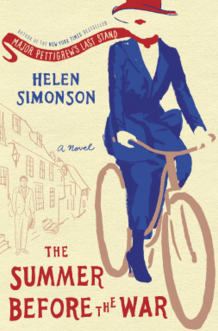
Day 871: The Summer Before the War

Cover for The Summer before the WarBest Book of the Week!
I, for one, have been waiting for Helen Simonson’s second novel ever since I read the first one. And here it is!

Hugh Grange is preparing to pick up the new schoolteacher from the station at the beginning of The Summer Before the War. His Aunt Agatha has been instrumental in the school board’s controversial decision to hire a woman as the school’s new Latin mistress. Agatha has supported the hire because the woman was the most qualified applicant, but she is aware that her position as well as the teacher’s is precarious and that the mayor’s wife, Bettina Fothergill, is up to something.

So, Beatrice Nash arrives to take the position unaware that it is already threatened. She has been eager to leave the home of her father’s relatives, where she has lived since her father’s death. She soon finds that he has bargained away her freedom by agreeing to put her money into trust in return for being allowed to return home to his estranged family. Beatrice’s trustees start right out by assuming that she is mishandling her money.

Hugh is a medical student who is working under Dr. Ramsey, a well-known Harley Street physician. Hugh is a careful person whose future is neatly charted out. He will qualify in a year and then marry Dr. Ramsey’s daughter and join his practice. But the Great War breaks out, and Dr. Ramsey pressures him to accompany him to the front. Hugh wants to finish qualifying first, but Lucy Ramsey threatens to give him a white feather if he doesn’t join up.

Hugh’s cousin Daniel is a poet, and he plans to open a journal in London with his good friend Craigmore, Lord North’s son. But after Lord North sees Daniel and Craigmore together at the local hops festival, he makes Craigmore join the air corps. Daniel joins the Artists’ Rifles in reaction.

link to NetgalleyThis description doesn’t do much justice to the novel, which is about how all the characters’ lives are affected by the war. Aside from the same kind of class and town politics featured in Simonson’s delightful Major Pettigrew’s Last Stand, we meet a handful of characters who are genuinely likable and we get very involved in several subplots.

Simonson evokes a bustling town of Rye in 1917, with it occupants becoming involved in their various war activities. Belgian refugees arrive, and the town begins to experience the first horrors of war. This novel makes an absorbing second effort that is at times very touching.

Related Posts

Major Pettigrew’s Last Stand

The Daughters of Mars

Goodbye to All That

Day 870: Jane Steele

Cover for Jane SteeleBest Book of the Week!
Fans of Lyndsay Faye’s Timothy Wilde trilogy (I am one) have undoubtedly been looking forward to Jane Steele, which she describes as a riff on Jane Eyre. In this novel, which Faye dedicates to “Miss Eyre and Mr. Nickleby,” Jane Steele describes her life as one very similar to Jane Eyre’s, only with an important difference—Jane Steele is a serial killer.

At the beginning of the novel, Jane is nine or ten years old, living in a cottage with her mother on the grounds of Highgate House. Although her mother has told her Highgate House belongs to her, it is occupied by her Aunt Patience Barbary and her cousin Edwin. Mrs. Barbary hates Jane and her mother, and after her mother’s death from an overdose of some opiate, Mrs. Barbary wastes no time in preparing to ship Jane off to Lowan Bridge School, run by Mr. Vesalius Munt. But before that can happen, Edwin tries to rape Jane, who pushes him off a cliff to his death. Terrified by the perspicacious Constable Quillfeather, Jane goes meekly to school.

It is difficult to know how much to reveal in this review, but suffice it to say that almost every action in Jane Eyre is echoed in some way in Jane Steele, but always with a twist. Mr. Munt is, if anything, a worse sadist and hypocrite than the headmaster of Lowood School. Jane Steele has a dear friend in the school, Rebecca Clarke, who comes close to dying, but when Mr. Munt offers Jane a choice between further starving Clarke or agreeing to be sent to an asylum, Jane instead chooses to stab him with a letter opener. Jane being sixteen by then, she and Clarke run off to London.

link to NetgalleyEventually, Jane meets her Mr. Rochester when she forges credentials as a governess to go work at Highgate House. There she hopes to search for proof of her mother’s claim that the house belongs to her. She finds herself in an unusual environment. The house belongs to Mr. Charles Thornfield, a nephew of Patience Barbary. Her charge is a little Sikh girl named Sahjara, and the entire household is Sikh. This household has its own secrets, to do with the betrayal of the Khaba, the Sikh military, by its own leaders.

This novel is a romping good read, full of adventure. It features a missing treasure, secret identities, several oily villains, and the resurrection of the heroine’s self-esteem. Yes, Jane kills five men. Do we still like her? Absolutely. I think you’re going to love this book.

Related Posts

Dust and Shadow

The Gods of Gotham

Seven for a Secret

Day 867: The Squire

Cover for The SquireI don’t think I paid attention to what The Squire was about when I picked it up. Instead, I homed in on the author’s name when selecting it from a list of Persephone books. I’m not sure whether I would have picked it out if I had noticed, since it is about childbearing and motherhood, something I have no experience with. Further, some of the attitudes expressed, particularly about the role of men, are very out of date, although well in tune with the novel’s time.

The squire, who is known only as that through the novel, is a woman past 40 who is due to give birth. With her husband away, she is trying to run her household in the last days of her pregnancy, and there are quite a few crises, particularly with the servants. The squire already has four children, the youngest about four, and she spends a lot of time observing them and thinking about their characters.

There are some things about this novel that I found very foreign. One is how much time the squire spends thinking about death. First, I thought this was because she was about to give birth, but later she considers the same trait in her daughter Lucy, who is only 11 or 12. The other was my surprise at the role of the midwife, who is there more for after the birth than the birth itself. She keeps the squire almost totally isolated and quiet, trying to get her milk to come in correctly. What a contrast to today, when women are practically booted out the door of the hospital. But also, there is a strong class aspect to this and to all the squire’s problems. A woman from another class would have to take care of all her children during this time, unless she was lucky enough to have a neighbor or family member to help, and her biggest concern wouldn’t be hiring a new cook or nursemaid.

I found some aspects of this book interesting, but I didn’t really relate to the main character. But then again, I also felt some distance from The Happy Foreigner, so maybe my problem is with Bagnold as a writer rather than the subject matter of this novel.

Related Posts

The Happy Foreigner

The Land of Green Ginger

Someone at a Distance

Day 866: Yuki Chan in Brontë Country

Cover for Yuki Chan in Bronte CountryYuki Chan is on a pilgrimage of sorts. Her mother died ten years ago when Yuki was 13, and just before that she made a trip to England. Yuki is trying to visit the places her mother visited, to feel closer to her and to try to figure out why she died. This pilgrimage has brought her to Haworth and a tour of the Brontë’s house.

Yuki thinks of herself as a psychic detective, but we also follow some of her other musings, most of them very peculiar. She is clearly an eccentric personality.

I wasn’t sure how much I related to Yuki as she performed her various experiments, for example, standing in the same place before the Haworth parsonage window where her mother appears in a photo. She has five photos that she uses to retrace her mother’s footsteps.

link to NetgalleyDuring her adventures, she befriends a teenage girl named Denny. Denny has a bit of a lawless demeanor that gets them into some adventures as she takes Yuki around the snowy landscape on her brother’s motorcycle.

Ultimately, this novel is touching, but it takes a while before we understand Yuki’s compulsions. I don’t think we get any insight to any of the characters except Yuki herself. I only moderately enjoyed this quirky novel.

Related Posts

We Need New Names

The Enchantment of Lily Dahl

Wit’s End

Day 865: Arctic Summer

Cover for Arctic SummerFrom its description, I thought that Arctic Summer might be one of the most interesting books I’m reading from the Walter Scott Prize list. It is described as a fictional biography of E. M. Forster, particularly leading up to his publication of A Passage to India.

That is certainly the time period the novel covers, and A Passage to India is one of its preoccupations. But the novel spends most of its time on Forster’s obsession with his homosexuality and his desire for sexual experience. As I’m not all that interested in reading about anyone’s obsession with sexuality, this novel was not the best fit for me.

The novel begins in 1912 on Forster’s first trip to India. While he is there, he will visit a good friend, Masood, and he has hopes that his life will open up, particularly in regard to sex. At the age of 33, he is still a virgin, his fear of disgrace holding him back from expressing his sexuality at home. Perhaps in India he will have an experience, maybe with Masood, whom he loves.

Unfortunately, Forster, who goes by Morgan, has a tendency to fall in love with heterosexual men and prefers men from a lower class, so nothing quite works out the way he wishes. Even when he finally has some encounters, years later, what he is actually looking for is love, which he never finds. The novel follows him during the long gestation of his novel about India, back to England, to Alexandria during World War I, and back to India again. During this time, his most significant relationships are with two friends who do not return his feelings.

The novel is extremely well written, and Galgut deeply characterizes Morgan, if not the other characters. It did make me wonder if any person could be so relentlessly focused on sex, although of course he is also lonely. It also made me wonder how, if he really felt this unrelenting focus, he ever got anything written. Certainly this novel makes you feel for Forster—he was a sad man.

Related Posts

The Master

Under the Wide and Starry Sky

Studio Saint-Ex


Day 863: A Banquet of Consequences

Cover for A Banquet of ConsequencesDetective Sergeant Barbara Havers is in a lot of trouble with Superintendent Ardery since she nearly went off the rails in the previous Detective Lynley novel. So, Ardery is having Inspector Lynley keep her on a short leash. But Lynley thinks the leash is too short, because Barbara is tamping down everything, including her contributions to investigations. Finally, she is contacted about a case that Lynley thinks she can take charge of herself.

But the novel begins three years earlier. William Goldacre has been trying to reconcile with his girlfriend, Lily Foster. William has a condition that causes him to utter nonsense words and profanity when under stress. But Lily’s problem with him is the relationship he has with his family. William and Lily go on a camping trip, but Will commits suicide when he finds Lily reading his journal, and Lily is horrified about what she reads there.

In the present, Barbara encounters Caroline Goldacre, William’s mother, when she attends a talk by feminist Clare Abbott. Clare gives Barbara her card because she is interested in Barbara’s t-shirt, but Caroline, who is Clare’s assistant, takes it upon herself to ask for the card back. Rory Stratham, Clare’s agent and good friend, gives Barbara another card.

A few days later, Rory contacts Barbara to tell her that Clare was found dead in her hotel room. Although the death is considered natural, Rory finds it high suspicious. She also suspects someone, Caroline Goldacre, whose relationship with her employer seemed unusual at best.

When Barbara performs an initial investigation, she finds hotel staff who overheard Caroline and Clare arguing. An autopsy reveals that Clare was poisoned. Before Barbara can tell Rory, Rory herself has been poisoned, although she is not dead. Lynley dispatches Barbara and Sergeant Winston Nkata to Shaftsbury to investigate. Ardery’s orders are for Winston not to let Barbara out of his sight.

The evidence seems to point to Caroline Goldacre until the detectives find out that Clare borrowed Caroline’s toothpaste and that was the source of the poison for both women. But was someone trying to murder Caroline, or is Caroline simply a clever murderer who made it look that way? Caroline herself is manipulative and nasty to just about everyone.

I have been distressed by how melodramatic George’s series has been the past few books, basically since the death of Lynley’s wife. Although the Detective Lynley series is one of the few that has recurring characters who are as interesting as the mysteries, the last few years they have been behaving atypically. This book is the first in a while that seems back on track. The personal plots involve Lynley’s relationship with his current girlfriend and an amusing plan of Dorothea Harriman’s to spiff Barbara up and find her a boyfriend. I very much enjoyed this novel and feel that it is returning to the strong series it was when I first discovered it.

Related Posts

A Great Deliverance

Believing the Lie

Just One Evil Act

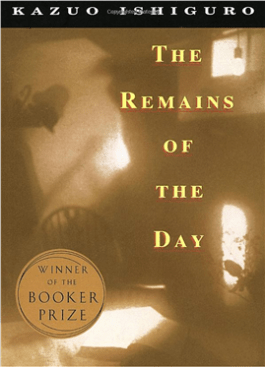
Day 862: The Remains of the Day

Cover for The Remains of the DayBest Book of the Week!
Having seen the movie The Remains of the Day years ago, I think it is just as well I waited so long to read it. Even so, some of the book’s scenes made me envision the movie, though I had forgotten most of it.

Stevens is the butler for Darlington House in the 1950’s. Lord Darlington, whom he served for 30 years, is gone, and now Stevens works for Mr. Farraday, an American. At Mr. Farraday’s suggestion, he has decided to take a holiday to visit the former Miss Keaton, who used to be the housekeeper in Darlington House. He surmises that her marriage is not altogether happy. She has split from her husband, and Stevens hopes she will agree to return to Darlington House as housekeeper. As he travels, he keeps a diary reflecting his thoughts on the journey.

To Stevens, his professional capabilities are the most important areas of his life. He reflects a great deal on such concepts as what dignity consists of. He has removed himself emotionally from the events of his own life, so much so that when his father is dying in the house, he won’t leave the dinner party he is serving. Stevens’ dedication is taken to such an extreme that when he sees in Mr. Farraday a disposition to banter with him, he, who has no sense of humor, begins to practice witticisms.

The Remains of the Day is the striking portrait of a unique individual as he comes to consider some of his life’s decisions. He has devoted his life to the service of Lord Darlington, whose political decisions before World War II left him a ruined man. Stevens thought he was helping Lord Darlington do important work, but later he had to re-evaluate that idea. In the meantime, Stevens ignored a possible other life for himself with Miss Keaton.

This novel tells a sad, sad story. Stevens is not always a reliable narrator for us, as his perceptions are as limited as his point of view. This is a novel of depth and brilliance, intricate as a puzzle box, as we delve the depth of Stevens’ psyche.

Related Posts

The Buried Giant

Life After Life

A God in Ruins