Day 690: Wylding Hall

Cover for Wylding HallElizabeth Hand’s earlier novel Mortal Love showed she was interested in a connection between inspiration and folklore. Wylding Hall is also an unusual exploration of this theme.

The novel is told as a series of possible interviews, maybe for a documentary, about a 70’s folk group called Windhollow Faire. The group released two albums, but a mystery surrounds the second one, which 20 years later has been re-released as a smashing success.

The novel is narrated by the band members, their manager, and a couple of other people who visited the band during the fateful summer the album was recorded. The band’s manager Tom Haring sets off the action of the novel by renting an old Tudor mansion in a remote rural area for the band to live and work in during the summer. Part of the house has been restored but the rest of it is a rambling wreck. The band works but in a party atmosphere of drugs and booze.

The novel builds up some suspense with the hints of something unusual happening that summer involving Julian Blake, the band’s lead singer and songwriter. He is the only member of the band who is not heard from in the novel. The house is described in a way that is both beautiful and creepy, featuring an old library that cannot always be located and is full of feathers. The local inn also features some folklore and is named after an old song about killing wrens on St. Stephen’s Day.

link to NetgalleyThe locals warn the band members away from the woods around the house, and their superstitious comments add to the hints of darkness in the book. For a short novel in which little actually happens, it creates quite a mood of creepiness.

My only criticism is that most of the band members blurred together for me, because I couldn’t keep them straight. A couple stand out, but most of them are too undefined to be successful characters.
Related Posts

Mortal Love

The Lace Reader

The Night Strangers

Day 687: Someone At a Distance

Cover for Someone at a DistanceBest Book of the Week!
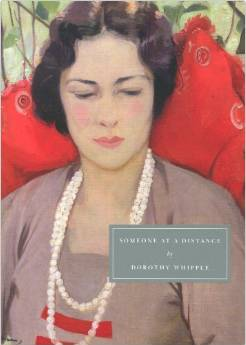
I would normally not give away something important that happens well into a novel, but the book blurb openly presents it as the novel’s central conflict. The Norths are an affectionate and happy family with little to discontent them in post-World War I England. Avery enjoys his work as a partner in a publishing firm and is a loving husband and father. He dotes on his daughter Anne especially. Ellen loves her family and her garden. Although she perhaps does too much for her family, she enjoys it. Hugh is serving his term in the army but can’t wait to get out and work at his father’s firm. Fifteen-year-old Anne loves her family and especially her horse.

The only small annoyance in the family’s life is Avery’s mother, who is critical and discontented, wanting more attention than the busy family can provide. But she soon solves her own problem by hiring a companion, a French girl named Louise Lanier.

Louise is a selfish and discontented young woman who is fleeing the end of an affair in which she was felt to be socially inferior to her lover and unworthy of marrying him. Eventually, she sets her sights on Avery, heedless of any destruction she may wreak with her harmful intentions and toxic personality.

I spent the first half of this novel entranced by this perceptive and layered novel and the last third in tears. The characters are wonderfully realized. Perhaps Louise’s character lacks a little nuance, but we have all met people who are able to justify their own bad behavior to themselves. This is a great book that should have had more attention since it was written in the 1930’s.

Related Posts

The Watch Tower

A View of the Harbour

The Travelling Hornplayer

Day 675: Amsterdam

Cover for AmsterdamThe Booker Prize people liked Amsterdam a bit more than I did. Although the shattering last page of McEwan’s Atonement absolutely upended that novel, the same technique did not work as well for this one. Perhaps the problem lies with my having seen McEwan do this several times already.

The novel begins with the death of Molly Lane. Two old friends, both former lovers of Molly, meet at the funeral. Clive Linley is a world-famous composer, and Vernon Halliday is an editor trying to save a floundering newspaper. At the funeral is another of Molly’s former lovers, foreign secretary Julian Garmony, a right-wing bigot whom both men dislike. They all pay stiff respects to Molly’s possessive husband George.

The brush with mortality makes both Clive and Vernon a tad hypochondriac, and they end up exchanging a pledge. But various stresses will soon interfere with their friendship. Clive is struggling to complete what he thinks will be his masterpiece in time for a performance in Amsterdam. And George has offered to sell Vernon some compromising photos of Julian that he found in Molly’s papers. Vernon has to decide whether publication of these photos will result in increased sales or backlash.

This novel is darkly humorous. None of these men is a sterling individual. In fact, they are all morally bankrupt. Clive seems the least at fault for quite some time, but then he does something unforgivable and justifies it as being for his art.

It’s difficult to explain my main criticism without revealing the ending. I can only say that the implications of the final page do not make sense, that there is no way that the character could have known how things would work out. So, I do not think the surprise ending works as well in this case as in other McEwan novels.

Related Posts

Sweet Tooth

The Sense of an Ending

The Child in Time

Day 673: The Illuminator

Cover for The IlluminatorIt is the 14th century, and Lady Kathryn finds herself in a precarious position. She is a widow and owner of Blackingham Manor, the mother of 15-year-old twin sons. The church has been incessant in its demands for tithes, and there are also the king’s taxes. She suspects her overseer of being dishonest, and he is certainly disrespectful, but she has no one who could replace him.

When Father Ignatius makes yet another demand of her, she has nothing to give him but her mother’s pearls. Still, the church could make trouble for her, so she gives them up. Later Brother Joseph arrives with a message from the Abbott. If Lady Kathryn will house an illuminator who is working for the abbey, along with his daughter, the abbey will let up on its demands for tithes. For the price of food, Kathryn thinks this is a bargain.

Soon the artist Finn arrives, along with his beautiful daughter Rose. Lady Kathryn is immediately worried about her son Alfred, who likes to dally with the serving maids. Finn’s arrival is made more chaotic because of the news that Father Ignatius was murdered. Although this happened after he left her house, Kathryn doesn’t want to draw attention to herself, so she lies to the sheriff, Sir Guy, and tells him she hasn’t seen the Father recently. This of course turns out to be a lie she regrets.

Sir Guy, being the rapacious type, has his eye on Lady Kathryn and her estate, which is her own and does not go to her son. But Kathryn and Finn are soon drawn to each other. To get Alfred away from Rose, Kathryn asks him to supervise the overseer. Soon involved with Finn herself, she does not notice the depth of Rose’s friendship with Colin, the younger twin.

Other important characters in the novel are Half-Tom, a dwarf who befriends Finn, and the anchorite Julian of Norwich, a real woman famous for her writings about religion, reflecting unusual views.

I wanted to like this novel more than I did. Overall, my impression could be summed up as meh. At first I was worried that it was going to be a historical romance, which I usually do not enjoy, but it was not. It shows a solid grounding in the time period, with convincing detail. I think I was turned off by the depiction of the church. This was a violent time in history, and the Catholic Church was in a period of corruption, but I don’t think that is a good reason for depicting every representative of the church (except Julian of Norwich) as a cartoonish villain. It is clear that the author’s sympathies lay with the Reformation, but that movement had its own abuses. In fact, in the 14th century, it is doubtful that many people in England would have even envisioned a Reformation. Martin Luther didn’t put up his theses until 1517.

I think that my biggest problem with the novel is that only a few characters were at all developed. The others were simply villains. I also had problems with the situations created in the novel simply by both Kathryn’s sons departing without notice. Alfred pulls a nasty trick on Finn before leaving—one that endanger’s Finn’s life and leaves Kathryn open to blackmail. Both sons behave like spoiled adolescents instead of the young men they would have been considered at the time, and Kathryn makes several poor or dishonest decisions regarding them.

There is also a theme of Kathryn’s changing religious beliefs, but I found this decision sudden and unlikely. I would have liked to see more about Finn’s art, but there was very little.

Related Posts

Cathedral of the Sea

Grave Goods

Who Murdered Chaucer? A Medieval Mystery

Day 665: The Sleep Room

The Sleep Room In this atmospheric novel set in the 50’s, Dr. James Richardson is a young psychiatrist when he accepts what appears to be an exciting opportunity to work with the world-famous Dr. Hugh Maitland. Maitland has just opened a clinic in rural Suffolk where he will be employing some experimental therapies and hires Richardson as a doctor for the facility. Richards is surprised to find he’ll be the only doctor on staff with just weekend relief.

When Richardson begins work at the clinic, he is surprised that Maitland will not let him examine the patient records. One of Maitland’s beliefs is that mental problems are chemical and need chemical solutions, not psychotherapy. In the Sleep Room,  one of his experimental therapies is keeping six women asleep for months.

Although Richardson has some twinges of doubt about Maitland’s ideas, he defers to him as the expert. Soon he has other things to think about. He becomes very busy with his work and is also romantically involved with a nurse, Jane Taylor.

Small odd things happen beginning almost with his arrival, though. He thinks someone is behind him when no one is. He hears sounds when no one else is in the room. Things disappear and reappear in places where they shouldn’t be. Richardson begins thinking that the stately home housing the clinic has a poltergeist.

The Sleep Room is a difficult book to review because it slowly builds up quite a bit of suspense, but then I found the explanation for the events absurd. Yet, there is a reason for that and I can’t really get into it without giving away too much. Let’s just say that after an apparent climax there is a long, boring explanation followed by a short, apparently aimless follow-up, and then everything gets turned upside down.

One problem is that the final twist isn’t signaled well enough by the rest of the novel and actually doesn’t make sense in terms of the total of the novel’s narrative style. I can think of another book that employed a very similar trick but much more successfully. So, although I was captured by this book, I find that it ultimately doesn’t work.

Finally, the novel is only adequately written and poorly edited. In particular, I noticed loads of unnecessary passive voice and several instances of confused homophones: “knave” instead of “nave” and “taught” instead of “taut,” for example. These problems were with the published book. I was not reading an advance reading copy.

Related Posts

The Solitary House

Your Presence Is Requested at Suvanto

Andrew’s Brain


Day 653: Viper Wine

Cover for Viper WineTo say that Viper Wine is an unusual novel is to make an understatement. The novel is based on events in the lives of historical characters, but its narrative style is wildly creative, including many anachronisms and quotes from both modern and historical sources, even computer code. It seems occasionally to blur the time between centuries.

In 17th century England, Venetia Digby was once the renowned beauty Venetia Stanley, but she is getting older. She is not exactly vain so much as humiliated by her loss of distinction and the pitying glances she thinks she detects. Her husband Sir Kenelm loves her as much as ever and thinks she looks fine, but she believes he doesn’t actually see her.

Kenelm is a sort of Renaissance man, a scholar, soldier, and adventurer. It is true that he spends a lot of time on his experiments and books. He has some other occupations he must be more careful of. He is an alchemist, and even though the Queen, Henrietta Maria, is Catholic, the Digbys’ Catholic religion must be observed with discretion.

Venetia has begged Kenelm to make her a preparation to restore her youth, but Kenelm doesn’t think she needs one and refuses without explaining to her how harmful such a preparation could be. Venetia finally sneaks off to try an apothecary’s concoction named Viper Wine that is made from snakes, and apparently some kind of opiate. Whether it really improves her looks or she just thinks it does is not clear, but soon, many of the ladies at court are sneaking off to find the same apothecary. Later she starts using something similar to Botox.

http://www.netgalley.comAs Venetia exuberantly pursues a renewed career at court and Kenelm continues his studies and adventures, Eyre reminds us by little digs and a sort of melding of time periods that people haven’t changed in their extreme remedies for aging. This novel is written with a zippy postmodern irony that adds energy and liveliness to the story of how the famous beauty’s autopsy after her death showed she had “very little brain” (not a spoiler, as her death is mentioned in the book blurb).

Related Posts

The Nature of Monsters

Queen Anne: The Politics of Passion

Look at Me

Day 646: The Marriage Game

Cover for The Marriage GameAlthough I have read several of Alison Weir’s meticulously researched histories and historical biographies, I feel her gifts are more for nonfiction than fiction. In her novel The Marriage Game, she concentrates on the struggles and power plays around the issue of Queen Elizabeth I’s marriage during the first years of her reign. Unfortunately, Weir focuses on this subject so much to the exclusion of others that you would think it was the only item of concern in the realm. For example, Elizabeth sends Cecil away to broker a peace with Scotland, which is almost the only mention of a war.

The novel begins right after Elizabeth hears of her sister’s death and takes the throne. Her advisor William Cecil almost immediately raises the issue of her marriage. Elizabeth, determined not to lose her hard-won power to a husband, finds her repeated statements that she will not marry either not believed or met with the opinion that her remaining unmarried would not be good for the kingdom. Elizabeth takes a flirtatious stance, refusing to be pinned down to a decision but forever pretending she’s considering a suitor.

Confusing the issue is Lord Robert Dudley, for whom she has a decided preference. But he is already married. Still, she heeds no one’s warnings about her reputation. She keeps him with her even when his wife is dying, and at least in this novel, their physical relationship includes everything except actual penetration. Just whether the Virgin Queen was a virgin is a subject of debate, and this seems to be Weir’s (perhaps unlikely) compromise. The mystery of what happened to Dudley’s wife seems much less important than it actually was at the time.

http://www.netgalley.comWeir has not chosen to make this story romantic or even depict the two main characters sympathetically. Neither is fully formed, but both are selfish, ambitious, demanding, and conniving. Although the novel is well written and should be interesting, it eventually devolves into repetitious arguments, with Dudley’s ambitions thwarted and Elizabeth incensed because he has overstepped his bounds. If there is an arc to the plot, I couldn’t discern it. I couldn’t help thinking that a novel about Elizabeth that was a little broader in scope would be more interesting. After reading most of the novel, I finally decided I was finding it tedious and quit reading it. Very disappointing, especially considering Weir’s excellent biography of Mary Boleyn.

Related Posts

Mary Boleyn

The Wars of the Roses

Wolf Hall


Day 645: The Secret Rooms

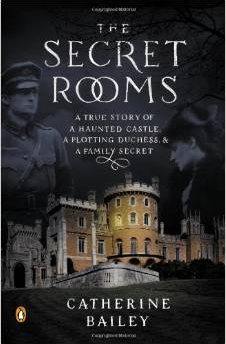
Cover for The Secret RoomsWhen British documentary producer Catherine Bailey began looking through family archives at Belvoir Castle, she was searching for information about the men from the area who served in World War I, including the 9th Duke of Rutland. What she didn’t find surprised her. Not only did she find few letters from the war, surprising for a family who wrote each other and others often, but the letters were missing from two other periods—when John Manners, later the 9th Duke, was nine years old and in 1909, when he was serving the ambassador in Rome.

Soon, Bailey learned that Manners spent the last days of his life, when he was dying of pneumonia, working among the archives in the room, that he died there, and that the rooms had been locked up ever since he died. It became clear that he was destroying correspondence and other papers. Further, she learned that the rooms had been broken into shortly after his death, the thief being identified later as John’s mistress, Hilda Lezard.

Bailey realized that without the letters for World War I, she could not complete her original project. However, she then decided to try to find out what happened during those three periods of the Duke’s life that he wanted hidden.

The result is a story as fascinating as any mystery novel. Although the entire truth of these periods will never be known—in particular, exactly what happened to the Duke’s brother Haddon when they were boys—the search is  as interesting as any modern crime story. The truth involves cruelty, duplicity, and a completely unscrupulous parent.

The Secret Rooms is an entertaining and interesting book. I highly recommend it.

Related Posts

The Forgotten Garden

Goodbye to All That

The House of Walworth

Day 637: The Quick

Cover for The QuickAt first, The Quick seems like a straightforward historical novel about a young writer in 19th century London. But it has a twist. To be honest, if I’d known what the twist was beforehand, I probably wouldn’t have chosen this novel to read, because frankly, I’m tired of this subject. That said, I’m glad I read the book, because it is absorbing, well written, and quite suspenseful.

James and Charlotte Norbury grow up neglected in a rambling house in Yorkshire. Their father rarely comes near them after their mother dies and seems to forget they might need attention or tutors or governesses. So, while the two children run wild, it is the older Charlotte who takes care of James and teaches him to read.

After their father’s death, James goes away to school while Charlotte stays in the care of Mrs. Chickering, an elderly relative. James eventually moves to London to try being a writer, but he is not wealthy and has difficulties finding acceptable lodgings he can afford. An acquaintance introduces him to Christopher Paige, a young aristocrat looking for someone to share his rooms. Although the more austere and shy James does not envy Paige’s life of frivolity, he slowly begins to realize that Paige is his first friend—then that he is more than a friend.

One night, though, a terrible event takes place. Christopher Paige is killed and James disappears. When James does not appear at Mrs. Chickering’s funeral, Charlotte travels to London to find him.

In London, Charlotte’s inquiries attract the attention of the members of a powerful and mysterious club, the Aegolius. There has been an unexpected event at the club, and other people are looking for James. Soon, Charlotte finds herself involved with a secret substrata of the city.

Owen depicts a wonderfully atmospheric London. Although I was at first disappointed with the direction the story took, I still was unable to put this book down.

Day 629: Giving Up the Ghost

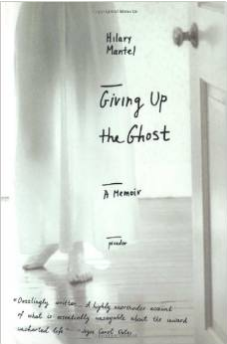
Cover for Giving Up the GhostBest Book of the Week!
In this gripping memoir, ghosts haunt author Hilary Mantel—the spectres of her past, her stepfather’s shade stumbling around the upper reaches of her holiday cottage, the spirit of her unborn daughter, the wisps of her yet unwritten books, and most confoundingly, the black smudge of an apparition that invaded her body when she was seven. Mantel’s is a memoir of wit, anger, and poetic truth.

It also meanders. It begins with the sale of Owl Cottage—where Hilary senses the ghost of her stepfather even though he never lived there—but then returns to the earliest memories of her childhood.

Of Irish Catholic parents, she grew up in the grim north England town of Hadfield, near Manchester. Although her family was poor, her earliest memories are the rich ones of her grandparents and aunts, who lived all along the lane, indulging the imagination of a child who was a knight of the round table, a red Indian, a priest, and was due to turn into a boy when she was four. To me, this last detail is one of the most charming. I can see this little girl.

Then a serious illness struck, changing her from a sturdy tough child with long black hair to a wispy, frail blonde girl, no longer due to change to a boy. From then on it seemed she was robbed of her true self.

The memoir details her rigid Catholic school education, where she developed an intolerance for ridiculous questions, from those asked by her teachers. It also tells of the more profound loss of her childhood, when her mother moved the family out of that lane of relatives so that she could take up life with her lover, Jack. Hilary’s father Henry was relegated to the status of a lodger and then left behind when Hilary won a place at a better school, never to be seen again.

The most debilitating events of her life began when she was a young married woman studying law. The extreme pains in her legs were diagnosed by patronizing and sexist doctors as mental rather than physical problems, caused by the stress of her studies on her feeble female brain, and she was treated first with Valium and later with anti-psychotics. What she actually had was endometriosis, which she finally diagnosed herself. It was left untreated so long that she ended up having a hysterectomy at age 29. She had put off having a child, and it was too late. The effects on her health continue to this day.

Mantel’s memoir is vividly and beautifully written. She strips herself bare, and it is unforgettable.