Day 613: Brave New World

Cover for Brave New WorldIt has been many years since I first read Brave New World, and I didn’t remember very much at all of this acid dystopian novel. It takes a bitter, satiric look into the future from 1931, and like the best of futuristic novels, is somewhat prophetic.

Bernard Marx is an unusual misfit in a society structured around the contentment of its people, or contentment as is rigidly defined there. Family units no longer exist. Society is strictly tiered. Everyone is artificially born, and the lower castes are cloned in multiples. Each caste is conditioned chemically and psychologically from before birth to be content with its lot, the mental and physical abilities of the lower castes chemically limited.

Everything is designed around productivity and consumption. People spend their leisure hours in pursuit of pleasure and get their daily dose of the drug soma. The arts are obsolete, supplanted by a very limited science.

At first it seems as though the discontented Bernard will be the hero of this novel, but there actually is none. He likes Lenina Crowne but is afraid to approach her for fear of being rejected. Lenina is a bit attracted to Bernard and is getting flak from her friends for being too exclusive of late, for there is no concept of faithfulness in this society: “everyone belongs to everyone.” So, she agrees to go with Bernard on a trip to New Mexico to view the savages—remnants of society, apparently American natives, who have not been civilized and live within a barbed wire reservation.

Lenina is too conventional a girl to enjoy this trip, horrified by the dirt and squalor of life that is not antiseptic. But Bernard, who has heard his boss’s story of a lost girlfriend in New Mexico years ago, is intrigued to find this woman, Linda, and her son John, actually born of his parent. John is an outcast of his culture, because he is the son of a woman considered a whore for behavior her own culture believes is normal. He has educated himself from Shakespeare’s complete works. Bernard gets permission to bring Linda and John back to London, setting in train unforeseen consequences.

Huxley apparently firmly believed that future societies would be controlled by drugs and psychological conditioning. It is his interest in cloning and the power of propaganda that strikes more modern readers. I’m willing to bet he paid attention to the then-current theories of eugenics that were particularly popular in England and Germany. His choice of Henry Ford as a godlike image for that society is telling not only for Ford’s invention of the assembly lines, clearly a model for Huxley’s vision of the Central London Hatchery and Conditioning Centre, but also for Ford’s own interest in eugenics.

I couldn’t help comparing Huxley’s vision of sexual freedom with that of Heinlein in Stranger in a Strange Land, a book I really hated. There are other similarities too, John the Savage almost standing in for Heinlein’s alien-born Messiah, only finally shunning what he views as an immoral society rather than trying to start a religion. I think Huxley’s ideas are much more insightful, though.

That being said, I enjoyed this re-read only moderately. I appreciate Huxley’s deadpan humor, but a late section of the book, where Mustafa Mond explains his choices in life, is a bit too much like a sort of reverse didacticism, by which I mean that Huxley is not trying to make us agree with him, but trying to show us what is wrong with Mond’s ideas (or maybe I’m wrong—I believe Huxley thought that such controls over society were inevitable). In any case, any kind of didacticism in a novel is a good thing to avoid. Still, reading this novel after such a long time was an interesting experience.

Day 608: The Convenient Marriage

Cover for The Convenient MarriageThe Winwood sisters are in turmoil. Miss Winwood has gained a spectacular suitor in the Earl of Rule, who has finally decided to marry. He is wealthy, and his generous settlement will save the family from ruin. The only problem is that Miss Winwood is in love with Edward Heron, a mere army lieutenant and a second son with no fortune.

Young Horatia Winwood, not yet out of the schoolroom, thinks she has the solution. Rule wants to marry a Winwood, and it should not matter to him which one. So, she goes to his house and proposes herself as an alternative. She forthrightly points out her unfortunate eyebrows and her stammer and hopes that Rule won’t mind them. Rule is enchanted.

So, Horry gets married without realizing she has made a love match. Since Rule is afraid he may be too old for her, he treats her with a little too much care. She has told him she won’t interfere with him, so she says nothing when she learns about his mistress, Caroline Massey.

Rule has broken with Massey, though, who is jealous and angry. Crosby Drelincourt, Rule’s foppish heir, is eager to make trouble, as is Rule’s enemy, Robert Lethbridge.

Horry soon finds herself very popular. But her efforts to make Rule jealous and the plots of Rule’s enemies land her in trouble, and her scapegrace brother Pelham’s schemes to get her out of it only make things worse.

In Horry, Heyer has created another engaging and feisty heroine. Heyer is an expert on the Regency period, as well as the master of warm and funny romantic escapades, and The Convenient Marriage is one of her best.

Day 607: The Bone Clocks

Cover for The Bone ClocksBefore I get started on my review of The Bone Clocks, my friend Ariel of One Little Library has put together a survey on reader’s interests. If you would like to participate, please do.

* * *

Best Book of the Week!
David Mitchell’s most recent book is another fascinating novel that reminds me a bit of his Cloud Atlas. It explores themes of temporality, life after death, and the human soul and ends in a near-future dystopian vision. Unlike Cloud Atlas, though, The Bone Clocks takes place completely within the course of one woman’s life.

The novel begins in 1984. Fifteen-year-old Holly Sykes has had a fight with her mom after staying out late with her 24-year-old boyfriend Vince. Determined to leave school and move in with Vince, she packs her things and goes, but not before being spotted by her seven-year-old brother Jacko.

She marches over to Vince’s, only to find him in bed with her best friend. Devastated, she flees her home town of Gravesend, not knowing where to go. Later that day, she meets Ed Brubeck, a boy from her school, who helps her find shelter for the night in a church. Taking the idea from a story he tells her, she decides to travel to a nearby island where he worked the summer before picking strawberries.

Holly heard voices when she was a child, and she called them the Radio People. But after her mother became worried about her, a Dr. Marinus stopped them simply by touching her forehead. Since then, her life has been perfectly normal.

But that afternoon several odd things happen. First, she thinks she sees Jacko go into a pedestrian tunnel ahead of her, but when she gets there, she can’t find him. Then a couple pick her up hitch-hiking and take her to their home for a meal. There some events occur that make it clear to readers that some kind of supernatural war is going on involving her. But Holly remembers nothing of this.

Holly goes on to work at the strawberry farm. But the second day, Ed arrives to tell her that Jacko has disappeared.

The narration continues in stories told by other characters, but Holly appears in all of them. In one, Hugo Lamb is a college student who seems to be genial and caring but is actually a sociopath who tries to lure his more wealthy friends into deals he will profit by and steals rare stamps from a senile old man. He meets Holly on a skiing trip in Switzerland and honestly falls in love with her. But fate and a mysterious group called the Anchorites have other plans for him.

We follow Holly through her life as she marries Ed, writes a book called The Radio People, and gets old. At each encounter, inexplicable things happen until Holly is pulled into a battle between the Anchorites and the Horologists.

David Mitchell is a master storyteller. Although I do not consider The Bone Clocks a masterpiece, as I do Cloud Atlas, it is almost as rewarding—at times comic, at times suspenseful. Mitchell likes to tease us, too, by repeating characters from book to book. In this case, Dr. Marinus also appears in his wonderful historical novel, The Thousand Autumns of Jacob De Zoet. Time spent with Mitchell is well spent.

Day 599: Kind of Cruel

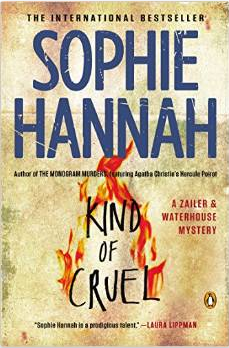
Cover for Kind of CruelWhen Amber Hewerdine decides to consult a hypnotherapist for her insomnia, something unexpected happens. She blurts out a phrase that is puzzling her because she has seen it somewhere and doesn’t know what it means, “Kind, Cruel, Kind of Cruel.” Then she realizes she saw it written on a pad that one of the other clients was writing on in her car before her session.

She knows she has seen it before that. When she asks the woman if she can see it, the other woman denies having it on her pad. So, after the woman goes in to consult with the therapist, Amber gets into her car to look at the pad.

What Amber doesn’t realize is that the phrase is a clue in a murder. Detective Constable Charlie Zailer is the other client, and even though she is not on the case, she has been mulling over the phrase. But it was impossible for Amber to have seen the entire phrase on Charlie’s pad, because she had only written “Kind, Cruel” before Amber interrupted her.

The case where the phrase was discovered was the bludgeoning death of Katherine Allen in her own home, now being investigated by Charlie’s husband Simon Waterhouse. Amber didn’t know Katherine. She believes the phrase is somehow linked to a Christmas event several years before, when her sister-in-law Jo and her family disappeared for two days after inviting the entire extended family to stay at a house they had leased. Amber thinks maybe she saw the phrase in a locked room in that house. No one ever spoke about why part of the family disappeared, and Amber has always been curious.

Amber’s insomnia started after her best friend was killed in a fire. After the fire, Amber and her husband Luke took in her friend’s two daughters. Amber loves the girls but hasn’t slept much since the fire.

Sophie Hannah writes compelling psychological thrillers. Amber’s narrative is interrupted by that of Waterhouse, the detective whom Amber agrees to speak to, as well as that of Ginny Saxon, the therapist. Hannah’s plots are complicated and always interesting to unravel.

Day 598: Mrs. Palfrey at the Claremont

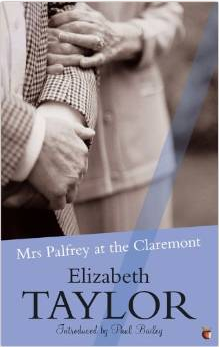
Cover for Mrs. PalfreyI’ve read two books by Elizabeth Taylor, who is beginning to be appreciated as a novelist years after she authored the books. Both the novels are melancholy, about sad people in realistic situations.

Mrs. Palfrey is an old lady who takes a permanent room at the Claremont, a hotel that has seen better days. Staying at the Claremont are several other older people who are all living on limited means.

One reason Mrs. Palfrey chose the Claremont instead of a seaside resort her daughter recommended is because her grandson Desmond lives in London and works at the British Museum. Mrs. Palfrey regrets having mentioned him to the other guests, though, as day after day passes and no one comes to visit.

The life of all the permanent residents of the Claremont is similar to hers, as they sit waiting for something to happen. Mrs. Post knits while Mr. Osborne writes letters to various newspapers hoping to see them in print. Any incident, no matter how trivial, constitutes a break in the monotony.

One day while out walking, Mrs. Palfrey falls. A young man runs out from a nearby building and helps her. He is Ludo Myers, an impoverished would-be novelist. After this encounter, the two become friends of a sort. Mrs. Palfrey doesn’t know that Ludo has decided to write about old people and is using her as a model. Still, they both behave kindly to one another, he even pretending to be her grandson so she can save some face with the other hotel residents.

Underlying the lives of all the old people are sadness and boredom, but Ludo also feels lonely. His mother goes from one affair to another and doesn’t seem to care if he comes to visit. He eventually takes up with Rosie, a young woman who also doesn’t care for him much.

This novel is observant enough of people’s behavior that it is sometimes funny, but mostly it sensitively explores the solitude that is in all of us. I saw the movie a few weeks after I read the book and was interested, but not surprised, to see how the movie was just enough more heartfelt and touching to make it avoid the central message and atmosphere of the book. I liked the movie, but it missed the point.

Day 591: Goodbye to All That

Cover for Goodbye to All ThatThis is my book for the most recent Classics Club Spin! I originally announced that I would post my review a day late, on October 7, but I decided to post it early instead, so as to meet the spin deadline, since Monday, the deadline, is Literary Wives.

Goodbye to All That is the only memoir by Robert Graves, written in his 30’s about a dozen years after World War I. Nowadays, Graves may be best known as the author of I, Claudius, but the publication of Goodbye to All That was extremely controversial. It was one of the first memoirs about the war, and it was one of the most critical.

But before Graves turned a satiric eye on the war, he pointed it at the public school system. I did not always understand what was going on in his boy’s school, but the layers of hierarchy and the customs seem ridiculous. Not surprisingly, this same complexity extends to the different regiments in the military and their customs—where to wear their decorations, what to wear (for one regiment in France, the answer is shorts), and who may speak or drink in the officer’s mess.

Graves, who enlisted early in the war at the age of 21, was soon viewing it all skeptically. One scene of high satire takes place in a meeting of battalion officers, who are all called in to listen to the complaints of their colonel that the men aren’t buttoning their pocket flaps and so on—the worst offence being that he heard a soldier actually call a noncommissioned officer “Jack”! This meeting takes place at the same time that the division is issuing commands for the men to perform impossible missions that would have gotten them all killed had they not been cancelled at the last minute.

Graves also deals somewhat facetiously with the premature reports of his own death, sent by the military to his family after he was wounded, by putting a polite announcement in the Times.

This memoir is interesting enough, although at times I could not follow the nuances of the events, having no knowledge of British school or military terms. There is a short glossary of military terms at the beginning of the book, but it is insufficient. These days, news of incompetency and jingoism during the war is no surprise, but when this book was published, it was the cause of a storm of letters containing all kinds of accusations against Graves.

Day 590: All the Birds, Singing

Cover for All the Birds, SingingBest Book of the Week!
Jake Whyte is a tall, strong young woman doing a man’s job on an island in northern England. She is keeping a sheep farm, doing the best she can at a hard job all by herself. She is haunted, though, by terrifying memories and the feeling that someone is watching her and coming into her house. Her neighbor Don thinks she’s imagining things, but there is no doubt that something is killing her sheep.

Interleaved with her struggles in the present time are scenes from Jake’s past, from the most recent backward in time to when she was a teenager in Australia. So, we slowly learn why Jake finds herself alone, feeling like an outcast from society.

This novel is haunting and in many ways reminds me of the excellent, Tethered, which I just recently reviewed, in dealing with damaged people. I don’t want to say more about it for fear of giving too much away. Let me say that the novel is extremely atmospheric and that I was completely involved in discovering the secrets from Jake’s past as well as what is hanging around her farm. It is also beautifully and sparely written, evoking a distinct personality in Jake.

Day 587: Harvest

Cover for HarvestBest Book of the Week!
Harvest seems to be concerned with exploring the dark side of human nature. Set in an unspecified time in the past, it focuses on unusual events in a small, remote village.

The villagers are celebrating the harvest. They are so busy drinking and eating that they forget to appoint their harvest queen. Groggily awakening the next morning, they spot two fires. One is green wood burning in the distance, a signal that some new family is establishing itself. The other is the master’s resented dovecote and the stables. Someone has set fire to the dovecote, and the fire has spread.

The novel’s narrator, Walter, noticed three young men return the night before with a load of hallucinogenic mushrooms and a dried puffball. He knows there is no use for the puffball except to spread a fire. Still, he decides to say nothing.

After the fire is out, Walter notices how the men he believes guilty behave over-helpfully to Master Kent and insist that the newcomers must have set it. So, the master and some of the villagers go off to see them.

Walter has injured his hand in the fire, so he stays home. But he soon hears how the villagers caved in the roof of the hovel so that it injured the young woman inside and how the master sentenced her two companions to a week in the stocks.

For some reason I felt dread from the onset of this novel, and this feeling was not wrong. Although the villagers have already started trouble by not confessing their actions, much worse is to come. For kind Master Kent has lost his property through an entailment to his wife’s cousin, a ruthless and cruel young man who is only interested in enclosing the common land and putting it to sheep. Now that he is master, it is up to him to mete out justice when the next incident happens.

Although Walt’s main fault is inaction, he soon finds himself being treated like a stranger again, for he came to the village long ago as a servant to Master Kent. Soon the village he loved is unrecognizable.

This novel is masterfully written, about how greed and ignorance can destroy a community. It is a dark and twisty tale.

Day 579: The Daughters of Mars

Cover for The Daughters of MarsNaomi and Sally Durance are sisters and Australian nurses in 1914. They are divided by old grudges and a new crime. The older Naomi deserted their home in the bush for a career in Sydney, leaving Sally stuck there with their parents. More recently, their mother was struck down with cervical cancer and suffered terribly. Sally stole enough morphine from her own hospital to help her mother die, but one day after Naomi arrived, Sally found their mother dead and the drugs gone. Sally feels guilt at her part of the crime and resentment that Naomi could do what she could not.

There is a fervor in Australia for the war, so both women decide independently to volunteer as nurses. They set out by ship for Egypt, then to serve on a hospital ship off Gallipoli, and finally to France.

This novel shows extensive research into the conditions of World War I for nurses, and of their treatment. Although by and large they receive respect, that is not always the case. In an incident based on a true event, their hospital ship Archimedes is employed for one mission as a troop carrier, its red crosses blacked out. It is torpedoed and the survivors, including Sally and Naomi, wait in the water clinging to a raft for hours for rescue. During this traumatic wait, one soldier after another simply lets go.

After the nurses are rescued, they are put to work in a hospital on Lemnos, where the officer in charge sees no use for them and lets the orderlies treat them with disrespect. All their possessions lost, they are given local peasant dresses to wear instead of uniforms. Eventually, an orderly rapes one of the nurses and after a perfunctory investigation, gets off lightly.

The adventures of the sisters and their friends are indeed interesting and provide a different view of the war. With the few of Keneally’s books that I have read, Schindler’s List being the most well known, I have felt a certain distance from events and characters. This book is no exception, but at the same time I wanted to see what would happen.

Although told in a straightforward limited third-person narrative that moves between the point of view of the two women, Keneally offers up an alternate ending. It is not one we can choose between, but one where he tells us what might have happened and then tells us what did happen. The ending brought tears to my eyes but also seemed a little like a trick.


Day 576: Indiscretion

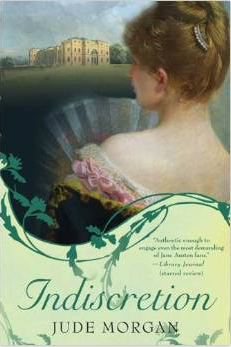
Cover for IndiscretionIn Regency London, Caroline Fortune and her ex-soldier father have been surviving at the edge of poverty for a long time. When her father reports that he has lost all his money in a bad investment, Caroline decides to look for work as a governess.

Soon, her father tells her he has found her a better situation, as companion to Mrs. Catling, the widow of her father’s former colonel. In his ebulliant way, he assumes Caroline could easily be left Mrs. Catling’s fortune. Caroline is not pleased with the situation, nor does she have any hopes of Mrs. Catling’s generosity, but seeing no other option, she takes the position. With no relatives other than her father to fall back on, as her mother’s relatives disowned her mother after her marriage, Caroline moves to Brighton to wait on Mrs. Catling.

Caroline soon learns that Mrs. Catling is demanding and petulant. She treats her servants harshly. When Mrs. Catling’s niece and nephew, the Downings, come to call, Caroline witnesses how her employer manipulates Matthew Downing with the promise of her fortune. Still, Caroline manages to get along with the Downings and Mrs. Catling fairly well, even receiving unwanted confidences from Matthew. However, her dependent position unexpectedly leaves her open to an insult from an unscrupulous man.

Re-opened contact with her relatives eventually removes her to an entirely new neighborhood and life, and she makes some new friends. After awhile, though, her experiences in Brighton return to haunt her.

I don’t often read romance novels and tend to stick to the older authors I love when I do. I have found no writer who can surpass Georgette Heyer in Regency romances. But a friend recommended this novel to me, and I found it quite entertaining. It does not seem simply a copy of Heyer as some other Regency novels have. The dialogue is witty. Once Caroline leaves Brighton she meets some endearing characters, and the plot is both complex and interesting. Caroline is an intelligent and engaging heroine. For some light, escapist reading, I recommend Indiscretion.