Day 523: Corrag

Cover for CorragBest Book of the Week!

Corrag tells two tales, both based in history. One is the story of the witch Corrag, a woman about whom little is known except in lore. The other is the story of the infamous massacre at Glencoe, where at the orders of King William, British soldiers attempted to murder an entire clan after accepting hospitality from them.

The Reverend Charles Leslie arrives in the town of Inverary looking for information about Glencoe, because he thinks that public knowledge of the event will help the Jacobite cause. He hears that the witch Corrag, awaiting her trial by burning, was present at the event, so he goes to see her. He is repulsed by her, a tiny young woman with pale eyes who is filthy, with matted hair. As a religious man, he is horrified to be in the same room with a witch. But she agrees to speak to him about Glencoe if he will hear the story of her life.

So, Corrag begins telling her story. She is a gifted story teller who loves the beauties of the world, and we can see Leslie’s changing attitude toward her in the letters to his wife that begin each chapter. She is the daughter of Cora, a persecuted “witch” of northern England. Sensing the end, Cora sends Corrag off to ride north and west for safety. After much hardship and poor treatment, Corrag finally arrives in the valley of Glencoe, where she is left alone at first and eventually earns a place because of her healing skills.

This novel is haunting and at times almost poetic in style. I was in tears most of the time I read it. Corrag tells affectingly about her feelings for the world and particularly for one man. Glencoe is the only community that ever accepted her, and she loves it. She is finally able to repay the people of the glen by saving some of their lives.

The real Charles Leslie anonymously published a pamphlet about Glencoe that struck the world with horror. This reimagining of the circumstances around the event is fascinating, especially for those interested in Scottish history. The novel is also extremely touching.

Day 521: The Dead in Their Vaulted Arches

Cover for The Dead in Their Vaulted ArchesThe tone of The Dead in Their Vaulted Arches is a little more somber than in the previous Flavia de Luce mysteries. Just as Buckshaw was about to be sold out from under the family in the previous novel, we learned that Flavia’s mother was found. Years ago lost in a mountaineering accident, Harriet de Luce was the owner of the house. Her fortune could not be passed along to her family without proof of her death. Now, her body is on the way home.

Flavia is surprised to find her mother’s remains have received a military escort. In fact, ex-prime minister Churchill is at the village’s small train station when the body arrives.

A tall man approaches Flavia at the station and asks her to tell her father that “the Gamekeeper” is in jeopardy. Moments later he is dead, having been pushed under a train.

I was a little surprised to find Bradley playing a few of the tricks that I associate with less skillful mystery writers. One of them is to spin out the story by having a character delay doing what is obviously urgent. Flavia waits quite awhile to convey this message from the tall man.

Part of the charm of these novels is always 11-year-old Flavia, who combines high intelligence with childish naïveté and some wild ideas. This time she decides to bring her mother back from the dead using some old chemistry experiments. While trying to do this, she finds her mother’s will inside her jacket. She doesn’t pass that on right away, either.

Flavia’s adventures this time include flying in a Gipsy Moth and getting involved in espionage. Of course, there is a murderer to capture and family secrets to explore.

Still, I didn’t find this novel as much fun as I usually do. Probably because of the subject matter, Bradley has to step back quite a bit from the humor.

Flavia is growing more thoughtful, although she is still as reckless. The novel hints at a change of scene in upcoming books, and although I think Buckshaw is wonderful, perhaps we need one.

Day 514: The Vanishing Point

Cover for The Vanishing PointI’ve found the last few Val McDermid novels I’ve read disappointing, and The Vanishing Point is no exception. First, it begins by using a contrivance that is not at all successful.

Stephanie Harker’s adoptive son Jimmy is kidnapped from the secure area of O’Hare Airport while she is in the full body scanner. After an initial frantic period of activity, she sits down with FBI agent Vivian McKuras to tell the long tale of how she became Jimmy’s guardian.

Even though this story is necessary to understand the novel, its context within a police interview during a search for a missing child is not at all convincing. I doubt very many police interviews consist of one person talking for hours without any questions from the police. Then there is the issue of how McKuras can lead the investigation if she is interviewing Stephanie all night long. Presenting this information as a series of flashbacks would have taken care of the problem. This is an unusual misjudgment for McDermid.

The bulk of the novel centers around Stephanie’s relationship with Scarlett Higgins, a reality TV star who hires Stephanie to ghostwrite a memoir for her. Although Scarlett maintains a persona of a dumb blonde, Stephanie quickly realizes that Scarlett is a lot smarter than she seems and grows to like her. Stephanie becomes involved in Scarlett’s life, her marriage to a popular D.J., and all the difficulties of her celebrity.

When Scarlett dies of cancer, she leaves her young son Jimmy to Stephanie’s care. The story is long and complicated but doesn’t turn up many suspects in the kidnapping except Stephanie’s own stalker ex-boyfriend Pete. In fact, the novel gets fairly involving and does a good job of leading its readers down the garden path for quite some time.

I won’t give away the ending, but it is so completely far-fetched that it left me gasping. Despite its rough beginning, McDermid as ever writes a gripping novel, but this one ends up in the stratosphere.

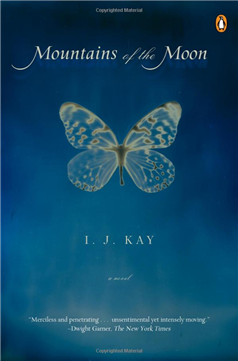
Day 509: Mountains of the Moon

Cover for Mountains of the MoonBest Book of the Week!
It will be difficult for me to put into words how unusual Mountains of the Moon is. The novel is about a woman’s act of creating herself despite a past that is nearly crippling, but its unusual quality is primarily in the style of narration.

At the beginning of the novel, Louise Adler is 31 and newly out of prison. She is doing what she can to make a fresh start, fixing up her dreary apartment, trying to find any kind of job.

The story shifts to when Lulu is a little girl. Brought up with her grandfather’s stories of the Mountains of the Moon, she pretends she is a Masai warrior, dressed in a bright strip of cloth and holding her spear on a perch high above the neighborhood.

Her home life is difficult. She loves her older brother Pip, but he is sent away to live with his father because of “disloyalty” to his mother. Her verbally abusive mother keeps her out of school and makes her stay up all night listening to her talk. Her physically abusive father is often away with his other family. When Baby Grady arrives, he is left to Lulu’s care much of the time, but she adores him.

This portrait of the imaginative little Lulu is charming, but fear always lurks around the edges of her world. We know something goes wrong for her, but Kay spins the story out by interleaving it with the present one. A third story line returns to when Louise is 21 and learning to deal blackjack at a casino. At that time, she becomes fatefully involved with a girl named Gwen and her friends.

Louise is a woman of many names and identities. As a child she plays gleefully with language, gobbling up new words but only saying parts of the ones she knows. As an adult she finally begins trying to make sense of herself as a person.

This novel is sometimes brutal and harrowing, other times endearing. Its narrative style reminds me a bit of that of The Bone People.We like Louise/Lulu and we want her to succeed, but there are secrets in store. This story is one of an unforgettable character.

Day 501: Waiting for Wednesday

Cover for Waiting for WednesdayThe writing duo Nicci French has come out with another powerful Frieda Klein mystery with Waiting for Wednesday. Although it deals mostly with another case, there is still the threat of a serial killer from the first book in the background.

DCI Karlsson and his team are trying to solve the murder of Ruth Lennox, a housewife whose face was smashed by a heavy object. Although her death appears to be part of an interrupted robbery, when the police find the thief, he has an alibi for the actual time of the murder. Soon Karlsson and his team find evidence that Ruth was leading a secret life.

Frieda is recovering from injuries incurred at the end of Tuesday’s Gone, and she is on leave from her practice. Her absence from the case does not prevent another psychoanalyst who is working with the police, Hal Bradshaw, from seeing her as a threat and attempting to professionally humiliate her.

Bradshaw has set a trap for Frieda and some other analysts he dislikes by sending in graduate students for consultation who pretend to have sociopathic thoughts and ask for treatment. Frieda immediately realizes her subject is pretending and sends him away, but something he says captures her attention and she begins trying to track down the source of the story. In doing so, she meets Jim Feary, a retired journalist who is sure he has happened upon traces of a serial killer. When Frieda takes Jim and his evidence to see Karlsson, though, Karlsson believes that her judgment is impaired because she is still traumatized by her experiences and that Jim is a nutcase.

http://www.netgalley.comFrench presents a complex set of mysteries in this novel, which is really gripping and ultimately suspenseful. While Frieda flounders with too much going on in her usually quiet life to allow her to make her recovery, Karlsson, Yvette, and Riley struggle with a case that gets more and more complicated. Even if you can figure out a piece of one puzzle, as I did, there is still a lot more going on in this intelligent mystery novel.


Day 497: The Last Pre-Raphaelite: Edward Burne-Jones and the Victorian Imagination

Cover for The Last Pre-RaphaeliteYears ago in London I was wandering through the Tate with my friends, tired of seemingly endless rooms of Italian Renaissance paintings, when I walked into another room and was simply blown away. The room was full of life-size paintings of stunning beauty, with gemlike colors, exact details of greenery and complex woven fabrics, and narrative depictions from myth and legend. They were by the Pre-Raphaelite Brotherhood, and they must be seen in person to be fully appreciated. Ever since then I have been interested in the Pre-Raphaelites, so when I read a glowing review of The Last Pre-Raphaelite in the New York Times, I tracked it down.

Although all art movements go in and out of fashion, the Pre-Raphaelites seem to come in for more than their fair share of controversy. I have even now picked up art history books that don’t contain a single Pre-Raphaelite picture. Edward Burne-Jones was the youngest of this group of painters, although he was outlived by Holman Hunt. He was also a prolific designer of stained glass windows and even jewelry.

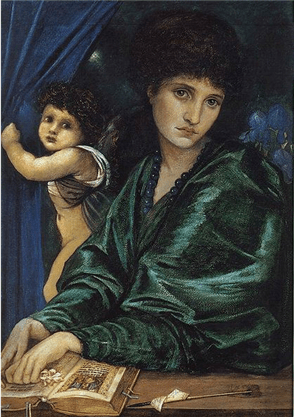
Portrait of Maria Zambaco
Burne-Jones Portrait of Maria Zambaco

MacCarthy’s biography is a fairly exhaustive study of Burne-Jones’ life and works, his marriage and family, life-long association and partnership with William Morris, his mentoring of younger painters and friendships with many important figures in art, literature, and politics and with a string of little girls, and his famous affair with Maria Zambaco. It discusses his association with the Pre-Raphaelites, the Arts and Crafts movement, and the philosophy of Aesthetics.

Burne-Jones believed strongly that beauty should be available to everyone. Hence, his involvement with William Morris in producing items of home decor, in illustrating manuscripts, and in designing stained glass windows for public venues. In fact, he is closely associated with the revival of the stained glass industry in England.

One surprise of this biography was to find the personality of a puckish jokester underneath Byrne-Jones’ ascetic, attenuated appearance. He continued throughout his life a schoolboy habit of drawing little caricatures of himself and his friends, particularly teasing ones of his good friend Morris. Although generally a moral person, he was understanding of the foibles of others and supportive of his friends, even those of whose habits he did not approve. He was beloved by many.

picture of Burne-Jones The Golden Stairs
Burne-Jones The Golden Stairs

I was interested throughout this book, even though much of it had to do with Burne-Jones’ struggles to finish work. He apparently had far more ideas than he could ever accomplish and was always working on many projects at the same time. The book is full of beautiful photographs of his art—although unfortunately most of them are too small to see the details—as well as of himself, his family and friends, residences, etc. The interiors of rooms are stunning examples of the Arts and Crafts movement.

A small quibble is the epilogue, which is concerned with the revival of interest in Burne-Jones. It is interesting up to a point, where it seems to be attempting to trace of ownership of every single work. Still, this is a fascinating biography.

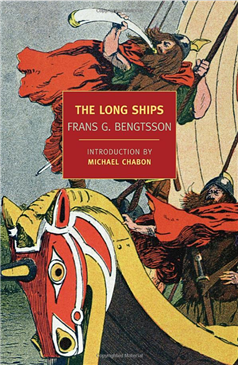
Day 496: My First Classics Club Review! The Long Ships

Cover for The Long ShipsBest Book of the Week!
Today I’m posting my first review for The Classics Club, the one chosen for me by the Classics Club Spin #5!  The Long Ships is a great start to the Classics Club for me. I found it to be a rousing adventure story full of deadpan humor.

This book is the result of Bengtsson’s desire to write a realistic novel about the Vikings. A poet, Bengtsson also wrote essays and a biography of Charles XII, but he became more widely known for The Long Ships.

His protagonist Orm Tostesson is only a boy when the novel begins. Orm is eager to go a-viking to Ireland with his father and older brother, but his mother tends to be protective of him, so he stays home. Shortly after the men leave, he attempts to stop some sheep stealing on the part of a group of Vikings from Lister and is kidnapped by them. The Vikings soon find him an able and intelligent companion, so he becomes part of their crew rather than being kept a slave.

In the course of their adventures down the western coast of Europe, they are initially successful but eventually are captured and sold as galley slaves. In return for a service they performed for a Jew from Córdoba, they are freed to serve as bodyguards for lord Almansur, the regent and imprisoner of the young Caliph of Córdoba. There they serve for years until circumstances force them to flee for home.

This voyage is the first of three related in the novel, during which “Red” Orm meets his bride to be, loses her when his best friend Toke steals her father’s concubine, goes a-viking to England to try to retrieve her from English priests, and many years later travels down the Dnieper to bring back a stash of hidden gold. Even when he is settled at home, he is involved in tiffs with his neighbors, attempts to murder him on the orders of the evil King Sven, visits from unusual acquaintances, rowdy celebrations, and a Thing, a convocation of various groups of Vikings for settling their differences.

There is plenty of action in this novel, but what I find most charming are its air of insouciance and its ongoing (although somewhat grisly) humor. It has a sense of playfulness, especially about the differences between the Norsemen’s old religion, Christianity, and Islam, to which Orm and his fellows are temporarily forced to convert. Take, for example, this passage from the prologue, about the arrival of the shaven men, or priests, in Skania:

They had many strange tales to relate, and at first people were curious and listened to them eagerly, and women found it pleasant to be baptized by these foreigners and to be presented with a white shift. Before long, however, the foreigners began to run short of the shifts, and people wearied of their sermons, finding them tedious and their matter doubtful . . . . So then there was something of a decline in conversions, and the shaven men, who talked incessantly of peace and were above all very violent in their denunciation of the gods, were one by one seized by devout persons and were hung up on sacred ash trees and shot at with arrows, and offered to the birds of Odin.

To give you another idea of the humor in this novel, a Viking tells a story of a wedding that broke up into a fight. When the bride sees the groom’s friends beating up one of her relatives, she hits the groom with a torch, which starts his hair on fire, beginning another fire in which 11 people are killed. Everyone agrees that it was the best wedding they ever attended.

The story of Red Orm is told in a detached manner but by a truly talented storyteller. It is full of sly humor and observations of human folly. I really enjoyed it.

Day 494: A View of the Harbour

Cover for A View of the HarborElizabeth Taylor was a mid-twentieth century writer who was interested in the realistic depiction of ordinary lives, particularly those of the working class. In A View of the Harbour, she provides glimpses into the lives of residents along the harbor of a shabby seaside village in post-World War II England.

Newby has seen better days. The trendy tourist area has moved away around the point, and all that is left aside from a few houses are a wax museum, a pub, a small store, a closed-down fun fair, and a lighthouse.

The main characters of this novel are Beth and Robert, a married couple, and Beth’s longtime friend Tory, recently divorced. Beth labors under the delusion that she is observant, but most of her focus is on her writing, as she is an author. Toward her family she is myopic. She doesn’t see when her five-year-old daughter Stevie is manipulating her, and she pays very little attention to her older daughter, Prudence, or to her husband. All family drama provides fodder for her prose.

Most people in town seem to think Prudence is slow, but she has noticed something that others haven’t—that her father is secretly visiting Tory.

Tory is torn between her feelings for Robert and her loyalty to Beth. She mostly seems to be at loose ends, however. She still cares for her ex-husband Teddy and makes a point of stopping in to see him if she is in London. In Newby she flirts with Bertram, a retired naval officer with ambitions to be a painter but little talent, and dallies with Robert.

Loneliness is a strong theme of this novel. Tory is clearly lonely, even though she is beautiful and has no trouble attracting attention. The attention she wants, from Teddy, is not available. Lily is a recent widow who goes to the pub nightly for companionship. She is timid and terrified of the walk home in the dark. The proprietor of the wax museum, she is afraid to pass the figures on the way up to her flat. The brief attention she gets from Bertram ends unfortunately.

Maisie, the hard-working daughter of invalid Mrs. Bracey, manages to attract Eddie, the boarder, but Mrs. Bracey is immediately jealous of the distraction of Maisie’s attention. Mrs. Bracey is a complex character. We have sympathy for her because she is paralyzed, but she has a terrible tongue and is a vicious gossip. She easily finds a way to squash Maisie’s romance.

Taylor’s characters are too realistic to be entirely likable, although Beth is less at fault than Robert or Tory. I found Maisie and Prudence the most sympathetic of the characters.

Taylor is highly regarded but relatively unknown because she was overshadowed in her time by the more famous Elizabeth Taylor. Her writing is observant of the small details of life. Although there is not much humor in the novel, Tory’s letters from her young son at school are believable and funny. My overall impression of the novel is that the lives of its characters are as sad and dilapidated as the village.

Day 489: Queen Anne: The Politics of Passion

Cover for Queen AnneHistorically, the legacy of the reign of the last Stuart monarch, Queen Anne, has been marred by allegations that Anne was a weak woman who was ruled by her favorites. The accomplishments of her reign have been attributed to men she entrusted with leadership roles, most notably John Churchill, Duke of Marlborough. Similarly, the wrongs perpetrated during her reign have been imputed to the misguidance of her favorites. Historian and biographer Anne Somerset’s new book exhaustively shows that Anne, to the contrary, was a sensible and conscientious ruler, most consistent in her views and often very stubborn, although private and reserved.

Much of what was popularly known about Queen Anne came from the writings of Sarah Churchill, the Duchess of Marlborough, who was Anne’s close friend and confidante for many years before becoming her bitter enemy. Even when they were close, the duchess seems to have been a demanding harridan, whose idea of her own power and desserts grew too rapacious and who treated the queen abominably for years. Having read a biography of the duchess several years ago, I approached this book believing Anne was a weak and silly woman, but it has made me change my mind.

Somerset makes an interesting point that Anne’s lack of charisma and physical appearance may have hurt her legacy. Although the portrait of the young Anne reveals a beautiful lady, by the time of her reign she was grossly overweight and plagued by serious physical ailments. These were diagnosed at the time as various disorders, including gout, but a modern look at her symptoms indicates that she may have suffered from lupus, a serious autoimmune disease. For the most part she soldiered on uncomplaining to do her duty for her country.

This book lucidly explains the complex issues that echoed throughout Anne’s reign, including the ouster of King James II, Anne’s father, and the refusal to acknowledge his son, Anne’s half brother James Francis Edward Stuart, as a legitimate heir to the throne because of his Catholicism; the bitter feuds between the Whigs and the Tories; and the War of the Spanish Succession. The book is thorough in its research and very well written. Although I tired at times of its dissection of a seemingly endless series of disputes among those vying for power, I think the book offers a considered and balanced look at Queen Anne’s life and reign.

I received a copy of this book free through a giveaway on Goodreads.

Day 485: Into the Darkest Corner

Cover for Into the Darkest CornerAlthough I can’t say I found this thriller terrifying, it was certainly difficult to put down. First-time novelist Elizabeth Haynes effectively evokes suspense by telling her story in two parallel time periods—the earlier one where we have a good idea of what happens and the present where we do not.

In the present, Catherine Bailey is a terrified woman suffering from OCD and PTSD. Three years before, her abusive boyfriend Lee Brightman nearly killed her. Since he managed to discredit her with her friends before that and she had a breakdown during the trial, his punishment was light. Although Cathy has moved away from London to Lancaster and obsessively performs her security checks, she is certain that he will come for her when he gets out of jail.

Five years earlier, Cathy is a care-free young woman who likes picking up men at bars. She meets Lee, who is mysterious about his work but stunningly handsome. We readers have seen him murder his previous girlfriend at the beginning of the book, though, and Lee is soon manipulating Cathy to try to separate her from her friends.

In response to suggestions from her new neighbor, the post-trauma Cathy finally begins getting help for herself, but she is wise enough to know that there is a difference between an unfounded fear and a real fear. Of her new contacts and medical professionals, only a female police officer seems to understand that she may actually be in danger.

Haynes is good at keeping up the suspense, even for the earlier plot for which we already understand the basic outlines. Awhile back I reviewed Accidents Happen, featuring a heroine in a similar condition facing a similar threat. Into the Darkest Corner seems much more realistic in its portrayal of a person suffering from OCD and depicts its characters’ behavior more believably.