Day 480: Playing with Fire

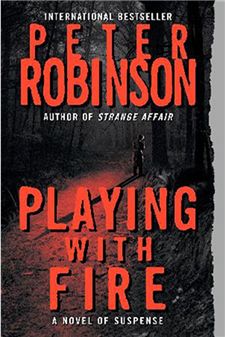
Cover for Playing with FireThis DCI Alan Banks mystery begins with a fire on a couple of canal barges. A squatter named Tina Aspern has been killed on one and an artist named Tom McMahon on the other. Accelerant is present, and it appears that McMahon’s boat was the origin of the fire.

On the scene appears Tina’s boyfriend Mark Siddons, but his alibi that he was with another woman after a fight with Tina checks out. Banks and DI Annie Cabbot and their team are able to discover very little about McMahon except that he has failed as an artist and buys cheap old books from a store owned by Leslie Whitaker.

Soon another fire kills Roland Gardiner in his caravan (mobile home). The police are trying to link the two men, but Gardiner was unemployed and almost a recluse. Tests reveal that both McMahon and Gardiner were drugged before the fires were set.

Annie’s boyfriend Phil Keane, an art expert, suggests that one use for old paper is to employ it in forged artworks. When the police find a fire-proof safe in Gardiner’s caravan containing money and some drawings that seem to be Turners, Banks and Cabbot think they may at least have uncovered a motive. But who could the murderer be? Is it Leslie Whitaker?

Finally, tracing a rented Jeep leads them to a shadowy figure, a man who does not seem to exist. He turns out to be very dangerous indeed.

Playing with Fire is a fast-paced and complicated mystery. Some sixth sense made me guess the killer almost as soon as he appeared, but I don’t think the solution is obvious. If you enjoy an intelligent police procedural, I think you’ll like Robinson’s series. The only other book I have read by him, which was not really part of the series (a more atmospheric novel in which Banks appears but is not part of the story), I enjoyed even more.

Day 479: Jane Austen: A Life

Cover for Jane Austen: A LifeIn Jane Austen: A Life, noted biographer Claire Tomalin has handily accomplished a difficult task. Because most of Jane Austen’s letters and papers were destroyed by well-meaning relatives, very little first-hand information about her life is available. As a 19th century unmarried woman, her experience was circumscribed, so the events of her life are ordinary ones. Descriptions of a life like this could be thin and lifeless, but Tomalin manages to provide us with a biography that is full of interest and lively and creates a convincing idea of Austen’s character.

From records, letters, the remaining few of Austen’s papers, and accounts of her by relatives, friends, and neighbors, Tomalin reconstructs the story of not only Austen’s life but of those who were important to her. Tomalin acquaints us with the members of Austen’s family and the bustling environment in the Steventon Rectory, where Jane’s father ran a small boys’ school. She describes friendships and visits to neighboring families. Even though Austen never used her own neighborhood in her books, it is easy from them to imagine the daily social calls and the housewifely tasks with which she and her female relatives were engaged.

It is not too hard to imagine the relationship between Jane and her sister Cassandra as close to that of Lizzie and her sister Jane in Pride and Prejudice, although Tomalin never mentions that either of these characters were based on real people. Still, the two sisters were extremely close.

Unlike Lizzie and Jane, though, both Jane and Cassandra were disappointed in love, Cassandra because her fiancé died, and Jane because her suitor needed to marry a woman with money. Tomalin makes the points that a married Jane Austen would probably have been too busy or too distracted to produce a body of literature and that later in life she seemed to understand some of the benefits of remaining single. As to the first point, it is certainly true that being removed without warning and against her will from Steventon because of the retirement of her father, and her family’s failure to settle anywhere for ten years afterward, completely cut off Austen’s literary production for that time period.

It seems that Austen’s status as a spinster with no money of her own gave her no control at all in her life about such questions as where she would live and even in one case when she could return home from a family visit. That is, she had no control until her late thirties, when she began to publish her novels. Even then, she ultimately earned very little money from them but enough to give her a small amount of autonomy.

Although most of the events of Austen’s life were relatively small, Tomalin’s book provides an absorbing account. I did not always agree with her interpretations of Austen’s novels, but I feel that this book allows me to know Austen and her family and friends a little better.

Day 474: The Travelling Hornplayer

Cover for The Travelling HornplayerThe Travelling Hornplayer revisits some of the characters I loved in Brother of the More Famous Jack. But first it starts with Ellen. Ellen has always had a close relationship with her sister Lydia, and the two girls’ adolescent silliness and charm is vividly depicted early in the novel in lively dialogue. But Lydia dies at age 17 while Ellen is away at university. She runs unexpectedly out into the street from the home of the man Ellen and Lydia call The Novelist and is hit by a car. Lydia has been consulting him about (well, actually cribbing from him) her essay for her A levels on Wilhelm Müller’s Seventy-Seven Poems from the Posthumous Papers of a Travelling Hornplayer. It takes awhile before we find out the cause of her death.

The Novelist is Jonathan Goldman, whose family so charmed Katherine, the heroine of Brother of the More Famous Jack, now his wife. Jonathan and Katherine have only one child, Stella, whose childhood illnesses and learning disabilities have led Katherine to do everything for her. Finally almost on her own at university in Edinburgh, where she becomes Ellen’s roommate (almost on her own because her mother arrives periodically to do the cleaning), Stella makes a series of spectacularly poor decisions that result in tragedy for herself and others and a separation from her family.

This sounds like a sad tale, and in some ways it is, but it is told lovingly and movingly, with intelligent characters and witty dialogue. Trapido depicts characters of surprising depth and complexity. She is a really beautiful writer, and I love her work.

My cover of The Travelling HornplayerA word about this cover. I was unable to find a good-sized picture of my book’s cover without the Amazon Look Inside logo on it. That cover, which shows two young girls comparing their identical outfits, conveys the feel of the novel much more successfully than the one above, which looks like children’s fiction or chick lit to me. Here it is in a smaller size.

Day 462: The Return of Captain John Emmett

Cover for The Return of Captain John EmmettThe Return of Captain John Emmett is the first of Elizabeth Speller’s Laurence Bertram mysteries set just after World War I. I previously reviewed the second in the series, The Strange Fate of Kitty Easton.

Laurence Bertram has felt himself at a loss since the war ended. He is haunted by his memories of the war and also by guilt at his lack of grief over the deaths of his wife Louise and baby son, whom he never saw. Ostensibly writing a book about church architecture, he is finding it difficult to work. So, it is with a bit of relief that he responds to a letter from Mary Emmett, the sister of an old school friend John Emmett, in which she asks him to come visit her.

Laurence has fond memories of some school leave visits with the Emmetts after his parents died but feels Mary has misunderstood the depth of his friendship with John, whom he has not seen in years. Of course, he has heard of John’s death, an apparent suicide. Mary explains that John had been staying in a rest home because of mental disturbance following the war. Since he seemed to be improving, she and her mother cannot understand why he committed suicide. She asks John to find out what he can about John’s motives.

Laurence feels uncomfortable but agrees to look into it because he has always been attracted to Mary. With the help of his friend Charles Carfax, who gets his detective skills from reading Agatha Christie books, Laurence investigates the rest home and anything he can find out about John’s state of mind before his death. Included in John’s curious scraps of paper and photos is a list of the beneficiaries of his will, some of whom cannot be identified or located, and some photos from the war.

Laurence comes to believe that John’s death has something to do with his war experience, possibly with an execution over which he was forced to preside. And it seems John may not have committed suicide after all.

Speller takes her time with these mysteries. The settings are beautifully described and the period effectively evoked. A true sense of depth of character emerges. Even though I was about 100 pages ahead of Laurence, not in identifying the perpetrator but in realizing the motive, I enjoyed every bit of this novel.

In the last few months, I have read several historical mysteries where the author did little with the time or place, simply using the historical events to frame the plot. Thankfully, Speller has taken more care with this interesting period of history.

Day 459: The Orphan Choir

Cover for The Orphan ChoirThe Orphan Choir is a departure from Sophie Hannah’s Simon Waterhouse and Charlie Zailer mystery/thriller series. It still is darkly atmospheric and features her trademark neurotic characters but goes off in another direction.

Louise Beeston’s neighbor on her Cambridge street regularly wakes her up playing loud rock music late at night. When she goes over to complain in the beginning of the novel, he ridicules her in front of his friends and refuses to turn the music down. Louise’s husband Stuart can sleep through anything and doesn’t want her to call the police, but she does anyway. They refer her to the Council.

The music stops as the representative from the Council, Patricia Jervis, arrives, but Patricia seems very sympathetic and takes the complaint. Louise also complains to Jervis that her neighbor mocked her for sending her son Joseph away to school at the age of seven. Louise is actually very unhappy about the decision, but Joseph was given a place at a school that requires him to board if he is in the choir, and Stuart insists that she would be ruining Joseph’s chances if they send him to a different school.

Louise continues to hear music, but the neighbor seems to have begun a more insidious program of sometimes quietly playing choir music of children singing. After Louise turns on some loud music of her own at 6 a.m., when she knows the neighbor is sleeping, the rock music stops but the choir music continues.

With the house being renovated, Louise talks Stuart into buying a second home in a gated community in the country. Peace is the rule there, and she is happy and calm for awhile until an argument with Stuart about removing Joseph from the school results in Stuart summoning Dr. Freeman, the director of the choir, whom Louise despises. Suddenly, she begins hearing the choir music again, but without her neighbor nearby, she fears she is going crazy.

http://www.netgalley.comAs I am familiar with Hannah’s other novels, I suspected someone was gaslighting Louise, possibly her husband, who seems genial but overrides and undercuts her at many points during the novel, including summoning Dr. Freeman without discussing it with her first. Another suspect is Dr. Freeman, who seems creepy and overly concerned with whether Joseph is in his choir or not. However, I won’t say whether I was right. I think I prefer Hannah’s mysteries, but if you like novels that are unusual and slightly macabre, you may enjoy this one.

Day 457: Sense & Sensibility

Cover for Sense & SensibilityIn general I’m not a fan of the plethora of Jane Austen rewrites, although I will occasionally read one by an author whose work I trust. Such is the case with Joanna Trollope, who writes realistic contemporary fiction about family situations. So, I thought I’d give her reworking of Sense and Sensibility a try.

The story is a familiar one. The Dashwood women are ousted from their family home when the girls’ half brother John inherits. His selfish wife Fanny quickly talks him out of the generosity he promised his father he would show to his father’s second family.

Elinor Dashwood is in love with Fanny’s brother Edward Ferrars, but Edward’s future is uncertain. He has not spoken, so Elinor keeps her feelings to herself. Her sister Marianne, however, throws herself wholeheartedly and recklessly into an affair with handsome John Willoughby, who is visiting his aunt, a neighbor of their new home.

The reworkings I’ve read generally have some twist or contemporary slant to put on the story. In Bridget Jones’ Diary, for example, it was the surprise of finding you are reading an update of Pride and Prejudice and the charming narrative style of Bridget. Unfortunately, aside from updating the story to the current time, I don’t feel that this novel has much to add to or say differently than the original.

More importantly, I’m not sure that this novel translates very well to the 21st century, or at least not this version of it. The amount of money the Dashwoods are left would sound like a lot to most people, unlike the paltry amount left to them in the original novel, and the girls can always get a job in the current time period. Marianne’s behavior, while shocking to a 19th century audience, where ladies did not reveal their feelings for young men until they received a proposal, is mostly just excessive in the current day, except for the lovers’ behavior when visiting Willoughby’s aunt’s house. And while Edward in the original novel was behaving scrupulously in a time when a gentleman did not end an engagement, in the current times Ed just comes off as weak and indecisive. Frankly, I found myself sometimes wishing that Trollope would change the end of the novel to have Elinor end up with Bill.

I enjoyed the novel to an extent, but this modern version doesn’t involve me as the original does. The scene where Ed finally proposes to Elinor left me dry-eyed. Sense and Sensibility is one of my favorite Austen novels, and I think I’ll stick to Austen.

Day 448: The Tiger in the Smoke

Cover for The Tiger in the SmokeI have only read one other Albert Campion novel, and that was so long ago that all I can remember is not having much of a sense of Campion. I can say the same thing after reading this novel, although it has other qualities. Perhaps one can only get an understanding of Campion through reading the series.

In this post-World War II novel, we get a feel for the effect of the war on London. The wealthier households no longer have servants, shoddy neighborhoods have sprung up near where service men used to gather, the ruins of bombed buildings are everywhere, as are groups of unemployed veterans. To this setting Allingham adds the further atmosphere of a heavy fog that persists over the course of the novel. This fog is vividly described and is almost a character in the novel.

Meg Elginbrodde, a young war widow, has recently announced her betrothal to Geoffrey Levett, a wealthy businessman. Beginning directly after the announcement, however, Meg receives poor-quality street photographs of someone who looks like her husband, Martin Elginbrodde, supposedly blown to bits during a battle. No message has arrived explaining these photos, and when we meet the engaged couple, Geoffrey is dropping Meg off for a rendezvous that Campion has arranged as a trap for the culprit.

Meg is to walk into the train station to meet the man, where Campion and the police will capture him. However, when Meg sees the man at a distance, his resemblance to Martin is so strong that she shouts his name and runs toward him, startling him away. Campion eventually captures him, and Meg is embarrassed and puzzled to find that close up, the man doesn’t look like Martin at all. He turns out to be a low-level criminal named Duds Morrison.

Campion and Detective Charlie Luke are fairly confident that someone hired Duds for the impersonation, but what was it meant to accomplish? Duds isn’t talking; in fact, he seems terrified, and rightly so. Within an hour of his release, he is found stabbed to death in an alley.

Campion notices one thing that helped Meg mistake Duds for her husband. He is wearing Martin’s distinctive coat. When Campion repairs to the unusual household of old Canon Avril, Meg’s father and Campion’s uncle, to investigate, he finds the coat was recently in the house. How could it have fallen into the imposter’s hands?

Soon the police find a connection between this case and the escape from jail of a very dangerous man, who calls himself John Havoc. Havoc murdered an eminent physician to escape and subsequently killed three people trying to break into the law office that handled Martin Elginbrodde’s estate. He did not escape, though, early enough to have killed Duds.

In the meantime, Geoffrey Levett is missing.

The plot of this novel, like many of those from the Golden Age of Detective Fiction, is absurd. However, the novel is notable for its strong and vivid characterizations—of one of fiction’s first sociopaths as well as of the many unusual and delightful characters living in Canon Avril’s house. Campion himself remains a quiet character instead of being a presence such as Lord Peter Wimsey or any of Christie’s detectives.

Day 447: To Marry an English Lord: Tales of Wealth and Marriage, Sex and Snobbery

Cover for To Marry an English LordTo Marry an English Lord is entertaining enough, if certainly holding few surprises for those of us who read about this era. It is about the influx of wealthy American girls as brides into England beginning after the American Civil War and ending shortly after the end of the Edwardian era. First, girls were traveling with their mothers to Europe in search of a titled husband, followed by a flood of not-so-eligible young men over to the U.S. after the discovery of gold in them-thar hills (not the metallic kind, although some of the girls’ fathers’ fortunes were made that way).

The main portion of the text focuses on the fates of several girls—Consuelo Yznaga, who became the unhappily married Duchess of Manchester is one—who were among the first to travel to Europe in search of a suitable match. The book refers to them as the Buccaneers, a reference to Edith Wharton’s novel by the same name and on the same subject. The book covers some of the later marriages as well and explains how the trend changed over time. It provides snippets of details about life in a stately home or at court and about the stuffy societal structures in old New York.

The material is given an interesting presentation, with plenty of sidebars, inset photos, double-page spreads set in the flow of a chapter—more like a magazine or a textbook. This approach occasionally made me feel as if it was designed for someone with attention deficit disorder. It looks attractive but is hard to read coherently, and sometimes there is an unfortunate effect. For example, I had just finished reading about the death of Edward VII and its impact on society when I turned the page to read about his refusal to recognize the Marlboroughs after their divorce.

Although the book seems to take the position that girls went willingly into this search for and bagging of their titled husbands because of their own ambitions, Edith Wharton, in most of her novels that deal with this subject (with the exception of The Custom of the Country), rather regards them more as lambs to the slaughter.

I don’t think anyone will get a deep understanding of the period from this book, which is rife with generalizations, but if you’re looking for an entertaining presentation of a plethora of little details, it is a fun book to read. One big complaint for me is that many of the inset pictures are reduced to such a small size, in the interest of the layout, that it is impossible for me to tell what I’m looking at, particularly for interior shots of the various houses.

Day 444: Murder at Mansfield Park

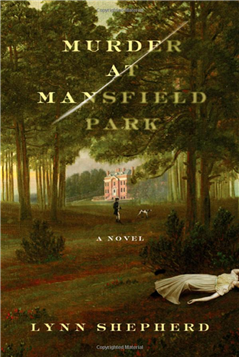
Cover for Murder at Mansfield ParkIt’s hard to explain my fascination with the books of Lynn Shepherd, even to myself, when she repeatedly skewers the books and some of the characters I love with her dark reinterpretations.

The cover of Murder at Mansfield Park quotes the literary critic Lionel Trilling: “Nobody, I believe, has ever found it possible to like the heroine of Mansfield Park.” Apparently, Shepherd shares his views.

That heroine, of course, is Fanny Price, and I have to admit I do like her in the original novel, even though she is not my favorite Austen heroine. Shepherd had to jump through some hoops in her recasting of Fanny, however, to get her to be really unlikable.

In Shepherd’s novel, instead of Fanny Price being the despised, impoverished orphan living with wealthier relatives, Shepherd transforms her into a spoiled heiress, whom the Bertrams and the dreadful Mrs. Norris treat better than their own children. Fanny’s marriage with her cousin Edmund Norris has long been planned, at least by Mrs. Norris.

Mary Crawford in the original novel was the worldly socialite whose lax views eventually shocked Edmund into dropping her, but in Murder at Mansfield Park, she is the heroine. Her brother has been hired to redesign the grounds of Mansfield Park. In this novel, she has switched positions with Fanny Price in that she and her brother have little money, and Mrs. Norris treats them with disdain.

Fanny shows little desire to wed the introverted Edmund and finds entertainment in filching suitors from her cousin Maria Bertram and being nasty to everyone. I would not usually give away an event that occurs well into the novel, but the blurb makes no secret that Fanny is eventually found murdered after going missing for some weeks. Suspects abound. Charles Maddox, Shepherd’s sleuth, arrives to solve the crime.

I don’t think I enjoyed this reimagining of Austen’s novel as much as I have some of Shepherd’s others, even though she is amazingly adept at recreating Austen’s writing style. I think my reaction is because she probably could have achieved a similar effect, more subtly, without changing so many aspects of the original story.

I don’t mean to imply, however, that I didn’t enjoy the novel. Shepherd has made a very interesting career for herself by putting a dark spin on classic novels, and it is always entertaining to read her. She is a wonderful writer, and she gets the period details and style of dialogue correct. I think my favorite of hers, however, is still her chilling rewrite of Bleak House.

Day 433: Black Sheep

Cover for Black SheepI hadn’t read this Georgette Heyer novel in some years. Although it is not one of my absolute favorites, reading it is still a relaxing, amusing way to spend a few hours.

When Abigail Wendover is away from her home of Bath visiting her family, she hears disturbing rumors that her niece Fanny, an heiress, is being courted by a fortune hunter named Stacy Calverleigh. Returning home, she finds that her 17-year-old headstrong niece believes they are madly in love, and she is not ready to listen to arguments that Calverleigh, a much older man, has not behaved as he should. He has also worked his way into the good graces of Abigail’s foolish sister Selina.

Abigail encounters a man named Calverleigh in a hotel parlor, and she is shocked to find him neither of good looks nor address and much older than she is herself. He is further prone to uttering the most shocking remarks that unfortunately make her laugh. Soon Abigail finds that this Calverleigh is not Stacy but his uncle Miles, the black sheep of the family, who was sent away to India after a youthful scandal and has now returned. However, he is unwilling to interest himself in the situation between her niece and his nephew. He is only interested in Abigail herself.

Although Abigail knows she shouldn’t encourage his attentions and finds some of his views about family and duty shocking, he never fails to make her laugh. Soon she discovers that he is even more unsuitable a companion than she thought, for his youthful indiscretion was to run off with Fanny’s own mother, who later married Abigail’s older brother!

Abigail is one of Heyer’s more mature heroines, an intelligent, sensible woman with a sense of humor some of her relatives consider unfortunate. Of course, the journey out of the tangle her niece is in will be enjoyable and entertaining. Although this novel is not as funny as some of my favorites, it is always a pleasure to spend time with Heyer’s creations.