Day 397: Sylvester, or the Wicked Uncle

Cover for SylvesterOn occasion, I reread a few of Georgette Heyer’s Regency romances, which have been some of my favorite reading for many years. Just recently, I reread Sylvester, which in some editions is titled Sylvester, or the Wicked Uncle.

The extremely eligible bachelor Sylvester, Duke of Salford, has decided to take a wife. His only difficulty is in deciding which of five eligible girls to marry. When his beloved mama mentions that she and her best friend made a plan for their children to marry many years before, he decides to go inspect the girl, his godmother’s granddaughter, to see if he might like her. Although he is warm and thoughtful to those he cares for, since his twin brother’s death, he has been aloof to others and comes off as haughty.

Sylvester’s visit is disguised as a hunting party, but Phoebe Marlow is informed by her detestable stepmother that the duke is coming to make her an offer. Unfortunately, Phoebe has already met Sylvester and took such a dislike to him that she used him as the villain in a novel she wrote. That novel is going to be published, despite all expectation. Normally, she would not expect him to recognize himself in a silly gothic romance that pokes fun at various society figures, but for the mention of Sylvester’s very distinctive eyebrows.

Fearful of her stepmother’s pressure and not understanding that Sylvester has no intention of proposing, Phoebe talks her childhood friend Tom into escorting her to her grandmother’s house. However, an accident and a snowstorm strand her and Tom with Sylvester in a small country inn.

After Phoebe gets to know and like Sylvester, she is horrified to find out that he has a nephew, since in her silly romance his character is a wicked uncle who wants to steal his nephew’s fortune. Another horror lurks, because Phoebe’s book proves to be a smashing success, much read by society members, who are all trying to identify their friends. Since Phoebe has never brought herself to admit to Sylvester that she wrote a book, she soon fears that people will find out she is the author.

Heyer creates delightful, engaging characters and puts them into silly and unbelievable situations, which is part of the pleasure of reading her novels. They are very well written, with entertaining and sparkling dialogue and a complete understanding of the customs, dress, and speech of the period. If you decide to read Sylvester, get ready for some fun. Many of Heyer’s novels have been re-released in the past few years, so they should not be hard to find.

Day 393: The Cuckoo’s Calling

Cover for The Cuckoo's CallingBefore I go on to say some nice things about this mystery, I have to say that the author pulls one big dirty trick to put the readers off the scent. I can’t say what it is because it is too big of a spoiler, but this one thing lessened my enjoyment of what proved to be a very readable mystery. Of course, you probably know by now that this novel was written by J. K. Rowling. I was slightly more interested in figuring out whether—had I not known that—I could have guessed the novel was by a woman (probably) than by Rowling (probably not).

Robin Ellacot is excited to discover that her new temp job is with a detective agency, even when the office proves to be less than impressive and she is almost knocked down the stairs by the detective when she arrives. She is smart, pretty, newly engaged to be married, and always wanted to be a detective.

Cormoran Strike, her new boss, isn’t happy to see her. He has just been dumped by his fiancée, and anyway he can’t afford a secretary. As it is, he has nowhere to live but his inner office.

His luck looks like it may change when he gets a new client, a lawyer named John Bristow from a wealthy family. Bristow’s adopted sister was Lula Landry, a famous supermodel who fell to her death from her apartment balcony several months before. The police have decided her death was a suicide, but John is convinced she was pushed.

Strike, although he really needs the money, is inclined to turn down the job because he thinks the death is a suicide. He is a man with very high principles, a former Royal Military Police officer whose army career ended after he lost a foot in Afghanistan. Something in the “evidence” Bristow has collected makes him decide to take another look, however.

Lula was a manic-depressive, but Bristow claims she was on her meds and under control. Her contacts on the day she died include her on-again, off-again drug-using rock star boyfriend Evan Duffield; her supermodel friend Ciara Porter, who has alibied Evan for the night of the death; the famous designer Guy Somé; and a strange friend from rehab who may be named Raquel.

Neither Lula’s adoptive nor her birth family are stellar human beings. Her mother Lady Yvette is now dying but has been needy and clinging and disapproves of Lula’s search for her real father. Her uncle Tony is nasty. Her birth mother, Marlene Higson, only cares about the money she can make from their association.

The novel is fast moving and interesting, with a complicated plot. Robin shows her value as a bright employee with initiative and is an engaging character. Strike is complex, a tough, wounded guy who is very systematic in keeping records and carrying on his investigation.

I liked this novel and will be happy to read another one. I’m just unhappy about the trick Galbraith played, one that makes little logical sense once you know the identity of the killer, and the Psycho-esque wrap-up used to explain it at the end of the novel.

Day 392: The Invention of Murder: How the Victorians Revelled in Death and Detection and Created Modern Crime

Cover for The Invention of MurderJudith Flanders, a British journalist and history writer specializing in Victorian times, has written an entertaining and exhaustive book showing how the Victorian fascination with murder grew and forced improvements in policing. In addition, it resulted in the evolution of the detective novel. Flanders begins this discussion with the interest in a few major crimes from before the Victorian era, explaining how public response changed during the Victorian age.

One theme of the book is class. Flanders effectively shows that the public interest in murder was for crimes that involved the middle or upper classes, with a tendency of the newspapers and popular songs and legends to elevate in class the murderers who were from the lower classes. Newspapers flagrantly made up “facts” about accused murderers that sensationalized their backgrounds or their crimes, including changing their social class. Even as late as the Jack the Ripper murders, interest was probably only taken by the public (since the victims were lower-class prostitutes) because of the number and viciousness of the crimes.

Flanders tells us about a series of panics that took place as a result of a growing audience for this kind of subject matter. Once a tax was removed from newspapers in 1855 that had kept the price high enough to restrict their circulation to the middle and upper classes (although the poor shared newspapers or picked them up in coffee houses), circulation greatly expanded and the papers found a new audience for sensationalism.

Even though there had only ever been a very few cases of murder by poisoning, in the early and mid-nineteenth century a poisoning panic resulted from a highly publicized murder case. In the ensuing rash of accusations, people were brought to “justice” when there was no actual proof that anyone had been poisoned let alone any proof that the accused was guilty of any wrongdoing. Unqualified persons were allowed to testify on the “scientific” evidence, including one Alfred Swaine Taylor, who for years testified to the presence of arsenic using a test that actually introduced arsenic into the sample through copper gauze. Even worse, the lower class “poisoners,” who usually had little or no legal representation, were invariably hanged, while the middle and upper class accused often got off completely or with lighter punishment, even if there was more real evidence against them.

Eventually, with improvements in the science of criminology and the rise of public indignation about some obvious miscarriages of justice, the police force was compelled to become more professional and the law to pass more stringent rules of evidence.

Frankly, our lurid interest in crime hasn’t changed, as shown by the prevalence of true crime shows on TV. A large part of the fascination and entertainment value of this history has to do with the details of the crimes as well as the plots of the many plays, novels, and penny dreadfuls that derived from them. Flanders has written an entertaining and lively history for anyone interested in true crime, the evolution of the mystery novel, or the history of advancements in criminology.

Day 391: Brother of the More Famous Jack

Cover for Brother of the More Famous JackBest Book of the Week!

It seems as if many American readers are not familiar with the British writer Barbara Trapido. She is one of my favorites and yet I sometimes find her books hard to come by. I think she is absolutely delightful. Brother of the More Famous Jack is her first book, but I have not run across it until now, when I explicitly searched for it.

Katherine Browne is a naive but stylish eighteen in the early 1970’s when she meets the family of her philosophy teacher, Jacob Goldman. She immediately falls in love with their untidy, chaotic household and their witty brilliance, but particularly with their oldest son, Roger. Jane is the dowdy, schoolmarmish, upper-crust wife and mother, who plays gorgeous duets with Roger and tends cabbages. Jacob is witty, sometimes vulgar, and subversive. He flagrantly fondles his wife over the kitchen sink. The beautiful Roger is studying to be a mathematician. Jonathan has large feet, loves to fish, and is somewhat gauche. Katherine finds him a bit alarming. And there are the littler ones, bright and noisy. Everyone speaks his or her mind without fear. To Katherine, brought up quietly by a middle-class, widowed mother, this is a heady environment.

After a summer in Kenya, Roger returns to begin at Oxford and immediately starts seeing Katherine. Their affair does not end well, however, for Roger has embraced the snobbery that the rest of his family disdains. When he drops her, he catalogues all her “faults,” including her lack of interest in math and science and her middle-class background. Katherine’s self-esteem plummets and she flees to take a position teaching English in Rome.

She does not return to England until, after ten years, a tragedy brings her home to her mother. Eventually she begins a renewed acquaintance with the Goldmans.

Written in a humorous, breezy style, the novel is still touching and affecting. The dialogue is the best part of it, vivid, witty, and literate. (The title of the novel is Jacob’s appellation for W. B. Yeats.) Katherine is an engaging heroine as she learns to find her own way through life. Full of high spirits and eminently readable, this novel is a gem.

Day 385: Sweet Tooth

Cover for Sweet ToothBest Book of the Week!

I’m always suspicious of book blurbs that compare one writer’s books to another’s. On the cover of Sweet Tooth, a blurb says “Jane Austen meets John Le Carré meets John Barth.” To my shame, I can say nothing about John Barth (except that I attempted once without success to read The Sot-Weed Factor), but Sweet Tooth has nothing to do with Austen except that she is mentioned in it and has only a few similarities with Le Carré but none of the extreme tension. Generally speaking, I don’t really believe that the work of one writer is like that of another, and certainly no one is like Ian McEwan.

Serena Frome is a smart, beautiful young graduate from Cambridge in the early 1970’s when she takes a job as a very minor employee of MI5. She has been groomed for this position by her much older mentor and lover, Tony Canning, a don. She is a naive young woman from a relatively privileged background who loves literature in a fairly superficial way (speed reading through stacks of novels) but has been pushed into mathematics because her mother wants her to accomplish something “important.” Unfortunately, she finds her facility at mathematics to be superficial too, unequal to the level of her classmates, and only earns a third. Her only distinction at school is some breezy articles written for a student magazine about what she is reading, and they lose their audience as soon as she writes more seriously about political issues.

Really, her mother seems much more eager for her to accomplish something than she is. She is somewhat shallow and eager to please, more interested in her relationships with men than in a career. She also has a tendency to pretend she knows about things that she doesn’t.

After carrying on a fairly innocent flirtation with a coworker, Max Greatorix, and having him break it off, Serena gets her big break at work. MI5 is setting up an operation called Sweet Tooth, the intention of which is to quietly fund young writers who have political beliefs sympathetic with those of the government in a subtle propaganda war against communism. Serena is told that the money will simply give the chosen writers more freedom to work, and the operation will not interfere in any way with their work.

Serena, with her voluminous reading habits but flimsy background of the series of articles she wrote in college, is asked to pronounce on the work of Tom Haley. She loves his stories and is soon given the job of recruiting him, the only fiction writer in the operation. The project seems to go swimmingly, although Tom is soon writing about themes the government would not approve. But Serena tells herself that they were not to influence Tom’s work, and anyway she is having an affair with him.

Their relationship is born in deceit, though, since Tom has no idea that his grant is coming from MI5 or that Serena is his handler. As their affair grows more serious, Serena struggles with when to tell him. Soon something else is going on that Serena doesn’t understand. As with any good spy story, you don’t always know who is lying to whom.

Since this is McEwan, we know the story will not be straightforward, and again he presents us with a great example of an unreliable narrator and a foray into metafiction. We also get a light evocation of England during a difficult period of miners’ strikes, economic and political instability, IRA bombings, and the dawning hippy and drug cultures. Although by no means a Cold War spy thriller, the novel provides plenty of plot twists.

Day 382: Touch Not the Cat

Cover for Touch Not the CatI was surprised by how many people were interested in my review of Mary Stewart’s This Rough Magic, so I decided to post a review of another Stewart novel, one of my favorites of her later romantic suspense novels, about family secrets, published in 1976. Touch Not the Cat is the only Stewart book, aside from her Merlin novels, that includes a touch of the supernatural.

Bryony Ashley is awakened on Madeira, where she works, by a message from her father. She has always had a telepathic link with one of her cousins—she doesn’t know which one—but he unexpectedly relays a garbled message from her father. So, she is not altogether surprised when she learns that her father has been severely injured after a hit and run accident. Before she can go to him, he dies, leaving behind a warning of danger. She returns to England to settle his estate.

Bryony’s family owns Ashley Court, an ancient stately home that the family has not been able to afford for some time. It is entailed to her cousin Howard and after him to his sons, her identical twin cousins Emory and James.  Bryony has always assumed that her “lover,” as she calls her telepathic friend, is one of these two cousins, since telepathy is said to run in her family and she was never very close to her third cousin, Francis.

The only part of the estate that passes to Bryony is the small cottage where she lives on a patch of land surrounded by a system of canals. The rest of Ashley Court is currently being rented by a rich American family, the Underhills.

Almost as soon as Bryony gets home, odd things begin happening. Someone steals an old book of records from the church. She goes on the tour of Ashley Court and notices that small, valuable objects of art are missing, including some of her own possessions. Then Emory and James arrive on the scene and immediately begin pressuring her to wind up the estate affairs and sell her own property to them.

As she pokes around in the library, Bryony figures out that her father was worried about something he discovered about the ancient property and is reluctant to sell it until she determines just what his discovery was. Calmly helping around the estate is her childhood friend, Rob Granger. It was to Mrs. Granger and her son that Bryony always turned in times of trouble as a child, so she confides some of her concerns to him.

Interspersed with Bryony’s story are a few paragraphs in each chapter from the point of view of an ancestor, the black sheep of the family, Nick Ashley. It was Nick’s father who selected the puzzling family motto “Touch not the cat, but [without] a glove” (an actual motto of the Clan MacPherson). Eventually, the two stories converge to reveal the secrets of the house and the reason for Bryony’s father’s death.

From a more innocent time, Mary Stewart’s novels are among those I turn to periodically for a bit of light reading, and I find them unfailingly entertaining. As usual with Stewart, her heroine is appealing and she slowly builds a feeling of suspense. Her plotting in this novel is complicated and the mystery engrossing. Although we are accustomed these days to narratives that move back and forth between two periods of time, this was a more unusual technique for the 1970’s.

Day 381: Death on Lindisfarne

Cover for Death on LindisfarneI got a free copy of this novel in a giveaway from Goodreads. I was attracted to it because of its setting (I can’t resist novels set on islands), and frankly its cover. Unfortunately, however, I found the mystery to be mediocre at best.

Aidan Davison and his eight-year-old daughter Melangell are on a pilgrimage of sorts. Aidan’s wife died about six months ago, and Aidan is taking Melangell to one of the places she loved best, the island of Lindisfarne off the Northumbrian coast. They are scheduled to attend a course on the history of Lindisfarne given by Reverend Lucy Pargeter.

Lucy is traveling with Peter, a student, and Rachel, a troubled teen who has recently given up drugs. Other attendees are two middle-aged Oxbridge women, a fussy older couple, an evangelist who shows signs of wanting to take over the tour, and his worshipful assistant.

Lindisfarne is a tidal island, which means it can only be accessed by the bridge or across the sands when the tide is out. Aidan and his daughter decide to walk, and on the trek across the sands see on the shore a woman struggling with another person. When they approach the spot, Melangell finds an earring that turns out to belong to Rachel, but they aren’t able to identify her opponent. In any case, Rachel’s subsequent behavior is erratic. Lucy is very concerned about her.

Soon Rachel is found dead, apparently from drowning. The police are inclined to treat the death as a suicide, although the water rescue folks doubt that her body could have drifted to where she was found if she jumped into the water from any height. Soon, though, the autopsy shows she was strangled.

As far as the mystery is concerned, there is a long central section of the book during which no detection is going on, just a lot of speculation. Nothing turns up to point to any of the suspects. In fact, the most suspicious character is involved in an event that could exonerate him. Although it can be frustrating to read a mystery where evidence or suspicion arbitrarily seems to point to everyone, it is even more frustrating to have no evidence at all. When the definitive clue finally arrives, the main characters stupidly miss it, even though it makes the motive and the culprit immediately obvious.

More troublesome, though, is that the entire murder depends on Rachel not telling Lucy something that I couldn’t imagine not being said almost right away. Yes, one sentence at the logical time would have either prevented the murder or made the solution obvious.

But these are problems that only become obvious once the case is solved. Characterization and behavior are problems from the start. The novel is only adequately written, including some poor writing. What bothered me more were all the characters’ exaggerated reactions. Lucy is almost frantic about Rachel from the first scene, when she has just wandered off somewhere–not concerned, frantic. All the characters are constantly starting, stiffening, or being startled. Really, how often does a normal person start? Characters routinely overreact for everything. All this is an artificial attempt to interject drama.

The best I can say for the novel is it made me want to visit Lindisfarne. Sampson obviously had things she wanted to say about its history, however, and the only way she could think of to get them in was through short lectures as part of the course. Besides providing a little color, however, the lectures aren’t really relevant to the story, and repeated verbatim, are far too short to constitute any kind of believable course. I don’t think I’ll be reading more of this series.

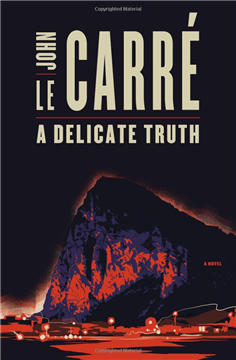
Day 379: A Delicate Truth

Cover for A Delicate TruthBest Book of the Week!

A mid-level diplomat called Paul is sent on a mission to Gibralter with an army detachment and some mercenaries to capture a terrorist about to do an arms deal. Paul’s role is to act as the “red telephone,” keeping the minister in charge, Quinn, appraised. The agreement is that no action will be taken on British soil without British approval.

A person is spotted in the houses that the teams are monitoring, and there is an argument about whether to go ahead. The British, lead by a Welshman named Jeb and backed by Paul, argue that there is not enough evidence to proceed, but the mercenaries start to move anyway, and Quinn then gives permission to go. During the actual mission, though, all the monitors in the command center where Paul is waiting go dead, and Paul has to take the word of Elliott, the head mercenary, that everything went as planned.

Returning to a few days before the mission, Tony Bell, Quinn’s private secretary, is looking for help. For months, Quinn has been going AWOL, leaving him out of meetings, and keeping documents from him.

Toby has unofficially been informed that Quinn was censured a few years ago for a mission that went wrong involving a mercenary company lead by Jay Crispin. Quinn was forgiven but told not to consort with Crispin. Now Toby finds that Quinn has been meeting with Crispin and even sneaking him into the Foreign Office on the weekend. However, Toby is not supposed to know about the prior incident, so he has nowhere to turn. Taking a drastic decision, he secretly tapes a meeting about the mission to Gibralter. But his mentor, who originally was the one to break confidentiality, fails him, and soon he is sent to another posting.

A few years later, Kit Probyn, lately known as Paul, has retired to his wife’s property in Cornwall when he runs into Jeb, no longer a soldier but a leather worker who makes the rounds of fairs. Jeb tells him that the Gibralter mission, which Kit thought was a success, actually went horribly wrong and that Jeb himself was used as the fall guy. When Kit decides to collect evidence and blow the whistle, he turns to Toby with what he has learned. Although Toby is more aware of the dangers of their task than Kit is, neither has any idea of what they are getting into.

This novel is another of Le Carré’s taut and cynical thrillers, now moving from espionage to the theme of mixing private enterprise with politics and the fight against terrorism. Although not quite up there with The Constant Gardener, which I think is one of the best and most touching of Le Carré’s post-Cold War thrillers, it is deeply involving and tense. With Le Carré, you are never sure of whether good or evil will win, which makes his novels that much more exciting. He is really the master of this genre.

Day 375: King Lear

Cover for King LearKing Lear is about fathers and their children–in particular, how two fathers misjudge their children, mistaking flattery and trickery for love, and push away those who sincerely love them. It is also about the responsibilities of power.

We all know the plot. King Lear has three daughters, Regan, Goneril, and Cordelia. As he is an old man, Lear wants to rid himself of the cares of governing while keeping the title and prerogatives of his office. So, he proposes to divide his property among his daughters but first sets them a silly test of telling him how much they love him to determine the sizes of their gifts. Regan and Goneril reply fulsomely, but Cordelia, who is not comfortable with expressing feelings, replies with restraint. Lear, who had planned to give her the biggest piece as she is his favorite, banishes her and splits his kingdom between the two other sisters.

In a parallel story, the Duke of Gloucester has two sons. His eldest, Edgar, is legitimate, while Edmund is not. Edmund, who is a lot like Iago but with more cause, decides to take all that Edgar has, so he forges a letter that makes it seem as though Edgar is trying to tempt Edmund into murdering their father. He also keeps Edgar away from Gloucester by making him think that he, Edmund, is on Edgar’s side and telling him that Gloucester is angry.

In both cases the fathers, without considering their own experiences of their children’s qualities, throw away the loving child and favor the conniving children.

One metaphor throughout the play is that of sight. Neither father can see what is plainly before him. Gloucester actually loses his sight during the course of the play, and Lear goes mad before he can see clearly.

Madness also factors heavily in the play. Lear is driven mad with grief when he sees his older daughters for what they are, while Edgar pretends to be a madman to hide from his brother and father. Of course, madness is exciting in the theatre because a mad character is allowed to say anything, but Lear’s lines seem very obscure to me, unlike Hamlet’s when he was pretending to be mad.

This play seems to me to be rather disorganized. A lot of time is spent wandering around on the moors, with different characters running into other characters. I confess to finding that part tedious. Cordelia, who in one way is so important to the play, spends most of it offstage, while the fool, who is a dominant character at the beginning of the play, is ruthlessly killed in the middle of it. I am not sure of the point of the scene where Edgar makes his father think he has committed suicide by leaping off a cliff. All in all, this play seems rather messy to me.

Day 362: Finders Keepers

Cover for Finders KeepersBelinda Bauer returns us to Shipton, the setting on Exmoor of her first two chilling novels. Someone abducts a girl from her father’s car, leaving a note that says “You don’t love her.” At first the police assume the kidnapping is for money or revenge against the girl’s apparently wealthy father, but more abductions follow. The small town, which has been ravaged by serial killers twice, is horrified.

Constable Jonas Holly is still on leave following the murder of his wife Lucy the year before. He will soon be returned to duty, although Inspector Reynolds is skeptical of the help he can provide.

Steven Lamb, almost a victim in the first novel, thinks he knows who murdered Lucy Holly. As more children disappear, he becomes worried about his younger brother Davey, as well he might. Unknown to their mothers, Davey and his pal Shane have been running around the countryside while their families think they are at each other’s houses.

Reynolds and his team are at a loss. They hope the children are alive but can’t figure out where they’re being held, despite having covered the moor with heat-seeking technology from a helicopter.

Bauer’s thrillers keep me on the edge of my seat. Her novels are well written and suspenseful, her characters complex. If you like dark thrillers, you can’t do much better.