Day 195: The Water’s Lovely

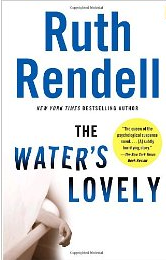
Cover for The Water's LovelyRuth Rendell is not for the faint of heart. She is certainly capable of building her readers’ sense of dread, and I felt one from the beginning of The Water’s Lovely, to the point where I almost couldn’t enjoy it.

Ismay suspects that her sister Heather drowned their stepfather Guy in the bathtub years ago to save Ismay from his advances. She and their mother assumed Heather’s guilt at the time but never spoke of it, and their mother is now mentally ill. When Heather gets seriously involved with a coworker, Edmund, Ismay begins to worry that she should tell him what Heather did. She stupidly records her theory on a cassette tape.

Rendell does a great job of portraying a slew of repellent characters, including self-obsessed Ismay; Edmund’s clinging, whiny mother; and Ismay’s selfish, manipulative boyfriend Andrew. The worst is Marion, the woman Edmond’s mother would like him to date. She likes to befriend elderly people she thinks will put her in their wills, and then she perhaps poisons them.

I worried what was going to happen with that tape, because Heather and Edmund were practically the only likeable characters in the book, except for the girl’s aunt Pamela and her friend Michael. Happily, the ending wasn’t as dreadful as I feared.

Day 194: Burning Bright

Cover for Burning BrightI’m afraid I cannot read any book by Tracy Chevalier without thinking of the purity of the character she created in Girl with a Pearl Earring. Unfortunately, I haven’t read a book by her that was as good, but I keep hoping for one.

In Burning Bright, set in 18th century London, Jem Kellaway, a young lad from the country, moves with his family into Lambeth. They settle into a row house owned by Kellaway’s new employer, next door to the poet and artist William Blake and his wife.

Jem befriends a London street urchin named Maggie Butterfield, and they spend some time with the Blakes. These two children are meant to represent Blake’s ideas of innocence and experience.

Jem’s father has taken a carpentry job with Astley’s Circus. Unfortunately, Jem’s sister Maisie soon attracts the eye of John Astley, the rapscallion son of the circus owner.

Most of the action of the novel centers around the unease generated in England by the French Revolution. Blake’s unusual publications have made him appear to be seditious, and he and his family are threatened as the hysteria rises.

Unfortunately, the characters and story are not very interesting, and William Blake is almost incidental to the novel. The novel does nothing to make the mysterious Blake more understandable to us.

Day 191: The Wrong Mother

Cover for The Wrong MotherAgain, Sophie Hannah uses the technique of multiple narrations in the enthralling mystery/thriller The Wrong Mother, featuring Simon Waterhouse.

Sally Thorning is married with two children, and although she is happy, she feels worn out with working and child rearing. When a business trip is cancelled, she lies to her husband so that she can take some time at a spa. There she meets a man named Mark Bretherick and has a brief affair.

A year later she is out shopping when someone pushes her into traffic. When she arrives home, she sees a news report about a woman who apparently killed herself and her child. The woman’s husband is supposed to be Mark Bretherick, but the man on the television is not the man Sally met at the hotel. She does not want to go to the police because she doesn’t want her husband to find out about her fling.

In the meantime, police constable Simon Waterhouse thinks there is something wrong with the diary found for Geraldine Bretherick, in which she writes about how much she hates being a mother.

Although Hannah seems to have a very dark idea of human behavior if you look at the totality of her work, I always enjoy her twisty plots and her grasp of psychological manipulation. Her two recurring characters, Simon and Charlie, are also almost completely disfunctional in their abortive romance and occasionally behave very oddly as police officers. Still, if you like dark mysteries, her books are fun to read.

Day 188: The Nature of Monsters

Cover for The Nature of MonstersClare Clark seems to be fascinated with shit. Her first book, The Great Stink, featured a mystery during the digging of the London sewer system, and it seemed to revel in descriptions of filth. The Nature of Monsters also spends a great deal of time describing the sanitary conditions of 18th century London.

The novel begins with a description of the 1666 Great Fire of London and the subsequent birth of a disfigured child. This opening is perplexing, and it takes you awhile to figure out the connection to the rest of the novel.

It is 1718, and Eliza Tally has essentially been sold by her mother to a wealthy man’s son, although they first perform a semi-legal marriage ceremony. When Eliza gets pregnant, her mother goes to the man’s father to negotiate a settlement. The results are not what she expects, as Eliza is sold into servitude in London as a maid for an apothecary, whom she thinks is supposed to rid her of her child. But he has other plans.

Eliza is trapped in a bizarre household. She is never allowed to see the apothecary. His wife, Mrs. Black, is intimidating and maintains an iron control over the household. The apothecary has a slimy assistant, and the only other servant is Mary, a mentally handicapped girl. The atmosphere of the house is dark and creepy.

Convinced that he is a scientist and that he is making scientific experiments, the apothecary believes that what a pregnant woman experiences determines the formation of her child. Since he has a handy pregnant woman in his house, he decides to use her for his experiments. Clark has written another disturbing but well-written and suspenseful novel.

Day 187: A Perfect Spy

Cover for A Perfect SpyWhen I was younger, I used to confuse John le Carré and Ken Follett, but last year I went to see the excellent movie Tinker Tailor Soldier Spy. After that, I began reading le Carré again (my review of the novel is here) and have realized that he is the real spellbinder.

Although le Carré writes about espionage, these are not your typical James Bond novels. Le Carré is interested in the moral ambiguity of the work and in psychological drama rather than action. Nevertheless, his novels are extremely suspenseful.

At the beginning of A Perfect Spy, Magnus Pym has escaped his bosses in the British government and the Americans who are investigating him and has arrived at his secret rooms in a small British seaside town to write his novel, he says. As the British search for him feverishly and his boss Jack Brotherhood reluctantly begins to wonder if he is the traitor the Americans claim, Pym writes the sad story of his life.

Pym’s father has recently died, and Pym feels himself finally free to be himself, but perhaps even Pym doesn’t know who he is. His story begins with his charismatic father–a man who is beloved by many but who is also a liar, a cheat, a con man, and a thief. Pym learns to lie and pretend everything is fine from a master, and he goes on pretending for his entire life. But Pym’s motivating force, unlike his father’s, is never money. It is love. He will be anyone and do anything to make people love him.

Is Pym a traitor or isn’t he? As his boss and his wife frantically try to find him, Pym recalls the circumstances and tangled events that lead him to where he is in the present time, alone in his rooms contemplating the next step.

It is difficult to convey, without giving much away, just how compelling this novel is. Le Carré’s genius is that he can make you care for this deeply flawed character and keep you riveted by his story. A Perfect Spy is said to be the most autobiographical of le Carré’s books. It is certainly an involving novel.

Day 186: The Red House

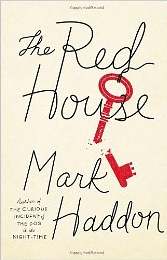
Cover for The Red HouseI really enjoyed Mark Haddon’s The Curious Incident of the Dog in the Night-Time, so I was looking forward to reading The Red House. Curious Incident employs unusual narrative techniques, such as including math games, to try to re-create the thought processes of an autistic teen. The Red House also plays with narration, only not as effectively.

After being estranged for years, siblings Angela and Richard have met again at their mother’s funeral. In an impulsive attempt to restore ties with his sister, Richard rents a holiday house in Herefordshire and invites the other family to join his for a week. Richard’s family consists of his second wife Louise and her teenage daughter Melissa. Accompanying Angela are her husband Dominic and their children Benjy, Alex, and Daisy.

Each of the characters is dealing with issues. Angela had a miscarriage 18 years ago, and she has dwelled on this lost child ever since, naming her Karen and neglecting her teenage daughter Daisy as a result of this obsession. Dominic is having an affair. Daisy has become very religious and fights with Angela about it. Teenage Alex is yearning to have sex with Melissa. Richard is dreading a possible lawsuit from a patient. Louise barely knows the other family and is having problems with Richard. Melissa is awaiting the time when her parents learn that bullying by her group of friends has caused another girl to attempt suicide. Only young Benjy does not seem to have some sort of obsession.

The book jumps among the narrations of all eight characters. The voices are not always so distinct that you can immediately tell them apart. The one that is distinct is expressed as disjointed lists of things, but it is difficult to attach to anyone. For awhile I thought it might be that of the dead daughter and later I thought it may be Angela having a nervous breakdown. Most often, to figure out who the narrator was, I had to relate the narration to something that was already going on. One technique Haddon uses is to interject part of what each person is reading, which at first helps you know which person it is, but after awhile becomes tedious.

Virtually plotless, this dour novel consists of the characters struggling with their own thoughts and with each other. Generally, I disliked most of the characters and thought the novel was a frustrating reading experience.

Day 177: Below Stairs

Cover for Below StairsThis is actually my posting from yesterday. We were having some internet problems.

Below Stairs is the memoir of a kitchen maid that inspired the series Upstairs, Downstairs. Margaret Powell worked in service in the 1920’s from the age of 15 until her marriage. She was an intelligent girl who could have been a teacher, but her parents couldn’t afford to support her while she qualified, so she left school and began working at 13. Later, after her sons were grown, she went back to school and passed her 0-levels at the age of 58, followed by her A-levels.

Powell began as a kitchen maid and worked her way up to cook, mostly through ambition and nerve because she never really received any cooking training. (You had to feel sorry for the first employer who hired her as a cook, because she admits she only knew how to cook vegetables!) Her memoir describes the conditions the servants worked and lived in, sometimes very bad; the work she had to do, including ironing shoe laces in one position; and the way she resented how servants were treated by many of her employers. Although Powell wanted to become a cook, as it was the most privileged job available to her, her biggest ambition was to be married so that she could leave the life of servitude.

The memoir is written in a conversational style, including quite a bit of scathing commentary. It is an interesting book, although Powell’s memories are mostly negative. She says that she had fun, but she only slightly mentions any amusements, focusing on the numerous snubs she received and the ridiculous things she was expected to do. Of course, this adds to the interest of the narrative. One employer was actually even a bit miffed at Powell’s own name (Margaret Langley at the time), deeming it too “posh” for a servant. Although the memoir is written at least 40 years after Powell worked in service, the experience still obviously rankles.

Day 173: David Copperfield

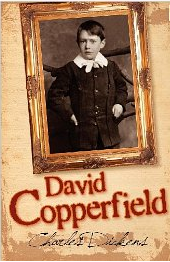
Cover for David CopperfieldBest Book of the Week!

I believe that David Copperfield was the very first book I ever received as a young girl that was not a children’s book. My dad brought it home for me one day when I was sick (beginning my collection of Modern Classics back when they were hardcover), and it transported me to another world.

People have differing opinions about which Charles Dickens book is best. For example, author Nick Hornby blogged that Great Expectations was one of the greatest books ever written. I myself have never fallen under the spell of Great Expectations, though. David Copperfield is my favorite. Tolstoy thought Dickens was the best of all English novelists and considered this book Dickens’s finest work.

David is the narrator of his own story, and he begins it on the night of his birth. David is a posthumous baby, and the novel begins with the first appearance of Aunt Betsey Trotwood, who comes to greet the appearance of her niece and terrifies David’s gentle, foolish mother. When David turns out to be a boy, Aunt Trotwood is mightily offended and departs.

Although David’s early childhood is idyllic, worshipped as he is by his mother and Peggoty the maid, it soon takes a turn for the worse. David’s mother is courted and won by the stern, apparently upright (and ultimately cruel and hypocritical) Mr. Murdstone, and the house is taken over by his cold and fault-finding sister Jane. David is a true innocent with only good intentions, but at every turn he is found to be in the wrong. He is soon shipped off to a typically horrible (if you know Dickens) boarding school.

After a bit of a rocky start, David finds himself made a pet of the popular Steerforth and also befriends Tommy Traddles. However, his mediocre education is interrupted when his mother and baby brother die. Mr. Murdstone sends him to London to lodge with the feckless Micawber family and work in a factory. When the well-meaning but impecunious Micawber is sent to debtor’s prison, David tires of his degrading life and runs off to find the only family he has left, Aunt Betsey Trotwood.

Although Aunt Trotwood is still disappointed that he isn’t a girl, she is kind, and from here, David’s life improves. The story continues with his education, marriage, and young adulthood. It is loaded with some of Dickens’s most delightful characters and a few villainous ones. Alternately turning from comedy to pathos, Dickens expertly drives the story along.

I believe one reason I find David Copperfield so touching is that David’s early life is taken from Dickens’s own. Dickens’s father was sent to debtor’s prison and Dickens went to work in a factory at an early age. This connection translates into a moving experience for the reader.

When innocent and loving David is punished by his stepfather because he is so terrified he can’t recite his lessons or when he is sent off to work in a factory, who remains untouched? When Barkis is willin’ or Mr. Micawber appears on the scene, who doesn’t laugh out loud? When steadfast and valiant Ham dies trying to rescue his rival, who isn’t tearful? When the slimy Uriah Heep finally gets his comeuppance, who isn’t delighted?

If you are not used to reading Victorian literature, you may find the writing old-fashioned, but you will almost certainly be carried along by the story.

Day 169: The Distant Hours

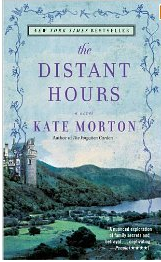
Cover for The Distant HoursKate Morton has been one my favorite authors ever since I read The Forgotten Garden, which is still my favorite of her books. The Distant Hours is another of Morton’s atmospheric novels about family secrets.

When a letter posted in 1941 finally reaches its destination in 1992, Edie Burchill is surprised at the emotional reaction of her usually cool mother. She finds out for the first time that her mother was an evacuee during World War II at the home of Raymond Blythe, the author of Edie’s favorite childhood book, The True History of the Mud Man.

Later, after Edie has been asked to write an introduction for a reprint of Blythe’s classic, she gets lost meeting a potential author and accidentally finds Milderhurst Castle, the once stately but now crumbling home of the Blythes. Living there are the Blythe sisters, Percy, Saffy, and the invalid Juniper. In a way, too, the house is still occupied by the memory of their overbearing father.

The novel alternates between the present time and 1941, as we discover what happened during one night in 1941 that has haunted the family ever since. Morton is deft at creating a compelling atmosphere in the moldering castle and in keeping her readers in suspense.

Morton’s latest book, The Secret Keeper, is due out in October. I can’t wait to get my copy!

Day 162: Religion and the Decline of Magic

Cover for Religion and the Decline of MagicKeith Thomas’s Religion and the Decline of Magic, first published in 1971, is not for the faint-hearted. Thomas is a British historian, and this book is considered an important work because of its then revolutionary combination of research in the fields of history and anthropology.

With that kind of background, you might expect the book to be academic in writing style. It is not, but in fact is actually very accessible and well written. I say it is not for the faint-hearted because of its length and the numerous examples of every point, expected for an academic text but a little rough on the casual reader. These examples are mostly interesting; it is the number of them illustrating every point that threatens to become tedious. The book is 800-900 pages long, depending upon the edition, and nearly half of it is devoted to notes, additional explanations, and references. And truth be told, I was reading the electronic version so could not judge my progress, but it felt like I was reading a lot more than, say, 500 pages. (I did not read the back matter.)

Thomas concentrates upon the history of magic in England from roughly 1500 to 1700, tracing the changes in how the different types of “magic” are viewed and treated by the common people, the judicial and governmental authorities, and the religious ones. His definition of magic is rather broad, including alchemy–which at the time was considered a science and is now generally regarded as the forerunner to modern science–and astrology–which again was considered a science at the time. I believe his inclusion of these disciplines was because at some time they were also considered magic, at least by the church.

Thomas shows that the Catholic church actually encouraged a belief in magic in some ways–linking the connection between prayer and incantations, for example, and fostering a belief in the efficacy of exorcism–consciously building on pagan beliefs to encourage conversion just as it did when it adopted a slew of pagan holidays and modified them to its own purposes.

The ways in which religious leaders and common folk viewed magic, then, changed radically with the Protestant Reformation. Protestant clerics were actually less likely to, for example, attempt to prosecute witches even though the laws defining witchcraft and the penalties against it were prone to fluctuate between more strict or more lenient over time. On the other hand, prosecutions of witches that originated with demands by the common people–who initially were not inclined to fear witchcraft but had to be taught to do it–became more common and more hysterical as the Protestants increased their preaching against it.

Thomas’s premise is that the ultimate decline in witchcraft as a concern of the public and the powers of justice was a result of the Enlightenment–the increasing number of truly scientific studies and the assumption that everything can be understood in terms of science–and ultimately the increase in technology that eventually became the industrial revolution.

This book can be an absorbing study for those who are interested in the subject. I made a good-faith effort to finish it but found that I eventually was unable to cope with the myriad of examples of every point. I skipped maybe 50-100 pages to the conclusions, but when I found the same technique employed there too, I finally gave myself permission to quit. I found the writing style interesting and even dryly witty, but overall the intent of the work was too scholarly for my total enjoyment as a more casual reader.