Day 23: The Dead Lie Down

Cover for The Dead Lie DownBest Book of Week 5!

Sophie Hannah is another writer of dark mysteries who I discovered during the past year. The Dead Lie Down was the first of her books that I read, not the first in the series. Be careful if you buy her books as some of them have two titles, depending upon whether you buy the British or the American version. I have bought two copies of the same book by mistake.

Ruth did something bad in the past but was punished far out of proportion to her crime. She is still trying to recover some confidence and self-esteem when she meets Aidan, a picture framer. The night they get engaged, they make a pact to tell each other everything and forgive each other their secrets, with no questions asked. But Ruth is shocked when Aidan confesses he strangled a woman named Mary Trelease years ago. She is even more confused when she realizes that she has met Mary Trelease and she is alive.

Ruth takes her case to Sergeant Charlie Zailer, a recently disgraced police officer, who dismisses it. At the same time, Aidan confesses to Charlie’s fiancé, DC Simon Waterhouse. After further consideration, both of them decide to investigate further, because they feel a sense of dread.

The Dead Lie Down is a compelling novel with a tangled plot. Sophie Hannah follows a convention in her novels of alternating the narrative between a usually victimized character (in this case Ruth) and the police officers. She indicates this alternation by changing the form of the dates that head each chapter. This confused me at first because for every other chapter she was using the European form of putting the day before the month, and I thought the chapters that took place in early March were actually flashbacks to January and February. Just something to keep in mind when you are reading Hannah.

I have found that Hannah’s novels are deliciously dark and always difficult to figure out, even though by now I know the pattern that someone is being deeply deceived. The trick is to figure out who and how. Her police officers are seriously flawed and have a difficult relationship. A bit of narrative that I have had difficulty following is the story of their romance, which is, however, just incidental to the novels. In other respects the books are stand-alone and do not have to be read in order.

Sophie Hannah is another find for those who like edgy, complex mysteries with a touch of the gothic thriller.

Day 21: The Sweetness at the Bottom of the Pie

Cover for The Sweetness at the Bottom of the PieI don’t know that anyone has invented a more delightful heroine than Flavia de Luce, the eleven-year-old sleuth in Alan Bradley’s funny, charming series. I haven’t read The Sweetness at the Bottom of the Pie in a few years, but for series books I am trying to start with the first one, so I’ll do the best I can.

It is 1950’s Britain, and Flavia is an eccentric in a family full of eccentrics. She spends her time cooking up dangerous chemicals in the laboratory she inherited from a great uncle or riding around on her bicycle, Gladys, looking for trouble. Her father is a reclusive widower who stays locked up in the library with his stamp collection and worries about how to support their ramshackle estate. She engages in all-out warfare with her two older sisters, which includes putting poison ivy extract in Ophelia’s lipstick. Her only ally is the Dogger the gardener, her father’s batman from WW II who suffers from post-traumatic stress disorder.

First, Mrs. Mullet the housekeeper finds a dead bird on the porch with a valuable stamp in its beak. Then a mysterious stranger calls upon her father, and they have an argument. Later Flavia finds the stranger dying in the cucumber patch. When her father is arrested for murder, Flavia decides to investigate. She finds out her father may have been involved in the suicide of a former schoolmaster and the theft of a valuable stamp. As Flavia cycles around the village of Bishop’s Lacey looking for clues and interviewing suspects, she may be putting herself in danger.

If you’re looking for a light mystery with plenty of twists and turns that will make you laugh out loud, look no further than any book featuring Flavia de Luce.

Day Fifteen: Britten and Brülightly

Cover for Britten and BrulightlyAnd now for something completely different!

Britten and Brülightly by Hannah Berry is a noir graphic novel. I haven’t read many graphic novels, but this one seems to be outstanding. Most of them look like superhero comic books to me.

Britten is a depressed detective whose partner is a tea bag (I can’t believe I just got the pun of his name! I am so dense sometimes!) who makes humorous comments from inside the pocket of Britten’s (of course) trench coat. Britten takes a case from Charlotte Maughton, who doesn’t believe her fiancé, Berni Kudos, committed suicide. She is convinced he was actually murdered. Britten begins investigating Kudos’s job at Maughton Publishing, because Charlotte thinks Kudos’s death might be connected to a blackmailing scheme aimed at her father. During the investigation, he begins to uncover family secrets.

Although I became confused by the plethora of characters, I was impressed by the drawings, which are detailed and gorgeous. I am no expert on art, but I think they are stunning. To match with the noir theme, they look like watercolors in shades of gray with muted, subtle touches of color.

Reading this book made me more interested in exploring graphic novels, but so far I haven’t seen anything that looked as interesting. Two other highly lauded graphic novels, Persepolis, by Marjane Satrapi, and Maus, by Art Spiegelman, have compelling themes but much more primitive drawings (in the case of Maus, I couldn’t tell one character of a certain type from another), and I was attracted to Berry’s book mostly by the beautiful art and witty dialogue. Unfortunately, Berry doesn’t seem to have published anything else yet.

Day Ten: Before I Go to Sleep

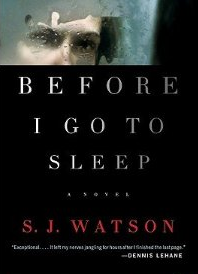
Cover for Before I Go to SleepBest Book of Week 2!

Before I Go to Sleep by S. J. Watson is a stunningly creepy novel that successfully creates a sense of growing dread. It is not really a traditional mystery, more like a slow-starting but absorbing thriller.

Every morning Christine awakens not knowing who the man in her bed is and thinking she should be younger, sometimes twenty years younger, sometimes a lot younger than that. Every morning her husband Ben has to explain who he is, show her pictures of their life together, and explain that years before she had a traumatic brain injury that causes her to forget everything when she goes to sleep at night.

A neurologist calls her each day to explain he has been treating her without her husband’s knowledge and reminds her to take out her journal and read it. As she reads and keeps her journal every day, she begins to remember a few things by herself, and she finds her husband is telling lies. She remembers having a baby, but he says they never had children. She has specific memories of a good friend who he claims moved away to Australia, but she finds out she didn’t. Her husband always has good explanations for these lies, but more and more things begin to disturb Christine.

Should she trust her husband or not? Is she falling back into the paranoia that has been a symptom of her illness? And how exactly was she injured in the first place?

Day Nine: Mary Boleyn

Cover for Mary BoleynIn the introduction to Mary Boleyn, biographer Alison Weir talks about the many misconceptions we have about Anne Boleyn’s less famous sister, which were not only derived from such popular fictions as The Tudors (wildly inaccurate, but I still loved it!) and The Other Boleyn Girl (ditto), but also from biographers and historians over the centuries. Weir calls her book both a biography and a historiography, because she tackles many published statements about Mary’s life and attempts to show the extent of their truth or even likelihood.

Because most of Mary’s life was spent in the background of her glittering, ambitious family, not many actual records or letters that mention her exist, and only a couple of her own letters survive. Even the exact date of her birth is unknown, so that there has been been debate about whether Mary is the older or younger of the two sisters. (Weir makes a good case for older.)

Weir examines Mary’s life from as early as it is known and explores such subjects as whether she had an affair with the King of France (yes, probably a short one), whether she came from that with a ruined reputation, as has been alleged (no, but her family may have sent her away from court), whether she had an affair with Henry VIII (yes, but possibly reluctantly), whether she was then labeled a “famous whore” as has also been alleged (no, hardly anyone knew about it), whether she was married off to an unworthy but complaisant husband as a result (no, she married before the affair to William Carey, a wealthy and influential courtier who was one of Henry VIII’s trusted friends), and so on.

The picture Weir paints is of a woman who has repeatedly been smeared over the centuries. She certainly did not seem to be ambitious, like the rest of her family, because she got very little from her royal lovers. She was almost certainly also not well regarded by her family, probably because she had taken these lovers without gaining an advantage. After her first husband died, she eventually remarried for love, William Stafford, a relatively poor man much lower in status who was 12 years her junior. After she was cut off from her family and court as a result, she described the time of her widowhood as “bondage” and stated in a letter to Thomas Cromwell that no one in the world cared for her except Stafford.

Mary seems to have been slighted by her family for much of her adult life and was finally exiled from them because of her second marriage. This separation may be the only reason she survived her sister and brother.

Weir makes a strong case for Mary’s first child, Katherine Carey, being the unacknowledged daughter of Henry VIII. An appendix relates what happened to Mary’s descendants. Weir remarks that Henry VIII’s line is believed to have died out with Elizabeth I, but assuming she is correct about Katherine’s birth, she provides a fascinating list of some of the famous British people who can trace their lineage back to Mary’s daugher—and so to Henry—including Winston Churchill, Charles Darwin, Lord Nelson, Vita Sackville-West, Ralph Vaughn Williams, Princess Diana, Camilla Parker-Bowles, and Queen Elizabeth II herself.