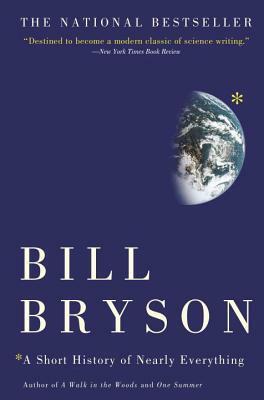
Review 2579: A Short History of Nearly Everything

I picked out A Short History of Neary Everything because it filled one of the last holes in my A Century of Books project and I generally enjoy Bill Bryson. I don’t know what I thought it was about—I think I expected it would be something like At Home, which told the histories of objects and rooms in an ordinary house. But silly me, it’s all science.

It’s not that I never read about science, but I have a limited tolerance for it.

When I first began reading it—actually for the first few chapters—I wondered who the audience for it was. It seemed to be telling about things I supposed most people know, so I wondered if it was for middle grade readers. But it certainly was never marketed that way.

It took a while before Bryson got to subjects that I wasn’t as familiar with, but in any case one of his strengths is finding out strange facts or biographical details of the scientists who made discoveries, so that he makes the material more interesting. And he writes with a lively style. However, he also really likes numbers, which are in general fairly meaningless to me (although he does make good comparisons to make them at least imaginable).

But this is a very long book, nearly 600 pages, and after a while I found myself skipping material. The first thing I skipped was the end of a chapter after it started getting too far into particle physics. Later, I skipped the entire chapter on cells. The geology chapter was interesting, but I was less than 100 pages from the end of the book when I finally pooped out. It didn’t even work to take a break and read a different book. It also didn’t help that such a book becomes rapidly out of date.

As a side note, I found the format of the library’s fancy version a little annoying. It used magazine-style callouts. That is, they didn’t provide additional information but just included quotes from the text. The purpose of such callouts in a magazine is to attract attention to the article, but in a book that you’re already reading?

Related Posts

At Home: A Short History of Private Life

The Body: A Guide for Occupants

Annals of the Former World: Assembling California, Basin and Range, Crossing the Craton, In Suspect Terrain, Rising from the Plains

Day 752: The Ascent of Man

Cover for The Ascent of ManThe book The Ascent of Man is a companion piece to the 1970’s era TV series. The introduction to the book states that the series was an answer to Kenneth Clarke’s famous Civilisation, which left out the accomplishments of science. Author Jacob Bronowski was a well-known mathematician, biologist, and science historian.

Bronowski begins this book with our ape relatives and a discussion of evolution, but he really gets into his subject after man has moved from a nomadic to an agrarian lifestyle. His contention is that nomads do not have the time or energy to innovate.

The book takes us through a series of the most important discoveries for the improvement of human life and understanding. These include the combination of copper and tin to make bronze, mathematical discoveries, the Copernican system, the Scientific Revolution, and so on up to the double helix.

As the book is so obviously the script of a program, there are some frustrating times when it refers to an image that certainly appeared on TV but not in the book. On the other hand, the illustrations in the book are many and beautiful.

Of course, since the book was written in the 70’s, it is a little dated. One example is that Bronowski frequently comments on how slowly animals evolve, but I believe this idea has been reconsidered.

Because the discussion of the concepts is very brief, there were times when I felt Bronowski was implying a lot more than he described. That is, his greater understanding of the topic interferes a bit in his simple explanations. So, even though I watch a lot of science programs and usually have no trouble understanding them, I felt sometimes as if the explanations of the more difficult subjects have too much left out. Still, for someone who wants to learn basic information about important scientific discoveries up to the middle of the 20th century or is interested in the history of science, this is a good place to start.

Related Posts

Salt: A World History

Death by Black Hole and Other Quandaries

A History of the World in 12 Maps

Day 641: Remarkable Creatures

Cover for Remarkable CreaturesRemarkable Creatures is based on the true stories of Elizabeth Philpot and Mary Anning. These were two women of the early 19th century who collected fossils along the sea near Lyme Regis, beginning before fossil collections became wildly popular. Some of their finds resulted in discoveries about evolution and extinction. The novel is told in alternating chapters from the point of view of the educated upper-class Elizabeth and the uneducated working-class Mary.

Elizabeth Philpot already realizes she will be a spinster when her newly married older brother nudges her and her two sisters to look for a less expensive place to live away from the family home in London, perhaps in some genteel seaside resort. The women choose Lyme Regis, and their brother soon finds them a comfortable but small stone cottage.

Louise Philpot becomes interested in gardening and Margaret busies herself with the town’s social scene, but Elizabeth realizes she must find something to occupy herself. When visiting a carpenter’s shop, she meets Mary Anning, at the time a child, and sees the fossils Mary has collected and is trying to sell. She is fascinated particularly by the fish and decides to look for fossils herself, doing much to help label herself and her sisters as eccentric.

Mary Anning finds and sells fossils to support her family, but she is also fascinated by them. After she begins her acquaintance with Elizabeth, she starts learning more about the scientific theories behind her work. When she discovers the fossil of a previously unknown animal, she does not know that her discovery challenges the beliefs of conventional religion that every animal created by God is currently alive on Earth.

Philpot and Anning, who made significant contributions to the science, both eventually find themselves frustrated by the lack of recognition for their contributions. It is worse for Mary, for she is not only a woman and uneducated, she is considered just a fossil hunter.

I found the subject matter of this novel interesting but feel Chevalier was probably struggling with the difficulties of depicting real people in fiction. Although she depicts two distinct women, they do not seem fully formed to me. I couldn’t help contrasting this novel with the wonderful The Signature of All Things, which is a similar story although completely fictional. There I got a sense of a strong, fully realized individual. To contrast, Chevalier gives each of her main characters a few signature traits—for example, Elizabeth judges people by what part of their physique they “lead with”—and we don’t get a sense of fully formed individuals.