Review 2654: #NovNov25! Why Did I Ever

Technically, Why Did I Ever is a little longer than the page limit for Novellas in November at 210. But I found it in a list of recommended contemporary novellas and read it for this event.

Part of me doesn’t want to present a cogent plot synopsis for this book, because it isn’t presented cogently. Instead, the novella is written in fairly unconnected snippets, some of them titled but in a way that seems to have nothing to do with the snippets.

So, maybe not a synopsis, but here are some of the things that are going on. Melanie Money (we don’t learn either name for quite some time) hates her job as a Hollywood script doctor. She lives somewhere in the Deep South but occasionally flies to California for bizarre meetings about an inane script.

She has two grown children. Mev, her daughter, is methadone-dependent and has trouble keeping a job. Paulie, her son, is in New York under protective custody before testifying against a man who held him prisoner and viciously abused him.

In her home in a small Southern town, she has two very odd friends—the Deaf Lady, an old lady who is not deaf, and Hollis, a driving instructor who seems to spend most of his time in Money’s house.

Money has a boyfriend in New Orleans named Dix who calls a lot but from whom for a while she is keeping her address secret. She doesn’t regard him as very smart, but he seems to care for her.

Aside from the states of her various relationships, in which every character seems to respond to what is said with a non sequitur, the ongoing plot is about the state of the script and whether Melanie will be fired and about Paulie’s situation.

Melanie herself obsessively covers everything in her house (literally everything, even her books) with a coat of paint or alphabetizes everything, seems to drive aimlessly around the South, and worries about her missing cat and her kids.

It’s a very disjointed account, but it’s quite funny at times, especially about the movie industry.
Related Posts

Milkman

Girl, Woman, Other

A Girl Is a Half-Formed Thing

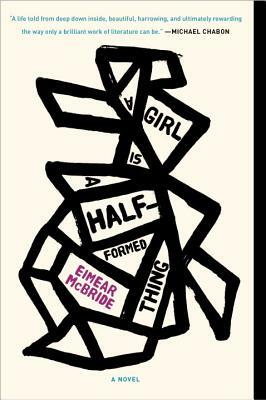
Review 2551: #ReadingIrelandMonth25! A Girl Is a Half-Formed Thing

I was going to review this book in February, but then I decided to hold it a few weeks so it could be part of #ReadingIrelandMonth25 hosted by 746 Books. This may be my only contribution, because I’m busy finishing my A Century of Books project. And now for my review.

When he was two, the unnamed narrator’s brother had brain cancer. To her mother’s mind, her praying rather than the surgery saved him, and she became extremely religious. Her father left, saying he couldn’t take it. So, she, the younger child, her brother, and her mother grew up in a sort of microcosm.

When she isn’t praying, their mother is full of anger, which is expressed at them, particularly at her. Their classmates think they are weird—he because he is slow and has a scar across his head, she because she scorns them and is intelligent. She doesn’t care, but he wants to fit in.

Then at 13, she begins a sexual relationship with an older relative that forms her later relationships with men around violence and mistreatment.

This book isn’t for everyone. For one thing, it is written in an experimental, half-incoherent style. It takes a while to get used to it. However, it is bold and bleak and ultimately it made me cry, which to me means it’s very good. It’s ground-breaking.

It contains scenes of verbal and physical abuse, sexual violence, and rape. Also, suicide and death. So be warned.

Related Posts

The Lesser Bohemians

Milkman

The Virgin Suicides

Review 2523: The Bee Sting

The Barnes family is having a difficult time. On the surface is a monetary issue because in the downturn no one is buying cars from the family dealership. But actually, each family member has been making poor choices.

The novel starts with Cass, the oldest child, who in the beginning is in the final year of school before starting university. She has long been best friends with Elaine, on whom she has a crush, but there are indications that Elaine is not as good a friend to her. Elaine gets interested in boys, and the two girls begin drinking at bars every night instead of studying for their leaving exams. Suddenly, Cass is sure she’s flunked her exams. If that’s not enough, she learns that her mother, Imelda, was engaged to her father’s brother and married her father soon after his brother was killed in an accident. The timing shows that her mother was pregnant for the wedding, so whose daughter is she?

The next section is about PJ, Cass’s preteen brother. He is disturbed because his parents seem to be always arguing since the business got into trouble, with his mother blaming his father. His friends have been dropping him, and a bully tells him his father ripped off his mother, so he owes him €163. PJ tries to collect the money while his attempts to talk about it to his family members are cut off by their preoccupations with their own problems.

Next is Imelda’s turn, in an unpunctuated section. Now that her husband, Dickie, is having financial problems, she begins to dwell on the past. Dickie’s brother Frank had been a golden boy—rich, handsome, good at sports, and charismatic—liked by everyone. But Imelda, although she comes from an impoverished, abusive background, didn’t love his money. She was madly in love with him. This section is more revealing about the circumstances that led to her wedding with Dickie. Now, she is furious, blaming Dickie’s poor salesmanship for their problems.

Finally, there is Dickie’s point of view. A family story that he went to Trinity only to be hit by a car on the first day and return home turns out to be completely fictitious. He had been a serious scholar and was happy in his university life. But then he was called home by his brother’s death. Now after acting the upstanding citizen for nearly 20 years, he begins to make some serious missteps.

Each section reveals more about the family secrets and the problems ensuing from this misguided marriage. This doesn’t necessarily sound like gripping material, but it really is. I was fascinated immediately. And the last 50 or so pages are unexpectedly suspenseful. Finally, the ending blew my mind. Not everyone will like it, but to me it is a great book.

I read this for my Booker Prize project.

Related Posts

Faith Fox

The Birds of the Innocent Wood

The Weird Sisters

Review 2443: After Sappho

I read After Sappho for my James Tait Black project. It is experimental, written in short vignettes that jump around in time and from person to person. It tells the stories of lesbian women, mostly literary figures, trying to make a place for themselves. It begins in the late 19th century with women fascinated by the poet Sappho. Some of them study Ancient Greek, some dress like ancient Greeks or re-enact ancient plays, some travel to Greece.

The novel is vividly written in first person plural or in third person, at times slyly ironic, sometimes engaged in word play, often invigorating and with lots of sexual metaphors. It is interesting, telling of repressive laws against women, particularly in Italy, and reporting actual aggressively misogynistic “scientific” or political statements by men. It goes on to tell of the accomplishments and tragedies and love affairs of its protagonists, largely ignoring the men in their lives. For example, from this novel, you wouldn’t know there was a Leonard Woolf, just a Vita Sackville-West.

Although I found the novel very interesting at first, there were so many characters that I couldn’t keep track of them or remember which events happened to which ones. I could only track the ones I was already familiar with. For example, the novel begins and ends with Lina Poletti, even though she disappears about halfway through, so she is obviously important to Schwartz, but by the end I couldn’t remember her. I felt like I needed a chart.

And yet, I feel that with more character definition, I might have remembered all of them, but these short vignettes that tell of an activity or something they said didn’t really provide a cohesive picture to me of what the women were like.

So, I applaud this novel’s daring devices, but they didn’t really work for me.

Related Posts

The Hours

Crudo

LOTE

Review 2249: Murmur

When the cover of a book calls it “hallucinatory,” I know it’s not going to be a good fit for me. However, since Murmur is part of my James Tait Black project, I felt compelled to read it.

The novel aims to portray the mindset of an Alan Turing-like scientist named Alec Pryor after he is undergoing chemical castration because of a homosexual encounter. Aside from making his body more feminine, the chemical makes him dream and eventually induces wakened dream states, including ones where he fantasizes letters from his friend June, whom he hasn’t seen in years, and relives events of his boyhood.

Those who have been reading my reviews know how much I hate reading about dreams. Since it is difficult to know some of the time whether he is dreaming or remembering, this was a novel I found it hard to stick with, despite it being very short.

The rest of the novel is filled with philosophical musings about whether machines could have consciousness and other subjects. I felt that either I didn’t want to follow his thoughts or they were too hard for me to grasp. The journal section at the end is the most accessible part of the novel.

Related Posts

Crudo

Umbrella

Outline

Review 2151: No One Is Talking About This

The unnamed narrator (possibly Lockwood herself) is a media influencer made famous by such utterances as “Can a dog be twins?” She seems to spend all her time online that she isn’t lecturing to her fans. She calls the Portal her information, and although she has a broad sense of irony, doesn’t seem to understand that most of it isn’t.

When I was reading this portion of the book, which is related in a sort of stream of consciousness, I realized that I was officially a geezer, because I didn’t understand a lot of what she was talking about, didn’t like her sense of humor, didn’t get her world view or sensibility. The book didn’t seem to have a plot and was mostly made up of her musings on a vast array of subjects, particularly the Internet.

Then a family crisis occurs. The second half of the book suddenly gains a plot and becomes meaningful in a way the first half wasn’t. I was deeply touched by it.

I read this novel for my Booker project.

Related Posts

Flights

Crudo

Still Alice

Review 2066: The Candy House

The Candy House is billed as a follow-up to A Visit from the Goon Squad, but at first, aside from its structure as linked short stories, I wasn’t sure why. Bix, a wealthy high-tech entrepreneur, is not one of the characters from the original novel, I don’t think, nor is Alfred Nollander, whose quest for authenticity leads him to scream in public just so he can see the expressions on people’s faces. (Although later I realized he was a child in the first book.)

However, as I continued reading, I encountered familiar names and realized I was dealing mostly with descendants and connections of the original characters. A lot of the novel deals with social media run amok, a world where it is common for people to upload their unconsciousness to the internet using the software provided by Bix’s company, Mandala, and the opposition to this and other such practices by the company formed by Chris Salazar, the son of Benny of the previous book.

The novel doesn’t seem as experimental in form as the original, although there is a chapter constructed in Instant Messages and another of a recorded manual, but that’s really because Egan’s approach, which was unusual when the previous novel was published, is more common now. Set from the 1990s to roughly the 2030s, the novel is more futuristic.

Although I wasn’t blown away by this book as I was by its predecessor, I was happy to revisit the lives of its characters, all of whom eventually reappear, even those from the ridiculous tale that parodied the P. R. field. Another good one for Egan.

Related Posts

A Visit from the Goon Squad

Look at Me

The Keep

Review 2009: The Selected Works of T. S. Spivet

Tecumseh Sparrow Spivet is a 12-year-old boy who spends most of his time on a Montana ranch mapping things. Not just making geological maps but mapping the everyday activities on the ranch—his sister’s technique of shucking corn, the regularity of his father’s sip of whiskey, as well as numerous scientific subjects. In fact, his mentor, Dr. Yorn, has encouraged him to submit drawings to various journals, and he has had some published.

T. S. does not feel comfortable at home. He is mocked by most of his schoolmates. He feels he is a disappointment to his rancher father, and his scientist mother, whom he calls Dr. Claire, seems to be completely obsessed by the search for a particular beetle. Worse, his oldest brother has recently died.

One day he gets a call from the Smithsonian. It appears that Dr. York submitted one of his diagrams as an entry in a prestigious fellowship and he has won. Dr. Jibsen, unaware of his age, informs him he is expected at the Smithsonian on Thursday to give a speech.

At first T. S. hesitates about accepting the award, but then he decides to go to Washington. He packs up some things and hops a freight train east.

Liberally decorated with T. S.’s drawings and musings, this novel is inventive and sometimes funny. In a way, it is meant as a wild romp with a philosophical dint, so maybe we’re meant to overlook the truly implausible aspects of the story, such as that a recipient of an important award would have someone on the Smithsonian end immediately organizing his flight.

I was drawn along at first and ready to suspend my disbelief, but first, what can your hero do while he spends several days on a freight train getting to Chicago. Nothing, right? If you are expecting a picaresque series of adventures like I was, you’ll be disappointed. But T. S. has brought along one of his mother’s notebooks, which is how he discovers she is writing a novel about one of his father’s ancestors. Larsen inserts the entire contents of the notebook into the middle of the novel, with a few interruptions. At first, it was interesting, but after a while I sighed every time I saw the typographic clue that the novel was restarting.

This is all fairly unimportant, though, against the criticism that T. S.’s voice is never convincing as that of a 12-year-old, genius or not. Yes, he is childish at times, but then his voice is much too young for a 12-year-old. But most of his musings and concerns are those of an adult.

Is the book fun to read? Yes, mostly. But I tired of it after a while.

I read this book for my James Tait Black project.

Related Posts

The Sweetness at the Bottom of the Pie

The Invention of Hugo Cabret

The Case of the Missing Marquess

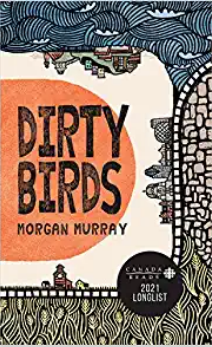
Review 1819: Dirty Birds

Just before I read Dirty Birds, I attempted to read Quichotte by Salman Rushdie, and I was surprised by the parallels. Both protagonists are on a quest to make a woman love them. Although Rushdie’s protagonist is old and Murray’s is young, both are naïve and deluded. Road trips are part of each novel, and so is satire—Rushdie’s for the cult of personality and big pharma, among other things, Murray’s for the Montreal art scene and the young man as artist. I found Murray’s book more successful and a lot funnier.

Milton Ontario is a hapless young man who is not only utterly average but characterized by the extent of his naiveté and inexperience. He gets an idea in his head that he wants to be a poet, even though he writes atrocious poetry (at first dedicated to the love of his life, Ashley, and later to the love of his life, Robin), so he sets out from his small town for Montreal and a tiny room he has rented sight unseen in a dilapidated, filthy house full of students and would-be artists. There he attempts to enter the art scene and falls in love with Robin, the maker of a seven-minute documentary entitled Dirty Birds, who is almost unaware of his existence.

Milton stumbles through a series of horrendous jobs horrendously performed and meets a cast of rowdy, raucous characters. He inadvertently starts a riot and gets to meet his hero, Leonard Cohen, only to find he is a mob boss (where I think the novel starts to go a bit astray). In among all this silly action is a series of footnotes enlightening us about the history of Canadian mistreatment of indigenous peoples, Newfies, and French-Canadians, among others.

Although I think it gets a little carried away with itself (and I didn’t like the part about the late, great Cohen), for the most part, this novel is a hoot.

Quichotte

Cluny Brown

The First Bad Man

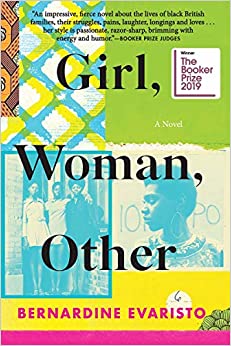
Review 1643: Girl, Woman, Other

Readers who prefer traditional narrative styles beware—there are hardly any periods in Girl, Woman, Other. Although I often enjoy more experimental novels, this bothered me at first, because it forces Evaristo to start a new paragraph almost every sentence, if you can call them sentences—many are more like lists. After a while, I got used to it.

Girl, Woman, Other is about the lives of British black women, twelve women who each has her own chapter. The plot, which is minimal, centers around a play about black female warriors named The Last Amazon of Dahomey, written and produced by Amma, a radical feminist gay woman. The novel is divided into four parts, each devoted to the lives of three women who have some type of relationship to each other. But there are more relationships within the book, some of them surprising.

The novel is fresh, the stories interesting, many of the characters justifiably angry. I wasn’t sure how much I liked it, though, until the Epilogue, which was touching.

All-in-all, Booker prize winner or not, I would call this novel of linked stories a semi-successful experiment in form and writing style. It is at times a little didactic through characters’ speeches, but it does tell some powerful stories about the experiences of black women, women’s sexuality, women in general.

Related Posts

Ducks, Newburyport

The Rehearsal

The Lesser Bohemians