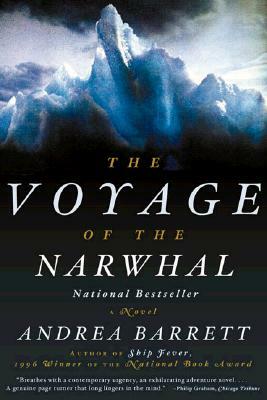
Review 2506: The Voyage of the Narwhal

In 1855, Erasmus Wells has spent years working with the items in his father’s collection of specimens, ever since he himself returned from an ill-fated exploration in the South Pacific. The members of the expedition were mocked, but the worst thing was the acclaim given to the leader after he released his book—cut and pasted from the journals and records he confiscated at the end of the trip—including Erasmus’s—but giving them no credit.

But Erasmus almost unwillingly finds himself departing on a voyage to the Arctic, to be lead by his sister Lavinia’s young fiancé, Zeke Vorhees. Zeke was raised like a younger brother to Erasmus and his brothers. He is handsome and charismatic, but may not make good leadership material. However, Erasmus has promised Lavinia he will take care of Zeke.

And Zeke proves divisive as a leader almost from the beginning, determined to do what he wants even if it unnecessarily risks the lives of his men. He almost immediately gets on bad terms with Mr. Tyler, the sailing master, even though he should be relying on Tyler’s experience. Although the purpose of the voyage is to find out more about the Franklin expedition, Erasmus becomes worried that Zeke has other intentions.

Periodically, the novel looks back at the people left behind, particularly Alexandra, who has been hired to keep Lavinia company. She is also hired by Erasmus’s brothers to color illustrations for a book of exploration, and later begins to engrave, but she yearns to travel herself.

Barrett builds suspense as the novel moves from Erasmus’s loneliness and sense of isolation to his fears about the results of Zeke’s leadership to a sense of true peril. This is a truly fascinating novel that builds on the records of actual voyages of exploration during this period. Although Erasmus has his flaws, he is a sympathetic main character. I’ve read several really good historical novels this year, and this is one of them.
Related Posts

Minds of Winter

The Wager: A Tale of Shipwreck, Mutiny, and Murder

The Ghost of the Mary Celeste

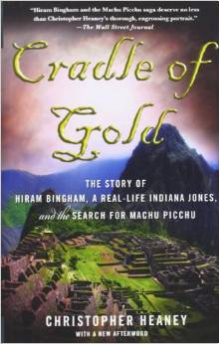
Day 541: Cradle of Gold

Cover for Cradle of GoldA few years ago I reviewed The Lost City of Z, which told about Percy Fawcett’s search for a fabled city in the Amazon jungle. That book alleged that Fawcett was a possible model for Indiana Jones. It is a minor point of Cradle of Gold that Hiram Bingham III is much more likely to be the model. Bingham was the man who brought the world’s attention to Machu Picchu.

At the time, Bingham was hailed by the western world as Machu Picchu’s discoverer, despite its being known about all along by the nearby farmers. Bingham’s story also has other examples of chauvinism and controversy, including his removal of artifacts without the permission of the Peruvian government. (He more or less permanently “borrowed” them.) Peru has only recently won a law suit against Yale University for the return of the collection, including many human remains. Still, Bingham is recognized even in Peru for his contributions to Peruvian history and archaeology.

The book begins in Hawaii, where Bingham was born the son of missionaries who expected him to study theology. But Bingham did not see himself taking up his father’s mantle. He was still fairly young when he took the money saved for his education and tried to embark for San Francisco. Although he was prevented from leaving and eventually ended up attending Yale University, he soon after became an explorer.

The book is named Cradle of Gold after Choqquequirau, supposedly the home of the Virgins of the Sun, which was the first site Bingham visited. He found it had been looted long before. Instead of pursuing it further, he became interested in finding Vilcabamba, the residence of Manco Inca, one of the last rulers of the Inca who was captured and slaughtered by the conquistadors. Initially attracted because no one knew what happened to Manco Inca’s great treasure, Bingham eventually became more interested in Incan history and artifacts.

This book is the engrossing story of Binghams’ origins and expeditions, his contributions to science, and the controversy that followed. Author Christopher Heaney is a Doctoral Fellow in Latin American history at the University of Texas, Austin. He has written a clear and interesting account for the general public but supported by extensive documentation. If you are interested in stories of exploration, you will like this one.


Day Seventeen: The Lost City of Z: A Tale of Deadly Obsession in the Amazon

Cover for The Lost City of ZThe Lost City of Z by David Grann tells the story of a famous British explorer, Percy Fawcett, and his obsession with finding the fabled city of El Dorado in the Amazon. He was the last of the great Victorian adventurers and possibly the inspiration for Indiana Jones (and for the explorer in the movie Up).

Fawcett made a career of exploring the Bolivian and Brazilian Amazon, beginning with being hired by the Bolivian government to establish its border in the Amazon. He became convinced that there had been a large city, which he called Z, in the region of the Xingu River. Hundreds of expeditions had been made to find it, beginning in the 16th century, and many of them were never seen again.

In 1925 Fawcett set off on an expedition funded by the Royal Geographical Society with a small party that included his son and son’s best friend. He sent daily dispatches back from the jungle that were published in the newspapers and waited for with anticipation by the general public. Then the dispatches stopped, and he was never seen again.

But the story wasn’t over. Others went into the jungle to try to find out what happened to him, including a famous movie star. Many of them never returned, either.

Grann, a staff writer for The New Yorker, became interested in the subject, which he came upon while working on another project. During his research, he met with members of the Fawcett family and was given access to a some previously unpublished personal papers. He is able to provide insight into the explorer’s character and thought processes, which makes for a fascinating story.

Grann also became consumed with the fate of the Fawcett expedition and found himself deciding to follow in Fawcett’s footsteps. Although his trip through the Amazon in a jeep was no Victorian expedition, he himself is no explorer. He was surprised to find the Amazon almost as wild today as it was 100 years ago.

And maybe he solved the mystery of what happened to Fawcett’s expedition. The story of Fawcett’s adventures makes compelling reading, and the ending is unexpected.