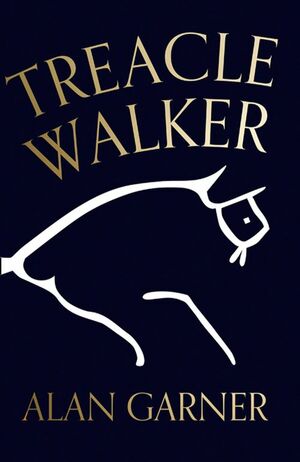
Review 2580: Treacle Walker

I read Treacle Walker for my Booker Prize project. It is an unusual novella that reads a bit like a fairy tale or myth.

Joseph Cappock is a young boy with a lazy eye who wears an eye patch and lives by himself. One day a rag and bone man named Treacle Walker comes to the door, and Joseph trades a pair of used pajamas and a bone for his choice of one thing in a box. He chooses a jar. Treacle Walker also gives him a stone.

When he leaves, Treacle Walker tells him to clean his front step with the stone. The stone turns the dirty step white.

Joseph finds that he sees different things with his good eye than he sees with his bad eye. One day he sees the characters in one of his favorite comic books climb out of a cel and disappear through a mirror in his room. Using the stone, Joseph finds he can go through the mirror himself.

This is an imaginative novel told in some kind of vernacular. I wasn’t always sure what was going on, but the telling was enjoyable.

Related Posts

Neverwhere

Sealskin

Under the Harrow

Review 2155: #1940 Club! Miss Hargreaves

When I saw Miss Hargreaves on the list of books published in 1940, I knew I had to read it for the 1940 Club, mostly because of recommendations by Simon Thomas.

Norman Huntley is quite a young man, impetuous and given to making up stories. He is traveling with his friend Henry in Ulster when they take refuge from the rain in a church they agree is hideous. However, the sexton appears and insists on giving them a tour.

When the sexton shows them a commonplace inscription dedicated to a previous vicar, Norman blurts out that he has a friend who knew him. Together he and Henry describe an eccentric old lady named Miss Hargreaves, continuing after they leave to add details.

To cap the joke, Norman writes a letter to the address they made up, inviting Miss Hargreaves to visit. Shortly after he returns home, he receives a letter from Miss Hargreaves saying she is arriving on Monday.

Miss Hargreaves is exactly as Norman described her, including a dog named Sarah and a parrot named Dr. Pepusch. Norman is confused and his friends treat him badly because of his relationship with the old lady. But he comes to believe that Miss Hargreaves exists only because he created her. He both likes and hates his creation.

Although some events seem to confirm this idea, after he gives Miss Hargreaves a title, she begins to go in her own direction, and things get even more complicated.

Of course, this frothy story is meant in fun, but I couldn’t help thinking that the novel could be a metaphor for an author and his creations—how they sometimes take control and don’t want to do what you planned, and how you can love them and hate them at the same time.

Although I don’t usually like magical realism, I found this novel madcap and funny, and I especially loved the character of Norman’s father.

Related Posts

Cluny Brown

The Stone of Chastity

Berry and Co.

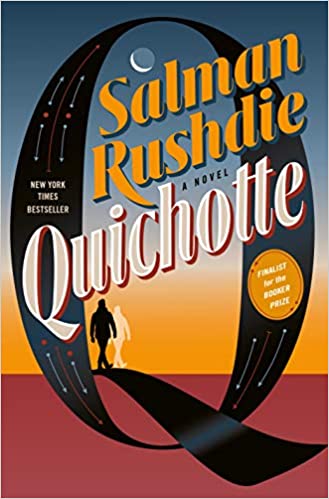
Review 1818: Quichotte

I was fairly sure I was going to hate Quichotte. I did not much like Midnight’s Children or Don Quixote for that matter, which Quichotte retells. However, this novel is part of my Booker project, so I opened it with hope.

Quichotte is Ismail Smile, an elderly consumer of all things TV who becomes infatuated with Salma R, a young TV star. He decides to go on a quest to earn the love of his beloved. This is a road trip, and for a partner he takes Sancho, his imaginary son. To add another layer, Quichotte is himself an imaginary character, created by Brother, a writer of spy novels who has decided to change his genre.

This novel is one full of circumlocution. As we meet each character—and we meet a lot of them—we go off on the tangent of that person’s life story. Further, there are lots of subplots, for example, the one about Smile’s cousin and employer, whose pharmaceutical company has developed a drug even more dangerous than OxyContin and who has himself developed a similar model to that of the makers of Oxy, delivering it in huge quantities to small rural communities.

The genre for this novel is fantasy and of course satire. Fantasy is not my genre, and although I wouldn’t have thought the same was true about satire, I have not enjoyed the satirical entries on the various shortlists. They all feel the same to me: ponderous, overblown, and written by old men. Definitely lacking subtlety. Even the reviewer from The Guardian remarked that the book was funny but not as funny as Rushdie thought it was. That is exactly how I feel about it, except I didn’t think it was very funny. I sensed Rushdie winking all the time.

Still, I was enjoying parts of the novel, although it didn’t seem to be getting anywhere. Then Sancho decided he wanted to be a real boy, and guess who popped up? Jiminy Cricket. At that point I had to restrain myself from throwing the book across the room (only because it was a library book), and I stopped reading.

The Finkler Question

You & Me

The Broom of the System

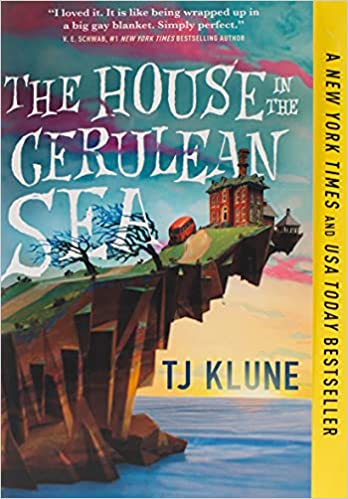
Review 1808: The House in the Cerulean Sea

I have to confess to having picked this book out because of its cover and title. What a great word “cerulean” is.

Linus Baker is a caseworker in the Department in Charge of Magical Youth. He goes completely by the book, which may be why he is selected for an unusual task—to investigate the orphanage on the island of Marsyas where seven magical orphans live under the tutelage of Dr. Parnassus. He is instructed to report everything.

On the island, he meets Dr. Parnassus as well as Ms. Chapelwhite, a sprite who helps with the cooking and care of the house and children, and the seven orphans. These unusual children include Lucy, the six-year-old Antichrist.

This novel is well written and occasionally amusing, but I don’t read much fantasy, and when I do, I have high requirements for it. This isn’t really my genre. But my biggest problem with it was trying to decide who it was written for. It reads like a children’s book and its sense of humor is juvenile. However, Linus and Dr. Parnassus have conversations on such topics as Kant and I think it was Schopenhauer that would certainly be above most kids’ heads, and he uses vocabulary (like “self-flagellation”) that seems aimed at adults. In addition, the novel features a love story between two middle-aged men, which doesn’t seem as if it would appeal to even gay children, so more for adults. But the tone of the piece smacks of children’s literature, and not necessarily good children’s literature.

Finally, though, the novel was just too saccharine to appeal to me. I ended up reading about 2/3 of it but eventually decided that I wasn’t invested in the outcome. The kids were cute but kind of one-dimensional, although I thought the concept of Lucy was clever and sometimes funny.

Miss Peregrine’s Home for Peculiar Children

Good Omens: The Nice and Accurate Prophecies of Agnes Nutter, Witch

Neverwhere