Day 637: The Quick

Cover for The QuickAt first, The Quick seems like a straightforward historical novel about a young writer in 19th century London. But it has a twist. To be honest, if I’d known what the twist was beforehand, I probably wouldn’t have chosen this novel to read, because frankly, I’m tired of this subject. That said, I’m glad I read the book, because it is absorbing, well written, and quite suspenseful.

James and Charlotte Norbury grow up neglected in a rambling house in Yorkshire. Their father rarely comes near them after their mother dies and seems to forget they might need attention or tutors or governesses. So, while the two children run wild, it is the older Charlotte who takes care of James and teaches him to read.

After their father’s death, James goes away to school while Charlotte stays in the care of Mrs. Chickering, an elderly relative. James eventually moves to London to try being a writer, but he is not wealthy and has difficulties finding acceptable lodgings he can afford. An acquaintance introduces him to Christopher Paige, a young aristocrat looking for someone to share his rooms. Although the more austere and shy James does not envy Paige’s life of frivolity, he slowly begins to realize that Paige is his first friend—then that he is more than a friend.

One night, though, a terrible event takes place. Christopher Paige is killed and James disappears. When James does not appear at Mrs. Chickering’s funeral, Charlotte travels to London to find him.

In London, Charlotte’s inquiries attract the attention of the members of a powerful and mysterious club, the Aegolius. There has been an unexpected event at the club, and other people are looking for James. Soon, Charlotte finds herself involved with a secret substrata of the city.

Owen depicts a wonderfully atmospheric London. Although I was at first disappointed with the direction the story took, I still was unable to put this book down.

Day 622: Under the Harrow

Cover for Under the HarrowBest Book of the Week!
Under the Harrow is an unusual and imaginative novel. It is described in some write-ups as if Charles Dickens had written a modern thriller, and that description does give a sense of the novel.

Dingley Dell is a hidden valley occupied by about 11,000 people who have never been out of it. Their history relates that their ancestors were deserted as children in an orphanage during a terrible plague in 1890. With the only books available to them an old encyclopedia, the Bible, and the complete works of Charles Dickens, they have invented for themselves a very Dickensian environment, not omitting some of its evils, like a workhouse, a huge separation between classes, and a government by a privileged few. Only a few people have ever left the valley to see what is outside, and only a very few of them ever returned. Those few were promptly clapped into the madhouse, victims of a terrible mental illness.

Frederick Trimmers has lately suffered from some misgivings about the state of the dell. He is a writer for a muck-raking newspaper who sees much to improve in the dell. Lately, though, he has more personal problems. His troublesome nephew Newton, sent off by his parents to school, has run off from the dell. Newton’s father Gus soon goes after him. While they are having unexpected adventures outside, Frederick is learning disturbing things about the existence and history of the dell. Soon he begins to believe that the entire valley is in danger.

Dunn is having some fun with us while building up a fair amount of suspense. The novel is narrated in a sort of über-Victorian English. The inhabitants of the dell have almost all taken some of the silliest names from Dickens, and many of them remind us of his oddest characters. And in a moment of major action, he offhandedly remarks that the farmer in the dell purposefully left the cheese standing alone. That will give you a little idea of what you have in store, although he doesn’t overdo it. It’s about what you must expect from an author known for a novel where letters disappear one at a time from the text or another written entirely in footnotes.

There is a conspiracy, of course, and if I have a complaint, it’s about the unbelievable extent of the conspiracy and the unlikelihood, given how big Dunn makes it, that everything would come out okay. Still, I give this novel high marks for its originality and its ability to capture and hold my attention.

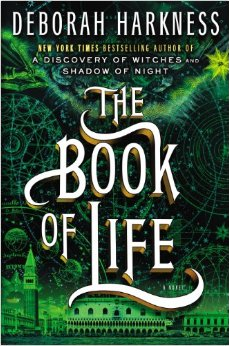
Day 611: The Book of Life

Cover for The Book of LifePerhaps I’m the last woman left in the country who doesn’t think it would be romantic to be in love with a tall, dark man who could suck my blood at any moment. In any case, although I first thought that Deborah Harkness’ All Souls Trilogy was refreshingly original, by the third book I was not as charmed by this complicated series.

In The Book of Life, Diana Bishop, a timewalker and special kind of witch called a weaver, and her vampire husband Matthew Clairmont have returned from the past where Diana was learning her skills. They have one of three missing pages from a manuscript called Ashmole 782, or The Book of Life, and they are trying to find the others to reunite them with the book. It was Diana’s accidental retrieval of this book from the Bodleian Library that started all the action. Diana is also pregnant with Matthew’s children.

Matthew and Diana are in violation of the Covenant, an old agreement among witches, vampires, and daemons that they will not associate with each other. They think the Book of Life may provide information about the origins of the three creature races and even help Matthew with his research into a deadly vampire disease called blood rage.

In addition, they are being pursued by Benjamin Clairmont, a crazed child of Matthew who wants Diana and her daughter.

Like the second book of the trilogy, The Book of Life seems rather scattered to me, with Diana and Matthew running here and there on their various quests. The spots in the plot that could be climactic can be a bit of a let-down, as, for example, we don’t even get to hear what Diana has to say to the Congregation when she finally presents the evidence she and Matthew have collected.

After reading the first two books, I wanted to see what happened, and I was fond of several of the characters. But I didn’t think the novel was romantic, nor do I have much use in general for the overprotective male partner.

Day 607: The Bone Clocks

Cover for The Bone ClocksBefore I get started on my review of The Bone Clocks, my friend Ariel of One Little Library has put together a survey on reader’s interests. If you would like to participate, please do.

* * *

Best Book of the Week!
David Mitchell’s most recent book is another fascinating novel that reminds me a bit of his Cloud Atlas. It explores themes of temporality, life after death, and the human soul and ends in a near-future dystopian vision. Unlike Cloud Atlas, though, The Bone Clocks takes place completely within the course of one woman’s life.

The novel begins in 1984. Fifteen-year-old Holly Sykes has had a fight with her mom after staying out late with her 24-year-old boyfriend Vince. Determined to leave school and move in with Vince, she packs her things and goes, but not before being spotted by her seven-year-old brother Jacko.

She marches over to Vince’s, only to find him in bed with her best friend. Devastated, she flees her home town of Gravesend, not knowing where to go. Later that day, she meets Ed Brubeck, a boy from her school, who helps her find shelter for the night in a church. Taking the idea from a story he tells her, she decides to travel to a nearby island where he worked the summer before picking strawberries.

Holly heard voices when she was a child, and she called them the Radio People. But after her mother became worried about her, a Dr. Marinus stopped them simply by touching her forehead. Since then, her life has been perfectly normal.

But that afternoon several odd things happen. First, she thinks she sees Jacko go into a pedestrian tunnel ahead of her, but when she gets there, she can’t find him. Then a couple pick her up hitch-hiking and take her to their home for a meal. There some events occur that make it clear to readers that some kind of supernatural war is going on involving her. But Holly remembers nothing of this.

Holly goes on to work at the strawberry farm. But the second day, Ed arrives to tell her that Jacko has disappeared.

The narration continues in stories told by other characters, but Holly appears in all of them. In one, Hugo Lamb is a college student who seems to be genial and caring but is actually a sociopath who tries to lure his more wealthy friends into deals he will profit by and steals rare stamps from a senile old man. He meets Holly on a skiing trip in Switzerland and honestly falls in love with her. But fate and a mysterious group called the Anchorites have other plans for him.

We follow Holly through her life as she marries Ed, writes a book called The Radio People, and gets old. At each encounter, inexplicable things happen until Holly is pulled into a battle between the Anchorites and the Horologists.

David Mitchell is a master storyteller. Although I do not consider The Bone Clocks a masterpiece, as I do Cloud Atlas, it is almost as rewarding—at times comic, at times suspenseful. Mitchell likes to tease us, too, by repeating characters from book to book. In this case, Dr. Marinus also appears in his wonderful historical novel, The Thousand Autumns of Jacob De Zoet. Time spent with Mitchell is well spent.

Day 596: Aurorarama

Cover for AuroraramaThe city of New Venice floats on the ice in the Arctic Circle in this steampunkish work of fantasy fiction. The city is a supposed near-utopia, not a utopia because it is ruled by the corrupt Council of Seven and their sinister police force, the Gentlemen of the Night. The residents of the city dress in Victorian clothing and go on about their business, which is most often the pursuit of pleasure (and their idea of pleasure, basically sex and drugs, also doesn’t fit into my idea of a utopia). A black airship hangs over the city, but no one seems concerned about it.

The novel has two main characters, friends. Brentford Orsini is an aristocrat, an administrator of the city gardens, and a friend to the frightening Scavengers. He is concerned about the behavior of the Council of Seven, particularly in its mistreatment of the Inuit, and has anonymously published a subversive pamphlet called “A Blast on a Barren Land.” Gabriel d’Allier is more of a bohemian, concerned with his own pleasure. He is a reluctant professor at the city college who is being pushed out by the machinations of a colleague and his accusations of impropriety with students. He also soon finds himself receiving the unwelcome attentions of the Gentlemen of the Night, who think he knows who wrote the pamphlet.

Brentford receives a visit from a ghost in his dreams, Helen, a former lover, who tells him to make a trip to the North Pole. He heads out the morning after his disappointing wedding. Gabriel, who has ruined Brentford’s wedding and is in despair about his own love affair, sets out on his own intending to freeze to death outside the city’s controlled Air Architecture.

At this point, the novel, which is imaginative and well written in a style that is faintly Victorian (and has, as you can see, a beautiful cover—yes, I got it for its cover), becomes one of the silliest books I have ever read. It is almost hallucinogenic at times, like a combination of watching a side show and taking too many drugs. I can imagine it developing some kind of cult following, but I found it exceedingly ridiculous.

At one point when the book describes Snowdrift and Reliance, a book being read by one of the characters, I felt the description could have been self-referential, just substituting Victorian for Elizabethan:

Part melodrama, part Elizabethan tragedy, Snowdrift and Reliance has little to recommend it to the reader’s benevolence, the bewildering intricacies of its plot being further shrouded by unfathomable esoteric symbolism, not to mention an amphigoric style whose only coherent trait is its consistent lack of taste.

Day 589: Broken Monsters

Cover for Broken MonstersIn the wreck of the city of Detroit, Detective Gabi Versado is investigating the bizarre murder of a young African-American boy. His torso is found glued to the body of a deer. Gabi is so involved in the case that she doesn’t realize her teenage daughter Layla and Layla’s best friend Cas are attempting to entrap a child molester.

Jonno is a failed writer who moves to Detroit and is soon posting video blogs about the wild art scene. He just happens to be on the scene to videotape the discovery of another weird murder.

Clayton is an artist whose work has recently shifted. A few people have been stunned by the strange beauty of his animal fusion statues. An art promoter wants him to exhibit at a massive art party where the artists are assembling themed shows in a group of abandoned houses.

Beukes steadily builds tension in a novel that juxtaposes the ruins of the city with themes about abuse of the Internet. Those who are fans of her stunning debut, The Shining Girls, will not be surprised by the additional twist the plot takes.

http://www.netgalley.comIf I have any criticism, and it is a very small one, it is that the South African author, who has set both of her novels in the urban ruins of large cities in the U.S., occasionally gets her American idioms wrong.

Day 584: The Shining Girls

Cover for The Shining GirlsBest Book of the Week!
The Shining Girls is a clever, clever novel, a hybrid of a fantasy novel and a crime thriller. I read rave reviews of it, and it deserves them.

Harper has just killed a man in a Chicago Hooverville in 1931. He is being pursued in the freezing cold when he murders a blind woman for her coat. Inside the pocket he finds a house key, and somehow he knows the way to the house. It is a boarded up old wreck on the outside, but inside it is warm and comfortable, even prosperous looking. When Harper goes into an upstairs room, he finds souvenirs and girls’ names written on the wall. He understands that the house wants him to kill these girls. When he goes back outside, he finds himself in another time.

In 1993, Kirby Mazrachi interviews for an internship at the Chicago Sun-Times. She has asked to work with Dan Velasquez, a former crime writer who now covers sports. Her goal is to find the man who attacked her and nearly killed her in 1989. She believes he is a serial killer, and she is planning to use the paper’s resources to find more of his murders.

As Kirby continues her investigation, finding evidence that doesn’t make sense, Harper tracks down his shining girls one by one, visiting them when they are young and then going back for them as adults, over a time period of 60 years. He takes something from each one and gives it to the next.

This novel is completely absorbing, well written, and suspenseful. It is also haunting and unusual, with everything cleverly linked up. In the larger context, it explores the issues of fate and free will, but as entertainment, it keeps you pinned to your seat.


Day 481: St. Lucy’s Home for Girls Raised by Wolves

Cover for St. Lucy'sDifficulties of youth and adolescence are the themes of Karen Russell’s unusual collection of short stories. Many of them are set in the Florida Everglades among bizarre and tacky theme parks or tourist destinations, where children sled through the sand on crab shells or visit enormous conches.

The first story, “Ava Wrestles the Alligator,” provides an introduction to the two sisters who are more fully developed in Russell’s later novel Swamplandia! Abandoned momentarily at their Everglades theme park home, Ava has a murky encounter with the Bird Man and tries to rescue her sister Osceola from her ghost lover. That story is expanded in the novel, which I really enjoyed.

Although certainly all are unusual, some of the stories are more bizarre than others. In “from Children’s Reminiscences of the Westward Migration,” a 19th century family makes a difficult crossing west, their wagon pulled by their father, the Minotaur. In the title story, human children of werewolves are sent away to be raised by nuns so that they can have a better life than their parents.

Russell’s stories are at once peculiar and oddly touching, full of young misfits who are even more out of place than all adolescents think they are. At times funny, such as the descriptions of the wolf-girls’ canine behavior when trying to adjust to their new school, the stories all reverberate with longing. Russell’s writing is brilliantly fierce and original, sparked by her own peculiar vision.

A few of the stories felt to me as if the author was just trying to think of the strangest ideas possible, and she almost lost me in “Lady Yeti and the Palace of Artificial Snows.” But ultimately, I enjoyed the stories, although I prefer the more developed characters and plot of Swamplandia!

Day 472: Miss Peregrine’s Home for Peculiar Children

Cover for Miss Peregrine's Home for Peculiar ChildrenThe inception of this novel is extremely creative. Ransom Riggs began collecting unusual old photos from bins in resale shops. Then he became acquainted with similar collections owned by other people. He noticed that many of the more interesting photos were of children and decided to write a story around them (some having been lightly edited).

Jacob Portman has grown up hearing his grandfather Abe’s stories about life in a children’s home during World War II after he escaped the holocaust. These stories featured children with seemingly magical abilities all staying in a lovely school on an island off Wales. As he grows older, he dismisses these stories as fairy tales.

Now Abe is getting paranoid and senile, and 16-year-old Jacob is trying to keep his parents from putting him in a home. One day Abe calls Jacob demanding the key to the arsenal of weapons he keeps in his shed. Jacob’s father has hidden the key for fear his father could be dangerous. When Jacob arrives at his grandfather’s home, the old man is dead, and in the woods Jacob thinks he sees a monster with tentacles in its mouth.

Jacob suffers from horrible nightmares after this incident, so his parents put him into treatment with a Dr. Golan. Not so sure he was hallucinating, Jacob decides he wants to travel to the island in Wales and try to find out about his grandfather’s past. His father agrees to take him only after Dr. Golan decides it is a good idea. When Jacob arrives on the island, though, all he can find is a ramshackle old house destroyed in a World War II bombing containing a chest full of odd photographs of children.

Of course, there is more to it than that, and eventually we find ourselves back in the past and in the requisite battle of good against evil. That’s where the creativity of this novel breaks down for me. I love the Harry Potter books, which also have this theme, but they have a richness of detail and originality that is lacking in many other works in this genre. Perhaps I am a poor audience for books written for teens, too, for I often feel they lack fullness of characterization and have a certain first-person teenage narrative style that I find irritating (adult author pretending to be a teenager). This novel also callously discards Jacob’s parents, those too cumbersome quantities for fiction for this age. First, the parents are flat ciphers, and finally we leave them behind altogether.

This is not to say, though, that older children and teens won’t enjoy this novel. I think they will, and they’ll be entertained by looking at the pictures. I think young children could get nightmares from some of them, though.

Perhaps this is unfair, but I’m an adult, and I’m only going to give the best reviews to books that entertain me as an adult, even if they’re for younger people. That’s a high standard but one that is possible to meet and that is a characteristic of the best children’s and young adult fiction.

This book was written to have a sequel, by the way, so don’t expect the ending to be neatly wrapped up.

Day 464: Practical Magic

Cover for Practical MagicI’m ambivalent about Practical Magic, the first novel I’ve read by Alice Hoffman. It reminds me a bit of the Vianne Rocher books by Joanne Harris, only it is more heavy handed and less principled.

Gillian and Sally Owens have grown up in their aunts’ house in Massachusetts and have always longed for something different. Their aunts are considered witches, and people walk on the other side of the street when they see the girls. Sally longs for normalcy and tries to keep the untidy house clean and feed everyone wholesome meals. Gillian is spoiled and beautiful.

Eventually, both of them leave. Gillian runs away to begin a series of ill-conceived marriages and affairs. Sally’s brief marriage brings her two daughters of her own, Antonia and Kylie. When her husband is killed in a car accident, she flees the dark old house for suburbia and a chance for a normal life for her daughters.

Thirteen years go by before Gillian arrives unannounced at Sally’s house bringing trouble. Her latest boyfriend Jimmy is a dangerous criminal, and Gillian has accidentally killed him. His body is out in the car, and she has come to her sister for help. Together, they bury the body in the yard, but soon they are being haunted.

This story is told in a fairy tale style, and despite several setbacks, we are in no doubt that everything will turn out all right in the end. Characters fall madly in love on sight, and the troubles between both sets of sisters are worked out. The final removal of the spirit requires the assistance of the aunts themselves. Of course, it turns out that Gillian didn’t really kill her lover.

I guess I felt as if everything was tied up too neatly in this story. It’s a romance novel lightly disguised as magical realism, and I haven’t much patience for either.

On the one hand, I found myself mildly enjoying the novel. On the other hand, I found it too cheerfully immoral. We are supposed to accept through most of the book that Gillian killed her lover, however accidentally, and that it is okay to cover it up. Finally, the law officer who tracks them down while looking for Jimmy is required to fall in love with Sally on sight so that he can help cover up their crime, despite his being perfectly straight-laced up to that point. Even if the “murder” turns out not to be as big a crime as they thought, now he has committed a crime, too, which everyone immediately forgets so that they can live happily ever after. It leaves a bad taste in my mouth.