Day 431: Butterfly Winter

Cover for Butterfly WinterI have to start right out by saying that Butterfly Winter was a poor choice for me. W. P. Kinsella is beloved by many, and I know that people are excited that this is his first novel in fifteen years. However, I should have known better than to select a book by the “master of magical realism,” as one reviewer put it, because I have a problem with magical realism. It is a very tough sell for me. I have to be fully bought into the realism before I can accept the magic. In the case of this novel, though, I don’t even think it can be called magical realism, because the realism was left out.

This novel is about baseball. That shouldn’t be a problem, although I am not a sports fan. I was willing to be wooed by The Art of Fielding into at least grasping that it can be pretty fantastic. But Kinsella doesn’t try to convince us of that. He just posits that it is wonderful and magical and obviously thinks everyone should agree with him.

I think I could have dealt with either of these two issues, but the first chapter of this novel, where the Gringo Journalist is trying to interview the Wizard, and the Wizard refuses to answer his questions but goes off on a bunch of tangents, is the most annoying piece of writing I have ever read. The novel picks up a little in the second chapter when it changes to a narrative style and picks up again every time it returns to that style, but unfortunately the irritating voice from the first chapter is the novel’s primary narrator. The tone of the novel is arch, to me a little forced, and the humor unsubtle.

http://www.netgalley.comNow to the story. Julio and Esteban Pimenthal are twins who play baseball in their mother’s womb (a wince-inducing image). One of them is born with cleats on, and the other with a baseball glove. (I think it is safe to say that only a man would have thought of that.) They are inhabitants of Courteguay, a fictional country wedged between Haiti and the Dominican Republic where magic is commonplace. (Silly me, when I read “magical Caribbean island” in the blurb, I was thinking scenery and beauty.) When Julio and Esteban are ten years old, they travel to the United States to play pro ball. But first we hear about the Wizard and how he came to the island in the late 19th century and introduced baseball to it.

I have to admit, I did not finish this book. I’m sure that many will think it delightful, but I found the narrative style too annoying to continue. This novel was the wrong one for me to choose to become acquainted with Kinsella.

Day 389: A Dance with Dragons

Cover for A Dance with DragonsA Dance with Dragons is the fifth book in George R. R. Martin’s A Song of Ice and Fire series. Sadly, we have now all caught up with the author.

On the Wall, Jon Snow has been elected Lord Commander of the Night Watch, but he is having trouble holding his own against his enemies. He is aided by the only one of the battling kings to come to the Night Watch’s assistance, Stannis. Jon is considering allowing the wildings through the Wall, as they are fleeing from Winter. This idea is not at all popular with the Watch, as they have spent many years fighting the wildings to try to keep them north of the Wall.

Far north of the Wall, Bran Stark and his friends have traveled to a secret cave in search of the three-eyed crow. Bran’s intention is to learn to be a greenseer, and he has traveled there for instruction. He is learning that a greenseer communicates through the weirwoods, the ancient trees worshipped by the oldest religion in the Seven Kingdoms.

Across the Narrow Sea and east at Slaver’s Bay, Daenyrys is ruling the city of Meereen but does not want to lose sight of her goal to return to the Seven Kingdoms with an army. Tyrion Lannister, on the run, is on his way to join her. Also on that side of the Narrow Sea, in Braavos, young Arya Stark is training to be an assassin.

The rapacious Cersei Lannister looks like she is down for the count, as her plot to remove her daughter-in-law has resulted in she herself being imprisoned by the Faith of the Seven. But it is always a mistake to underestimate Cersei.

Jaime Lannister is still traveling the Riverlands and has besieged Raventree Hall, the home of the Blackwoods, the last family supporting Robb Stark that has not surrendered. Brienne is on her way to find him to tell him about Sansa Stark’s peril, as they both promised her mother to keep her safe.

The series continues to be very exciting. The characters are thoroughly developed and it is easy to become engrossed in their fates. The complexity of this imagined world is impressive. I am waiting for the next book to come out, but I understand that won’t be for about another two years.

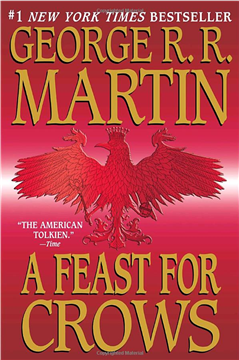
Day 322: A Feast for Crows

Cover for A Feast for CrowsBest Book of the Week!
It’s been awhile since I reviewed a book in A Song of Ice and Fire, and at the rate I’m going, the next book will be out before I catch up!

At the beginning of this fourth novel in the series, the War of the Five Kings is almost over, and several of the contenders for the crown are dead. Stannis Baratheon is the only king who has responded to the cries for help from The Wall, where Jon Snow is now Lord Commander of the Night’s Watch. Stannis’ religious beliefs are causing problems at The Wall, however, particularly because he has brought along the witch Melisandre. Jon must send his friend Sam and Maester Aemon away from the wall to save the maester’s life, as his family is an enemy of the Baratheons.

Tyrion Lannister is accused of murdering his father Tywin and has fled the city. Cersei Lannister’s son Tommen is now king, with Cersei acting as Regent. This situation in King’s Landing is a dangerous one, because Cersei is clearly a psychopath. She has complete control over the city and has many megalomaniacal plans, including trying to bring down her son’s wife. However, she soon seems to be working toward her own defeat.

Brienne, having long ago promised Catelyn Stark to save her daughters in exchange for Jaime Lannister’s freedom, is still searching for Sansa Stark, who has been removed to the Eyrie for her safety by the creepy Petyr Baelish, also known as Littlefinger. Littlefinger has been pretending that Sansa is his daughter, but he soon murders his wife and plans to put Sansa in her place.

Cersei has sent her brother Jaime to the Riverlands to establish order. He seems to be getting disillusioned with Cersei, and is appalled she has made him break his promise to Catelyn, among others. After all, “Lannisters always pay their debts.”

Arya Stark has crossed the waters to Braavos, where she has found shelter in the House of Black and White, a temple of assassins. When Arya kills a man who bragged that he deserted the Night’s Watch and then confesses the murder to the Kindly Man, her mentor, he gives her a potion to drink and she wakes up blind.

Characters have died and Daenerys is not featured in this novel, but new characters are being brought to the fore. In Dorne, Arianne Martell, princess of Dorne, tries to force her father, Doran Martell, into war by attempting to have Myrcella Baratheon, his ward, crowned as queen of Westeros. This plot results in tragedy.

Without giving away too much, it is difficult to convey how exciting this series is. One of the most intriguing features is that you never know what is going to happen with a character. Martin has populated this series with a plethora of them—so many that you need the reference at the back of the book to keep track of the minor ones—but your favorite character in one book can be dead in the next, or maybe not. He is skillful at depicting characters who are convincingly human and keeps up the suspense masterfully.

Day 301: 1Q84

Cover for 1Q841Q84 is an extremely unusual novel. I notice that the blurbs about it don’t reveal much about the plot, but I have chosen to describe the incidents in the beginning of the book because I found it difficult to decide whether to read it (I prefer book covers that give some indication of the plot or subject matter instead of just quotes) and probably wouldn’t have were it not for all the buzz.

1Q84 was originally published in Japan as three books, so it is very long. It is sort of a combination of a fantasy novel, a romance, and a mystery, but it is not by any means a genre novel.

In 1984 Tokyo, Aomame is on her way to an important meeting with a client when traffic becomes gridlocked on an elevated expressway. The taxi driver, who has Janáček’s Sinfonietta playing on the radio (which Aomame is surprised that she can recognize), tells her that there is an emergency staircase nearby that will allow her to exit the expressway and catch the train. He mysteriously reminds her that there is only one reality. Aomame climbs down the stairway–and enters a world on a slightly different track from her own.

Aomame is a physical therapist who works occasionally as an assassin, murdering men who have repeatedly abused women. Her appointment is with a victim, whom she murders. When she emerges from his hotel, she notices there are two moons in the sky and realizes she has entered a slightly different world, which she decides to name 1Q84.

In a parallel story also set in 1984 Tokyo, Tengo is a part-time math instructor who wants to be a writer and happens to like Janáček’s Sinfonietta. He is approached by Komatsu, a publishing company editor who is familiar with his work, to rewrite a novel that has been submitted to a competition. The story is unusual and imaginative, he says, but poorly written, and Komatsu believes that with help it can become a sensation. This suggestion is highly unethical for a submission to a literary competition, and Tengo is reluctant, but once he begins working with the material, he can’t resist it.

Tengo finds that the novel, named The Air Chrysalis, was written by a teenage girl named Fuka-Eri, who is a fugitive from an idealistic commune that has become a secretive religious sect. The novel is about Little People who weave a chrysalis out of the air and live in a world with two moons. Fuka-Eri tells Tengo that the Little People exist.

I was driven to finish the first book to try to figure out the connection between the stories of Aomame and Tengo. There are many echoes between the two stories, but the two characters seem to be living in different worlds, as tracked by the number of moons.

In the second book, the connections become clearer. By the third, I was reading to see if Aomame and Tengo are finally able to meet and emerge from danger.

Reviews of this novel are mixed, and I find that I feel the same way. I have seen 1Q84 compared to Ulysses, which is absurd, and on the other end of the spectrum, completely dissed. Certainly, Murakami has written a story that compels you to finish, but I found the mystery of the Little People to be lacking any internal logic and even a bit silly. I also have a sneaking suspicion that if The Air Chrysalis was really published, it would not be a publishing sensation but more likely a publishing joke. And don’t get me started on Cat Town.

Moreover, although Tengo as a character seems attractive and convincing, I found Aomame much less likely. To mention one detail, yes, many women are unsatisfied with their own appearance, including their breast size, but they don’t think about it constantly. After about the twentieth mention of Aomame’s breasts, this repetition becomes tiresome.

Tengo also has an obsessive memory of his mother’s breasts. In fact, the sexual context of the novel is definitely peculiar, with lots of odd descriptions of pubic hair and references to intimate body parts. The physical focus is just one facet of Murakami’s use of repetition as a thematic technique.

My prediction is that if you choose to read this novel you will want to finish it, but you may find parts of it absurd.

Day 287: The Dragonriders of Pern

Cover for Dragonriders of PernAnne McCaffrey’s fantasy books about Pern were a guilty pleasure for me starting in high school. For years, I picked up every one of the books, until it seemed as if she was simply dashing them off. I understand that the series is continuing, written by McCaffrey’s son Todd.

I recently reread The Dragonriders of Pern for old time’s sake. This book incorporates three of McCaffrey’s Pern novels: Dragonflight, Dragonquest, and The White Dragon.

Dragonflight was my introduction to and the first novel in the series, and I still enjoyed the tale of Lessa, revenge, and a new life. Lessa has been living as a kitchen drudge in the hold that Lord Fax invaded when she was a child, murdering the rest of her family, who had been the hold’s rulers. For years she has been nursing her thirst for revenge, and sees an opportunity when F’lar, a dragonrider, comes to the hold in search of female riders for the as-yet unhatched dragon queen. Soon, she finds herself renouncing some of her plans and going off with the weyrfolk. This novel still has all its original magic, featuring a fully realized fantasy world, an immanent threat, and an engaging hero and heroine.

Dragonquest begins seven “turns” after Dragonflight. F’lar and Lessa are now weyrleaders, and they are trying to unite all the weyrs in the battle against thread, which looks as if it might consume their planet. At the end of Dragonflight, Lessa went back in time to bring forward the weyrs from the past for help. Now those weyrs are behaving like a bunch of feudal lords, and F’lar and Lessa are searching for solutions to the problems. This novel was also just as good as I remembered.

The White Dragon seems much more of a children’s novel. Lord Jaxom is the son of Lord Fax, whom Lessa got F’lar to kill in a duel in Dragonflight. As a lord holder, he is expected to take on duties that have nothing to do with weyr life, but when he is a boy, he accidentally impresses a white dragon. The dragon never grows very big and seems to be unsuited to the regular tasks of weyr life. But Jaxom is convinced that his Ruth can fight thread and act just like any other dragon. This novel seems much more juvenile than the other ones, and I find it much less interesting.

I should also say something about the edition, which is cheaply constructed and poorly edited. I found many typos that I don’t think I encountered in the original versions of the novels.

Day 253: The Darkest Road

Cover for The Darkest RoadI guess it’s about time for me to finish The Fionavar Tapestry series by reviewing the last book. I have avoided doing this because my notes mostly consist of comments about who I was sad about (Finn, Tabor, and Diarmuid) and who I didn’t care about (Jennifer, Darien, Dave, Paul, Kevin).

The end of the novel is, of course, an epic battle. I would actually like to read a fantasy novel that doesn’t end with an epic battle. But the crux of the matter lies with the god-child Darien, who has to decide whether he is good like his mother Jennifer or evil like his father Rakoth. Unfortunately, because Kay chose the route of having Jennifer be Queen Guinevere reincarnate, she isn’t allowed to develop as a character but is treated more as a symbol. As I stated before in my review of The Wandering Fire, I think the whole Guinevere/King Arthur/Lancelot plot is completely unnecessary.

My other significant comments are that the pace is very slow and I feel the final book, although affecting, perhaps tied up all the loose ends too neatly. I would like to close, unusually, by quoting a review from Publisher’s Weekly, because it is true and made me laugh. “The exceptionally detailed background of this fantasy would be more impressive if it didn’t suffocate a book already burdened with static narrative and turgid, poetic prose that all too fittingly captures the adolescent posturing of its transplanted college student protagonists.” You might remember my comments about the juvenile characters in my review of  The Summer Tree.

The Fionavar Tapestry is a well-known work by Guy Gavriel Kay, but really, if you want to try reading him, you can do much better. Pretty cover, though.

Day 249: The Physick Book of Deliverance Dane

Cover for The Physick Book of Deliverance DaneBest Book of the Week!
Connie Goodwin has just passed her orals in history at Harvard and is one thesis away from her doctorate when her advisor, Manning Chilton, challenges her to find an undiscovered primary source on which to base some subject about Colonial America. She is almost immediately side-tracked in her research by a request from her mother to sort out her grandmother’s long-abandoned house in Marblehead and sell it to pay off back taxes.

Connie finds a very old, filthy house with a gate so overgrown with vines that it’s hard to find the house. Almost immediately she has a few odd glimpses, as if she can vividly picture her grandparents and other people in the house.

While sorting through the objects and papers in the house, she finds evidence of a woman named Deliverance Dane, who was found guilty of witchcraft in the Salem trials and left behind a “recipe” book, possibly of spells. Chilton immediately begins putting pressure on Connie to find the book, as it could provide the first evidence that people were actually practicing witchcraft at that time in Massachusetts. As Connie searches for the book, she makes some astonishing discoveries about her family and herself.

Back in the 17th century, Deliverance Dane, a wise woman or healer, is called to attend a child she cannot save. When the child dies, her father accuses Deliverance of satanism.

Some small things at the beginning of the novel irritated me. In laying the foundation of some basic history, I think Howe condescends to the reader a bit too much. For example, she finds occasion to tell us what a familiar is. Although many people may assume that all familiars are cats and find out differently from this novel, I would be surprised if people didn’t know what they were, if only from remembering their grade school lessons about the Salem witch trials. But perhaps I’m wrong.

There are also a couple of instances where Connie takes awhile to figure out something that she, as a graduate history student, should already know. For example, she doesn’t immediately know that “receipt” is another word for “recipe,” and then she has to explain this term to her professor, supposedly an expert in Colonial America. I am no historian or even generally interested in this period of history, but I knew immediately what the word meant. She does the same thing with figuring out that “Deliverance Dane,” mysterious words on a piece of paper, is someone’s name, as if in all her studies of the period she never encountered such an unusual name.

It is also very easy to see where the novel is going and who will turn out to be a villain. However, I still found it interesting enough to regard it as a strong first novel, especially if you enjoy the mixture of historical fiction and the supernatural. The characters are believable, and both story lines kept my attention. The historical portion seems solidly researched.

And I won’t mention the tomatoes, because it’s just too picky.

Day 228: The Night Circus

Cover for The Night CircusIt is the mid-19th century. Prospero the Enchanter raises his daughter Celia Bowen as if she were an apprentice magician, only it is not magic she is working. Continuing an ancient disagreement, Prospero challenges the man in the gray suit to a competition–his daughter against any opponent. So, the man in the gray suit takes a young boy out of an orphanage.

Both children grow up training for this elusive competition, and when they are adults, the man in the gray suit collaborates in creating the Night Circus and sends his protégé Marco to work for its designer. Soon Celia is employed by the circus as an illusionist, and Celia and Marco take up the competition with no understanding of its rules. Celia doesn’t even know who her opponent is.

The Night Circus is a marvelous place, all white and black and gray, constantly growing and changing. It becomes the venue for and creation of the competition.

The Night Circus has been extremely popular, and it seemed like it was right down my alley. However, although it is entertaining enough and is certainly based on an original idea, at some point my interest began flagging.

I think one major problem of the novel is that we are constantly told how wonderful the circus is, but Erin Morgenstern fails to describe it in a compelling way. Descriptions are vague instead of specific enough for readers to imagine a scene. In two or three consecutive pages, for example, I just happened to notice that Morgenstern used the word “elaborate” five or six times with no attempt to describe each object beyond that word. The details she does divulge don’t sound as if they would be that interesting, and frankly, a black, white, and gray circus seems to be the invention of a person more concerned with style than enchantment. An important part of a circus is the vibrancy of color. I felt no sense of wonder, was never surprised or beguiled, and I was occasionally confused, especially concerning the “wonderful coalescence” described in one scene. What does that mean? Although the competition turns out to be about life and death, I also never felt any sense of danger.

Another problem for me is the fable-like quality of the novel, which treats the characters more emblematically than as real people. You feel some sympathy for Celia and Marco, but you don’t know what they are like. Overall, I found the novel mildly disappointing.

Day 215: The Wandering Fire

Cover for The Wandering FireLike the middle book of many trilogies, The Wandering Fire has so much going on in it that it is hard to describe. It of course is meant to continue the plot of The Summer Tree, the first book of Guy Gavriel Kay’s The Fionavar Tapestry, and leave us with a cliffhanger before the final book.

In the first book, a mage brought five university students to Fionavar, where they were separated to fulfill their various roles. The five friends returned to their own world at the end of the book to rescue Jennifer from the hands of the Unraveller. The fact that they could have done this any time after she was kidnapped, fairly early in the previous book, and saved her from being raped and tortured seems to have escaped everyone.

Most of them return to Fionavar when Jennifer is near term with a child who will be half man, half god. Kim stays behind to wake up Arthur Pendragon and bring him along. Of course, Jennifer turns out to be an incarnation of Guinivere.

I think the Arthur and Guinivere subplot was where the book pretty much lost me. I know this novel  is a mishmash of just about every Celtic myth, but King Arthur? Really? Could we not get more original than this? I think this plot is where the novel really shows its roots in the early 1980’s. It also seems to have been written by a very young man, although Kay was in his early 30’s when it was published. Again, as I mentioned in my previous review, the characters are not well developed, and the men particularly seem immature.

Day 203: A Storm of Swords

Cover for A Storm of SwordsBest Book of the Week!

My notes for A Storm of Swords, the third entry in George R. R. Martin’s A Song of Fire and Ice saga, say “This series just keeps getting better and better.” This novel picks up slightly before the end of the last one.

The evil King Joffrey Lannister has set aside his betrothal to Sansa Stark so that he can marry Lady Margaery Tyrell. Sansa is forced to marry Joffrey’s uncle Tyrion, the dwarf. Tyrion treats her gently, but she remains afraid of him. Soon, Joffrey is murdered, and Tyrion and Sansa are accused of the crime.

Jaime Lannister has made a deal with Catelyn Stark for his freedom in return for Catelyn’s daughters. He goes off firmly intending to meet his part of the bargain, escorted by the knight Brienne of Tarth.

Robb Lannister’s army has smashed the Lannister forces in the Westerlands, but Robb has ruined an important alliance with the House Frey by marrying Jeyne Westerling of the Crag instead of his intended Frey bride. He agrees to a Frey marriage for his uncle in an attempt to make amends.

Arya Stark is still wandering, trying to get home to Winterfell. The group she is traveling with encounters Sandor Clegane, The Hound, who kidnaps her.

Up at the Wall, Jon Snow has disappeared on a scouting mission with Qhorin Halfhand. Although Halfhand has commanded Jon to act as an oathbreaker so as to infiltrate the wildings, when he returns, the members of The Watch think he has betrayed them. Bran Stark and his friends Jojen and Meera Reed, having hidden in the crypts during the destruction of Winterfell, arrive at the Wall in Jon’s absence and go on farther north.

In the East, Daenerys Targaryen gives up one of her dragons to buy an army of eunuch slaves called the Unsullied. Her hatred of slavery is such that she orders the Unsullied to sack the slaver cities and frees all the slaves.

Martin shocks you at times by killing off some of your favorite characters. But are they all really dead? If you haven’t read any of these books, you’re missing an exciting series.