Day 189: The Girl with No Shadow

Cover for The Girl with No ShadowI just reviewed Chocolat recently, so I thought I’d continue with a review of The Girl with No Shadow, Joanne Harris’ sequel to that novel.

The wind is blowing trouble toward Vianne Rocher, now running a small chocolatierie in Montmartre in Paris. The trouble is coming in the form of a con woman with many names, whom Vianne will know as Zozie de l’Alba.

Vianne herself has another name. She is going by Yanne Charbonneau because of some problems that developed after the birth of her second daughter, Rosette, now four. Vianne has been doing everything she can to avoid standing out. Anouk is now known as Annie. Gone are the red dresses with bells hanging from the hems. Yanne is demure and nondescript and doesn’t use her magic, even to know what a customer’s favorite chocolate is.

Annie, at eleven, is unhappy with school and with the changes in their lives. Soon more seeds of discontent are sown. As Zozie weasels her way into their lives and prises away their secrets, she decides that when she leaves, she is taking Annie with her. So, she does her best to encourage Annie’s rebellion against her mother.

Again, Harris combines the gentleness and kindness of Vianne’s temperament with a fair amount of suspense. As we learn more about Zozie’s past, we find out just how dangerous and devoid of conscience she is.

As usual the writing is beautiful, sprinkled with the scents and flavors of the chocolatierie and a dash of magic.

Another novel about Vianne and her family is just out, Peaches for Father Francis, so I guess I had better get reading!
Day 182: Chocolat

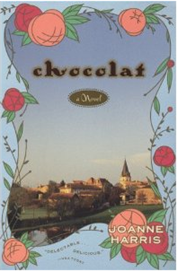
Cover for ChocolatI decided to review Chocolat today because I just started reading The Girl with No Shadow, Joanne Harris’s sequel. Even though I have always enjoyed reading Harris’s books, I didn’t read Chocolat until long after seeing the movie, perhaps because I saw it first. The movie is pleasant enough but anemic and inexplicable, and as I found later, does nothing to convey the magic of the novel.

Vianne Rocher and her six-year-old daughter Anouk blow into the small village of Lansquenet-sous-Tannes with the wind. They are distinctly odd. Vianne wears red skirts with bells on them, and Anouk has an imaginary friend, a rabbit named Pantoufle, that some folks occasionally think they’ve glimpsed.

Vianne opens a chocolate shop, making her own wonderful confections. She seems to have an almost sixth sense about which chocolate will be each person’s favorite, and she creates miraculously inventive window displays for special days. She also begins befriending some of the village’s misfits.

This all sounds very pleasant, but Pére Reynaud, the local priest, hates Vianne on sight. She has opened a chocolate shop during Lent! Right across the street from the church! He begins a campaign to try to force her out of town. When Vianne plans a chocolate festival to celebrate Easter, he believes she is being sacrilegious and vows to ruin the festival.

Vianne herself has lived like a vagabond her entire life and wants to settle down. Her witch mother died on the streets of New York, and she wants her child to have a better life than hers has been.

The novel is colorful and teems with eccentric characters, as well as lovely descriptions of food. It is beautifully written. As I read it, I was able to understand why the book is so beloved.

Day 170: The Subtle Knife

Cover for The Subtle KnifeA few months ago, I reviewed The Golden Compass, the first book in Philip Pullman’s trilogy, “His Dark Materials.” I thought it was about time to review the second book, The Subtle Knife.

As I have said before, it’s most difficult to review the second book in a trilogy, because everything is building up toward the third book. Lyra follows her father, Lord Asriel, through a window to another world. There she meets Will, a boy from our world.

Will has taken care of his mentally ill mother since his father disappeared on an expedition years before. Recently men have been breaking into their house trying to find his father’s papers. Will kills one of them accidentally and flees into the other world through a window, where he meets Lyra.

Lyra is trying to find out about dust, but the alethiometer tells her to help Will find his father. What they find first is the subtle knife, which can cut through anything, even the fabric between worlds. Will becomes the knife’s keeper.

Although the concept of the knife cutting the fabric between worlds is interesting, I really loved the whole feel of the world and the characters in The Golden Compass. Some of the characters are still with us in the second book, but we are moving away from that world. However, I enjoyed The Subtle Knife. I just don’t think the rest of the trilogy stands up to The Golden Compass in imaginative power and characters you feel really invested in.

Day 154: The Summer Tree

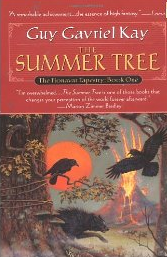
Cover for The Summer TreeLong ago I read books one and two of Guy Gavriel Kay’s The Fionavar Tapestry but was unable to find the third book. Awhile back, I found copies of all the books and decided to re-read the trilogy. It is going to be very hard for me to divorce my review of The Summer Tree, the first book, from that of the entire trilogy, because my impressions are of the complete trilogy, but I remember thinking that it was the best of the three books.

Five friends attend a lecture by Professor Lorenzo Marcus on the University of Toronto campus. After the lecture, he reveals that he is actually the mage Loren Silvercloak who has come to them from Brennin on another world to ask them to travel there and celebrate the reign of High King Ailell. (Of course, they decide to go.) One of them lets go of the others during the transfer and finds he is separated from the others for much of the action of the novel. On Brennin, it turns out to be the eve of a great battle, during which each of the five find they have their special parts to play.

I had more to say in my notes about my impressions of this book than the plot, which is complicated. I feel that the book, while interesting and beautifully written, is much more immature than the other Kay books I have read. (It is his first.) The strangers coming to save another world idea has been done to death, and the second and third books become even more trite with the introduction of a King Arthur and Queen Guinevere plot, which I find tiresome. The five main characters are relatively uninteresting, and some of the male characters, particularly, are a little juvenile. Finally, the entire trilogy seems dated, particularly in the behavior and attitudes of the characters. My impressions of other Kay books, such as Tigana or The Song for Arbonne, are that they are more rich and subtle.

Day 141: Shadow of Night

Cover for Shadow of NightAs with most second books of a trilogy, Shadow of Night is transitional and therefore harder to describe than the first book.

At the end of the A Discovery of Witches, the first book of Deborah Harkness’s “All Souls Trilogy,” Diana Bishop, an Oxford scholar and nonpracticing witch, and her husband Matthew Clairmont, a geneticist and vampire, were forced to flee because a union between a witch and a vampire is forbidden. Using Diana’s newly discovered time-travel skills, they have arrived in Elizabethan England so that Diana can find a witch to help her learn her powers. Even more importantly, they want to look for Ashmole 782, an enchanted manuscript that Matthew believes may hold the secret to the existence of witches, vampires, and daemons. This decision proves potentially hazardous, though, as the age they’ve chosen is one of persecution of witches and Diana has a tendency to draw attention to herself.

In Tudor England Matthew of the past is part of an intellectual group called the School of Night, the members of which include Sir Walter Raleigh and Kit Marlowe. Kit is a deeply disturbed daemon who is insanely jealous of Diana. Another hazard is that Matthew’s acquaintances may realize he is not the same person as the person from the past. In the meantime, both Diana and Matthew’s friends and enemies back in the present time watch for clues to their existence in the past.

Although this novel is a great sequel that propels you to the next book, it has the typical middle book problem of furthering the plot without arriving anywhere. Strictly because of personal taste, I could also have done without some of the heavy romantic passages, although other readers will like them. Nevertheless, I am extremely interested to see how Diana and Matthew will resolve all their problems in the final book.

Day 120: Tigana

Cover for TiganaI decided to try a book by Guy Gavriel Kay because I read somewhere that he is a great historical novelist who disguises his books as fantasy. I read another book a long time ago but more recently picked up Tigana. Each of his books seems to have the setting and atmosphere of a different medieval European country, although they are set on other worlds. In this case, the country is Italy.

On a peninsula made up of nine provinces, the provinces have been conquered and divided up between two tyrant sorcerors, Brandin of Ygrath and Alberico of Barbadior. During one of the last battles, Brandin’s son was killed by Tiganian soldiers. As revenge, Brandin had the Tiganian prince’s family killed and cast a spell so that no one except those born in Tigana can remember its name. That is, I think, an interesting and original idea that has far-reaching effects.

Years later, a young singer named Devin falls in with a group of wandering musicians and learns from them that he is from Tigana, although he cannot remember, as his father took him away as a child. The group, lead by Alessan, the last prince of Tigana’s royal house, has been waging psychological warfare to free the province from both tyrants and revive the name of Tigana.

These novels are well written and rich in detail. Unlike Kay’s most famous work, The Fionavar Tapestry, which seems immature at times, it is more fully realized and mature.

Day 107: A Clash of Kings

Cover for A Class of KingsThe second of George R. R. Martin’s Song of Ice and Fire saga, A Clash of Kings seems to reveal more of the true nature of the various characters, in particular, who is a villain and who is just being loyal to his or her own family. But the characters’ loyalties shift as the series continues.

Robb Stark has been declared King of the North in the rebellion against the Lannisters, his father’s murderers. Robb sends Theon Greyjoy to his father to form an alliance, but Balon Greyjoy has his own ambitions and so does Theon. Theon comes back in Robb’s absence and invades Winterfell.

Young Brandon Stark, who was crippled in the first book by Queen Cersei and her brother Jaime, has been dreaming of running with the wolves. When Winterfell is invaded, he flees for his life with friends and makes for The Wall. His half-brother Jon Snow is marching north of The Wall to try to stop the wildings from invading the South.

Joffrey Baratheon, Queen Cersei’s sadistic son, has gained the throne upon Robert Baratheon’s death. His uncle Tyrion Lannister, who is regent in the absence of his father and Jaime, does his best to rule fairly and counteract the actions of Joffrey, but everyone hates him anyway.

Robert’s brothers, the seemingly virtuous Stannis and charismatic Renly, also have claims to the throne. Stannis, stuck on his island and disliked by all, doesn’t seem to have a ghost of a chance of gaining enough support. But he swears himself to the Red Lord and begins using the dark arts to his advantage.

Daenerys, the only living heir of the former ruling family, is trying to find a way home with her three dragons. She is looking for alliances and money to buy arms and ships and hire soldiers so she can invade.

Eight-year-old Arya Stark is still trapped in enemy territory as is her older sister Sansa, who is quickly losing her infatuation with her fiancé Joffrey.

Such is the situation of the main characters at the beginning of the second book. Martin’s series is enthralling and complex, with many plot twists. You can never be sure that even your favorite character won’t be killed (or seem to be killed). This series thrusts you along, and despite the length of the books, you can’t wait to start the next one. Unfortunately for me, I have finished all of the books that are already available and am waiting for the next one to come out.

Day 99: Good Omens: The Nice and Accurate Prophecies of Agnes Nutter, Witch

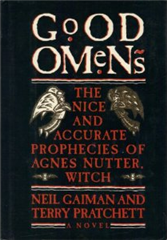
Cover of Good OmensAnd now for something completely different. Good Omens: The Nice and Accurate Prophecies of Agnes Nutter, Witch is an absolutely wacky spoof by Terry Pratchett and Neil Gaiman. In the planning for Armageddon, a demon gives the Antichrist to a Satanist nun to swap with the baby of an American diplomat. But she mixes up the babies, and the Antichrist goes home with an ordinary British family.

Eleven years pass, and the powers, both of light and darkness, gear up for the end of the world. But one angel (Aziraphale) and one demon (Crowley) have decided they like the human race and life on earth too much to want the war between Heaven and Hell. They go off together to find the Antichrist and avert Armageddon. And then there are Agnes Nutter’s “nice and accurate” predictions.

A review on the book cover says it is like a combination of The Omen and Monty Python, and that gets it about right. It contains lots of digs at sources of apocalyptic literature. This book is not for everyone, but many of you will find it hilariously funny.

Day 70: The Golden Compass

Cover for The Golden CompassThe Golden Compass is the first book in Philip Pullman’s trilogy His Dark Materials, a children’s book that appeals as much to adults because it is just plain exciting.

Lyra is an adventurous eleven-year-old orphan brought up by the scholars of Oxford in a world that is similar to ours in a previous century. In this world, every person has a daemon, an animal creature who is always with the person and who shares the person’s feelings. Until a child reaches puberty, the daemon changes from one animal to another.

Lyra is a bit of a wild child who spends most of her time clambering on the college roofs with her friend Roger, the kitchen boy, and getting into fights with the town kids. She has heard rumors of the Gobblers, a group who steals children, but she hasn’t paid much attention to them. Her real adventures begin the day she sneaks into the scholar’s room, where she is not supposed to be. She is hiding when she overhears a mysterious conversation about something called “dust” and sees the Master poison her Uncle Asriel’s wine. She is able to warn her uncle in time.

After her uncle departs on an expedition to the north, her friend Roger is stolen by the Gobblers. Then Lyra and her daemon Pantalaimon are removed from Oxford by the beautiful and mysterious Mrs. Coulter and taken to London. Before she leaves, the Master gives her the golden compass, a device that can tell the future, and says she should hide it from Mrs. Coulter.

Lyra flees from Mrs. Coulter’s house when she learns that Mrs. Coulter’s monkey daemon has been spying for the compass and also figures out that Mrs. Coulter is one of the Gobblers. She throws her lot in with a gang of the gyptians, a tribe of wanderers who have joined forces to go north and fetch back the stolen children.

The Golden Compass is wonderfully inventive. Just as a side note, I also greatly admired the movie, with its cool steampunk look. Lyra is a great heroine, you just love Pantalaimon, and you get very attached to many of the other characters. Full of action and suspense, The Golden Compass is a great book.

Day 43: A Discovery of Witches

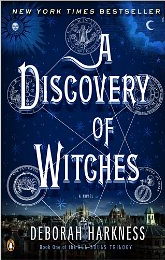
Cover for A Discovery of WitchesBest Book of Week 9!

A Discovery of Witches by Deborah Harkness is like Twilight for adults. A couple of years ago I decided to try the wildly popular Twilight series and found the first book terribly juvenile. But recently, I picked up A Discovery of Witches, also extremely popular and with similar themes. I just finished reading it and had a lot of fun.

Diana Bishop is a Yale science historian visiting at Oxford to study alchemy. She is also a witch, from a long line of witches. But ever since her parents were murdered in Africa when she was seven, she has refused to learn about and tries not to use witchcraft.

She is working in the Bodleian Library when among the manuscripts she calls up is one called Ashmole 782. As soon as she touches it, she can tell it is powerfully enchanted. To keep true to her vow not to use witchcraft, she refers to it as she would any other manuscript and then sends it back.

Not long after, she meets a mysterious vampire named Matthew Clairmont, a well-known but reclusive genetic scientist. He is interested in the book but disturbingly warns her to beware of other witches. As she has been brought up to fear vampires, she is appalled at his warning and tries to avoid him. But she soon figures out he is actually trying to protect her from the other vampires, witches, and daemons who have suddenly appeared in the library, despite the dictum that the three species are not supposed to draw attention to themselves from humans. Matthew explains that they all want Ashmole 782.

Soon Diana and Matthew have formed a strong bond of attraction, but because Diana has neglected her education in her heritage, she is unaware that relationships between the species are strictly forbidden.

This is a lively and engrossing book, sometimes light and comic but other times fraught with romance, danger, action, and suspense. You care about Diana and Matthew and are interested to see where their story is leading. The book also introduces other fascinating characters, such as Diana’s aunts, Matthew’s family, and Diana’s aunt’s house. Yes, it is a character. Matthew–overly protective, quick to anger, not always under control–makes a much more convincing vampire than does the sulky, languishing Edward from Twilight, and Diana is a lot smarter and more interesting than Bella. This book is the first of a series of three, and I’ll be looking forward to the second book.