Review 1352: Solace

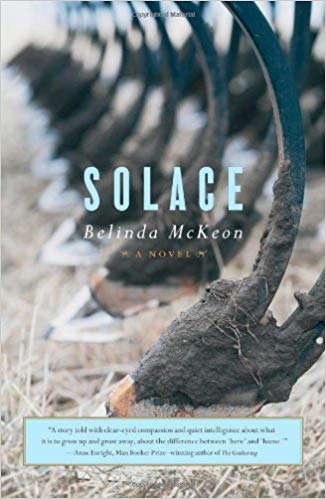
Cover for SolaceSolace examines with intelligence and compassion a difficult relationship between father and son. This relationship is eventually made more complex by grief.

Mark Casey is a graduate student writing his Ph.D. dissertation in English literature at Trinity. He feels as if his father, Tom, expects his help on the farm too often. His presence at the farm is brokered by his mother, who barely lets a day go by after he has left before she is asking when he’ll be back. Mark has no interest in running the farm, however, even though his work on his dissertation is faltering.

Tom Casey thinks Mark was born to work the farm. Although Mark was interested in helping as a youngster, his interests began changing when he became a young man. Tom does not understand Mark’s choice of a profession and makes it clear that he thinks Mark will eventually choose to return to the farm. When they are together, they are soon arguing.

Then Mark meets Joanne Lynch at a party, and they begin dating. By rights, he should already know her, because she grew up not ten minutes down the road from home. However, since they were both young, his father has had a feud with Joanne’s, which has not ended with Brian Lynch’s death. The situation between Mark and Tom becomes more complicated when Joanne finds she is pregnant after they’ve only been dating a few weeks.

This novel shows insight into a difficult relationship, how both father and son say things they don’t mean while being unable to say what they do mean. Then their relationship is tested further through tragedy.

This is an interesting, empathetic novel about ordinary lives that I read for my James Tait Black project. It is touching and true to life and provides no easy answers for its characters.

Related Posts

& Sons

The Sea

Gilead

Day 823: Black River

Cover for Black RiverWes and Claire Carver have been living in Spokane since they left Black River, Montana, 30 years before. But when Claire realizes she is dying from cancer, she asks Wes to take her home to Black River. She also asks him to play to her, which he cannot do, because his fingers were broken years before.

Although Wes plans to take her the day after Claire’s request, she dies during the night. So, Wes prepares to return her ashes to Black River.

Wes has not been there nor seen his stepson Dennis since he and Claire left, although Claire has been back to see her son. Their leaving was after a horrendous series of events. First, there was a riot in the prison where Wes worked. He was held prisoner by a convict, Bobby Williams, for more than a day, and tortured, his fingers ruined. Later, in an argument with teenage Dennis, Dennis pulled a gun on him. That was when he demanded that Claire choose between him and Dennis.

Added to his grief and the difficulties of seeing Dennis again, Wes has heard that Bobby Williams is up for parole. Williams claims to have found God and to be a different person than he was when he held Wes captive. Wes doesn’t believe that people can change. In fact, his beliefs go farther than that, the source of the problems between him and his stepson. Dennis’ father was a criminal, and Wes has always watched for criminal tendencies in Dennis. Finally, Williams robbed Wes of one thing, his gift as a talented fiddler, that made him believe true faith was possible.

Like the modern Western novels of Kent Haruf, which inspired this one, Black River is a quiet story about ordinary people. Although Hulse is not Haruf’s equal as a stylist, she shows herself as an accomplished storyteller.

Related Posts

The Hour I First Believed

Empire Falls

The Burgess Boys

Day 724: & Sons

Cover for & Sons& Sons is a novel about fathers and sons, but it is really most about sons and the effect on them of their father’s actions. It is also about the fate of a lifelong friendship.

The friendship seems to be the catalyst for events. Charles Topping has died, and his funeral is packed with people waiting to see his best friend, the reclusive novelist A. N. Dyer, give the eulogy. Dyer is noted for several excellent books, but Ampersand has become a classic about prep school life.

At the funeral, though, it becomes clear that Andrew Dyer himself isn’t quite all there. During the eulogy, he becomes upset about the whereabouts of his young son Andy and has to be removed from the podium.

The story is told by a narrator who is not at all trustworthy, Charles Toppings’ son Philip. When Andrew Dyer meets him at the funeral and finds he has split from his wife, he kindly invites him to stay.

This suits Philip, who grows more malevolent as we get to know him. He is on hand a few weeks later when the Dyers reunite at their father’s request to discuss something important. He can be there to eavesdrop and look through old papers, but generally he cannot possibly be privy to all the details of the story he tells.

Andrew Dyer has been estranged from his ex-wife and two sons since the family learned about the existence of his third son, Andy. Andy is now seventeen. Andrew has tried to avoid neglecting him, as he did his two other sons, and do a better job of bringing him up. But Andrew knows he is nearing the end and is afraid Andy will be alone. He fears Andy is just as messed up as the other sons, only in a different way. Andrew has formed another preoccupation about Andy that shows how divorced he is from reality.

Andrew’s oldest son Richard is an ex-drug addict who has stabilized his life with great difficulty. He is now a drug counselor and has a wife and two teen children. The other son Jamie is a documentary filmmaker whose films for years have dwelt on the darkest of subjects. Philip Topping has a grudge against both of them for the teasing he received as a child.

The novel is told using letters between Andrew and Charlie, passages from Ampersand, and other artifacts from Andrew’s life, as well as Philip’s testimony. We find Andrew feverishly manufacturing an “original draft” of Ampersand because he burned up the original manuscript in disgust at what he did to his old friend Charles in fiction. Now he needs one to leave with his papers.

I waited to write my review for a few days after I finished the book, and I’m still not sure how much I enjoyed the novel. It is well written and absorbing, and it provides a lot to think about.

Related Posts

The Art of Fielding

The Sense of an Ending

The Child in Time