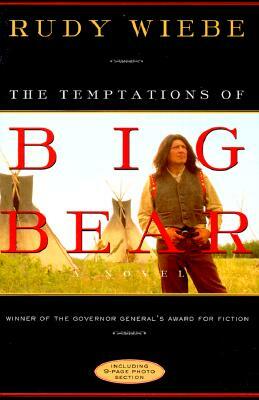
Review 2546: The Temptations of Big Bear

I can’t remember whether I found this book when looking for more about native peoples or for filling holes for my A Century of Books project. In any case, it does both.

Readers from the U. S. may not be familiar with the name “Big Bear,” but I’m betting Canadian readers are. He seems to have been their equivalent of Sitting Bull.

In The Temptations of Big Bear, Wiebe tells Big Bear’s story beginning in 1876, when the Cree, of whom Big Bear was a chief, along with other groups of native peoples and the Métis, meet to discuss a treaty with British officials. The treaty calls for the people to “sell” several hundred thousand acres to the government in exchange for small reservations and regular payments as well as assistance when they are hungry. Big Bear does not sign the treaty. He wants to wait to see what happens.

Within a few years, it becomes apparent that the buffalo, upon which the Cree depend, are dying out, so Big Bear signs the treaty. However, he does not select a reservation for his people. Instead, they continue to move among their usual environs.

This novel leads up to events at Frog Lake in 1888, where some of the Cree warriors attack the settlers, kill some, and take others prisoner. These attacks follow years of broken promises and starvation. Although Big Bear tries to stop them, he is disregarded. Of course, he is held responsible by the authorities and tried, despite all the white witnesses but one having testified for him.

This is an eloquently written novel. It is insightful and interesting, and Big Bear’s last speech at his trial made me cry.

Wiebe doesn’t cite sources, and it’s hard to tell whether some of the speeches and writings are verbatim from records or not.
Related Posts

One Thousand White Women

Mayflower: A Story of Courage, Community, and War

The Sentence

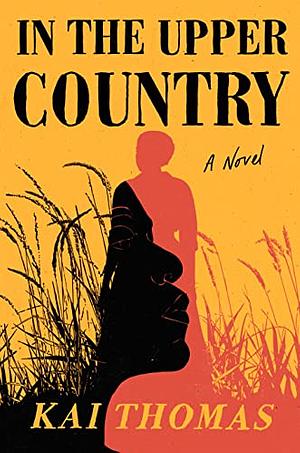
Review 2483: In the Upper Country

In 1850, Lensinda Marten lives in an all-Black town in Canada north of Lake Erie. She is a healer, but she is puzzled when she is summoned to the side of a slave catcher who has come after a group of escaped slaves that are hiding on Simion’s farm. Puzzled because the man is dead. When she hears that an old woman, one of the escapees, has been arrested, she realizes she is wanted to write a story about the woman for the Abolitionist paper.

She goes to visit the old woman in jail and finds that she isn’t ready to tell her story. Instead, she wants to swap stories with Lensinda. In doing so, a history of cruelty is reveealed, and the two women find connections between each other.

Thomas says in the Afterword that he heard and read many stories about Canada’s history of slavery, its treatment of First Nations people, and the War of 1812, but he could find no story that did everything he wanted. So, he chose this method of telling several stories that interface.

Although I found the information interesting and the settings and historical details to be convincing, I’m afraid his approach didn’t work that well for me. Just as I was getting interesting in Lensinda’s story, the novel appeared to move away from her. There were quite a few characters whose connections aren’t immediately clear, and I kept getting them confused as we jumped from story to story. Eventually, the stories connect, but that wasn’t clear for quite a while.

I read this novel for my Walter Scott prize project.

Related Posts

Washington Black

Beloved

This Godforsaken Place

Review 2337: The Berry Pickers

Joe’s Mi’kmaq family travels every year from Nova Scotia to Maine, where his dad is the foreman of the berry pickers and the rest pick berries, too. In 1962, Joe’s little sister Ruthie disappears from where they left her sitting on a rock eating a sandwich near their camp. The police don’t give them much help. The family searches for her for days but does not find her and continues to look for her in subsequent years..

Now an older man dying of cancer, Joe has lived most of his life away from the family, blaming himself for events caused by his anger. He has finally returned home to die, surrounded by his family but not Ruthie.

While Joe looks back over his life, we hear from Norma. As a child, Norma had dreams of another home, another mother, a brother named Joe. She also had an imaginary friend named Ruthie. But her mother told her it was just her imagination—her neurotic, overprotective mother who barely let her go outside. It’s not too hard to guess Norma is Ruthie.

Every other chapter is Norma’s, as she grows up, sometimes receiving clues about her identity but never really going there.

The novel is built around whether Norma will find her family before Joe dies. There’s not much doubt about that, although the ending is touching.

I thought the idea behind this novel was an interesting one, although in Norma’s mother Peters has invented a monstrous creation, as proved by her family keeping her secret to pacify her. I think we’re supposed to feel some sympathy with this grief-stricken woman, but I absolutely didn’t, and even though her husband is a sympathetic character, I couldn’t fathom his actions.

That aside, Peters’ writing is fairly commonplace, with lots of clichés. I found her characters flattish. I was a little disappointed in this one.

Related Posts

There There

History of Wolves

Guy Mannering