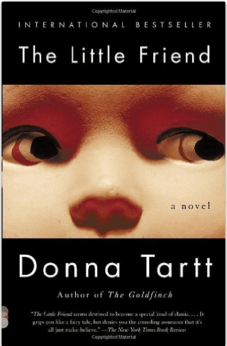
Day 853: The Little Friend

Cover for The Little FriendI didn’t decide to read The Little Friend until recently. That was because I was one of the few people who didn’t like Donna Tartt’s first book, The Secret History. I thought The Goldfinch was wonderful, however, so I decided to give The Little Friend a try.

This novel shows influences from practically every modern southern novel I’ve ever read, a bit of the Comptons from Faulkner, a touch of To Kill a Mockingbird, and lashings of Southern Gothic. The novel’s world is a harsh one, although not as twisted as that of Flannery O’Connor.

The main character is 12-year-old Harriet Dufresnes, a bookworm and misfit in 1970’s Alexandria, Mississippi. She is from a once-wealthy family whose rotting mansion, no longer in the family’s possession, is out in the countryside. Harriet lives in town with her mother Charlotte and sister Allison. But whatever future they might have had was prematurely blighted by the death of Harriet’s brother Robin, at the age of nine, 12 years earlier. Robin was found hanging from the tree at the edge of the yard, and his murder has never been solved. Their household has been made miserable by the ceaseless mourning and lassitude of Harriet’s mother.

Harriet is facing a long, lonely summer when she decides to avenge the death of her brother. She understands from the family’s maid Ida that Robin and Danny Ratliff were bitter enemies, so she decides that Danny, who is now a small-time criminal and meth addict, must be the murderer. She begins stalking him with the help of her best friend, Hely.

The Ratliff family embodies almost cartoonish O’Connor Southern Gothic. Farish, the oldest brother, is a half-crazed and hyperactive meth cooker and dealer. Although he talks about fighting in the Vietnam War, he spent it in a mental institution and is said to have calmed down since he had a head injury. Eugene is a street corner preacher who is inept at preaching. Curtis is a sweet-natured boy of limited mental capacity, and Gam, the boys’ grandmother, relentlessly favors Farish and does her best to undermine the other brothers’ efforts to leave their lives of crime.

Danny is rather a more tragic figure than anything else, but I was more interested in Harriet’s life than in her interactions with the Ratliffs. That situation provides the tension and danger of the plot, but I was sometimes bored by it and other times found it grotesquely funny.

Harriet’s family is the essence of dysfunction. Her mother is almost completely self-obsessed, spending all her time mourning Robin. She neglects her two daughters and stays in her bedroom. Harriet is dependent on Ida for any attention or care in a house that is only held from chaos by Ida’s efforts. Allison, although 16, is timid and milky and almost doesn’t exist as a character.

The other influences on Harriet are her grandmother Edie and her great-aunts. They are really the only points of stability in her life, especially her great-aunt Libby.

By and large, I was impressed by the energetic writing and the imagination of The Little Friend. The parts I don’t admire as much are the forays into an almost clichéd Southern Gothic of the Ratliff brothers. Still, I found it hard to put down this novel.

Related Posts

The Goldfinch

The Optimists’s Daughter

Wise Blood

Day 388: Wise Blood

Cover for Wise BloodFlannery O’Connor stated that she didn’t understand when her works were termed Southern Gothic or grotesque. She continued throughout her life to emphasize that the theme of her works is redemption. Nevertheless, Wise Blood is grotesque.

Hazel Motes has returned from the service after World War II to find his home town in Tennessee deserted and his house crumbling and decrepit, so he goes to live in the city, the fictional town of Taulkinham, Alabama. Having grown up in a fundamentalist environment, he has decided that Jesus was just a man and there is nothing from which to be redeemed. Soon, he is preaching outside movie theaters about the Church of Christ Without Christ.

Haze doesn’t see anything he’s looking at and doesn’t hear anything anyone says to him. He is totally wrapped up in his obsessions about religion. He becomes fascinated by Asa Hawks, an evangelist who supposedly blinded himself for Christ, and can’t see that this man is a con man who is not even blind.

He also meets Enoch Emery, a whining zookeeper who spends his days peeping out of the bushes at the women bathing in the park swimming pool. Enoch tells Haze that his family has “wise blood,” that is, his blood tells him where to go in life and what to do. Enoch’s blood is obsessed with a mummy in the museum, which he thinks would be a Jesus for Haze’s church, not seeming to fully understand the point of Haze’s church. But Enoch doesn’t see or listen either.

In fact, no one in this novel listens to what anyone else says, and all of the characters are incredibly ignorant and uncultured. They are all grotesque, repellent creatures. Although the novel is supposed to be comic, it only made me laugh despite myself, as the situation becomes more and more ridiculous. O’Connor’s humor is brutal.

Everything in this short novel seems significant, is to be paid attention to, even the characters’ names. Both of Hazel Motes’ first and last names refer to the eyes, and Haze can’t see. Enoch Emery is abrasive. Asa Hawks is the “blinded” con artist who can actually see, and his daughter Sabbath Lily is anything but a lily. Hoover Shoats and Onnie Jay Holy try to take over Haze’s church. And speaking of Shoats, keep an eye out for the pig imagery, and think about what pigs are a symbol for in the Bible.

This novel is deemed a work of “low comedy and high seriousness.” Just speaking for myself, the religious theme is not one I find interesting. Yet, when you read O’Connor, you can’t help but be drawn along to the end.

Day 371: A Good Hard Look

Cover for A Good Hard LookA Good Hard Look is a novel about the last few years of writer Flannery O’Connor’s life. The book begins with the wedding of Cookie Himmel and Melvin Whiteson, which Cookie believes has been ruined because Flannery’s peacocks made so much noise the night before that Cookie fell out of bed and gave herself a black eye. Flannery’s mother Regina insists that Flannery attend the wedding, but Cookie is not happy to see her there.

Lona Waters lives her life absentmindedly and takes pleasure only in the hour of solitude she has every day before her daughter Gina comes home from school. Then her friend Miss Mary asks her if she will give her awkward teenage son Joe a job, thereby eliminating her hour.

Soon Melvin Whiteson has struck up a friendship with Flannery, but he keeps it a secret from his wife because of her dislike of the writer. Cookie is busily serving on committees in town and trying to get Flannery’s books banned from the library, while Melvin, a successful New York banker who gave up his career to move to this small town in Georgia with Cookie, is feeling out of place and bored with his insurance job.

These seemingly mundane stories eventually result in tragedies that force the main characters to take a good hard look at themselves, as Flannery states is a technique she uses in her fiction.

The novel is well written but not evocative. It does not evoke the 60’s South, and my feeling is that it does not evoke Flannery O’Connor. I am not an expert on her or her life, but the incisive spirit I would expect from her is missing in this character. Napolitano uses O’Connor’s peacocks to great effect, but I found that the novel tidied things up a bit more neatly than I would expect from one inspired by O’Connor’s life and works. Finally, the character of Cookie is essentially a caricature of the southern junior matron, similar to Hilly Holbrook in The Help, although Cookie evolves a bit. Most of the other characters are only sketchily drawn.

It is rather risky to use an actual person as a main character in a novel, especially if you are not able to create a character who is convincing as that person. For a much better attempt at using a famous writer as a main character, see Colm Toíbín’s wonderful The Master.