Review 2564: Animal, Vegetable, Miracle: A Year of Food Life

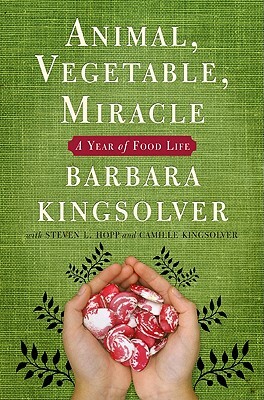
I usually enjoy Barbara Kingsolver, but even in her fiction, she can get preachy, so I have avoided her nonfiction. That is, I avoided it until I saw that this book filled a hole in my A Century of Books project. (At the book’s reading, I had seven or eight to go. Now, while I’m typing up this review, I have three. By the time it appears, I hope to have finished.)

Although Kingsolver is the primary author of the book, it also contains essays or informational sidebars written by her husband, Steve L. Hope, and her oldest daughter, Camille Kingsolver. It is about food—in particular, her family’s decision to act on its principles. To do so, they move from Arizona to her husband’s farm in Southern Appalachia (somewhere in Virginia). The idea is to try to live for a year only on food they grew or raised themselves or on local food.

Kingsolver has chapters on issues, for example, an early one is on the growth cycle—which vegetables and fruits are started when and when they are ready to be picked. (I didn’t find her concept of the vegetannual helpful at all. A timeline might have worked better.) But for the most part, she tells the story of the year, the things they plant or raise and when, the people they meet, the things they learn. These chapters were mostly interesting and sometimes entertaining. I was truly wrapped up in suspense about whether the turkey eggs would hatch.

Kingsolver talks also about issues around local food, such as how much gas is used transporting food that isn’t local to supermarkets; the takeover of Federal funds for farmers by large conglomerates (your local farmer isn’t getting the money); the negative effects genetically engineered seeds have on farmers, especially for organic farms; the growing local food movement and how to support it; and so on. The sidebars were some of the same topics, though, so I sometimes felt as if I was in church—tell them, tell them again, and tell them again. (Just as my own sidebar, I remember at about age ten asking my father after church why they did that and finishing my polite question with, “Do they think we’re idiots?”) You can see I have no patience with that kind of thing.

So, that’s a criticism, but on the other hand, lots of things in the book were interesting, and the descriptions of the meals had me licking my lips, recipes included in the book.

I personally have made steps at times to eat more locally. I belonged to a CSA for years, and I’m thinking of signing up for another one. I kept a vegetable garden here until growing trees cut off my sunlight, so now I just grow tomatoes on the back deck (in the tomato wagon). I try to stop often at a local farm store. (During the summer, I stop by every week, and I have stopped buying grocery store strawberries—I just wait for the fresh ones in late spring, because once I moved to this area and ate a real one, I realized that the ones in the store were not real.) In any case, this book has made me think of all this again.

Those of you who worry about the higher cost of local food may be very interested in the chapter about the food economics for a year. It turns out that when you forgo processed foods and do most of the cooking yourself, it’s a lot less expensive for a family to eat for a year even if paying more for some local foods. Of course, they were growing most of theirs, which everyone cannot do. However, like Michael Pollan also points out, Americans spend less money on food than people in most other countries. And even in the city, it’s possible to grow some of your food.

Related Posts

The Omnivore’s Dilemma

Cod: A Biography of a Fish That Changed the World

John Saturnall’s Feast

Review 2533: The Stone Angel

When I was looking for books to fill a hole in my A Century of Books project, I found this one. I thought I had read a book by Laurence before, but apparently not. The Stone Angel is the first in her Manawaka series.

Hagar Shipley is 90 years old. She is a proud, tough woman who has never expressed any of her gentler feelings. Now she finds that her son Marvin and his wife Doris are thinking she needs to move to a senior home. She understands this idea as greed for her home and possessions, although that is not the case. She is fighting the idea as best she can.

Hagar, though, is prone to falling and has memory lapses. In between the scenes from her current life, she returns in her memory to important events and tragedies in her life.

Hagar is not a pleasant person, but Laurence makes us interested in her and manages to make us understand and even sympathize sometimes with this complex character.

Related Posts

The Night Stages

Fifth Business

The Northern Lights

Review 1884: John Saturnall’s Feast

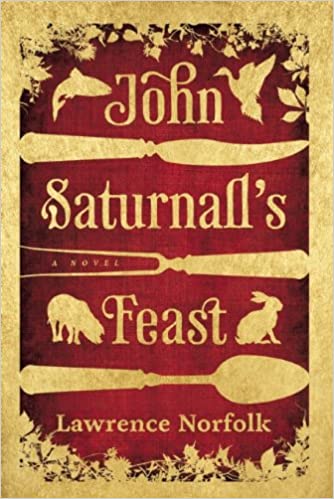
It’s 1625 when young John Saturnall and his mother are chased up into Buccla’s Wood by religious zealots who term her a witch. She is not a witch but a wise woman with ancient knowledge and stories of a magnificent feast that happened centuries before.

When John’s mother is dying in the wood, she sends him to Buckland Manor in the Vale, the home of Sir William Freemantle. There he learns that his mother worked in the manor before she became pregnant with him. He is taken into the kitchen, where he shows promise of becoming a great cook.

Just as John is becoming a Master Cook and Sir William’s daughter Lucretia is reluctantly betrothed to a wastrel in an attempt to save the Vale, the Civil War breaks out. As the Freemantles are supporters of King Charles I, the household has years of suffering before it.

At the beginning of each chapter is an excerpt from The Book of John Saturnall, written using the culinary language of the times. The novel is lushly written, full of the details of running a 17th century kitchen and household.

I was less interested in the unlikely romance, perhaps partly because Lucretia as a character is poorly defined. However, overall I found this novel deeply interesting.

By the way, the Grove Press edition is beautifully presented, with heavy paper, two colors of ink, and gorgeous woodcut-style illustrations.

Related Posts

Corrag

Merivel: A Man of His Time

Salt: A World History

Day 555: Mastering the Art of Soviet Cooking

Cover for Mastering the Art of Soviet CookingAlthough Mastering the Art of Soviet Cooking is billed as a memoir, it is written with the help of the author’s mother and begins long before Von Bremzen was born, with the start of the Soviet Union. It is an unusual memoir, tracing as it does the history of the Soviet Union, decade by decade, through the meals cooked by one family.

In an entertainingly wry writing style, Von Bremzen relates the changes in Soviet approaches to government over time and the way these changes affected the populace. She begins by explaining how Lenin’s asceticism nearly eliminated Russian cuisine because of the idea that food was decadent (and hardly any food was available).

Von Bremzen ironically and knowingly traces the history of Soviet Russia through famine and glut, for each decade featuring a dish that seems to represent it (although one decade features ration cards). The recipes are at the end.

Von Bremzen relates her own mother’s history as the rebellious daughter of a prominent Soviet military officer, her mother totally rejecting the party line. Larisa was terrified throughout the Stalinist era and longed to leave the country. Anya, herself with a difficult start as a child not allowed to join the Young Pioneers or visit Lenin’s tomb (things she secretly yearned for), had finally found a comfortable place when her mother dragged her off to Philadelphia.

This amusing book is fascinating for people who are interested in Russia, which I have always been. Darkly funny are the countless contrasts between the official views of the country and Von Bremzen’s descriptions of the actual plight of the population. It is difficult to describe the divided viewpoint of the author, who obviously loves Russia and the 60’s vision of what it was, while at the same time being deeply skeptical of everything about it.

This book is unusual, intelligent, and well-written, about a woman’s attempts to reconcile her feelings about her country and upbringing.

Day 168: Cod: A Biography of the Fish That Changed the World

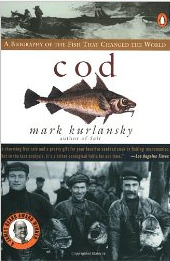
Cover for CodCod is the best known of Mark Kurlansky’s interesting micro-histories. If you are not familiar with the term, a micro-history is a short book that details the history of a specific and focused subject. Cod explores the importance of cod and the history of cod fishing beginning in the early days when the Vikings and Basques dominated the industry.

It was interesting to learn that Vikings and Basques going after cod were probably the first Europeans to “discover” America. They had been fishing off the coast for years before Columbus traveled to the Americas, keeping their fishing grounds secret.

Later, the eastern seaboard provinces of Canada and the New England states dominated the industry because of their location. The abundance and importance of cod provided many years of prosperity for these areas, but the later dearth of cod has had the opposite effect. Iceland, whose economy was almost solely dependent upon cod until recent years, has been severely impacted.

Of course, there is an ecological aspect to the history of cod. During the height of the fishing industry, the fish were so plentiful that it was said a person could walk across their backs. In the present, the fisheries are in danger of dying and many families with long histories in the industry are being forced to find other work. Kurlansky shows how the fishermen’s warnings about cod disappearing were routinely ignored by scientists and governments for years.

There is some overlap with Kurlansky’s book Salt, as he explains the importance that being able to salt the cod had to the success of the fishing industry. Before salting was begun, the cod had to be dried and a lot of it spoiled onboard. The chapters about battles over international waters are also fascinating.

As always with Kurlansky, the book is interesting and well written. It employs his usual format of mixing in recipes for preparing cod with the historical information.

Day Fourteen: Salt: A World History

Cover for SaltNo, this review has nothing to do with the Angelina Jolie.

For those of you who aren’t familiar with micro-histories, they are histories about very limited topics. Micro-histories are usually fairly short because of their focus but can be fascinating and go into great detail on a very specialized subject. The best of these that I have read is Zero: The Biography of a Dangerous Idea by Charles Seife, who writes on math and science topics. However, I read that so long ago that I would not be able to write a good review of it.

Today’s review is of Salt: A World History by Mark Kurlansky, who has specialized in writing micro-histories. The book traces what is known about the collection, processing, and uses of salt from the earliest times and the role it plays in history. He quotes commentators from ancient China, Rome, and Egypt on the qualities of salt. He explains how certain cities became prominent in early times because of salt mines or salt fields on bodies of water and how empires (for example, that of Venice) were built around salt, either making it or trading it. He also discusses its close connection with cod and other things important to world history.

The book is a micro-history full of micro-histories. Kurlansky tells about the mines in Poland that have chandeliers carved from salt and explains that the downfall of the French monarchy was a result of the hated salt tax, which placed a heavier burden on the peasants than it did the aristocracy. He explains that one of the reasons for the success of Napolean’s army was the discovery by Nicolas Appert of how to preserve meat by canning (using salt), allowing the army to have a more reliable source of food than simply pillaging the villages. He explains the reasons for Mahatma Ghandi’s illegal march to the sea to gather salt and why it galvanized resistance to British rule in India. He includes recipes.

Basically, if a subject has anything to do with salt, he writes about it. Salt is an interesting book, although it contains many digressions and seems unfocused at times. To pursue a point, he sometimes goes backward and forward in history, which can be confusing. The recipes were interesting at first, as they come from all times in history and from many different countries, but after awhile I felt that they interrupted the flow, especially as some were more than a page long.

I’m told that Kurlansky’s book Cod is even better, and I have that on my shelf waiting to be read, but he said so much about cod in Salt that I’m wondering what more there is to say!

Despite my caveats, if you want to read an engrossing book that will tell you many interesting things you probably didn’t know, read Salt.

What, Me Read? Day One

Cover for The Omnivore's DilemmaHi, there.

I am a voracious reader, sometimes reading several books a week, and I have decided to use this blog to write a book review for every book I read. Maybe no one will be interested in reading this, but maybe it will be fun.

I’m going to start with The Omnivore’s Dilemma by Michael Pollan, journalist and food activist, which I read for my book club.

The book traces back four different types of meals that Pollan ends up preparing and eating, a meal from McDonald’s, one using groceries purchased at a big-box organic grocery store, one using food purchased from a small farmer, and one with food he hunted and gathered himself.

The premise is interesting, and readers familiar with Pollan will know that he goes off on philosophical side trips and provides a lot of vital information about how the American food industry is set up. With one of his other books, In Defense of Food, he did more to make me change my eating habits than anything else I have ever read.

Pollan finds his hunted and gathered meal most satisfying and surprises himself by actually enjoying shooting a wild pig. From a practical standpoint, I was more entranced by the chapters about the small family farm in Virgina, the owner of which was so clever about his use of animals to keep his land and food products healthy.

One of Pollan’s main premises is that food based on corn and soybeans—and you would be surprised how much food IS based on them—is inherently less nutritious and good for you than food based on grass. This is both because of the nutritional value of these foods and the conditions in which corn-based animals are kept versus those who are allowed to graze free.

I was startled by how misleading the labels are, even on our “organic” food. Pollan’s conclusion is that your ability to actually go to the source of your food and see especially how the animals are treated is going to be the only way to ensure that your food is healthy and the animals are humanely treated.

Pollan does some philosophical musing that I sometimes don’t have much patience for, and occasionally I felt like we were getting way off the subject. I noticed that he sometimes didn’t seem to understand how he felt about things without reading what someone else said about them, which I thought was curious.

All in all, though, I think Pollan is one of the most interesting writers about food. I would even more strongly recommend In Defense of Food, where he provides some easy-to-follow shopping rules that allow you to eat more healthily.

Kay