Day 331: Peaches for Father Francis

Cover for Peaches for Father FrancisLast seen in Paris in The Girl with No Shadow, Vianne Rocher has been living there on a boat with Roux and her two daughters. However, the wind is about to blow her back to Lansquenet, the village she left at the end of Chocolat. In fact, her summons comes from the dead, as she receives a letter from her long-departed friend Armande. Armande’s grandson has reached his majority and, with other papers, received and forwarded a letter for Vianne telling her that Lansquenet needs her help.

Roux is mysteriously reluctant to return to Lansquenet, so Vianne takes her daughters Anouk, 15, and Rosette, 5, for the journey back to the village. She arrives during Ramadan and finds the village practically in a state of war. A large population of Moslems has moved into Les Marauds, the slums where Vianne had her chocolaterie. At first cautiously welcomed into the community, the Moslems now are at odds with the original inhabitants.

This state of affairs is almost uniformly being blamed on Ines Bencharki, a veiled, mysterious woman dressed in black. However, it has most urgently affected the fate of Vianne’s old nemesis, Father Francis Reynaud. He has been accused of burning Madame Bencharki’s home, the same building Vianne used for her chocolaterie, which Ines had turned into a school for Moslem girls. Father Francis is expecting to be transferred out of the village by the bishop. Ironically, he finds himself forced to turn to Vianne for help.

Although I continue to enjoy Vianne and her family, I feel that this novel does not contain the magic of the previous two and is a little more predictable. Vianne’s doubts about Roux’s fidelity seem too foreseeably wrong. We know that Vianne favors the underdog, but considering Reynaud’s unrelenting treatment of her in Chocolat, their alliance seems unlikely. The flavor of the small village that makes us want to return there, so evocative in Chocolat, is missing.

Also, few of the secondary characters, so colorful and interesting in the other books, are given much consideration here. Luc, whose house Vianne and her family are staying in, barely gets a mention. Even though Vianne makes friends with several of the Moslem women, their personalities do not stand out, one from the other. Only the old lady Omi is her own self. The sole old friend who gets any attention is Joséphine.

Nevertheless, it is always a pleasure to spend time with Vianne. There is real danger in this novel and an evil villain. And as always, the novel is beautifully written.
Day 313: Murder on the Eiffel Tower

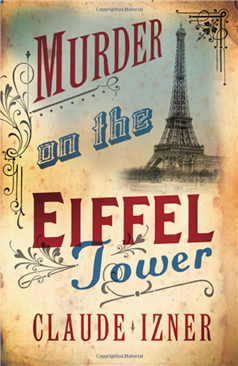
Cover for Murder on the Eiffel TowerThis mystery set at the opening of the Eiffel Tower has a nice sense of history and is well written, but like mysteries written early in the genre (which it is not), it depends almost entirely upon determining opportunity. There is no indication of motive until the lengthy written confession at the end of the novel–standard early detective fiction nonsense–that is, charming in earlier fiction, but not so much now. This novel was published in 2009.

People begin being killed by “bee stings” on or near the Eiffel Tower the day before Buffalo Bill arrives in Paris for the opening of the 1889 World Exposition. Bookseller Victor Legris starts looking into these incidents after he notices that Kenji Mori, his father figure and business partner, met with more than one of the victims near the time they were killed. He also begins to fear that the woman to whom he is attracted, Russian illustrator Tasha Kherson, could be involved.

I found Victor to be silly, not very good at investigating, and prone to overlooking clues. Many secondary characters are only sketchily drawn and therefore difficult to keep straight. So for me, despite all its promise and its setting in an exciting period of time, Murder on the Eiffel Tower was not a success.

Day 309: Parrot and Olivier in America

Cover for Parrot and OlivierBest Book of the Week!

Peter Carey’s Parrot and Olivier in America is a fictional riff upon Alexis de Tocqueville’s trip to America in the early 19th century, from which resulted the classic Democracy in America. Olivier de Garmont is the character meant to be Tocqueville, an aristocrat with liberal leanings who is nevertheless an elitist snob.

Parrot is his servant, a man who has lived a colorful but frustrating life. An Englishman, he has had his life disrupted since he was a boy by another French aristocrat, the Marquis de Tilbot, who spirited him away from England after his father, a typesetter, was arrested as an accomplice to forgery.

In dangerous post-revolutionary France, Olivier’s mother has decided it would be wise for Olivier to leave the country, as his liberal leanings have offended the conservatives, but he is unacceptable to the liberals because of his aristocratic birth. She ends up shipping him off to America with Parrot as his secretary, on loan from Tilbot and instructed to report back Olivier’s movements.

But America inflames Parrot’s own democratic leanings. He believes himself to have a talent for engraving that he has never been able to develop while working as Tilbot’s servant, and he resents his status as a “vassal.” While Olivier feels that their rocky start has developed into a relationship that is almost love, Parrot affectionately? calls him “Lord Migraine.”

This novel is narrated in alternating chapters by Olivier and Parrot. It is entertaining–wittily and robustly written–although sometimes we seem to have stumbled into a Dickens novel, especially when reading about Parrot’s early life. In fact, I read recently that Carey wrote an earlier book, Jack Maggs, based on Magwich of Great Expectations, so that feeling is probably not too far off.

Day 292: Russia Against Napoleon: The True Story of the Campaigns of War and Peace

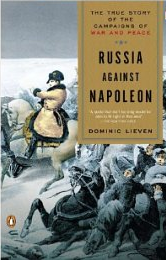
Cover for Russia Against NapoleonDominic Lieven explains in the introduction to Russia Against Napoleon that the popular conception of Russia’s role in the battles with Napoleon in 1812-14 is mostly derived from Tolstoy’s War and Peace. Tolstoy posited that the fate of Napoleon’s army was mostly a result of luck on the part of the Russians and the brutality of the Russian winter. Lieven also explains the reasons why most scholarship on this subject has been done from French, German, Austrian, or British records.

However, Lieven is able to convincingly show that the Russian victories, although of course partially due to luck, were mostly because of the understanding of Russia’s Emperor Alexander I and his field marshall, Mikhail Barclay de Tolly, of the kind of war Napoleon was good at and their refusal to give it to him. That is, Alexander and Barclay de Tolly planned from the beginning for a long, drawn-out war that would lure Napoleon deep into Russia, to be followed by a second campaign in Germany and France.

Lieven is a professor of history with the London School of Economics and an acknowledged expert on Russian history. Interestingly, he is also the descendent of three of the generals at the Battle of Leipzig.

Lieven’s book explains in the clearest terms the details of every campaign in those three years, taken from the Russian letters, diaries, and records that have not been readily available until recent years, as well as from the records of British observers and others of the combatants. He provides insight into the political jealousy and maneuverings and even to the details of staffing and provisioning the armies and maintaining the long supply lines needed when the Russian army entered western Europe.

Lieven’s analysis of war is comprehensive, and even though it is very detailed, it never seems to get bogged down in minutia. It introduces us to some colorful characters and vividly and suspensefully describes the battles.

The book’s only weakness for me was that it assumed a little more knowledge of the events immediately preceding these years than I had and knowledge also of the functions of the vast numbers of different types of troops. However, that lack of knowledge on my part did not really impede my understanding or detract from this very interesting history.

Day 283: My Alsace

Cover for My AlsaceDuring a visit to Alsace several years ago, I was fascinated by this book, especially by the pictures, but I could only find it in French. Then, awhile back, I found it on Amazon in English.

My Alsace was written by Hansi (Jean-Jacques Waltz), a beloved Alsatian poster and children’s book artist who grew up in the late 19th century under German occupation. In the 19th and early 20th centuries, the region of Alsace, which identifies itself as French, changed hands between Germany and France four times. In the German school at Colmar as a boy, Hansi only learned about the great Prussian victories and the defeat of Alsace in his history classes. He deemed this period the worst in his life and wanted Alsatian children to know that Alsace has a prouder history.

My Alsace is a selection from the history he wrote in 1912 and some writings from after World War I. The latter section of the book goes on to tell about the trouble he got into with the German authorities during World War I because of his jokes about Germans in the earlier book. He was originally fined and later he was given a year’s prison sentence for insulting a German officer. He published the latter part of the book in 1919 to celebrate the region’s liberation from the Germans.

Hansi’s drawings are wonderful. He was well known for his pictures of Alsatian villages, people in traditional costumes, and celebrations of Alsatian life from an earlier time. The text is amusing, although it is full of anti-German satire. Written for children about eight years old, it is also entertaining for adults.

Day 235: The Eloquence of Blood

Cover for The Eloquence of BloodIn the second of Judith Rock’s series, the Louis le Grand school run by the Jesuits is under financial hardship in this cold winter of 1686. On a visit to Monsieur Callot to ask for a contribution to the alms budget, rhetorician Charles du Luc meets a lovely young woman, Martine Mynette.

Martine’s mother Anne has recently died, and Martine is very concerned, because Henri Brion, a notary and Monsieur Callot’s nephew, has been unable to find a copy of Martine’s donation entre vifs. Because Martine is adopted, according to French law of the time she cannot inherit, so the only way her mother could leave her an inheritance is through this document. The copy usually hidden in the house is gone, and M. Brion is looking for his own copy.

When Charles relates this story to the school’s rector, Pére le Picart, the rector is dismayed because the Jesuit order was expecting the money through a bequest by Anne Mynette’s father. If a donation entre vifs exists, the school will not be entitled to the bequest. Another concern is that M. Brion is the same person who has supposedly been following up on the order’s claim. The rector sends Charles to the Brion’s house to find out what is going on.

Charles finds the area in disorder. Martine–a neighbor of the Brion’s, and Isabelle Brion’s best friend–has been murdered. No one has seen M. Brion. Isabelle is concerned because her father was trying to force her brother Gilles to marry Martine, which gives Gilles a motive for murder.

In addition to finding out about the bequest, Charles is assigned to follow the investigation into Martine’s murder. There are rumors on the street that the Jesuits murdered Martine for the money, and Paris seems to be entering one of its periodic convulsions against the Jesuit order.

As usual for the two books in this series, the historical details seem convincing and interesting. The novel is well written and keeps you involved. One very small caveat that I did not notice in the first book–Rock explains even the simplest French, which is annoying.

Day 224: The Happy Foreigner

Cover for The Happy ForeignerThe Happy Foreigner by Enid Bagnold is interesting as a record of conditions in France right after World War I. In fact, at the time of its publication (1920), it was lauded for its journalistic qualities. The book is almost certainly quasi-autobiographical, although it was published as fiction.

Fanny is a British girl who volunteers to drive for the French army right after the war. In many places the villages are completely destroyed, and very little food is available. The driving is difficult and hazardous. Fanny and the other girls live in a shack with paper-thin walls, a leaky roof, and mud on the floor, and sleep on stretchers supported by sawhorses. From there, she is transferred closer to Germany, where she lives more comfortably in a town with more gaeity. It is ironic that the Germans seem to be in better shape economically and their towns less ravaged after the war than the French.

As well as a true depiction of the time and place, the novel is about the entrance of women into areas of work that had previously belonged solely to men. When Fanny first enters the dining room of an underground fortress in Verdun, her second posting, all talk ceases, as most of the men have not seen a woman in years. Later when she is assigned to drive for a Russian Colonel, she must address his doubts about her capabilities before he will let her drive.

Fanny meets a French officer, Julien, and they fall in love, but their relationship is one of the oddest things in this unusual, almost telegraphically written book. They are both so leery of each other that their dealings with each other are very tenuous.

I was a little disappointed that Bagnold chose to anchor this tale around a romance, no matter how odd, as it seemed a hackneyed idea, but I suppose that given the circumstances of just a few women among a huge number of men, that was an inevitable choice.

Day 189: The Girl with No Shadow

Cover for The Girl with No ShadowI just reviewed Chocolat recently, so I thought I’d continue with a review of The Girl with No Shadow, Joanne Harris’ sequel to that novel.

The wind is blowing trouble toward Vianne Rocher, now running a small chocolatierie in Montmartre in Paris. The trouble is coming in the form of a con woman with many names, whom Vianne will know as Zozie de l’Alba.

Vianne herself has another name. She is going by Yanne Charbonneau because of some problems that developed after the birth of her second daughter, Rosette, now four. Vianne has been doing everything she can to avoid standing out. Anouk is now known as Annie. Gone are the red dresses with bells hanging from the hems. Yanne is demure and nondescript and doesn’t use her magic, even to know what a customer’s favorite chocolate is.

Annie, at eleven, is unhappy with school and with the changes in their lives. Soon more seeds of discontent are sown. As Zozie weasels her way into their lives and prises away their secrets, she decides that when she leaves, she is taking Annie with her. So, she does her best to encourage Annie’s rebellion against her mother.

Again, Harris combines the gentleness and kindness of Vianne’s temperament with a fair amount of suspense. As we learn more about Zozie’s past, we find out just how dangerous and devoid of conscience she is.

As usual the writing is beautiful, sprinkled with the scents and flavors of the chocolatierie and a dash of magic.

Another novel about Vianne and her family is just out, Peaches for Father Francis, so I guess I had better get reading!

Day 182: Chocolat

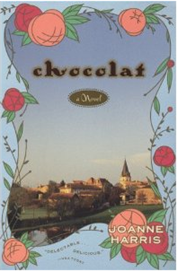
Cover for ChocolatI decided to review Chocolat today because I just started reading The Girl with No Shadow, Joanne Harris’s sequel. Even though I have always enjoyed reading Harris’s books, I didn’t read Chocolat until long after seeing the movie, perhaps because I saw it first. The movie is pleasant enough but anemic and inexplicable, and as I found later, does nothing to convey the magic of the novel.

Vianne Rocher and her six-year-old daughter Anouk blow into the small village of Lansquenet-sous-Tannes with the wind. They are distinctly odd. Vianne wears red skirts with bells on them, and Anouk has an imaginary friend, a rabbit named Pantoufle, that some folks occasionally think they’ve glimpsed.

Vianne opens a chocolate shop, making her own wonderful confections. She seems to have an almost sixth sense about which chocolate will be each person’s favorite, and she creates miraculously inventive window displays for special days. She also begins befriending some of the village’s misfits.

This all sounds very pleasant, but Pére Reynaud, the local priest, hates Vianne on sight. She has opened a chocolate shop during Lent! Right across the street from the church! He begins a campaign to try to force her out of town. When Vianne plans a chocolate festival to celebrate Easter, he believes she is being sacrilegious and vows to ruin the festival.

Vianne herself has lived like a vagabond her entire life and wants to settle down. Her witch mother died on the streets of New York, and she wants her child to have a better life than hers has been.

The novel is colorful and teems with eccentric characters, as well as lovely descriptions of food. It is beautifully written. As I read it, I was able to understand why the book is so beloved.

Day 176: Queens’ Play

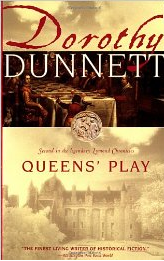
Cover for Queen's PlayBest Book of the Week!

Queens’ Play is the second book of Dorothy Dunnett’s excellent historical fiction series, the Lymond Chronicles. Although it is not absolutely necessary to read the first book, Game of Kings, you will enjoy the other books more if you do. If you decide to continue this series, it is important to read them in order after this one.

Francis Crawford of Lymond enters the scene disguised, and it is some time before we figure out which of two characters he is. Francis has been asked by Mary de Guise, Queen Dowager of Scotland and mother of Mary Queen of Scots, to travel to France and protect Mary. Although Mary is still a little girl, plots revolve around her, and her mother is afraid her life is at risk.

The Irish prince Phelim O’Liam Roe’s arrival into France is a spectacular one, as his ship almost crashes into another one when entering the harbor. This incident is perhaps not an accident, as evidence mounts that someone is trying to kill the prince. To the French court, O’Liam Roe is unbelievably provincial, and he is immediately the butt of ridicule. He is attracted to Oonagh O’Dwyer, an Irish woman living on the borders of society, but she disdains him. In fact, she is the mistress of the Irish rebel Cormac O’Connor.

O’Liam Roe has brought with him Thady Boy Ballagh, an ollav, or trained master poet. Untidy, fat Thady Boy is gaining popularity with the decadent French court through a series of reckless deeds and his brilliant musical performances.

It seems that the Queen Dowager’s fears are correct. During a hunt that employs the king’s leopards as hunting animals, someone lets Mary’s pet hare out in front of the cat near her pony. As she struggles to save her pet, the cat turns its sights on Mary.

As always, Dunnett combines heart-stopping action and suspense with a detailed knowledge of the period. This book begins some of the plot threads that will continue throughout the series.