Day 926: No More Parades

Cover for No More ParadesBest Book of the Week!
The second book in Ford Madox Ford’s tetrology about World War I, No More Parades, begins as Christopher Tietjens is busy preparing a draft of men for the front in an atmosphere of almost total chaos. The discussion between Captain Tietjens and his fellow officers reveals the difficulties of this task, with shortages, supplies withheld from his troops because they are Canadian, and contradictory orders.

During this night, Tietjens is not able to retire to bed because of his duties. And one of his men is killed because of the lack of a helmet during a bombardment, helmets having been refused them. Since Tietjens recently refused the man leave because of fears he would go home and get himself killed over an unfaithful wife, he blames himself for the death.

Tietjens is already feeling rocky when Colonel Levin comes to tell him that his wife Sylvia has arrived. Levin has been sent by General Campion to advise him of this extremely compromising situation, women not being allowed there and Sylvia having come without papers.

Tietjens was under the impression that Sylvia had left him, after an evening where she acccused him of infidelity with Miss Wannop just before he returned to the front. He is in love with Miss Wannop, certainly, but he has never acted on it. In fact, it is Sylvia who has been consistently unfaithful.

Sylvia, though, is torn between the need to get some sort of reaction from Tietjens and the realization that she wants him back, that in fact, no man seems adult after him. However, she continues to try to injure him with his family, his commanding officer General Campion, and society.

This volume is a fascinating portrait of two unusual characters—Tietjens with his old-fashioned morality and Sylvia with none at all. This story is an indictment of the conduct of war but also a tale about a disappearing kind of man.

Related Posts

Some Do Not

Goodbye to All That

The Happy Foreigner

Day 898: An Adventure

Cover for An AdventureAn Adventure is the account by two English woman academics of a couple of supernatural events during a visit to Versailles, published under pseudonyms. The women had the first experience on August 10, 1901, and the second was experienced by one of the women alone the following year. The two women claimed not to have spoken together about the first event until three months later, when they agreed that the Petit Trianon, where the first event occurred, must be haunted. At that time, they decided to write down separate accounts of the incident.

The first section of the book is each woman’s account of the incident. On a visit to Paris, they went to Versailles and decided to stroll the grounds looking for the Petit Trianon, which was a favored place of Marie Antoinette. Although their accounts disagree in some respects, both women reported seeing the same landscape and layout of buildings and some of the same people dressed in antique costumes. One of the women saw a lady painting in a white dress. They also reported an oppressive atmosphere.

On a subsequent visit, “Frances Lamont” heard people speaking as if they were walking on a path nearby and music from the 18th century. Later, the women were unable to locate many of the places they had visited on the previous visits. These events led them to decide they had observed supernatural visits of Marie Antoinette and some of her servants and courtiers. They also learned that Petit Trianon was rumored to be haunted on August 10, which is the anniversary of a pivotal date in French revolutionary history.

The second section of the novel relates the discoveries that the women made. It describes the differences between the landscape of the area at the time of the event and in the 1780’s. It details the women’s research to explain the costumes of the people they saw and the events witnessed.

The final section of the book contains the women’s explanations of the events as a combination of memories in the mind of Marie Antoinette as she and her family were cooped up in a small room on the day of August 10, 1789.

The most interesting part of the book is the first section, containing the women’s accounts of the events. The section about their investigation is harder to follow and difficult to visualize. Subsequent reading I’ve done on the notorious event contained allegations that their sources validating some of the information they researched were questionable.

The final section seems much too suppositional for easy belief (if you can believe any of it) as well as repetitive, revisiting much of the information from the second section. Whether you believe something supernatural happened to these women or whether their memories were influenced in the time that elapsed after the event or even that they invented the whole (which does not seem to be a general assumption), this is a mildly interesting account that was controversial when published, even during a time that was credulous about the supernatural.

Related Posts

Giving Up the Ghost

The Séance

The Sun King

Day 882: Rebecca

logo for the 1938 clubBest Book of the Week!
Since Rebecca is a book that qualifies for The 1938 Club and is also on my Classics Club list, I thought this was a good time to reread it. I must say that during this reread, I noticed things I’d never noticed before.

Some years after the time of the novel’s action, the narrator recollects the events at Manderley from a life of exile. As a young, naive woman working as a companion for the vulgar Mrs. Van Hopper, the narrator meets the older, sophisticated Maxim de Winter one spring on the Riviera. When Mrs. Van Hopper becomes ill, the narrator spends some time each day with him, driving through the countryside. Mrs. Van Hopper recovers and decides abruptly to return to the States. When the narrator tells Maxim, he proposes.

Cover for RebeccaThe narrator, whose first name we never learn, is an immature girl who is prone to imagining what people are saying about her or what may happen, usually in exaggerated terms. The wedding is not the romantic event that she imagined, but she goes along with whatever Maxim suggests.

Finally, they come home to Maxim’s family home of Manderley, and that’s where the novel really gets going. For the narrator is already haunted by the thought of Rebecca, Maxim’s first wife. Rebecca was beautiful, assured, accomplished—everything the narrator believes she is not. Everyone assures her that Maxim adored Rebecca and was shattered when she died in a sailing accident. Everyone tells her she isn’t at all like Rebecca. The decor of the house reflects Rebecca’s taste, her name is scrawled inside books, her monogrammed handkerchiefs are in the pockets of coats, and the servants tell her, when she timidly makes a request, “Mrs. de Winter used this vase,” or “Mrs. de Winter sat in this room in the morning.”

Further, there is the terrifying Mrs. Danvers, the housekeeper, from whom the new Mrs. de Winter senses actual hostility. Mrs. Danvers was devoted to Rebecca and resents a new wife taking her place, especially one so much Rebecca’s inferior.

The narrator was not brought up to a life with servants, running a big house, and she has no idea how to behave. Maxim gives her little help in this regard, just expecting her to adapt. She makes mistakes, and his moods become more erratic until she thinks he regrets their marriage. As she becomes more unhappy, events build to a climax on the night of a big costume ball.

This is an extremely powerful novel that, I think, hits you differently depending upon the age you are when you read it. When I was young, I thought it was romantic and scary. Now, I think it’s more of a study of some very maladjusted characters. But this is the first reading where it made me think of Mr. Rochester.

Even though I love Jane Eyre, I’ve never been much of a fan of Mr. Rochester. But what does he do? He yearns for a young, innocent girl and is prepared to commit a crime to get her. We can say this for Jane, though, she has a strong sense of herself.

I don’t want to say much more about Rebecca in case you haven’t read it. But let’s keep it at this. Maxim de Winter also yearns for a young innocent girl, but his choice has such a weak sense of self that we don’t even learn her name. He takes her to a life for which she is completely unsuited and untrained, with a servant he might predict would be hostile, and just leaves her to make the best of things. And this comment doesn’t even touch on the darker secrets of the novel.

Do these observations make me love the novel less? No, this is a great novel. Rebecca is one of Daphne du Maurier’s most atmospheric novels, in a career with many atmospheric novels. I believe she modeled Manderley after the house where she lived in Cornwall, and its description is detailed and loving. Du Maurier was interested in aberrant personalities, in which she probably counted her own. This is a dark novel that fully draws you in. It is very well written, an excellent character study and a masterful suspense novel.

Related Posts

Castle Dor

The Poison Tree

Daphne du Maurier: The Secret Life of a Renowned Storyteller

Day 878: Death on the Riviera

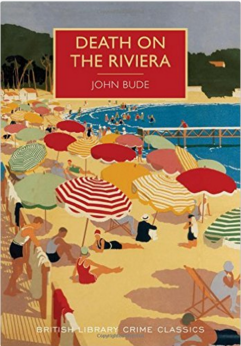
Cover for Death on the RivieraDetective-Inspector Meredith and Sergeant Freddy Strang are on an unusual mission. They are following up clues that a British counterfeiter, “Chalky” Cobbett, is operating a counterfeiting ring on the Riviera. Since Meredith has encountered Chalky before, the French police hope the D. I. can help find and identify him. Meredith cautions Strang that they are working undercover, but not before they meet a tourist named Bill Dillon.

Nesta Hedderwick is a rich, middle-aged British woman with a villa in Menton who sometimes patronizes young, handsome men. Currently, she has two living with her in addition to her niece Dilys. Tony Shenton, in Dilys’ opinion, has been sponging off her aunt for far too long. He has no employment and orders the servants around as if they were his. His aunt has even given him a sports car. Even worse, he has invited a girl to stay, Kitty Linden, who is clearly infatuated with him.

Paul Latour is the other man. He keeps odd hours and spends most of his time in his room, painting. But when Dilys goes to an art show, she recognizes some of his work—with someone else’s name on it.

At the show Dilys meets Freddy Strang, who introduces himself as John Smith. Later, he is embarrassed when they run into Bill Dillon, who has come looking for Kitty, and Dilys finds out he is using a false name.

link to NetgalleyThe murder mentioned in this novel doesn’t occur until fully halfway through the book. Instead, we follow the details of the investigation into the counterfeiting ring and Freddy’s romance with Dilys. This atmospheric novel is one of the more enjoyable of these Poisoned Pen class reprints. There isn’t a great deal of characterization, but in general that is common with these older mysteries.

Related Posts

The Singing Sands

Thirteen Guests

Antidote to Venom

Day 804: The King Without a Kingdom

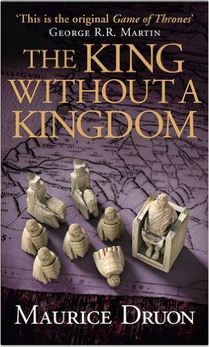
Cover for The King Without a KingdomWhen I first read Maurice Druon’s The Accursed Kings series, I didn’t even know there were seven books. I read the first six, which told of the destruction of the Capet dynasty and ended with the death of Robert of Artois, a prime mover of events. But Druon still had one more tale of incompetent royalty to tell, that of King John II, the third Valois king.

The entire novel is written as a monologue by the Cardinal of Périgord, who tells the tale as he travels to try to mediate peace between King John and Edward, Prince of England. The Cardinal is a sharp old man with many a sarcastic observation to make to his audience, his nephew. King John is actually in captivity to the English, and the cardinal’s story is about how this situation came to be.

Unfortunately, I found this change of narrative style to be irritating, uninterrupted as it is by anything except references to arrivals, changes of horse, and other details of the journey. Although the story he has to tell is certainly interesting—about how the king threw away certain victory in battle because of his own stubbornness and incompetency, and about how he alienated his allies by reneging on deals in order to give honors to his favorite—the narrative style just seems too artificial.

In The Accursed Kings, though, Druon draws a devastating portrait of how a series of bad monarchs brought France down within a few years during the 14th century, from the greatest nation in the world to an impoverished, poorly run country that was considerably smaller.

Related Posts

The Royal Succession

The She-Wolf

The Lily and the Lion

Day 787: The Hunchback of Notre Dame

Cover for The Hunchback of Notre DameWhen I was making my list for Classics Club, I thought I should finally read something by Victor Hugo. The obvious choices were Les Miserables or The Hunchback of Notre Dame, but I had tried Les Mis some years ago only to put it down in disgust when Jean Valjean hits the priest who has tried to help him over the head with the candlesticks he wants to steal. So, it was Hunchback for me.

I was interested to read in the Introduction that the French title of this novel was Notre-Dame de Paris and that Hugo hated the English title. And truly, the focus of the novel is more on Notre Dame and 15th century Paris than it is on the story we’re familiar with. In fact, one entire chapter just describes Paris as it looks from the tower of the cathedral in 1482, street by street. I have to say, though, that the chapter was almost meaningless to me, since I found myself unable to visualize what he describes, at least not in that detail.

The novel has many characters, not just the three emphasized in all the movies. It begins with Pierre Gringoire, a hapless poet who is attempting to put on a play he wrote in celebration of Epiphany and the Festival of Fools. This great (and long) production is supposed to pay tribute to the betrothal of the Dauphin with Margaret of Flanders. The problem is that the people have been waiting since dawn to see it. It is past noon, when the play is supposed to have started, but the Cardinal and the Flemish ambassadors haven’t arrived yet. The crowd, egged on by the student Jehan Frollo du Moilin and his buddies, is getting disruptive.

Gringoire decides to start the play, and the crowd settles down, but the actors are still reciting the prologue when the Cardinal and the Flemish arrive, making a lot of noise. The students turn their attention to making rude remarks. Soon the crowd begins trying to select the Pope of Fools instead of watching the play. They choose the hideously deformed hunchback Quasimodo, the bellringer at Notre Dame, and everyone leaves. Poor Gringoire will not be paid, so will not be able to pay his lodging, and he goes off homeless to wander the street.

So, we meet Quasimodo, who was taken in as a child by Claude Frollo, the severe Archdeacon of Josas and older brother of Jehan Frollo. Claude Frollo is obsessed by his studies of alchemy until his eye lights on Esmeralda, a young gypsy dancer and street performer. He becomes infatuated and lustful and so (with the typical logic of zealotry) decides she must be a witch who has enchanted him. On the other hand, when Quasimodo is sentenced to the stocks simply because he is too deaf to hear the judge, the only person who is kind to him is the gypsy dancer. So are sewn the seeds of tragedy.

And make no mistake, there is tragedy in store for most of the characters in this novel. Justice is solely dependent upon the whims of powerful men, and the more powerful they are, the more scathingly Hugo treats them. We even spend some time with the king, Louis XI, who is depicted as grasping, arbitrary, and vicious. Hugo pretty much skewers everyone except Quasimodo and the gypsy girl, who are basically cardboard figures.

Hugo is interested in many things in this novel—the cathedral itself, its own architecture, and the architecture of Paris are strong presences. The transmission of culture from century to century is a preoccupation, as are the themes of the nature of love, loyalty, and not judging by appearances. As a son of the revolution, he also has an axe to grind about the aristocracy and the corruption in the church.

I have to confess, though, that I only mildly enjoyed this gothic novel. The only highly developed character is Claude Frollo, and he is a sickening person.

Related Posts

La Reine Margot

The Lily and the Lion

The Rhetoric of Death


Day 748: The Lily and the Lion

Cover for The Lily and the LionBest Book of the Week!
The sixth book of Maurice Druon’s The Accursed Kings series follows the fall of Robert Artois, the prime mover in many of the events of the other five novels. It is the reign of Philippe VI, the first Valois king, so you’d think the curse of the Knights Templar against the Capet kings would be complete. But Druon points out that there is one Capet we’ve probably forgotten.

It is Robert Artois who ensures that his Valois cousin is chosen from the candidates proposed for the crown, despite the better claims of Isabella of France, the only surviving sibling of the Capet King Charles IV, for her son Edward III of England. But even though by supporting the victorious candidate Robert finally gains a peerage and property of his own, he is still obsessed by the theft of his county of Artois by his Aunt Mahaut years ago.

He hears of the existence of a copy of the will and deeds that left him the property when he was a boy. The originals were stolen and destroyed by Mahaut and her minion, Monseigneur Thierry. But the Monseigneur kept the copies to protect himself, Robert is informed by Jeanne de Divion, the Monsiegneur’s mistress. Now that he is dead, Mahaut has treated Divion so poorly that she offers to steal the papers from the Monseigneur’s office. Before she gets the opportunity to do so, however, Beatrice d’Hirson, Thierry’s niece and Mahaut’s servant, steals them for her mistress. Robert then makes the decision that will decide his fate. He decides to forge the papers.

In the meantime, Isabella and Roger Mortimer have taken the throne from Edward II for his son, but the young king is a ruler in name only. Mortimer’s abuses are just as bad as those of the previous reign perpetrated by Edward II’s favorites. In addition, Edward III hasn’t forgiven Mortimer for having his father murdered. Soon, Edward will act for himself.

As with the others in this series, this novel is packed with traitorous acts, poisonings, and other skullduggery, as well as amazingly readable historical detail. Druon peppers his tales with plenty of cynicism and sly remarks. As always, I highly recommend this series.

Related Posts

The Iron King

The Strangled Queen

The Poisoned Crown

Day 721: Death in Brittany

Cover for Death in BrittanyI selected this book just because of its setting, and it certainly makes an effort to impart the scenery and atmosphere of Brittany.

Commissaire Georges Dupin is originally Parisian, but he is enjoying his relocation to Brittany. He is sitting in a cafe with his morning coffee when he is summoned to Pont-Aven, where the 90-year-old owner of the Central Hotel was stabbed to death in the bar. It was Pierre-Louis Pennec’s habit to spend the evening there, sometimes with other people, sometimes alone. The death happened after the restaurant was closed.

No one at the hotel reports anything unusual. Pennec’s life revolved around the hotel, which had been in the family for generations. His grandmother had helped build Pont-Aven’s reputation as an artists’ haven by supporting artists, the most famous of whom was Gaugain. Copies of their paintings hang throughout the restaurant. The only unusual thing Dupin and his team can discover is that Pennec was told that week that he would not live long.

Under suspicion are Pennec’s son and daughter-in-law, but they seem to have no motive. Also under suspicion is Pennec’s estranged half-brother.

The night after the murder someone breaks into the restaurant. But to all appearances, nothing was taken or has changed.

link to NetgalleyI was reading an advance copy and was at first put off by the writing, which was not stellar, particularly overuse of the word “very.” But these problems may be resolved in the published version. One thing Bannelec attempts is to illustrate the beauties of Brittany. Most of this material was interesting, and I appreciated the effort, even though sometimes the novel reads like a travel guide. But I have criticized other novels for not providing a sense of the location, and this one certainly attempts to do so.

The characters aren’t particularly distinctive. I kept confusing two of Dupin’s inspectors and several of the suspects. So, overall, I would rate this novel as just average.

Related Posts

Murder in Pigalle

Murder on the Eiffel Tower

The Bones of Paris

Day 676: The She-Wolf

Cover for The She-WolfThe fifth novel in Maurice Druon’s wonderful Accursed Kings series begins where the first one did, with the problems of Isabella of France, unhappy queen of England and sister to Charles IV of France. While Charles IV’s administration is being ably handled by his uncle Charles of Valois, the same cannot be said for that of Isabella’s husband, Edward II. He is completely under the sway of Hugh Despenser the Younger, his rapacious lover. At the beginning of the novel, Despenser has taken everything from Isabella’s dowry for himself and forces her to give him the valuable book she is reading.

Roger Mortimer is the only person to have ever escaped from the Tower of London, and he soon arrives in France. He too has been a victim of the greedy Despensers. He has a fateful meeting with Isabella when she arrives to broker a treaty. Soon their actions will cause the overthrow of a king.

The powerful Countess Mahaut of Artois still remembers Isabella’s testimony, which condemned her daughter and cousin to prison in the first book. She will make it her business to cause trouble for Isabella. And we know what trouble can mean, for in The Poisoned Crown, Mahaut had Charles’ oldest brother murdered so that her daughter could be queen of France.

Druon’s knowledge of medieval history, customs, and architecture is especially noticeable in this book, with its extensive historical notes. This fantastic series continues, with Druon specializing in snark.

The sixth book in this series will soon be available in paperback while the last is soon to be published in hardcover. Years ago, I read all but the last book, which I was unable to find, so I am looking forward to finally being able to read the entire series.

Related Posts

The Iron King

The Strangled Queen

The Poisoned Crown

The Royal Succession


Day 659: The Prague Cemetery

Cover for The Prague CemeteryThe Prague Cemetery opens in 1897 with a monologue that is so vile and bigoted against just about everyone—the French, the Germans, the Italians, Jesuits, Masons, women, and especially Jews—that I almost put it down at that point. That monologue is the ranting of the main character, Simonini, as learned at his grandfather’s knee. Simonini is an absolutely repellent person who makes his living forging wills and other documents but who also works for the French secret police, and the German secret police, and the Okhrana, making up lies and creating international incidents.

Simonini has a problem. He has gaps in his memory. Further, when he explores a passage in his house, it leads to the rooms of someone who wears a cassock. Following the advice of an Austrian Jew (whom he calls Froïde), he begins writing down what he can remember of his life. The next time he awakens, he finds his diary annotated by the Abbe Della Piccola, who seems to remember the time periods he cannot but doesn’t remember the others. It is soon obvious that these are two personas of the same man.

Simonini is already a forger when he begins his first employment in espionage, spying on the leadership of Garibaldi’s army for the Piedmontese secret police. He always ends up exceeding his orders, though, so when he blows up the ship containing Ippolito Nievo, who is in charge of Garibaldi’s finances, instead of simply assuring the books go to the government and nowhere else, he is shipped off to Paris.

Simonini is most concerned with the fate of what he considers his life work, a document that is supposed to be a true account of a meeting of eminent rabbis—and one Jesuit—in the Prague cemetery, where they plot against the Gentiles and scheme for world domination. Although Simonini has plagiarized some of this document from other sources, he has fabricated most of it, including the setting. Over the course of 40 years, he perfects this document, eliminating the Jesuit and changing it to a series of protocols, all the while trying to sell it to different governments. It is this document that becomes the infamous Protocols of the Elders of Zion, used by the Nazis and other hate-mongers through the years to justify anti-Semitism, even though everyone involved in its creation knew the document was apocryphal.

Although this tale is supposed to be some sort of answer to Dan Brown’s The Da Vinci Code, being based on actual instead of made-up events, and though it is told with proper postmodern irony, it left a bad taste in my mouth. As Simonini and his abettors make up more and more ridiculous stories linking, say, the Masons to Satanic rites, with the public gleefully believing everything, I felt disgusted. Almost every character in the novel except Simonini was an actual person, and all the events the novel is based on are true, which makes it even more disturbing. Eco even has Simonini responsible for framing Dreyfus. Simonini also murders people and dumps their bodies in the sewer beneath his house.

Maybe I agree with one reviewer that some readers may not understand irony. I’m not sure. The construction of a truly dark and repellent protagonist reminded me of the novel Perfume, except that I enjoyed Perfume. I just know that although I have a dark sense of humor myself, this novel made me want to take a bath.

Related Posts

Great House

In the Garden of the Beasts

The Bones of Paris