Day 507: My Wish List

Cover for My Wish ListMy Wish List is very popular in France and was just recently released in English. It is narrated by Jocelyne, a middle-aged woman who is feeling she missed something in life when the novel begins. She runs a fabric store and keeps a blog about sewing and knitting that is gaining a large audience. Still, she feels unsatisfied with her life and with her husband Jo, who has not always been kind to her.

Then Jocelyne wins more than $18 million Euros in the lottery. She is cautious about her money, not sure what to do about it or how it will change her life. Although she begins making lists about how she could spend the money, she hides the check in a shoe in her closet and doesn’t tell anyone she has won it.

Although I supposed this novel would be light and fluffy, it is more thoughtful than that. It is not in any way deep, but it does examine the question of whether money can buy happiness. Its outcome is unexpected.

http://www.netgalley.comIn the novel we get to know Jocelyne and to like her. The other characters are more sketchily drawn. Delacourt writes in the present tense, which can be a poor choice but in this case lends it a jaunty flavor even when the mood is somewhat somber. I found this novel mildly enjoyable.

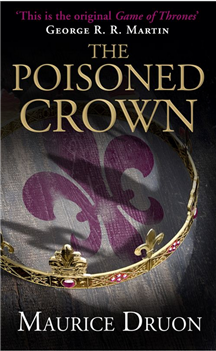
Day 502: The Poisoned Crown

The PoCover for The Poisoned Crownisoned Crown begins with the beautiful and devout Clémence of Hungary on her way into a pit of vipers, the court of Louis X of France, and marriage with the king. Louis has managed to rid himself of his inconvenient first wife. His attention span is short, however, so by the time Clémence arrives after a horrendous journey he is more involved with an ill-conceived siege against the Count of Flanders than with arrangements for the wedding. Still, the new queen is soon esteemed for her gentleness and generosity, even by her horrible husband.

During Louis’ short reign, France has already descended from relative prosperity to famine, and the progressive steps taken by his father have all been rescinded. Robert of Artois, always trying to cause trouble for his aunt Mahaut, has provoked her barons to rise up against her in Artois. The cardinals have still not settled on a new pope. In short, France is in chaos. Louis’ younger brother Philip of Poitiers has striven to dissuade his brother from his poorer decisions, but Louis sends him off to the papal conclave.

Another character who has served in previous books as almost comic relief will soon become more important. This is Guccio Baglioni, the very young nephew of a rich Lombardi merchant. He has fallen in love with the daughter of impoverished nobility, Marie Cressay, and hopes to marry her, without understanding how much beneath them her family considers him. He has just helped escort Clémence of Hungary to France when he is badly injured.

The curse against the Capet kings of France continues in this third book of Druon’s excellent series The Accursed Kings. Those who are following it will not be surprised to learn how short Louis X’s reign will be.

Day 484: The Black Count: Glory, Revolution, Betrayal, and the Real Count of Monte Cristo

Cover for The Black CountTom Reiss, previously the author of the fascinating biography The Orientalist, seems to be drawn to unusual figures who were famous in their own time but have become virtually unknown. Such is the case with Thomas-Alexandre Dumas—the father of the famous author of The Count of Monte Cristo, among other classics—who reached the heights of his fame as a great soldier and general of revolutionary France.

Dumas, who went by Alex rather than Alexandre or Thomas, had a colorful past. He was born on the island of Saint-Domingue (now Haiti), the son of a black slave and a French marquis, Antoine Davy de la Pailleterie. His father was a wastrel and a scoundrel who, although he apparently did not raise his son in slavery, sold him in order to raise the passage money for his own return to France after his family had thought him dead for years. After claiming his right to his title and property (which his relatives had been maintaining and improving for years at their own expense), Pailleterie redeemed his teenage son and brought him up in privilege.

However, shortly after entering manhood, Alex broke with his father, took his mother’s name, and proceeded to make his own way as a soldier. He was the first person of color to become a general-in-chief of the French army and was the highest ranking black officer in the western world of his time.

This book is an account of Dumas’ fascinating life, in which his physical courage, ability, and principled behavior won him acclaim. Unfortunately, he was not as gifted politically and inadvertently made an enemy of Napoleon Bonaparte, who perceived him as a rival and really comes off here as a jealous and power-hungry opportunist. Bonaparte’s resentment, in combination with an abrupt change in policy of the French government to remove the rights previously granted subjects of color, ended in the loss of his career and a death in neglect and poverty.

The book is written in an energetic and informal style for the general public, although it is copiously documented in the back. The Black Count is an engrossing story of an event-filled life.

Day 483: Reread: The Strangled Queen

Cover for The Strangled QueenThis article is a repeat review of the second book in Maurice Druon’s excellent Accursed Kings series. I wrote my initial reviews years after I read the books, from memory. This review is from a recent reread in preparation for my first review of the third book in the series.

The name of Philip the Fair would glow down the centuries only by the flicker of the faggots he had lighted beneath his enemies and the glitter of gold he had seized. It would be quickly forgotten that he had curbed the powerful, maintained peace in so far as it was possible, reformed the law, constructed fortresses that the land might be cultivated in their shelter, united provinces, convoked assemblies of the middle class so that it might speak its mind, and watched unremittingly over the independence of France.

So says Druon in his prologue to The Strangled Queen about Philip IV of France (Philip the Fair), whose death in 1314 begins the action of the novel.

Marguerite of Burgundy has not heard of Philip’s death. She and her sister-in-law Blanche, Philip’s daughters-in-law, are imprisoned in the Château-Gaillard for adultery, and she does not know that her husband has become the king of France, Louis X. When her cousin Robert of Artois comes to tell her, she naïvely believes he wants to help her, unaware how he has assisted in her downfall. What he actually wants is for her to agree to an annulment, as now she poses a big problem to the succession.

But Marguerite doubts when she should not. Although she would gladly exchange her harsh prison for a convent, she is afraid that once she signs, those in charge of her will leave her where she is. She also does not want to declare her daughter a bastard, the other requirement of her release.

Louis X soon sets his sights on marrying Cleménce of Hungary. To do so, he must get a pope installed who will agree to give him an annulment. However, the cardinals have been arguing ever since the death of Pope Clement V, who with Philip the Fair was a victim of the curse of the Grand Master of the Knights Templar (whose death by burning at the stake is referred to in the quote at the beginning of this review).

The weak and stupid Louis is faced with a battle between the forces of order and progress, represented by Enguerrand Marigny, his father’s coadjutor, and the old ways of feudalism, represented by his uncle, Charles of Valois. Whoever can get Louis a pope or his marriage with Cleménce will ultimately win, but in the meantime he begins stripping away all of the governmental reforms instituted by his father.

Bitingly told, about a fascinating period of French history, these novels introduce us to a world of complicated alliances, treachery, and politics, as well as murder and mayhem. Lately the novels are being marketed as the original Game of Thrones. There are certainly strong similarities.

Day 470: Reread—The Iron King

Cover for The Iron KingI already reviewed The Iron King during my first year of blogging, but that review was based on my memory of the novel, having read it several years before. I recently re-read it and would just like to mention it again, as it is so good and easier to find now that the first three volumes of the series have been republished.

The Accursed Kings series concerns the history of the last Capet kings of France. The first in the series, The Iron King, begins with some fateful acts that eventually affect the future of the kingdom.

The novel begins in England with Queen Isabella plotting with her cousin, Robert of Artois, against her three sisters-in-law. Queen Isabella, the daughter of Philip IV of France (known as the Philip the Fair or the Iron King), is unhappily married to Edward II of England, who disdains her and lends the power of his throne to the Despensers, the family of his male favorite. Isabella is disposed to make trouble. Her cousin has brought her his conviction that at least two of her three sisters-in-law are being unfaithful to their husbands, her brothers, the princes of France. Isabella and Robert hatch a plot to expose them.

Robert of Artois has his own reasons for the plot, for his father’s property was awarded to his aunt Mahaut instead of to him so that it would pass into the hands of King Philip the Fair’s two younger sons when they married Jeanne and Blanche, Mahaut’s daughters. Robert is only too happy to ruin Marguerite, Queen of Navarre and wife of Philip’s oldest son, along with the two other girls, as she is Mahaut’s cousin.

Awaiting their own fates are the last four members who are not in hiding of the once wealthy and powerful Knights Templar. Years before they had refused to admit Philip the Fair as a member, as it was against the rules of their order to admit royalty. Since then, Philip has plotted their ruin, assisted by Pope Clement, who covets the riches of the order. Now they have been condemned of heresy, largely on trumped up charges.

Early in the book, Jacques de Molay, Grand Master of the Knights Templar, is burned at the stake. During his burning, he curses the King, Pope Clement, and Guillaume de Nogaret, Secretary-General of the Kingdom, to their thirteenth generation. The Pope is dead within 40 days, de Nogaret soon after. Thus the name of Druon’s fantastic series, The Accursed Kings, for you can be sure that Philip the Fair will be dead by the end of the novel.

This series is being marketed as the original Game of Thrones. Perhaps there are some similarities. The court is a nest of vipers—those in power are constantly engaged in political machinations and those not in power in other kinds of plots. The world Druon presents is fascinating, depicted with cynicism and wry observations. The novel is extremely well written, about an extraordinary time in French history.

Day 452: Under the Wide and Starry Sky

Cover for Under the Wide and Starry SkyUnder the Wide and Starry Sky traces the relationship between Robert Louis Stevenson and his wife Fanny from shortly before the two meet. At that time, he was a young man still trying to decide his profession and she was a married woman, although separated from her husband, ten years his senior and with children.

Fanny Osbourne has a great creative urge, and she has moved to Paris for art lessons for both herself and her grown daughter Belle, leaving her philandering husband in America. Fanny meets Stevenson while on a recuperative visit to southern France after the death of her youngest son.

The novel follows closely the entirety of their relationship from courtship to his death and her life afterwards, mostly from Fanny’s point of view. They separate because Fanny wants to give her marriage another chance, but they finally come together again. Stevenson, called Louis by his friends, is a sickly man, and his health often requires them to move to climates that are better for his lungs. When it seems as though he cannot live much longer, they find that his health revives on ocean voyages, so they go to sea and finally settle in Samoa until his death.

Although Horan appears to follow faithfully the course and events of the couple’s life together, and the novel is interesting from that standpoint, she never really brings the characters or settings to life. Aside from Fanny’s devotion to Louis, Horan concentrates on her frustration at not being able to live her own creative life. The characters seem relatively flat.

http://www.netgalley.comI was struck also by how, on the original voyage to the South Seas, Horan describes almost nothing but one chieftain until they get to Samoa. If she was working from journals or letters, surely she could have researched further to find out or even imagine what the islands would have been like for Louis and Fanny, seeing them the first time. Instead, we come into their voyage toward the end, as if all the sights and experiences are routine. I’m missing the sense of wonder. Although this novel should have been fascinating in its focus on some amazing lives, it generally does not fulfill its promise.

Day 419: The Bones of Paris

Cover for The Bones of ParisHappy Halloween! I tried to select a book that was appropriate for the occasion, although I didn’t have a ghost story lined up.

Laurie R. King’s series about Mary Russell and Sherlock Holmes is very popular, but I prefer her Kate Martinelli series or, even better, some of her dark psychological stand-alone novels. Folly is my favorite. With The Bones of Paris, she brings some of that darker sensibility to what looks like the beginning of a new mystery series.

Harris Stuyvesant is an ex-FBI agent who has been scraping a living in Europe by taking private investigation work. Among the hordes of American expatriates in 1929 Paris, he is searching for a young woman, Pip Crosby, whose relatives have not heard from her in months. A cause for possible embarrassment or worse is that Harris met Pip in Nice the year before and had a brief fling with her. Ever since a disastrous incident that ended his career and cost him his fiancée, he has been living an aimless and bohemian existence.

Two of Harris’ first stops in his search for Pip are Pip’s flatmate, Nancy Berger, and the Paris Missing Persons Bureau. Nancy seems to have a hangover but is actually suffering the effects of travel. She just returned from an archaeological dig in Greece and has not seen Pip for months. Harris finds the police officer, Doucet, concerned about what may be a series of killings.

Harris’ attentions soon narrow on three men connected with the art world whose names keep surfacing in connection with Pip and who all have a fascination with the macabre. The artist Man Ray‘s photographs of Pip focus on a gruesome scar from an accident in her youth. Count Dominic de Charmentier is a wealthy patron of the arts who owns a theatre that alternates grotesque and frightening scenes with comic ones. He also hosts parties that feature macabre decorations and terrifying staged events. Didi Moreau is a creepy, disturbing artist who makes displays of found objects, including human bones. Pip has a few of these displays in her room, as well as some of Man Ray’s photographs. When Harris begins investigating these men more closely, he finds to his alarm that his ex-fiancée, Sarah Grey, is working as de Charmentier’s assistant.

King evokes the time and place with mastery, introducing us to a dissolute café culture populated with famous figures such as Cole Porter and Josephine Baker. She also cleverly raises the creep factor by interjecting short chapters about the bones that underlie parts of Paris, foreboding snippets of conversation, and other indications that something monstrous is going on behind the scenes of glittering nightlife.

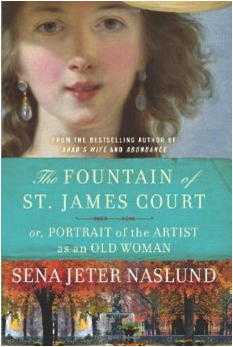
Day 394: The Fountain of St. James Court or, Portrait of the Artist as an Old Woman

Cover for The Fountain of St. James CourtI received this book in a First Reads giveaway from Goodreads. I haven’t read Naslund before, so I am not sure whether she adapted her writing style for this novel, but it took me awhile to accustom myself to it. She follows the activities of two artists, one Kathryn Callaghan, a fictional older writer in the current time, and the other a once-living person, Élisabeth Vigée-Le Brun, a painter known especially for her portraits of Marie Antoinette.

The modern-day story begins at midnight next to a fountain of Venus in a neighborhood of Louisville, Kentucky. Kathryn, or Ryn, is taking her newly finished manuscript to her friend Leslie’s door because she can’t wait to deliver it.

The novel’s structure is a book within a book. Chapters following one day in Ryn’s life are interleaved with chapters covering the whole of Vigée-Le Brun’s life, which are from Ryn’s book. Both stories are about the theme of what it means to be an artist and what you must give up of your personal life to pursue your profession. The novel is said to be a deliberate variation on Joyce’s Portrait of an Artist as a Young Man, but it has been so long since I’ve read it that I cannot comment on that.

This novel is contemplative, especially in the modern-day narrative, but the interleaving of stories in such short chapters slows down the pace too much. It literally takes until page 34 for Ryn to walk across the street and deliver the manuscript. Even with some chapters from the 18th century interleaved, the pace is frustrating. I found myself thinking, when is this woman going to make it across the street?

I found the story of Vigée-Le Brun’s life more compelling than the modern-day story, during which we follow Ryn’s every thought. She is an excitable, emotional woman who contemplates everything she looks at and repeatedly broods over the same things. We read about the russet and yellow fall colors or the appearance of the fountain many times. Nothing much happens all day until a late-night confrontation that seems artificially created to provide some tension.

I did not feel, however, that the two women, Ryn and Vigée-Le Brun, were two different people–they seemed to be the same person in different time periods. Vigée-Le Brun is slightly less emotionally excitable than Ryn, but their observations of the world around them, their attention to color and the details of design and structure, are very similar. Vigée-Le Brun’s narrative style, in first person where Ryn’s is in third person, is a little more formal as befitting an earlier age, but conversations in this story often sound stilted, and her first conversation with Marie Antoinette is positively sycophantic.

Naslund’s writing style, although sometimes vibrant and lyrical, often seems affected, particularly in the modern-day story. The copy I read was an advanced reader’s edition and it had quite a few typos, which I assume will be corrected. I was not quite as sure of some self-consciously unusual phrases, whether they were stylistic choices rather than errors. Naslund’s writing style tends to the unusual, to be sure, but I stumbled over some of these phrases. The only one I wrote down was an instance where some characters “made quick chat.”

I wanted to like this novel more than I did. I think the theme of women and art is worth exploring, although I’m not sure how much this novel actually explored this issue, despite its obvious intentions. I am actually curious about the alleged feminist leanings of Naslund and their effect on this book. Vigée-Le Brun has to put up with her father and then husband appropriating all her money and, in her husband’s case, only giving her a bit of it back as an allowance. When they divorce, he gets almost everything. Yet, she is determined not to let it bother her. I am not sure whether that is a feminist viewpoint or not.

However, the characters in this novel certainly reflect the “gift for pleasure” noted in reviews of Ahab’s Wife (which I am currently reading). The women go on pursuing their lives and dreams without much heed to their menfolk, they have cordial relations with those around them, they delight in color and the fineness of life. Their regrets and sorrows mostly focus on their children.

One thing that surprised me about the historical story was that Vigée-Le Brun hardly seemed to notice the causes of the French revolution or the revolution itself. There is one scene where a woman confronts her on the street and another where she grieves for the fate of so many. That’s about it.

Conversely, it is hard to believe that she would be shocked to the core by seeing a model of internal organs, as artists had been studying the body for hundreds of years. I do not know how much of this novel actually reflects Vigée-Le Brun’s true thinking and feeling. The danger when portraying a historical person is that you are imagining who the person really is–you don’t know–and you have no idea if you are doing them justice or injustice.

Day 374: A Plague of Lies

Cover for A Plague of LiesA Plague of Lies is the third in the mystery series set in 17th century France and featuring Charles du Luc, a master of rhetoric at the Louis le Grand school in Paris.

Charles is dismayed when he is summoned to escort Père Jouvancy to the court at Versailles to present Madame de Maintenon with the gift of a holy relic. Madame is angry with the Jesuits because the King’s confessor, Père la Chaise, convinced the King not to give her the title of Queen, so the gift is an attempt to regain favor. Although Charles disapproves of what he sees as the Sun King’s constant self-glorification, he must escort Père Jouvancy, an old man who is just recovering from an illness that is raging through Paris.

On their way to Versailles, Charles and Jouvancy encounter Lieutenant-Général de la Reynie, head of the Paris police, whom Charles has assisted on occasion. La Reynie asks Charles to keep an eye on the Prince of Conti while he is there and to listen to what is said about him.

Once at court, though, Père Jouvancy has a relapse, and Charles comes close to witnessing the death of a much-disliked man, the Comte de Fleury. Apparently, he too was ill and running for the latrine when he slipped on the wet floor and fell down the stairs. The rumor is that he was writing a scandalous memoir, and poison is immediately mentioned. When the other members of Charles’ party fall ill, there are more rumors of poison, but all the men seem to just have food poisoning.

De Fleury does appear to have been poisoned, however, and Charles observes several people going in and out of his room, including the Duc du Maine, son of the King. Charles finds himself getting embroiled in the problems of the Duc’s sister, Mademoiselle de Rouen, who is soon to be engaged to the son of the King of Poland and is not happy about it. Charles also observes Conti behaving suspiciously. Next, a gardener is found drowned.

The novel presents us with a convoluted plot but also with a fascinating portrait of the court at Versailles. Rock’s knowledge of the period, even of how the places she describes would have appeared at that time, seems convincingly complete. Her novels are always absorbing.

Day 347: The Strangled Queen

Cover for The Strangled QueenBest Book of the Week!

The Strangled Queen is the second in Maurice Druon’s The Accursed Kings series. In The Iron King, King Philippe IV and his progeny were cursed at the stake by the Grand Master of the Knights Templar for conniving with the pope to destroy the knights for their wealth. Now, after the pope and one of the king’s advisors dies, Philippe begins to believe in the curse and dies shortly thereafter, within a year, just as foretold.

His death leaves Philippe’s eldest son, Louis X, on the throne. Louis needs an heir, but his wife, Marguerite of Burgundy, was imprisoned in the Chateau Gaillard for adultery along with her sister-in-law Blanche. He is unable to get a divorce because a new pope has not yet been chosen. He sends Robert of Artois to coerce Marguerite into signing a letter claiming that their marriage was not consummated and their daughter is illegitimate.

In the meantime, Louis is involved in a power struggle against his uncle Charles of Valois. Louis does not know that Robert of Artois has taken his uncle’s side as part of his scheme to reclaim his inheritance, stolen by his aunt Mahaut.

Druon’s historical fiction is powerfully written, elegant and ironic. His novels do not take the point of view of one fictional character, as do most historical novels. All of the characters are actual historical figures, and few of them are sympathetic. The plots are driven forward by the power of the events they relate.

Several years ago, I had a hard time finding this series of books so that I could read it, but I felt that the result was worth the effort. Now, luckily for readers who are interested in the series, a new version of these books is available in paperback.