
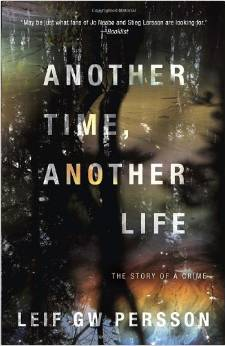
 Another Time, Another Life is the second book in a trilogy of complex political police procedurals by Leif GW Persson. I reviewed the first book last spring.
At first, it is difficult to see the connection between the two books, but eventually some of the names and events from the previous book re-emerge. Another Time, Another Life begins with two crimes 14 years apart. Like Between Summer’s Longing and Winter’s End, one of the crimes is based on an actual event, in this case the bombing of the West German embassy in Stockholm in 1975 by German terrorists. Although the Swedish authorities are certain that the Germans must have had help from Swedish citizens, the case is wound up fairly quickly without any indication of who those Swedes might be.
Inspector Bo Jarnebring was on the scene right after the bombing, and 14 years later he is the first to respond to a call for help. A little old lady has overheard an argument in a neighboring apartment and called to report that someone is attacking her neighbor. When Jarnebring and his partner Anna Holt arrive, they find Kjell Göran Eriksson stabbed to death in his living room.
Eriksson turns out to be an unpopular man—no one at his workplace liked him and he had only two friends, both of whom have not seen him in awhile and have alibis. Bäckström, the inspector in charge of the investigation, gets it into his head that the crime involves homosexuality, based solely on there being no evidence that Eriksson had a girlfriend. He has no compunction in using illegal means to make the facts fit his idea of the crime. Jarnebring and Holt are suspicious of the amount of money in Eriksson’s bank account, not justified by his salary or his background. But Bäckström won’t let them pursue their leads, and no suspect is ever identified.
Ten years later, Lars Johansson has just taken a job as head of the Swedish Security Police when he finds some puzzling information in his files. The names of four Swedes suspected of helping the German terrorists in 1975 were redacted from a file, but then two were reinstated. Both men are dead, and one of them was Kjell Göran Eriksson. The other was one of his two friends. This discovery leads Johansson back to his friend Jarnebring and to an official reopening of the Eriksson case and an unofficial reopening of the embassy bombing case.
Having read the first book in this series, I was not surprised to find the case becoming very complex, with important political ramifications. Persson’s work is reminiscent of some of John Le Carré’s political thrillers, although not as exciting and probably not as well written (hard to tell with a translation). The novels are intended more as complex procedurals, though, than thrillers, and they succeed in keeping my attention. As with the first book, Persson seems to delight in depicting incompetence and idiocy in the police and government. Jarnebring and Johansson’s teams are capable and intelligent, though, and for once we meet detectives who are happy with their wives.

 What? Me Read?