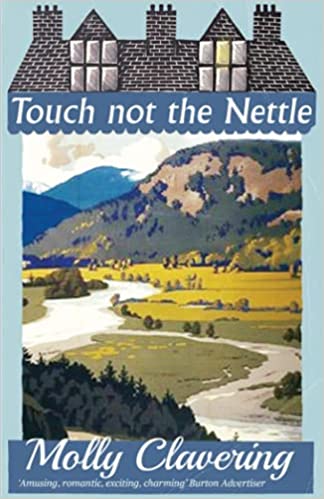
Review 2006: Susan Settles Down

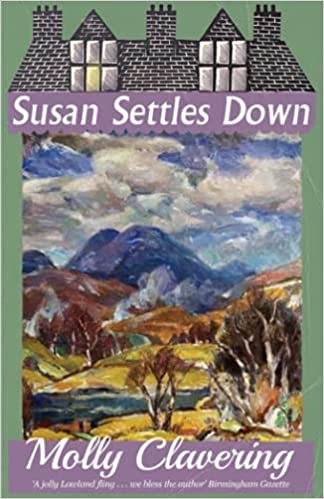
Susan Parsons has been leading a wandering life keeping house for her naval officer brother Oliver, but Oliver was badly injured in a fall months before and has left the Navy, still suffering a limp and not his old self. Then Oliver inherits a small estate in Southern Scotland. It’s not in good condition and the Parsons haven’t much money, but Oliver decides to make it their home.

While Susan struggles to get some help in the kitchen and repair the worst problems of the house, Oliver begins supervising the farm work and almost immediately meets Jed Armstrong, the farmer next door. Although they immediately become friends, Susan finds Jed rude and uncouth.

Soon, the two siblings become involved in village activities. Susan befriends Peggy Cunningham, the parson’s young daughter, who has been receiving unwelcome attentions from the organist. The Parsons become fast friends with the Cunninghams, and all try to avoid the Pringle sisters, three mischievous gossips.

This novel is a lovely tale of village life in pre-World War II rural Scotland, featuring two romances. The descriptions of the landscape are beautiful, the characters are attractive, and I enjoyed it very much. However, I continued to find problems with Furrowed Middlebrow blurbs. Twice now the main character’s name has been misspelled, and this time the blurb places the novel in the Highlands.

Related Posts

Apricot Sky

Music in the Hills

Five Windows

Review 1889: Apricot Sky

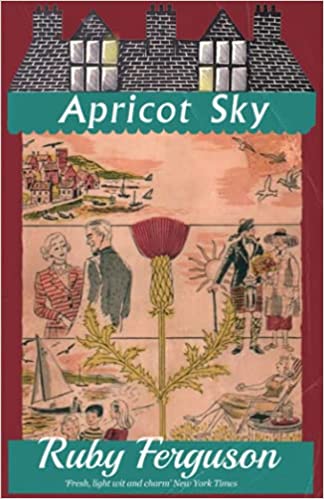
Mrs. MacAlvey is looking forward to a happy summer in her home in the Scottish Highlands. Her three grandchildren who live there are home from school. Her daughter Raine is getting married to Ian Garvine, the younger brother of the local laird, and her daughter Cleo is returning from eight years in the United States. Mrs. MacAlvey also expects guests, and she loves entertaining.

Primrose, one of the grandchildren, thinks Scotland is heaven. She is ready to run wild with her brothers all summer.

Cleo seems to have left home because she was hopelessly in love with Larrich, Neil Garvine, and at first sight of him she realizes she’s not over it. However, she was too homesick to remain in the States. Neil seems more interested, though, in Inga, a young widow whom everyone but Cleo seems to love.

I really loved this novel, and its descriptions made me want to visit the Highlands even more than I already did. It’s about an eventful summer in the life of an attractive, easy-going family in 1948. The characters are likable, it is funny and has a romance, and it’s a lot of fun.

Related Posts

Lady Rose and Mrs. Memmary

Beneath the Visiting Moon

Music in the Hills

Review 1868: The Swiss Summer

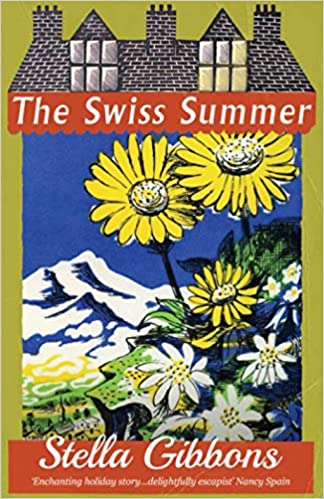
When Lucy Cottrell’s friend takes her to visit an elderly friend, Lady Dagleish, she has no idea how her immediate plans will be affected. Lady Dagleish is sending her companion, Freda Blandish, to spend the summer at her chalet in Switzerland to inventory its contents, and Lady Dagleish tells Lucy she must go along and spend the summer in the chalet, inviting any friends she wishes.

All during her marriage, Lucy has fallen in with her husband’s ideas for a holiday, he preferring to stay in England or Scotland and near convivial friends. But Lucy has yearned for the alpine meadows of her honeymoon, for quiet and beautiful scenery, so she is surprised but delighted by Lady Dagleish’s invitation.

Lucy is thrilled to arrive at a beautiful, large chalet high up in the mountains. Although she was not impressed by Mrs. Blandish when she met her, Lucy herself is an amenable person, and at first things go well. Then Mrs. Blandish’s teenage daughter Astra arrives and makes it clear that Lady Dagleish doesn’t like her and wouldn’t want her there. Mrs. Blandish asks Lucy not to tell her, and Lucy reluctantly agrees.

Lucy finds she likes Astra but is dismayed to learn that Mrs. Blandish expects more guests—paying guests—her friend Mrs. Price-Wharton and her family, and she expects Lucy to keep quiet about it. Utta, the Swiss housekeeper, is certain these people should not be there, but she doesn’t know what to do about it.

Finally, Lucy’s own guests arrive, her godson and a friend who are mountain-climbing in the area. The two young men begin to make friends with Astra and snobbish friend Kay Price-Wharton. Lucy does not quite have the quiet holiday she desired.

This novel has some likable characters and some not so likable. It is full of the beauties of Switzerland in the 50s, and like another novel, The Enchanted April, made me want to go to its setting immediately. I had to laugh at all the references to the characters’ healthy red (or tanned) faces, though. This novel is charming, with just a hint of the sardonic.

Related Posts

The Weather at Tregulla

A Pink Front Door

The Woods in Winter

Review 1859: Music in the Hills

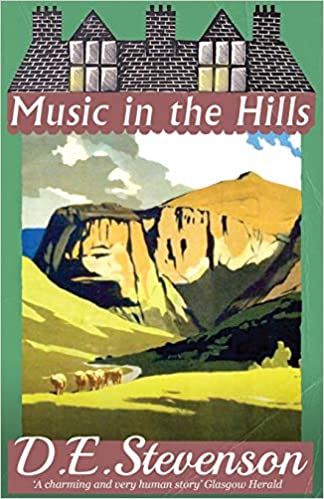
Music in the Hills is the second book in Stevenson’s Dering family series. The first book, Vittoria Cottage, is about Caroline Dering. This book has as its main characters Caroline’s sister, Mamie Johnstone, and Caroline’s son, James. The last book, which I read second, is Winter and Rough Weather.

James has returned from service in Malaysia and wants to become a farmer, so Mamie and her husband Jock have invited him to their farm in the borderlands of Scotland, Mureth, to learn farming. Although James settles in well and loves Mureth, he is unhappy, because he is in love with an art student named Rhoda. He proposed to her, but she has been clear that she’s picking her career over marriage.

This novel is mostly about the everyday events and people on the farm and in the nearby village, nearby in terms of straight distance but a bit remote along a hilly, twisty road. In the novel, as in the next, the landscape is an important character. There are two major subplots, however. One is about sheep being stolen from Mureth. The other is about Holly, the niece of Lady Shaw. She’s making a dead set at James, but there’s something about her that Mamie distrusts.

Another lovely book from Stevenson. I haven’t read Vittoria Cottage for a long time, but it makes me want to revisit it.

Related Posts

Vittoria Cottage

Winter and Rough Weather

Five Windows

Review 1854: The Weather at Tregulla

Una Beaumont (again, the publishers got the name wrong on the cover) is 19 and very much still a sulky teenager. She finds her home in a small Cornish village to be absolutely boring. Her father, Captain Beaumont, had promised her that she could live in London and study to be an actress. However, her mother has unexpectedly died and her money was entailed, so the Captain can no longer afford to send Una. Even her distraught father notices that she is more upset by this than by her mother’s death.

The weather in Tregulla is tumultuous, at least in regard to several love affairs. Una meets Terrence Willows, an artist leasing a cottage in the neighborhood, and his sister Emmeline. Terrence is a bit of a bounder, but Una immediately falls in love with him. Emmeline has the kind of looks admired by Una’s friend Barnabas, and she has in fact moved to the area in hopes of getting him to marry her, even though she hadn’t met him before. She is tired of the chaotic existence of her brother and his friends, but when she thinks of Barnabas, she always thinks of his parents’ estate first. Barnabas, although believing he is cautious, is smitten. Finally, his brother Hugo is in love with Una.

At first, I didn’t think I was going to like this novel as well as I did others by Gibbons. I didn’t like Una, and the novel has several more unlikable characters. However, Gibbons is a great storyteller and satirist, and her characters are believably written. Further, some of them improve, particularly Una.

Related Posts

The Woods in Winter

Nightingale Wood

A Pink Front Door

Review 1849: Much Dithering

Jocelyn Renshawe is a young widow who has always done what is expected of her, that expectation arising from two older ladies, Mrs. Pallfrey, her aunt, and the Honourable August Renshawe, her mother-in-law. She leads a quiet life, mostly doing good works. At the beginning of the novel, she is about to suffer a visit from her mother, Ermyntrude.

Ermyntrude is the most selfish being in this novel, which is full of them. She finds her daughter a bore, and her only reason for visiting her is because she is what Lambert calls a “baby-stealer” and what we would call a cougar. She is interested in cementing her affair with Adrian Murchison-Bellaby, whose parents have just taken a house near the village of Much Dithering, where Jocelyn lives. Ermyntrude wants to show Adrian’s parents how suitable she would be as a wife. However, when Adrian meets Jocelyn, Ermytrude is unable to see that he falls in love with her daughter.

In a thunderstorm on the way back from one of her good deeds, Jocelyn accepts a ride from a stranger who is having trouble finding Much Dithering. He is Gervase Blyth, who has unexplained business in the area.

Soon, Jocelyn unaccountably has three men in love with her. But the one she prefers is most likely to force her out of her protective shell.

It’s not very hard to guess the outcomes of this entertaining light novel, but that doesn’t make it any less fun to read. Its characters’ foibles are all too human, but still funny. This was a perfect light read for me from my Classics Club list.

Related Posts

Rhododendron Pie

The Blue Sapphire

Wild Strawberries

Review 1836: Rhododendron Pie

Ann Laventie comes from an artistic and elegant family, all of whom are witty and have excellent taste. All, that is, except for Ann, who thinks they are wonderful but likes ordinary things and people. While her family disdains their solid Sussex neighbors and stays away from them, she likes them, especially the large and noisy Gayford family. Still, she feels she must be at fault.

A young film maker, Gilbert Croy, comes to stay and pays Ann a lot of attention. After Ann’s sister Elizabeth moves to London, Ann goes to visit her, convinced that she is in love with Croy and determined to come back engaged. But once in London, she begins to notice things. Her brother Dick’s sculptures, for example, all look alike. She absolutely adores a girl that everyone in her siblings’ group of friends shuns.

Rhododendron Pie is Margery Sharp’s first novel, and it’s quite funny as it explores the bohemian world of her upbringing versus the more mundane. Ann is an appealing heroine, and frankly I liked the Gayfords a lot better than the Laventies, especially in their reaction to Ann’s engagement. Her mother, though, an invalid who is mostly just a presence in the novel, gives a wonderful speech at the end. A fun one from Margery Sharp. I’m glad to have read it for my Classics Club list.

Related Posts

Harlequin House

Cluny Brown

The Stone of Chastity

Review 1811: The Blue Sapphire

Julia Harburn is sitting on a bench in Kensington Gardens waiting for her fiancé when a young man sits down beside her and tells her he is on a business trip from South Africa and doesn’t know anyone in London. He is perfectly polite and friendly, but when the fiancé, Morland Beverley, arrives, Julia can tell Morland isn’t pleased.

Julia is taken aback, then, when she comes home one day to find the man, Stephen Brett, having tea with her stepmother. But this isn’t a tale of a stalker—it’s the story of how Julia finds herself.

Julia was close to her mother, who died when she was younger. She has never felt that her father paid attention to her. In fact, he’s always been quiet and depressed. Since he remarried, she has felt in the way, and her stepmother encourages her to move out and find a job. Julia finally finds a room with an eccentric but friendly landlady, who gets her a job in a hat shop. Morland isn’t very happy with her decision, but he has been delaying their wedding until he gets a partnership in his father’s firm, and anyway he is in Scotland golfing.

Julia’s parents are away in Greece when she gets a letter from Scotland from an uncle she didn’t know she had—her father’s brother. He says he is ill and wants to see her, so she goes, even though Morland is very much against her doing so. Thus begins an even greater adventure for her.

This novel is just what you expect from D. E. Stevenson: a heroine who didn’t know she had it in her, some light romance, some self-discovery, and some entertaining characters. Even though I could foresee the result of the romantic angle from the first pages, it didn’t make reading any less enjoyable.

I received a copy of this book from the publishers in exchange for a free and fair review.

Five Windows

Winter and Rough Weather

Vittoria Cottage

Review 1806: Harlequin House

When Mr. Partridge decides he needs a holiday, he just walks off from the Peters Lending Library, leaving it closed. He may be an older man with a shape like an egg, but he is lawless. Wandering around the seaside town of Dormouth Bay, he spots Lisbeth Campion and follows her. Lisbeth is the type of girl that men are always following. He not only follows her, he has tea with her and her aunt.

Later that night, he sees Lisbeth getting into a car with a man. He gets in the back. Finding they have landed in London at midnight, he learns that Lisbeth has been looking for her brother, Ronnie, who through a misunderstanding, of course, has been in prison for delivering cocaine and is just out. Ronnie claims he thought it was baking powder.

Although Lisbeth is engaged to a fine, upstanding captain in the army, Captain Brocard wants to ship Ronnie to Canada with a small pension, as he has never successfully kept a job. Lisbeth has other plans, though: to rehabilitate Ronnie so that the captain returns to find him an upstanding citizen with a job.

Using Mr. Partridge’s five pounds, the three find a modest lodging in Paddington and set out to find jobs. And they find very odd ones.

Harlequin House is a charming, silly comedy. It made me laugh.

Cluny Brown

The Stone of Chastity

Our Spoons Came from Woolworths

Review 1803: Five Windows

In Five Windows, D. E. Stevenson uses the metaphor of windows to reflect her main character’s growth, or change in mental outlook.

David Kirke (his last name again misspelled on the back cover of my Furrowed Middlebrow edition) begins his story as a young boy during World War II, the son of a rector of a small Scottish village. He comes from a happy home and loves rambling the countryside with his friend Malcolm, a shepherd, or Freda, a girl from a nearby farm.

David grows up a bit naïve, even after he goes to live with his uncle Matt in Edinburgh so that he can attend a better school. His eyes are opened to a less salubrious life when he moves to a London boarding house while he works as a clerk in a law office. That’s when he begins to learn that people aren’t always trustworthy or likable.

Five Windows follows David from childhood until just before he is married. It is pleasant, light reading about a likeable hero.

I received this book from the publishers in exchange for a free and fair review.

Winter and Rough Weather

Vittoria Cottage

The Baker’s Daughter