Review 1567: Beneath the Visiting Moon

It is the summer of 1939. The Fontaynes are dreaming along in their stately but crumbling home, left without much money since the death of Mr. Fontayne, who had been a noted thinker and politician. Unusually for them, they attend a local dance, where 17-year-old Sarah meets and falls immediately in love with Sir Giles Merrick, a middle-aged diplomat. Sarah begins a series of attempts to develop more of a life for herself so that she can meet more people and perhaps see more of Sir Giles, her hazy mother Elisabeth seeing no attraction in anything but staying home.

The Fontaynes have been trying to sell their house. When they learn that an “artsy” family is leasing a house of no distinction, the children urge their mother to call on them in hopes the family will buy Fontayne. This meeting has unexpected consequences, for soon Elisabeth has agreed to marry Mr. Jones, an orchestra conductor on rest cure.

The Jones children, Peter and Bronwen, are more sophisticated than the Fontaynes and take delight in mocking things the Fontaynes like. The Fontaynes particularly find 13-year-old Bronwen, who has written a book that is being published and constantly quotes poetry, to be ghastly. Shortly after the marriage, Sarah decides it’s time to get a job.

I found this novel delightful and was disappointed to learn it was Cavan’s last, for she became a playwright later on, encouraged by Noel Coward. It’s a vivid picture of life in an eccentric household right before everything is about to change.

Full disclosure: I received a copy of this novel from the publisher in exchange for a free and fair review.

Related Posts

Not at Home

Guard Your Daughters

The Great Fortune

My Latest Haul

Last month I was busy writing to publishers to request review copies of their newest books. Just this week, I reaped the rewards of a few emails with shipments from some of my favorite British publishers! I can’t wait to dip into these. In fact, I already have, reading Dangerous Ages right away.

The books I received are as follows:

From the new British Library Women Writers series, I received My Husband Simon by Molly Panter-Downes and Dangerous Ages by Rose Macaulay.

The Furroughed Middlebrow series of Dean Street Press sent me Somewhere in England by Carola Oman and Beneath the Village Moon by Romilly Cavan.

From Persephone Press, I received One Woman’s Year by Stella Martin Currey.

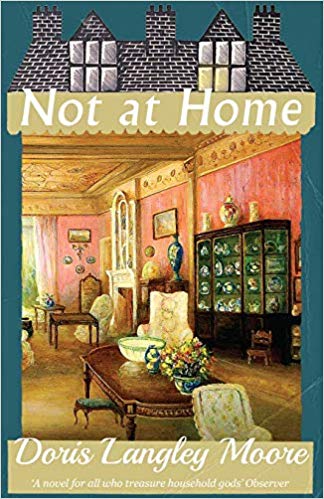
Review 1462: Not at Home

Miss Elinor MacFarren is dismayed to realize that something must be done about her finances. With World War II just past, there has not been much recent demand for her beautifully illustrated books on botany. She decides, with the London housing shortage going on, that she must find someone to share her lovely family home, filled with treasures.

When she interviews Mrs. Bankes, whose husband is an American journalist, she has some misgivings, but Mrs. Bankes agrees to all her conditions, and she relies upon the warm recommendation of her friend, Harriet Greenway. It’s not too long after Mrs. Bankes moves in, though, that the house is noisy and disorganized. Miss MacFarren’s precious objects are being mistreated, and Mrs. Bankes is using up all the time of the shared housekeeper. She is even taking Miss MacFarren’s food from the kitchen.

Mrs. Bankes proves to be a manipulator and a liar, willing to do or say anything to get her way. The situation is complicated when Mr. Bankes arrives, because he is so nice and appreciative of the house. Miss MacFarren can’t bring herself to give them notice while he is there.

This domestic comedy is thoroughly enjoyable as Miss MacFarren gets out of her rut, meeting new people and re-evaluating old acquaintances. With their help, she tries to figure out how to eject her unwelcome lodger.

I received this book from the publishers in exchange for a fair and honest review.

Related Posts

All Done by Kindness

A Winter Away

The Old Man’s Birthday

Review 1376: A Harp in Lowndes Square

In a lonely attic, a neglected child sits and makes clothing for her doll out of old clothes. Everyone is out, surely, but she hears voices on the stairs. These voices belong to her two children, twenty years in the future.

Those children are twins, Vere and James, who have been taught by their mother that all time is simultaneous. The two do indeed experience flashes of visions and sounds from other times, events that occurred in the room years before.

Vere and James’s happy growing up, along with their sister, Lalage, is interrupted by the death of their father. The family is left in financial difficulties and must move from their suburban home to a small house in London. This brings their mother, Anne, back into the orbit of her own mother, the formidable Lady Vallant.

It is clear that, when she returns from visits to her mother, Anne appears to be more worn than usual. Anne’s children know that the two don’t get along and suspect that Lady Vallant harasses Anne. However, a chance remark reveals to them an aunt they didn’t know existed, Myra, who died when she was young.

Vere and James receive impressions of serious events that are not talked about. They begin trying to find out the secrets in their family’s past.

This novel is a ghost story but not in the sense of one meant to scare. It reflects Ferguson’s interest in houses and her sense that actions taken in a room stay in that room’s atmosphere. This idea also occupied A Footman for a Peacock, which I found considerably less likely than this novel, which is set during World War I.

I like a ghost story, but this novel has more going on than that. It’s a story of how family events can affect the lives of others who weren’t even alive when they happened. It’s a good character study of Vere, who cares deeply about a few people but is meticulous and reticent in nature. It is also about a chaste love affair with an older man—and his wife. I didn’t really understand the charms of that relationship, but I very much enjoyed this novel.

Related Posts

A Footman for the Peacock

Alas, Poor Lady

The Priory

Review 1362: Begin Again

In the 1930’s, generational social changes away the Victorian age occurred, including sexual and social liberation. Begin Again follows four young women recently down from Oxford as they try to redefine themselves in the light of these changes.

Leslie is living at home, but she regularly visits her friends Jane and Florence in London. She has a romantic idea about the freedoms the two girls have and wants to get a place of her own in London, an artist’s studio, using her inheritance. Her mother doesn’t want her to use up her inheritance and has suggested she live with her aunt. Leslie, in truth, would like a little opposition to her plans instead of her mother’s acceptance and prefers complete independence to living with her aunt.

Jane and Florence are living the realities of the independent life, which means no servants and often very little food. Jane takes everything in her stride and doesn’t seem to have any deep feelings for anything or anyone. Unfortunately, this includes her boyfriend, Henry, who wants constant assurances of her devotion.

Florence, however, hates her office job and sometimes feels miserable about her and Jane’s lack of comforts. She feels that the girls who started work straight out of school have the advantage over her and that her Oxford education is not valued at work.

Sylvia lives in her parents’ home but has a lover, Claude. Despite their mutual devotion, Sylvia has kept Claud away from her family, assuming they will not get along. She believes in being absolutely honest and behaving honestly rather than worrying about how others are affected by this honesty. Her younger sister, Henrietta, has been taking Sylvia’s beliefs seriously, maybe more seriously than Sylvia intends, and is thinking of embarking on an affair with a middle-aged married man.

Each of the girls has to adjust her theoretical views about life to deal with reality. This is a sometimes amusing, true-to-life novel about how naive, idealistic young women learn to adapt between the gaps of Victorian and Edwardian values and Oxfordian theories and real life. I enjoyed it very much. The characters are depicted affectionately and seem very real.

Related Posts

My Mortal Enemy

The Home-Maker

Someone at a Distance

Day 1217: A Footman for the Peacock

Cover for A Foot man for the PeacockA Footman for the Peacock is a strange little novel. The novel was controversial when it was first published during World War II, because it depicts an upper-class family that tries to avoid its civic duty during the war. But that activity seems almost incidental to the rest of the plot.

What is the plot? The narration flits around in time but centers on the Roundelay family. Their current configuration consists of Sir Edmund and Lady Evelyn and their household of two daughters, three elderly aunts, and three or four servants, including the retired and senile Nursie. When we finally seem to be settling somewhere, on the new Lady Evelyn’s growing acquaintance with the village and regional customs, we stay only long enough for her to hear an old running song, which Evelyn in her innocence takes to be about hunting. then we skip over to her daughter, Angela.

Angela seems to have a sensitivity to an upper-floor servant’s bedroom where the words “Heryn I dye, Thomas Picocke, 1792” are etched on a window pane. She makes an odd connection between this room and an unfriendly peacock in the grounds of the estate, which seems to be signalling Nazi bombers to destroy the house.

I guess I found this novel, which has a supernatural element, peculiar enough to be amusing, but it certainly has an unusual premise. I had more of a problem with the scattered narrative style, which took a long time to get somewhere. Ultimately, the novel becomes a story of class abuse and cruelty in the 18th century.

Related Posts

Harvest

Longbourn

His Bloody Project

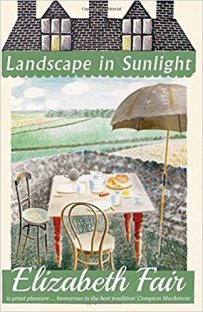
Day 1185: Landscape in Sunlight

Cover for Landscape in SunlightMrs. Custance, the vicar’s wife, is planning the annual church fête, but she is also wondering what will happen to her daughter. Cassie is currently tutoring Leonard Templar, but Mrs. Custance knows she is contemplating taking a caravan with her bouncing friend Joan and perhaps working at Joan’s school. Mrs. Custance once hoped that Cassie would marry George Brigham, Cassie’s childhood friend, but after the war George got engaged to an Italian countess. The engagement was short-lived, but Mrs. Custance has never forgiven George. George’s father, Sir James, also complains that George is an unsatisfactory son.

George has done nothing worse than go into partnership with a tradesman. Any income in the house belongs to him, but it’s not keeping the house from going to bits under the care of two lazy old servants.

In the meantime, Eustace Templar is trying to think of a way to get the Midges out of Prospect Cottage, his rental home. Eustace thinks it is the perfect home for his brother-in-law, Colonel Ashford, if only the Midges could be persuaded to move.

Landscape in Sunlight is another enjoyable domestic comedy by Elizabeth Fair. It follows the village people through their everyday lives, with just a touch of romance.

Related Posts

Bramton Wick

The Mingham Air

The Native Heath


Day 1176: The Native Heath

Cover for The Native HeathJulia Dunstan is delighted to have inherited her uncle’s Belmont House in Goatstock. Belmont House was the place of her fondest memories of childhood, when she and her cousin Dora would visit there. Dora, too, she is meeting for the first time in years, since Julia’s widowhood and return from life in the colonies. As Julia is given to impulsive and kind acts, she invites Dora to live with her at Belmont House, Dora having had such a hard life.

In Goatstock, the neighbors are all agog to set eyes upon Julia. And eccentric neighbors there are aplenty. Mrs. Minnis dresses like a juvenile and borrows from the neighbors; if returned, the objects are broken. Mrs. Prentice is so embarrassed at being caught looking into the house from the street that she fails to call. The vicar and Miss Pope are being preyed upon by Miss Briggs, who sees Alaric Pope as a future husband. Lady Fincy is the expert on food and gives lectures about eating nettles.

Of young people, there are only three. Julia has brought along her nephew, Robert, just qualified as an engineer. Marian Prentice is engaged to a missionary in Africa, and her best friend, Harriet Finch, would like to see her stay in England. Harriet plots to throw Robert and Marian together before she realizes she quite likes Robert herself.

As for Julia, her kind heart soon has her feeling responsible for several people. But she eagerly renews her friendship with her cousin, Francis Heswald. He always did like her, she thinks, but maybe he likes Dora a little more.

I’ve found all of Elizabeth Fair’s books delightful, and this one is no exception. They have been compared to the work of Angela Thirkell, minus the sentiment. I don’t actually think of Thirkell’s novels as sentimental, however, so I’m not sure what that comment means. With Fair’s flair for eccentric characters and their lightness, her books remind me more of some of those of Elizabeth Cadell.

Related Posts

Bramton Wick

A Winter Away

The Mingham Air

Day 1171: Seaview House

Cover for Seaview HouseAlthough Mr. Heritage has been friends with sisters Rose Barlow and Edith Newby for years, he is jealous of the attention of his godson, Edward Wray. So, he is not at all happy when he notices that Edward is attracted to Rose’s daughter Lucy.

Lucy has been friends with Nevil Fowler since they were children and has a dim expectation that they will eventually marry. That’s why it takes her a while to figure out that she has feelings for Edward. In the meantime, Mr. Heritage’s machinations have put matrimony in Nevil’s mind, and Lucy’s best friend, Philippa, has intimated that she is closer to Edward than she actually is.

Seaview House is another charming domestic comedy from Elizabeth Fair. I only recently discovered her novels, being republished by Furrowed Middlebrow, and wish there were more than six of them to read.

Related Posts

A Winter Away

Bramton Wick

The Mingham Air

Day 1166: The Mingham Air

Cover for The Mingham AirA broken engagement followed by a bout of pneumonia brings Hester Clifford to Mingham and her godmother, Cecily Hutton, for recovery. She is inclined to think the Huttons need some organizing. Cecily is a woman of two moods, the creative and the motherly, of which the creative is the predominant. So, her household is poorly run. Her husband, Bennet, has been an invalid for so long that invalidism has become more of a habit than a necessity. Maggie works hard on a nearby farm, but Cecily is constantly scolding her for her dress and general messy appearance. Derek can’t decide what to do with his life, so keeps changing jobs.

The Huttons used to be friendly with Thomas Seamark, but since his wife’s death four years ago, he has become a bit of a recluse. Hester thinks it’s about time the friendship was renewed, and her efforts are successful. This renewed acquaintance leads Cecily to the conclusion that Hester would make a perfect wife for Thomas. She becomes so convinced of this that she doesn’t even notice she is putting obstacles in the way of his pursuit of her daughter, Maggie.

Like Fair’s other novels, The Mingham Air is full of colorful village characters, like Mrs. Hyde-Ridley who competes with her closest friend to entertain her while spending the least possible money, and Mrs. Merlin, the rector’s wife, who co-ops the parish féte for a display of country dancing. I enjoy these light novels, which contain just the slightest edge.

Related Posts

A Winter Away

Bramton Wick

Money to Burn