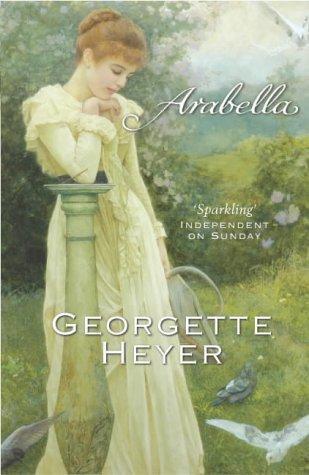
Review 2288: Arabella

Merry Christmas, everyone! Here’s a romp for Christmas Day.

The vicarage children are excited to learn whether their mother’s best friend will invite their sister Arabella for a season in London, in the hopes she can make an eligible match. The invitation arrives from Lady Bridlington, and then the worry is that the upright Reverend Tallant will not allow her to go.

Soon Arabella is on her way to London from Yorkshire. But the perch of her uncle’s old carriage breaks, and she sees nothing wrong with going to the nearest house for shelter. Unfortunately, it is the hunting box of Robert Beaumarais, a leading figure in society and a very wealthy man, who assumes she is one of many girls trying to make his acquaintance. When she hears him saying this to his friend Lord Fleetwood, she says she is the rich Arabella Tallant, who hoped to be unrecognized in London.

Beaumarais sees through this lie but maliciously lets the indiscreet Lord Fleetwood think he knows about her. He also decides to make her debut a sensation. Soon, Arabella is a success but doesn’t dare accept anyone’s proposal because she realizes that they all think she is rich, whereas she has no money at all.

Although she is in an awkward position, she is enjoying herself. But then her brother Bertram, who is supposed to be at Oxford, arrives and begins to get himself into financial difficulties. To make things worse, Arabella has begun to realize she cares for Beaumarais and is afraid to admit her deceit.

Arabella is an adorable heroine, and Beaumarais a likable hero, as he fondly watches her dig herself deeper into trouble, hoping she will confide in him. Heyer is at her best and funniest with these absurd plots.

Related Posts

Cotillion

Frederica

Friday’s Child

Review 2152: #1940 Club! The Corinthian

Since this is my first post for the 1940 Club, I’ll include my list of other books published in 1940 that I have already reviewed:

I was happy to reread The Corinthian for the club because I hadn’t read it in some time. It is one of Heyer’s sillier, unlikelier plots, and I found it delightful.

Richard Wyndham is handsome, wealthy, impeccable in appearance, and bored. When a family deputation informs him it’s time he got married and tells him Melissa Brandon considers herself all but engaged to him, he calls on her. He finds an icy, self-possessed young lady ready to make a marriage of convenience to help her family financially. With the prospect of calling on her father the next morning, Richard goes out and gets drunk.

During his subsequent rambles, he spots a boy climbing out of an upper-story window on a rope of knotted sheets that is unfortunately too short. When he catches the boy, he finds he is a girl. Pen Creed is escaping her family, as her aunt is trying to force her to marry her cousin for her money. When Richard finds Pen will not go home, he decides to accompany her to make sure nothing happens to her. She is on the way to the home of her old friend, Piers Luttrell, who vowed to marry her five years ago.

Richard finds himself experiencing many new things, starting with a stagecoach ride during which the coach is overturned. They meet a thief on the stage and soon learn that someone has stolen the famed Brandon diamonds. As if that wasn’t enough, they find a murdered man, assist a damsel in distress, and end up telling many fibs. Richard soon enough realizes he’s in love with Pen, but he can’t say so while she’s under his protection—and perhaps she’s still in love with Piers.

Heyer is always amusing and I had a lot of fun with this one.

Related Posts

The Nonesuch

Cotillion

The Convenient Marriage

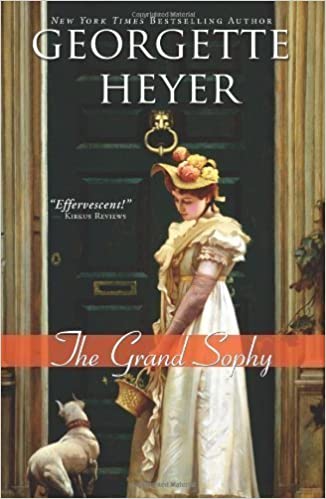
Review 1801: Classics Club Dare! The Grand Sophy

The latest Classics Club Dare is to read something romantic for February, so I have chosen The Grand Sophy from my list.

When Sir Horace Stanton-Lacey unexpectedly arrives at Lord Ombersley’s home to ask his sister to take charge of his daughter Sophy for a while, he discovers a depressed household. Lord Ombersley’s gambling debts had almost overrun the establishment until his son and heir, Charles Rivenhall, inherited a fortune from a distant relative. Charles “did something with the mortgages” and paid off the debts, and now he is trying to get the household to economize.

Charles is also engaged to Eugenia Wraxton, whose outward sweetness hides a self-righteous and meddling disposition. Her plans to occupy the family home after the wedding depress everyone except Charles.

By the time Sophy arrives, the announcement of her cousin Cecilia’s engagement to Lord Charlbury has been delayed by his having contracted mumps. Cecilia now thinks herself in love with Augustus Fawnhope, a devastatingly handsome but vague young man who fancies himself a poet.

Sophy arrives like a breath of fresh air. She brings a monkey and a parrot to entertain the children, a shy greyhound, and a fabulous black steed to ride. She immediately realizes that the family needs her help. And she never shirks her obligations.

Sophy is a firecracker of a heroine, and The Grand Sophy is one of Heyer’s most beloved novels. There is lots of fun to be had as Sophy’s stratagems twist and turn the plot. The novel is a re-read for me for the Classics Club, but I loved it this time just as much as I did the first time I read it.

Frederica

Venetia

Faro’s Daughter

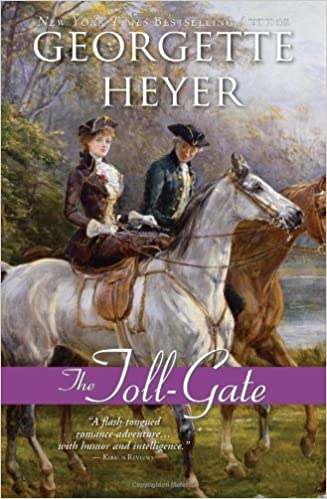
Review 1782: The Toll-Gate

I was rereading some Georgette Heyer novels last winter as I replaced some of my ratty old 70’s copies, and I remembered The Toll-Gate as one of my least favorite of her romances. I was confused, however, for the novel was amusing and had a fun adventure plot.

Back the second time from the Napoleonic Wars, Captain Jack Staple has been intending to settle down. His mother and sister have accordingly presented a string of attractive, eligible girls, but Jack hasn’t been interested. He says he doesn’t want to get married until he receives “a leveller.”

On going to visit a friend, he loses his way and comes to a toll-gate that is manned at night by a terrified young boy. The boy tells Jack that his father told him to mind the toll-gate for an hour, and he hasn’t been back. The boy is terrified of a man his father sometimes meets during the night. Jack decides to stay with the boy until his father returns. Then the next morning, he receives his leveller, in the person of Nell Stornaway.

This novel is just delightful, and I don’t understand how I misremembered it so badly.

The Talisman Ring

Sprig Muslin

Faro’s Daughter

Review 1773: A Civil Contract

Remembering back quite a few years to the last time I read A Civil Contract, I didn’t classify it as a favorite Heyer. As I was younger then and more romantic, I was disappointed in its plain and prosaic heroine. Now that I am more mature, I look at it with completely different eyes.

Adam Deveril is a dashing captain who has been serving in the Peninsular wars when he is abruptly called home because his father unexpectedly died. This death makes Adam Lord Lynton and leaves him heir to a huge amount of debt. Although the family has never been wealthy, Adam has had no idea just how his father’s spending habits and mismanagement have put the estate into debt.

Adam thinks there is no solution but to put his townhouse and the family estate on the market. Being a proud man, he ignores his businessman’s recommendation to look for a wealthy bride.

Adam also feels obliged to inform Lord Oversly of the state of affairs, since Adam had been hoping to wed his beautiful daughter, Julia. Oversly acknowledges that Adam can no longer be considered eligible to marry Julia but remarks that he and Julia probably aren’t well suited anyway. However, both Adam and Julia are heart-broken.

Oversly says he thinks he can help Adam. Soon, Adam is surprised to receive a visit from Jonathan Chawleigh, a wealthy but vulgar businessman. Chawleigh suggests that Adam’s financial problems can be solved if only he would marry Chawleigh’s daughter Jenny.

Adam’s pride does not permit him to consider this offer, but he agrees to meet Jenny. He finds her plain, plump, and matter-of-fact as well as poorly dressed. He does not even realize he has met her before, for she is a schoolfriend of Julia’s. Almost against his will, he marries her.

Maybe I’m giving away too much, but this is the story of how a young man learns to throw away his romantic illusions and begin to appreciate his thoughtful, supportive, affectionate wife. Thus, its intent is a little more serious than most of Heyer’s novels, and it also has a great deal to say, off and on, about the state of Europe at the time.

I had to laugh, because this time through I found myself impatient with Adam and Julia’s romantic yearnings and appreciated Jenny’s good qualities and hidden heartache a good deal more. The book is also not lacking in Heyer’s usual amusing dialogue, although most of it is between other characters than the two main ones.

The Convenient Marriage

Cotillion

Friday’s Child

Review 1768: Venetia

I didn’t remember Venetia as being one of my favorite Georgette Heyer books, but actually I liked it very much. It features a sparkling heroine.

Venetia Lanyon has lived almost secluded in the Yorkshire countryside. When her mother died, her father became a recluse and refused permission when the time came for Venetia to be brought out by her aunt. Now 25, since her father’s death she has been taking care of her brother’s estate until he returns from the wars, at which time she plans to take a house with her younger brother, Aubrey. Although she has two suitors, she cares for neither of them and believes she will need to be there for Aubrey, who has a bad hip and does not relish meeting people.

The Lanyons’ neighbor, Lord Damerel, is seldom home and has such a bad reputation that when they were children Venetia and her brothers called him the Wicked Baron. Venetia is out picking berries one day when she meets Damerel. He at first mistakes her for a village girl and kisses her. However, he soon finds his mistake and doesn’t know what to make of her reaction. Fairly quickly, they find themselves friends.

Of course, this will never do, think her friends and relations, and we’re off for another funny romp with Heyer.

Black Sheep

Regency Buck

Frederica

Review 1753: Faro’s Daughter

Max Ravenscar is exasperated when his aunt, Lady Mablethorpe, comes to consult him about Adrian, his young cousin for whom he is a trustee. She reports that Adrian has fallen in love with a girl from a gambling den and means to marry her. Ravenscar assumes the girl will have to be bought off.

When he meets her in her aunt’s home, which has indeed been converted into a gambling den, he is surprised at her well-bred appearance and demeanor. However, when he makes his offer, he finds she has turned into a termagant.

Deb Grantham, for her part, has no interest in entrapping naïve young men into marriage. Nor is she interested in Lord Ormskirk, who unfortunately holds some of her aunt’s debts and the mortgage to her aunt’s house. However, she is so angered by Ravenscar’s proposals that she decides to pretend she wants to marry Adrian and to behave as vulgarly as possible.

Even though this is not one of my very favorite Heyer novels, it is still great fun. It has some potentially melodramatic twists to it that are saved from seriousness by a feisty heroine who is not to be defeated.

Frederica

Sylvester, Or the Wicked Uncle

The Talisman Ring

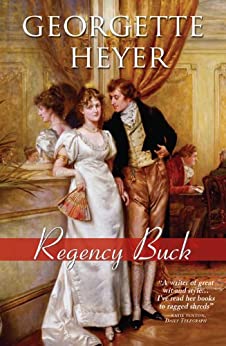
Review 1744: Regency Buck

On her way to London with her brother Peregrine, Judith Taverner mistakenly stops in a town hosting a prize fight and has an unfortunate encounter with a man in a curricle. When the siblings reach town and call on their guardian, Lord Worth, they find that he is the man in the curricle. Their father mistakenly designated their guardian as the fifth Earl instead of his friend, the fourth, who has died.

Judith is headstrong and determined to make a splash in London society. Although Lord Worth gives them assistance with suggestions and introductions, he and Judith continue to clash. Judith’s cousin Bernard Taverner warns her that Lord Worth may have designs on her fortune, which is large enough in itself but even larger if something happens to her brother Perry. Then Perry is first challenged to a duel and later his carriage is attacked. Judith and Worth are getting along better, but does someone have designs against Perry?

Most of Heyer’s Regency romances tend to either be funny or have an element of mystery (although they all have amusing dialogue). Regency Buck is one of the latter, with an engaging heroine, a mysterious plot, and as usual, perfect period detail.

Related Posts

The Nonesuch

Black Sheep

Frederica

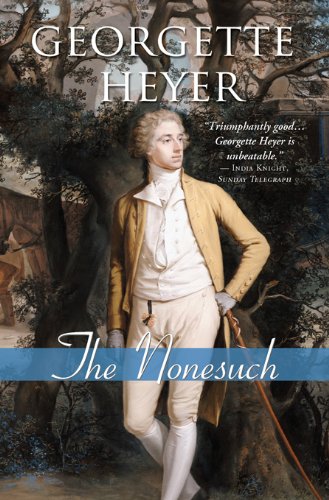
Review 1719: The Nonesuch

Often when I am in the middle of some hefty nonfiction book, I take a break by reading some sort of light fiction. I was reading a biography of Lyndon Johnson when I thought I hadn’t read any Georgette Heyer lately, so I picked The Nonesuch out of my library.

The inhabitants of the village of Oversett are all interested when they hear that Sir Waldo Hawkridge, known as the Nonesuch, has inherited Broom Hall from the miserly Joseph Calver and will be arriving to look it over. The young men are excited to see this notable whip. Up at Staples, kindly Mrs. Underhill is dismayed to learn that Sir Waldo has arrived with a lord, his young cousin Lord Lindeth, for her unprincipled but beautiful ward, Tiffany Wield, has announced that she means to marry into the nobility. Tiffany’s governess/companion, Ancilla Trent, remarks with her customary humor and calmness that they will just have to convince Tiffany she is wasted on anyone under a Marquess.

Lord Lindeth meets Tiffany after she carefully arranges an encounter while he is out fishing. When Waldo sees her and her affect on Lindeth, he is dismayed. However, he is much struck by Ancilla. It is Ancilla who does not have a high opinion of Corinthians, the set to which Waldo belongs.

As usual with Heyer, this novel is full of likeable characters, humor, and an engaging hero and heroine. I tend to like Heyer’s sillier plots best, because they are so funny. This is not one of them, but I enjoyed it very much just the same. A perfect Covid-era lightener. (I re-read it last January.)

Related Posts

The Convenient Marriage

Sprig Muslin

Cotillion

Review 1561: #1956 Club! Sprig Muslin

Seven years ago, Sir Gareth Ludlow’s fiancée died tragically. Since then, he hasn’t met any woman who would make him forget her. He knows it’s his duty to marry, though, so he decides to propose to his shy friend Lady Hester Theale.

On his way to Lady Hester, he meets a beautiful young lady in some difficulty. He learns that in trying to force her grandfather to let her marry, she has run off with the aim of becoming a governess. When her supposed employer turned her away, she presented herself at the inn where he meets her proposing herself as a chambermaid.

Gareth is afraid that Amanda is too inexperienced to know what dangers she may encounter, but she will not tell him her grandfather’s name, so he takes her to Hester. Hester’s family assumes he has brought along his mistress, and her roué uncle spirits Amanda away the next morning.

Sprig Muslin is Heyer at her most ridiculous and fun, as Amanda’s fibs land her and Sir Gareth into serious trouble, requiring, of course, more and more fibs. As usual, her characters are lovable and her wit engaging. I always love reading Heyer, This one, I reread for the 1956 Club.

Related Posts

The Talisman Ring

Cotillion

Cousin Kate