
Day 702: Dead Wake: The Last Crossing of the Lusitania

Cover for Dead WakeIn Dead Wake, Erik Larson has written another fascinating history—the story of the last voyage of the Lusitania. As he sometimes does, Larson goes after the story with a two-pronged approach: on the one hand following preparations for the voyage and the actual trip, on the other hand following the progress of the U-20, the German U-boat that sank it. In this book, the story has a third, weaker prong—the romance of President Woodrow Wilson with Edith Bolling Galt, who would become his second wife.

Even though everyone reading the book knows what will happen to the Lusitania, a passenger ship en route to England from the United States during World War I, Larson manages to create a fair amount of suspense. He tells us about a number of the passengers, and we want to know who survives, of course. I think this ability of Larson’s to create suspense even from a story where we know the outcome is quite a talent.

Aside from learning about the ship, the voyage, and the results of the attack, we also learn about things that are more surprising. In particular, Larson leads us to wonder whether the British admiralty was incompetent or whether the hope that some event like this would force the Americans into the war made them negligent. There were several actions the admiralty could have taken to keep the ship safer.

I recently read an article about the man who bought the wreckage of the Lusitania, who believes that the ship secretly carried armament meant for England. It is true that there was an unexplained second explosion after the U-boat’s torpedo hit the ship, but if the theory turns out to be correct, that makes the British admiralty’s conduct even more perplexing.

Related Posts

In the Garden of the Beasts: Love, Terror, and an American Family in Hitler’s Berlin

The Daughters of Mars

Midnight in Europe

Day 575: All the Light We Cannot See

Cover for All the Light We Cannot SeeI felt a bit of distance while I was reading All the Light We Cannot See, but by the end I was brought under its spell. It is about a German boy and a French girl who meet briefly during World War II.

Werner is growing up in an orphanage in Germany. He has always been fascinated by how things work, particularly electronics, and he is far advanced of his teachers in math. One day he discovers a broken radio set in the trash and is able to make it work. He and his sister Jutta discover a children’s broadcast from France in which a man explains science topics and plays music. This station delights them for years until it becomes dangerous to listen to under the Nazi regime.

With all his gifts, Werner is slated to work in the mines when he is old enough. He gets an opportunity, though, to attend a technical school. Against Jutta’s advice, as Werner has avoided being pulled into the orbit of Nazi politics, he takes his chance.

Marie-Laure’s father is a locksmith employed by a Paris geological museum. At the age of five she becomes blind. Her father teaches her to find her way in their neighborhood by making a model of it, which she learns by feeling her way. She loves spending time at the museum, learning about all its treasures and handling the shells. She also loves reading adventure stories in Braille.

When the Nazis are due to invade Paris, the museum gives four stones to four employees to keep safe. One of them is the museum’s most precious possession, a fabled diamond with a curse attached; the others are fakes. Marie-Laure’s father receives one of them, and the two leave the city, eventually arriving in St. Malo, where Marie-Laure’s great-uncle lives.

The diamond acts as sort of a MacGuffin in this novel. Of course, we are sure who has the real stone.

The stories of Marie-Laure and Werner’s pasts alternate with the bombing of St. Malo in 1944 by the Americans. Werner is trapped with some German soldiers in the basement of a hotel, while Marie-Laure is hiding in her great-uncle’s house from a German officer searching for the diamond.

This novel is beautifully written and shows the hardships of war from both sides of the conflict. Werner struggles with his desire to do what is expected vs. what is the right thing. Marie-Laure tries to resist the chaos of war in other ways. I felt for a long time that the novel would end predictably, but I was pleasantly surprised and delighted by how the ending opened up from a claustrophobic setting to a more universal feeling.

Day 487: The Book Thief

Cover for The Book ThiefLiesel Meminger is nine years old when she arrives at a house in a poor street near Munich. Her mother has given her and her brother up to a foster family because she cannot support them, but her little brother died on the train on the way there. She is dirty and illiterate, and when she arrives at the house of Hans and Rosa Hubermann, she has to be coaxed to come inside.

Although the Hubermanns prove to be loving parents and Hans eventually teaches Liesel to read, it is 1939 in Nazi Germany. Slowly, the difficulties of living in the Third Reich and the hardships of war will affect everyone she knows.

Liesel has already stolen her first book, when a grave digger dropped it the night her brother died. She steals her second book from a fire on the night of a book burning, for small and even large acts of defiance have become a part of her nature.

Zusak depicts a vivid life within Liesel’s little community. The boy that becomes her best friend, Rudy Steiner, has already distinguished himself before they meet by covering himself with soot and pretending to be Jesse Owens during the 1936 Olympics. Hans Hubermann is a failing painter and virtuoso accordion player who is ultimately too kind for his own good. His gruff wife Rosa shows her inner kindness by forcing people to eat her dreadful soup.

The novel is told by Death, which acts as an omniscient narrator, sometimes telling the back story, sometimes giving a glimpse of the future. At the beginning of the book, I thought I was going to find this irritating. By the middle of the book, I was wondering if it added anything that a traditional narrator wouldn’t provide. By the end, I thought it was effective. One little quirk of style that bothered me a little, though, was that Zusak occasionally creates his own words when perfectly good ones that are very similar already exist, like lovelily instead of lovely. I think this is an affectation that adds little to the novel.

The Book Thief accomplishes an unusual goal—to show that there were decent Germans during World War II. One of the kind and dangerous things that Hans Hubermann does is shelter a Jew, Max Vandenburg, in his basement for months. Liesel’s relationship with Max forms a core part of the story.

This novel is involving and affecting. It does have a few difficult scenes, but I think that it is a very readable experience for tweens, teens, and older readers. It has been wildly popular, so obviously readers are enjoying it.

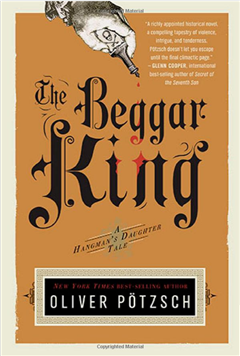
Day 475: The Beggar King

Cover for The Beggar KingBehavior is a problem in The Beggar King, the third of Oliver Pötzsch’s Hangman’s Daughter series, but the first I have read. Characters who are in peril of their lives stop running away from their pursuers to have arguments; characters who are fighting for their lives start flashing back to their pasts instead of concentrating on not being killed. To be very clear about this problem, the characters do what the plot requires. When the plot requires the three main characters to be apart, for example, Pötzsch has them begin arguing or just has someone walk off instead of finding a plausible reason for separating them.

The novel begins in 1662, when the Schongau hangman, Jakob Kuisl, gets a letter from his sister in Regensburg saying she is very ill. When he arrives at the bathhouse her husband owns, he finds her and her husband brutally slain. Immediately afterwards, the authorities rush in and arrest him. Now it is up to the Regensburg hangman to torture him into a confession.

In the meantime, back in Schongau Magdalena Kuisl and her lover Simon Fronwieser have run into trouble. As the hangman’s daughter, Magdalena is considered to be among the lowest rungs of society, and she is not allowed to marry Simon, a member of the middle class. A series of encounters with a group of bullies finally ends in the Kuisls’ house being set on fire. Instead of helping her mother and her eight-year-old twin siblings (who by the way behave more like four or five than eight) as might be expected, Magdalena and Simon decide to run off to Regensburg to start a new life.

I have been to Regensburg, which is a beautiful medieval city with an interesting history. We learn a bit about this history, and that is probably the most interesting part of this novel. The city is mostly described to us in terms of its mud and filth, however, not in terms of its lovely pastel stucco buildings decorated with beautiful medieval-era murals or winding cobblestone streets.

However unlikely, our three main characters have stumbled into two plots, one of revenge against Jakob for events during the Thirty Years’ War, the other involving an imminent threat to the Reichstag. Soon, all three protagonists are wanted by the authorities, Magdalena and Simon for arson after someone burns down the bathhouse with them in it, Jakob because he has escaped. Nevertheless, they chase all over the city without anyone noticing them unless Pötzsch needs them to be noticed. In the meantime, they unfailingly trust the wrong people and assault the ones who are trying to help them.

This novel is certainly full of frantic activity. Whether it is plausible at all is the question. I was particularly irked by the last 50 to 75 pages, in which all three characters are in peril in separate locations. Just as one scene reaches a climax, Pötzsch switches the action to another location. This tactic might foster suspense if done once, but Pötzsch uses this technique repeatedly over 50 pages simply to spin things out. I found this tactic so irritating that I almost quit reading at the end of the book!

Although the novel is written moderately well, the characters are one-dimensional and their behavior is driven by plot. The plot itself is ridiculous.

Day 460: March Violets

Cover for March VioletsThe blurb on Philip Kerr’s collection of three noir mysteries, Berlin Noir, compares him to John Le Carré and Alan Furst. I wouldn’t say that is an apt comparison. For one thing, the other two are writing in a different genre. For another, they are better writers. Still, if you like noir, March Violets has its own qualities.

This novel is the first in a series featuring private detective Bernie Gunther. It bears many of the hallmarks of a typical noir mystery. Its main character is a smart, wise-cracking tough guy who used to be a cop. It features beatings, untrustworthy dames, thugs, and murder. What makes it stand out is its setting in 1936 Berlin.

Bernie is hired by millionaire industrialist Hermann Six to find a family heirloom necklace. It was stolen from the safe of his daughter Grete and her husband Paul Pfarr when the two were brutally murdered in their beds and their bodies burned. Herr Six explicitly instructs Bernie not to look into their deaths but to find the necklace and return it to him. Of course, Bernie begins looking into everything.

Using credentials as a representative of an insurance company investigating the fire, Bernie soon finds out that Pfarr was a member of the SS, with a mission from Himmler to seek out corruption in the labor movement. That mission made him a lot of enemies. He also had some kind of friction with Herr Six, who is rumored to have ties to organized crime. In addition, there were unexplained problems in the Pfarr’s marriage.

Typical of noir fiction, the plot becomes very involved. The setting is convincingly evoked, especially the constant threat of violence for ordinary citizens under the Nazis. Bernie specializes in missing persons, and the novel makes clear that hundreds of people go missing from Berlin daily.

Since I am more familiar with classic noir, the novel occasionally struck me as too coarse, but that didn’t bother me as much as other uses of language. First, idioms with which I am unfamiliar are used constantly. Perhaps they are period German idioms, but they often seem clumsy and inapt, which idiomatic  language seldom does. Also clumsy and inapt are Kerr’s many metaphors, for example:

The butler cruised smoothly into the room like a rubber wheel on a waxed floor and, smelling faintly of sweat and something spicy, he served the coffee, the water and his master’s brandy with the blank look of a man who changes his earplugs six times a day.

Perhaps this style of writing is meant as a send-up of traditional noir style, but it is certainly overblown and irritating. (To be entirely dated in my references, it sometimes reminds me of the passages read by Jeff Goldblum’s character in the old TV series Ten Speed and Brown Shoe, but those were explicitly tongue in cheek, and I’m not as sure about Kerr’s writing style.) Although at one point I considered putting the novel aside, I finally decided to continue, and found the book moderately entertaining.

Day 354: Worldly Goods: A New History of the Renaissance

Cover for Worldly GoodsWorldly Goods promises a new look at the European Renaissance from a different point of view. Lisa Jardine, a professor of English at the University of London, proposes an interpretation of the period in terms of the growth of commerce and a new consumerism and multiculturalism.

However, the information offered does not seem new. Rulers and wealthy men have always been conspicuous consumers. Jardine attempts, for example, to turn around our view of the flowering of art as merely a series of demonstrations of the wealth of patrons who commissioned the works, a sort of competition to show who is most wealthy or powerful. But simply providing examples of patrons who specified expensive materials or the inclusion of their goods in pictures doesn’t prove this point.

Jardine does a better job of showing how the development of printing made the exchange of ideas easier, thus affecting the advances in many different fields, including the arts and the sciences. However, her argument that the policy decisions of the period were all driven by the dictates of commerce is taking things too far, I think.

The book is well written and lively. It does not back up its assertions with footnotes or a bibliography, however, indicating that it is written for the general public but frustrating those who would like to look further. At some point, I felt that the examples were becoming too repetitive and no new points were being made. For example, Chapter Three is about the proliferation of books and printing, but Jardine continues to make the same points about printing and the sharing of scientific and technical information repeatedly throughout the rest of the book.

Although the history provides an interesting discussion of commerce during the Renaissance, it is oversold as a complete history of the period.

Day 335: A Time of Gifts: On Foot to Constantinople: From the Hook of Holland to the Middle Danube

Cover for A Time of GiftsIn December 1933, nineteen-year-old Patrick Leigh Fermor set out alone on a great adventure, a walking trip from Amsterdam to Istanbul, or as Fermor still called it, Constantinople. (It was renamed in 1930.) He had no idea when he left that he would not return until 1937. In 1977, he collected his notebooks from the trip and wrote A Time of Gifts and its sequel Between the Woods and the Water.

Although Leigh Fermor had one notebook stolen from him with all the rest of his gear, he otherwise must have kept careful account and his memories of the trip must still have been vivid, for the result is an entrancing account of scenery and architecture, tales of chance encounters, glimpses of foreign customs and celebrations, and so on. Jan Morris, who wrote the introduction, calls him “one of the great prose stylists of our time,” and Wikipedia, quoting an unnamed British journalist, “a cross between Indiana Jones, James Bond and Graham Greene,” presumably for his work with the Cretan resistance in World War II as well as his writing. (He was also a friend of Ian Fleming.)

From his drinking bouts with Dutch barge men to his extended stays in various German, Austrian, and Czech castles, Leigh Fermor plunges enthusiastically into every experience on offer. At one moment he is sleeping in a barn, in the next hanging out with fashionable youth in Vienna. Along the banks of the Danube he is mistaken for a 50-year-old smuggler. All of these adventures as well as his observations of nature are described in beautiful, evocative prose. To add interest to the modern reader, he is describing a Europe that no longer exists.

If I have any complaint, it is one of my own education, for Leigh Fermor’s writing assumes for his audience a familiarity with classical culture that is no longer common. The book often alludes to mythology and refers to obscure historical events that I do not fully understand. Finally, in the footnotes, which are Leigh Fermor’s original ones, all utterances in modern languages (some of which I could have taken a stab at) are translated, but the quotations in Latin are not. They are not integral to comprehension, but it is a little frustrating to be unable to understand them. (Of course, I could have googled them, but I was almost always reading this on the bus.) That being said, I look forward to reading the sequel.

Day 155: In the Garden of Beasts: Love, Terror, and an American Family in Hitler’s Berlin

Cover for In the Garden of BeastsBest Book of the Week!

In the Garden of Beasts is the latest of Erik Larson’s extremely interesting histories. In a couple of his books, he takes the approach of  juxtaposing two seemingly different subjects and showing how they are related, for example, in Thunderstruck, where he tells the story of Marconi and the invention of radio and how that affected the capture of the famous British murderer, Crippen. In other books, though, he has managed to make historical events more personal by relating them from the point of view or one or two people. Such is the case with In the Garden of Beasts, which follows William E. Dodd’s years as the American ambassador to Germany during the build-up of Nazi power before World War II (1933-1937).

The book is about the experiences of Dodd and his family as they witnessed the events of those times. It focuses mostly on Dodd and his daughter Martha, based upon their letters and memoirs.

Dodd was in many ways an uncomfortable fit for the position of ambassador. He was an academic–a historian whose previous position was chairman of the history department at the University of Chicago. He had worked his way up from extreme poverty and believed that he had not risen as far as he would have if he had come from a more privileged background.

Dodd was a personal acquaintance of Franklin D. Roosevelt, and he requested a position as an ambassador of a small country from FDR, hoping both to add to his prestige and to be able to devote more time to writing his history of the South. In an ironic twist, though, he was offered Berlin, a much more demanding situation than he wanted and no sinecure, after several other candidates turned it down.

He saw his role as that of a reformer. He intended to live modestly on his salary and provide the other employees in the diplomatic service with an example of good stewardship of public funds, never understanding that his frugality was more likely to be misunderstood by his colleagues from more privileged backgrounds, who were the more usual occupants of such a position and who viewed him with disdain. In fact, some of them circulated a malicious and untrue rumor that FDR had made a mistake with the phone book and offered the job to the wrong Dodd.

The family was at first inclined to believe that the stories of attacks on foreigners and Jews by the SA (German Stormtroopers) were exaggerated. Frankly, they were also somewhat anti-Semitic. Martha admired the vigorous blond young men who were excited by the rise of Hitler, and she socialized with men in the Nazi leadership. In fact, she was quite the party girl, in every sense of the term. Dodd naively thought that he would have more impact on German policies if he maintained friendly relations with the country’s leaders, no matter what he thought of them personally.

It took Dodd an inordinately long time to recognize the truth about the kind of people he was dealing with, especially considering all his sources of information. However, when he did, he was at times heroically unflinching about standing up to the Nazi high command.

The genius of this book is that it relates history from the point of view of naive onlookers whose understanding of the situation and sense of danger grow slowly, rather than from complete hindsight. The book brilliantly conveys the feel of the time and place as the Dodds slowly realize the extent of the Nazi atrocities and begin to understand the growing terror of the German citizens. Dodd is an interesting character, a man who is sneered at by his staff and the Germans for his fuddy-duddy qualities, such as leaving state balls at 11 to go to bed, but who startles them several times by having the courage to stand up to Nazi leaders.