Day 407: This House Is Haunted

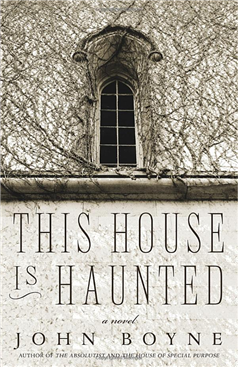
Cover for This House Is HauntedThis House Is Haunted fittingly begins when Eliza Caine and her father decide to attend a reading by Charles Dickens of his ghost story A Christmas Carol. Unfortunately, Eliza’s father takes a chill as a result of this outing and dies.

It is not long before the landlord informs Eliza that, rather than owning the house she has lived in all her life, her father had been leasing it, and the rent is exorbitant, too much for a schoolteacher to afford. Grief-stricken Eliza rather hastily decides that she wants to change her life, so she applies for a job as governess at Gaudlin Hall.

With this Dickensian beginning and the title of the novel, it is no surprise that Eliza will soon find herself living in a haunted mansion.

In fact, things become strange before Eliza even arrives at the house. In the station at Norwich, she feels someone push her in front of a train, and she only survives because a Mr. Toxley pulls her back. When Mr. Toxley and his friendly wife learn of her destination, however, they react oddly.

Eliza is especially taken aback by her reception in her new home. After being dropped at the house by Heckley, the surly and taciturn coachman, she is received by the children, Isabella and Eustace Westerley. No adults but Heckley are anywhere to be seen. She was engaged by an H. Bennet, whom she believed to be the master, but no one by that name resides at the Hall. When she finally gets a chance to talk with the Gaudlin solicitor, Mr. Raisin, he is evasive. The villagers behave oddly when they find out who she is. And the situation soon gets a lot worse.

All of this is a lead-in to a pleasantly creepy ghost story of a Victorian nature, with reminders of Jane Eyre and The Turn of the Screw. The narrative style is convincingly appropriate, more inclined to the descriptive than the conversational and old-fashioned without being difficult for the modern reader.

image for NetgalleyIf I have any complaint at all, it is that the title itself telegraphs a little too much too early. I did not feel the chill that I sometimes feel when a ghost story takes me by surprise. In addition, the style of writing itself promotes a lightness of tone that never led me to dread. In general, though, I found the novel entertaining and endearingly old-fashioned in style and tone.


Day 342: The Tryst

Cover for The TrystThe Tryst is an odd book by Michael Dibdin, the author of the Aurelio Zen mysteries. Although billed as a crime novel, it takes some time to get around to the crime. In fact, it misleads us into thinking it is one type of novel when it is actually another.

The novel follows the actions of two characters, a homeless boy and the therapist who is trying to figure out why the boy is pretending to be insane. Gary Dunn has come to the psychiatric hospital where Aileen Macklin works as a psychiatrist requesting institutionalization and insisting that someone is trying to kill him.

We find out that Gary, a glue-sniffing boy who lives with a bunch of junkies, has befriended an old man. Although Gary’s mates would like to rob the man, Gary has become involved in the old man’s long, involved story about a former employer who sees a beautiful woman no one else sees. In the story, the employer follows the woman to his death. This story eventually connects the fates of Aileen and Gary.

Ultimately, the novel doesn’t work that well, because it starts out being a crime thriller and turns into more of a gothic novel/ghost story. It is too much one kind of novel to work successfully as the other kind. Although the novel is well written and interesting, it reads almost as if Dibdin started with an idea and changed his mind in midstream. For a better example of a book that combines a crime story with a ghost story, read Johan Theorin’s fantastic The Darkest Room.

Day 328: Hamlet

Cover for HamletMy husband likes his jokes. When I told him I was re-reading Hamlet, he said, “It’s full of clichés, you know.” But it was amazing to see how many lines from this play are so familiar to all of us, have almost entered our societal DNA.

Everyone is familiar with the plot. Hamlet’s father, the King of Denmark, has died, and Hamlet’s mother Gertrude has married his uncle Claudius, his father’s brother, who is now king. Hamlet is in grief and dismay at his father’s death and his mother’s quick remarriage. In the first act of the play, Hamlet meets the ghost of his father, who tells him that Claudius murdered him by pouring poison in his ear as he slept. The ghost orders Hamlet to avenge his death.

One of the puzzlers for me about this play is the reason why Hamlet then chooses to fake insanity. It allows Hamlet to continually bait Claudius and Gertrude without consequences, but otherwise does not make sense to me.

An interesting point raised in the introduction of my version of the Collected Works is that Polonius, in appearance and behavior, is meant to be William Cecil, Lord Burghley, Queen Elizabeth I’s chief minister. The claustrophobic feeling in the play of not being able to trust anyone, of being spied on (depicted marvelously in the 2009 Royal Shakespeare Company production, starring David Tennant and Patrick Stewart), reflects the paranoid nature of Tudor society because of the prevalence of espionage at that time.

Of course, Hamlet’s musings on suicide, death, and the nature of revenge are a major focus of the play. An undoubted message seems to be of the unintended consequences of actions, particularly of revenge. Hamlet and Laertes are bent on revenge, but in obtaining it, they manage to wipe out both their families.

I have seen Hamlet played as a drooping figure of indecision, but I don’t think this is a correct interpretation. Hamlet is caught on the crux of a dilemma. He wants to do what is right but knows that whatever action he chooses, the results will not be pretty. Hence, the inaction.

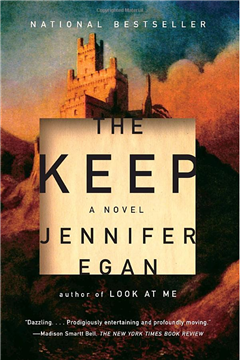
Day 316: The Keep

Cover for The KeepI only recently discovered the pleasures of reading Jennifer Egan when I read Look At Me last year. The Keep is another of her very interesting novels. Her most well-known novel, which I have on my list to read, is A Visit from the Goon Squad, which won the National Book Critics Circle Award.

Danny is an aging hipster who has long occupied the edges of power looking for a way to get some for himself. He is on his way to Europe to take up an invitation extended by his cousin Howard to help develop an ancient castle into a hotel.

Danny is anxious about accepting this position because of his guilt and paranoia over a horrible childhood event, when his older cousin talked Danny into abandoning Howard in a deep cave. However, Howard’s invitation comes at a time when Danny urgently needs to get out of New York, so he goes.

After an unsettling arrival at the half-renovated castle, which contains opulence and filth within rooms of each other, Danny meets an almost unrecognizable Howard, his wife Ann and their two young children, his second-in-command and best friend Mick, and other assorted workers. Living in the keep of the castle is a mysterious old baroness who thinks she still owns the castle. A creepy feature of the property is a dark, reeking pool that may be haunted by two twins who drowned in it.

Back in the states, Ray, a prison inmate, is taking a writing class and begins reading aloud his story about a guy named Danny who journeys to Europe to help his cousin develop a castle into a hotel. Discovering the connection between the two stories, and a third one involving the writing class teacher, is part of the pleasure of reading this deeply involving novel. Egan moves the narrative back and forth in time to tell these two parallel stories, keeping the reader’s interest with consummate skill.

Day 315: Beyond Black

Cover for Beyond BlackI have liked almost everything I have read by Hilary Mantel but could not finish Beyond Black. It is supposed to be extremely black humor, which I usually enjoy, and the idea is certainly an entertaining one, but somehow I felt it went too far, at least for me.

Alison is a medium who travels the rounds of the psychic “fayres.” She actually does see and hear the dead. Alison meets Colette, an event planner, who she hires as her personal assistant. Soon, the two women are sharing a house in a suburban wasteland, where apparently all hell breaks loose. (I did not get this far in the novel.)

Mantel’s skewering of the “fayres” is amusing. Another clever idea in the novel is that the dead are a bunch of seedy characters obsessed with trivial things, just as are many people in life. However, after awhile the sheer bulk of the trivialities becomes overwhelming.

Alison’s spirit guide, Morris, instead of being the traditional Indian chief or swami, is the ghost of an actual hoodlum Alison knew when she was young. I could deal with the spirits constantly talking about minutia, but Morris was incredibly repulsive and disgusting. With the mundanity going over the top combined with my disgust at Morris, I stopped reading.

Day 293: Before the Poison

Cover for Before the PoisonI never read anything by Peter Robinson before. I looked him up because of the TV series “DCI Banks,” as he is the author of the Inspector Banks series, but then I found that Before the Poison was already on my list of books to read. It is not an Inspector Banks novel, but I found it gripping from start to finish. Although it is not a mystery novel in the traditional sense, it involves an investigation of events in the past with revelations about the present and even the hint of a ghost story.

Chris Lowndes is a recent widower, a British composer of film scores who has been living in California for 35 years. He has purchased a large house in rural Yorkshire sight unseen with the intent of making his new home there and writing more serious music.

At the beginning of the novel, he arrives at his new home, which is beautiful and old but very isolated. He is puzzled to find some personal possessions left behind although the house has been leased for many years and asks his rental agent to find out who used to own it, as he bought it from a solicitor’s office.

Lowndes soon learns that his house was the scene of a notorious murder. Grace Elizabeth Fox, a nurse during World War II, was found guilty in 1952 of murdering her husband, the local doctor. Lowndes becomes interested in the murder and soon finds that the evidence against Grace was circumstantial and mostly based on the fact that she was having an affair with a much younger man. As he tracks down information and villagers who were alive at the time, Lowndes begins to wonder if there was a crime at all or if Doctor Fox died from natural causes.

Alone in the house most of the time, sometimes stranded by bad weather, Lowndes occasionally battles with depression, misses his wife, and is kept awake by strange noises in the house and thinks he glimpses a woman in the mirror of a wardrobe. He is also attracted to Heather, the realtor, who is having marital problems. And he keeps seeing a hooded figure out by the old lime kiln. Eventually he comes across a diary belonging to Grace, which relates her experiences as a nurse during the war.

This novel is atmospheric and very interesting. A few times I thought I knew where it was going, but it went somewhere else. I wasn’t really interested in the subplot involving Heather–I didn’t really like her–but otherwise I was totally engrossed by the novel.

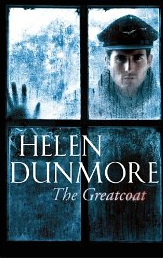
Day 259: The Greatcoat

Cover for The GreatcoatI am not familiar with Helen Dunmore, but I looked for this book after reading a review of it on another blog citing it as a good ghost story.

At first I was inclined to dislike it. Isabel Carey is a new wife in 1952, married to a young doctor in a small village in Yorkshire. Isabel is a poorly trained housewife who spends her time disliking her new home in the bottom floor of the landlady’s house and feeling as if everyone is looking at her. She especially dislikes the landlady, Mrs. Atkinson, who paces back and forth on the floor above, sometimes all night.

Unable to get warm in the dank little house, one night she searches through a cupboard and finds an officer’s wool greatcoat, which she uses as an additional bedcover. The next night a strange man dressed as a World War II officer comes and taps on her window.

Soon the officer, Alec, begins coming to visit her and by his behavior shows that he thinks they are lovers. She knows almost immediately that he is a ghost but seems to passively accept their relationship. Who the soldier’s actual lover was should be almost immediately apparent, but Isabel doesn’t seem to guess.

At this point, I was extremely annoyed with the novel, believing I was supposed to find all this romantic when all I could think about was Philip, Isabel’s poor, hard-working husband, who only treats her kindly. The only negative thing about his character is his desire to protect Isabel from everything, and I believe that attitude was typical of the times. I also thought Isabel is a spoiled little brat who does little but complain and thinks nothing of launching into an affair with another man, ghost or not.

Eventually, though, the novel takes a more sinister turn, which is more to my taste. My final overall impression was ambivalence.

By the way, the Amazon write-up of this book (probably taken from the publishers) compares Dunmore as a historical novelist to Tolstoy and Emily Brontë. Aside from the oddness of an implicit comparison between those two writers, this is a gross overstatement of Dunmore’s abilities. What Dunmore has written is a slight, moderately entertaining novel that cannot be compared to the work of the other writers.

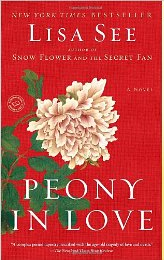
Day 161: Peony in Love

Cover for Peony in LoveI’ll start out right away by saying that after reading the touching and engrossing Snow Flower and the Secret Fan, I was disappointed by Lisa See’s Peony in Love. The innocuous description on the back of the book gives you no warning of the subject of the novel. I think that is unfortunate, because not very many readers of See’s other books will be prepared for it.

Peony’s sixteenth birthday is approaching. In six months she will “marry out” to the man who has been her fiancé since she was a child, although she only knows his name. She is excited because that night her family will begin hosting an epic opera by Tang Xianzu that she loves, and the secluded women will be allowed to watch it through a screen.

The story of the opera is important to the novel. It is about a girl who dies for love and haunts her lover until she is eventually brought back to life in honor of her steadfastness.

That evening, Peony peeps out from behind the screen and spots a handsome young man, with whom she falls instantly in love. Later in a brief absence from the performance she encounters him accidentally, and he begs her to meet him the next night. Such behavior is strictly forbidden. She has never been alone with a man outside her family, but she meets him anyway.

I usually try not to give away important plot points, but I will tell you one thing that happens in the first third of the book because I don’t think you can make a fair decision about reading it without knowing. So, this is my spoiler warning. Unfortunately, I don’t see any way to impart my objections without revealing this key plot point.

Convinced that she will be forced to marry a man she does not love even though she doesn’t know who her fiancé is, Peony starves herself to death, like the heroine in the opera. Just before she dies, when it is too late to save her, she finds out that her beloved actually is Ren, her fiancé (a twist that I found predictable). Presumably, she spends the rest of the novel as a ghost. I say presumably because after another 100 pages or so I quit reading.

I was already fed up with Peony because she wastes two opportunities to avoid the misunderstanding that causes her death. As in many movies, a few words could have cleared things up. That is, she and her lover never bother to exchange names. In addition, after the opera, when she is still in the audience, her father introduces her fiancé to the company. She is so convinced he is a stranger that she shuts her eyes. How likely is that?

Peony is already an extremely foolish girl even before she begins starving herself. I continued reading out of interest in Chinese beliefs about the afterlife, but when Peony begins manipulating Ren’s wife, I found this development too distasteful to continue. I regret that I cannot recommend this book, although I am still eager to try other books by Lisa See.

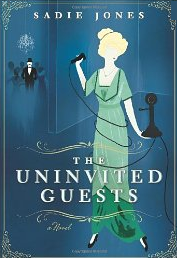
Day 101: The Uninvited Guests

Cover for The Uninvited GuestsThe Uninvited Guests is a delightfully original novel. At first it seems to be an Edwardian family social comedy that reminds me of the light, eccentric novels written by Stella Gibbons or Dodie Smith, but then it takes a turn toward the bizarre.

The Torrington-Swifts live in a large, ramshackle house that is at risk because they can’t afford it. The grown children, Emerald and Clovis, make a show of resenting Edward, their kind, patient, one-armed stepfather. Clovis is sulky and irritable, while Emerald is more likeable. Charlotte, their mother, is selfish and used to being cossetted. Smudge, the youngest girl, is used to being ignored.

It is Emerald’s 20th birthday, and the family is preparing for guests and a party, but Edward must miss the party because he has to travel to Manchester to try to borrow money to save the house. The guests are settling in and a storm is building when other people begin to arrive. A horrendous train accident has occurred a few miles away, and the railroad has sent the passengers to the house for shelter. Among them is an odd character in a red waistcoat who insists upon inserting himself into the birthday party.

Here is where the story begins its strange turn as the party gets odder and odder.

The novel is extremely well written and completely captivating, with a touch of the bizarre.

Day 87: Bangkok Haunts

Cover of Bangkok HauntsBangkok Haunts is unlike any mystery I have ever read.  I heard about the series by John Burdett and wanted to try it but think perhaps it might have been best to start with the first one. (Bangkok Haunts is the third.) I had an ambivalent reaction to it but am willing to try reading another one.

Sonchai Jitpleecheep is a devout Buddhist detective who tries to remain relatively straight in what is, according to one of the characters in the book, the world’s most corrupt police force. I say relatively because his mother is the proprietor of a brothel, where he helps out. He also keeps being pulled into the illegal schemes of his powerful boss, police captain Vikom.

A vicious snuff film is sent to Sonchai anonymously. He is horrified to see that the victim is Damrong, a prostitute with whom he was obsessed until she left him. Damrong’s ghost begins haunting him at night, even though he is living happily with his pregnant girlfriend. Sonchai is determined to bring Damrong’s murderers and those involved in the film to justice, even though Vikom is more interested in blackmail.

The novel’s Byzantine plot involves sorcery, Buddhist monks, an elite gentlemen’s club, Cambodian thugs, and some seriously disturbed individuals. For such dark material, the first person narration is oddly light in tone. However, the atmosphere and insights into Thai beliefs, modern life, and customs are rich and fascinating.

I did not buy at all the subplot about Sonchai’s FBI friend Kimberley Jones, who becomes obsessed with his assistant Lek. Lek is saving up for a sex-change operation, but Kimberley falls madly in love with him and keeps calling Sonchai to talk about how wrong the operation would be and to demand he talk Lek out of it. I can’t imagine that a woman who has fought her way into the FBI would be this susceptible and irrational–and unprofessional.

This novel is not for everyone, but I definitely think the unusual series is worth another look.