Review 1397: Deep Waters

I have read several of British Library Crime Classics’ mystery story collections, usually themed around a locale. In Deep Waters, most of the stories are set at sea, although some involve rivers and one each a pond and a swimming pool. The stories are in chronological order by when they were published, from 1893 to 1975.

The first story, “The Adventure of the ‘Gloria Scott'” by Arthur Conan Doyle, is a Sherlock Holmes I have never encountered before, supposedly his first case. Like several of the first few stories, it presents and solves a puzzle so quickly that I was barely aware there was a puzzle. In fact, as I read these stories, I felt as if I was watching the evolution of the mystery story.

“The Eight-Mile Lock” by L. T. Meade and Robert Eustace, only the second story, was one of three written by women. It details the theft of a diamond bracelet from a party staying on a houseboat. The mystery is not so much about who stole the bracelet or how but where he put it to evade the police.

“The Gift of the Emperor” is a Raffles story written by E. W. Hornung, who was Arthur Conan Doyle’s brother-in-law. I don’t know if it was the last of Raffles’s career, but it seemed to be.

One of the stories I liked best was “A Question of Timing” by Phyllis Bentley. The main character, Robert Beringer, uses his observation skills as a writer to foil a criminal, save a detective’s life, and get the girl, all during a walk. This story takes place on an embankment of the Thames.

I have a frustration in general with mystery short stories as they really only have space to pose and solve a puzzle. So much that I enjoy about mystery novels is not possible at this length. Some of these stories, though, had beautiful descriptions of their settings. In any case, this is a good collection for those interested in the evolution of the mystery story.

I received a copy of this book free from the publishers in exchange for an honest review.

Related Posts

Murder at the Manor

Silent Nights

The Mistletoe Murder and Other Stories


Review 1389: Murder in the Mill-Race

Murder in the Mill-Race is apparently E. C. R. Lorac’s 36th Chief Inspector Macdonald mystery, which means I have pleasure in store if only I can find others. I reported recently that I’d gotten up the nerve to request books from several publishing companies, and Poisoned Pen Press immediately sent me four books from their British Library Crime Classics. This was one of them.

When Anne Ferens, the new doctor’s wife, first meets “Sister” Monica, the warden of the children’s home in Milham in the Moor, she is taken aback by the dichotomy between the Sister’s reputation as a saint and her freakish appearance. What’s worse, Anne fears that the children are being terrorized by her. She soon learns the woman has a poison tongue, starting rumors by denying her belief in the scandal she’s trying to suggest.

Then Sister Monica’s body is found in the mill-race. The village is quick to assume the death was an accident. But Sergeant Peel is still bothered by the death a year before of Nancy Bilton, a resident of the home who was found dead in the same place. Peel finds the village just as closed as it was before. No one knows or saw anything. So, the authorities call in Chief Inspector Macdonald and Inspector Reeves. They soon ascertain that the death was no accident.

I enjoyed this mystery very much. It pays more attention to character than many of the books in this series, and the characters are believable. The mystery is not one of the over-complicated ones of the period. I guessed the identity of the killer but did not guess the motive except in general. The Ferens are a charming couple, and I liked the two detectives. This novel is a good choice for this series.

I received this book from the publishers in exchange for a fair and honest review.

Related Posts

Weekend at Thrackley

Murder at the Manor

The Sussex Downs Murder

Review 1354: Weekend at Thrackley

Cover for Weekend at ThrackleyOccasionally, I have been reading the British Library Crime Classics published by Poison Pen Press, so I was delighted to find one on the shelves of my local library. I had not heard of the author, Alan Melville, but I was pleased to find the novel one of the most enjoyable of this series that I have read so far.

Jim Henderson isn’t getting ahead in life, but he’s doing it cheerfully. He has a room in a rather seedy rooming house, but he likes his landlady. He hasn’t been able to find a job in years, but he has managed to keep his membership to his club.

One morning, he gets an unexpected invitation from an Edwin Carson, who claims to have known him as a child, for a weekend at his country house, Thrackley. Jim knows nothing about Carson, but when he visits his friend Freddie Upton to borrow evening clothes, he finds that Freddie is invited, too. Freddie tells him that Carson is a jewel collector with an amazing collection, and he has asked him to bring the Upton diamonds so that he can look at them. That doesn’t explain why Jim has been invited, however.

Before the two men arrive at the house, Freddie knocks over a charming girl on a bicycle. That girl, Mary, turns out to be Carson’s ward. Jim thinks things are looking up.

When the men arrive at the house, Jim is even more perplexed about why he is invited. The four other guests have only one thing in common: they all own famous jewels. Jim does not.

The house itself, although luxuriously and tastefully finished, is gloomy and built like a fortress. Jim soon finds that both his room and Freddie’s have been bugged. Just what is Carson up to?

This novel has an engaging hero and is written in a pleasantly jaunty style. It also has some witty dialogue. As is common in the genre, Carson’s plots are ridiculously complicated, and the chapter at the end where the police inspector explains everything seems unnecessary. All in all, though, I enjoyed this light novel.

Related Posts

The Red House Mystery

The White Cottage Mystery

The Iron Clew


Review 1351: Taken at the Flood

Cover for Taken at the FloodHercule Poirot is the interested listener to the club bore one evening in 1944. Major Porter tells the story of a widow who went on to marry Gordon Cloade, a wealthy man. Mr. Cloade was recently killed in the blitz, but Porter’s story is about Mrs. Cloade’s previous husband, Captain Underhay. Underhay reportedly made remarks to the effect that if he was reported dead, he may not be. Instead, he might return to his widow under the name Enoch Arden, a reference to a poem. Later, he was reported dead in Africa.

Two years later, Poirot is consulted by another Mrs. Cloade, the sister-in-law of the woman from the story. She wants Poirot to find Robert Underhay, whom she believes may be alive. She presents this request as a favor to Rosaleen Cloade, the widow of Gordon Cloade, but in fact, the Cloades, who were taught to depend on Gordon financially, were disinherited by Rosaleen when Gordon died intestate. If Robert Underhay can be found to be alive, Rosaleen’s marriage to Gordon will be nullified, to the benefit of the rest of the Cloades. Two days later, Poirot reads that a man named Enoch Arden was found dead in Warmsley Vale, the home of the Cloades.

Who killed Enoch Arden? It seems that the only people with a motive are Rosaleen Cloade and her brother, David Hunter, assuming Enoch Arden was Captain Underhay. But was he?

This is a complicated mystery and not one of Christie’s best. Her talent for portraying characters is lacking in this novel, as many of them seem flat.  It also seems unlikely that anyone would ever guess the culprit, so few clues point in that direction.

Related Posts

Appointment with Death

At Bertram’s Hotel

Death on the Nile

Day 1286: The Murder of My Aunt

Cover for The Murder of My AuntI’ve read quite a few of the British Library Crime Classics and enjoyed their beautiful covers, but The Murder of My Aunt is the first that has been darkly comic. Edward sees himself as fashionable and too good for the sleepy Welsh village of Llwll where he lives with his aunt. His aunt supports him but not well enough for him to live in London and indulge himself.

Edward is not a nice person, but he turns malicious after his aunt pulls a prank to get him to walk into the village instead of driving his car, La Joyeuse. He decides to murder her to get control of his life and her fortune.

link to NetgalleyIndeed, if we are to believe Edward’s version, his aunt is not much more likable than he is. But are we to believe him?

The novel is very entertaining until it bogs down a bit with a change of narrators. The Murder of My Aunt was considered a genre breaker in its time and was praised for its freshness and originality. Certainly, I found Edward’s machinations amusing, but the barbs directed at his effeminate nature are also mean-spirited.

Related Posts

The Iron Clew

The Moving Toyshop

Portrait of a Murderer

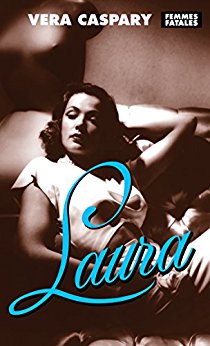
Day 1232: Laura

Cover for LauraBest of Five!
Laura is the first of eight mystery novels included in a two-volume set, beautifully bound, called Women Crime Writers, published by the Library of America. This is a nonprofit organization dedicated to keeping the best American literature in print, and I have ordered its catalog. (I received it after I wrote this, and I have to report that it publishes relatively few works by women. I am disappointed.)

Laura is a doozy of a mystery. I think it was made into a movie, and I believe I’ve seen parts of it, but I didn’t know the solution.

A young woman is murdered one Friday night by a shot in the face with a shotgun. Her body isn’t discovered until Sunday morning when the maid arrives. The apartment belongs to Laura Hunt, a successful advertising executive who is to be married the next week.

The first section of the novel is narrated by Waldo Lydecker, Laura’s long-time friend. He is an older man, a writer who considers himself an expert on crime. Mark McPherson, the detective in the case, calls to interview him about Laura.

Laura seems not to have an enemy in the world, but she was about to marry Shelby Carpenter, a man with a need to feel superior, which it was difficult to do with a woman like Laura. But Shelby was about to marry the golden goose, as Laura was much more successful than he was. Would he have killed her? To his dismay, Mark feels himself falling in love with a dead girl.

Laura has a couple of twists, one that I think I should have anticipated but did not. It packs quite an emotional punch, especially for a novel written in the 40’s, the era of the hard-boiled detective.

Related Posts

In a Lonely Place

Brat Ferrar

Some Must Watch


Day 1230: The Horizontal Man

Cover for The Horizontal ManThe Horizontal Man is the second novel included in my Women Crime Writers set of crime novels from the 1940’s and 50’s. I have only read one of them before, In a Lonely Place by Dorothy Hughes.

The Horizontal Man begins with a murder. Kevin Boyle, a popular professor at a women’s college, turns away from a woman who is furiously protesting her love, only to be hit fatally over the head with a poker. Who is this woman?

Kevin’s student, Molly Morrison, becomes hysterical when she hears of his death and seems to be taking responsibility for it. College President Bainbridge asks a psychiatrist, Dr. Forstmann, to evaluate Molly. Also investigating are college senior Kate Innes and reporter Jack Donelly.

The college seems to be a haven for neurotics. Leonard Marks, the professor who lives across the hall from Kevin, has been squeamishly privy to Kevin’s bragging about romantic conquests and is achingly aware of how poorly he fits into academic life himself. George Hungerford is an eminent professor who recently had a nervous breakdown. And there’s something odd about Freda Cramm.

Although we get to the answer before the characters do, this novel is truly chilling. I am really enjoying the novels in this series.

Related Posts

In a Lonely Place

Some Must Watch

Brat Ferrar

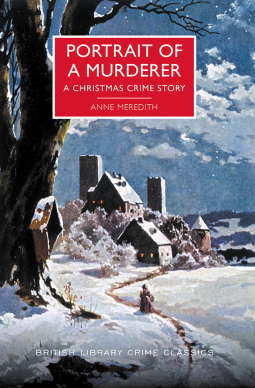
Day 1221: Portrait of a Murderer

Cover for Portrait of a MurdererSet during Christmas of 1931, Portrait of a Murderer is an unusual novel. We know from the beginning who the murderer is, and at first it looks like he is going to get away with his crime. For its time, the psychological portrait of the murderer is surprisingly deep.

Gathered together for Christmas are Adrian Gray and his family. Adrian is in financial straits because of reckless investments he made through his son-in-law, Eustace Moore. Adrian’s oldest son, Richard, is a member of parliament who has been spending heavily on a blackmailing mistress and his bid for a title. Eustace’s investments are all about to fail, with many investors bankrupted. Youngest son Brand’s need to pursue his painting full time has overcome his duty to his family.

All three men plan to ask Adrian for money that he doesn’t have. Richard needs it to pay his blackmailer. Eustace needs £10,000 to keep his investors happy. Brand wants to offload his wife and children onto his father and sister so that he can return to Paris to paint. Failing that, he’d like a loan to support them.

Brand goes to speak to his father around midnight on Christmas Eve. He gets so angry because of Adrian’s attitude toward his career and life that he lashes out. Meaning to slam a heavy paperweight onto the desk, he hits his father in the head instead. Soon he is standing there stunned by what he has done. But it’s not long before he begins trying to find a way out of it. His solution? Frame Eustace.

This novel isn’t so much about the investigation as about Brand’s mental outlook. Dashing off a portrait of himself as he stands in the murder room, Brand recognizes his own genius and decides that nothing should get in the way of his art. Meredith seems, on the whole, sympathetic with him, even as he treats his own wife and children as discardable, simply because he is not sure of the children’s parentage.

Brand’s brother-in-law, Miles Avery, is not satisfied when Eustace is charged with the crime. Despite his wife Ruth’s apprehension, he manages to work out what really happened.

link to NetgalleyThere are some things that are now considered politically incorrect in this novel, originally published in 1933. In particular, anti-Semitic remarks may bother readers. Then there is Brand’s Nietschean sense of superiority, reminding me a bit of Raskolnikov without the feverishness. However, it’s a fascinating character study.

Related Posts

The Talented Mr. Ripley

The Tiger in the Smoke

Murder of a Lady

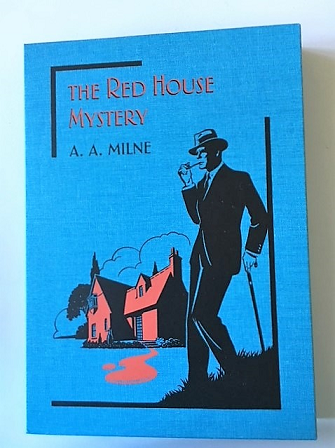
Day 1209: The Red House Mystery

Cover for The Red House MysteryWho knew that A. A. Milne wrote novels for adults, let alone mysteries? I didn’t, until Simon of Stuck in a Book reviewed The Red House Mystery. Then I saw it advertised in Folio Society, of which I am a member.

Our detective is an amateur, Antony Gillingham, who comes on the scene accidentally. He is visiting in the area when he remembers his friend, Bill Beverley, is staying at the Red House, a guest of Mark Ablett, so he decides to drop by. He finds a man hammering on the library door. This man is Mr. Cayley, Mr. Ablett’s secretary, who reports he has heard a gunshot from within the locked office.

Cayley and Antony break in and find the body of a man who has been shot in the face. Cayley identifies him as Robert Ablett, the ne’er-do-well brother of Mark, just arrived from Australia. Mark Ablett, who had been in the room with his brother, is nowhere to be found. The police decide Robert has been murdered and begin looking for Mark.

Antony begins noticing clues about the crime. Enlisting his friend Bill as his Watson, he decides to solve the mystery.

With typical Golden Age verve, Milne makes this puzzle just about as complicated as possible. I usually don’t hope to solve these mysteries because of that. However, I did guess at part of the solution and then decided it wasn’t possible. Apparently, it was.

What I enjoyed about the book was the congenial duo solving the crime. Antony is bright and witty, and Bill is jovial and loyal. The Red House Mystery makes a fun light read.

Related Posts

The Moving Toyshop

Thirteen Guests

The Iron Clew

Day 1191: Coffin, Scarcely Used

Cover for Coffin Scarcely UsedAlthough I am not familiar with Colin Watson’s work, when I read the title of Coffin, Scarcely Used, I just had to request the novel from Netgalley. Watson began writing in the late 1950’s and published more than a dozen books by the early 1980’s. This novel is his first.

No one thinks anything of the death of businessman Mr. Carobleat until the more unusual death of Mr. Gwill, the proprietor of the local paper and Carobleat’s next-door neighbor. Mr. Gwill was found in a field near an electric plant, apparently electrocuted. Inspector Purbright of the Flaxborough police wonders if the death could be suicide, but this seems an unusually cruel way to go. Purbright is also interested in the comments of Mrs. Poole, Mr. Gwill’s housekeeper, hinting at some kind of supernatural events from next door.

link to NetgalleyWhen Inspector Purbright begins looking into Mr. Gwill’s affairs, he is struck by some advertisements Gwill has clipped from his own paper that seem to be coded in a particular way. Whatever Gwill was involved with, it seemed to also involve several other local businessmen—Dr. Hillyard, the undertaker Mr. Bradlaw, and the lawyer Mr. Gloss.

This mystery is fairly complicated, but aspects of it are relatively easy to figure out. I was well ahead of the inspector in regard to what was going on with the ads but did not guess what else was going on. The novel is characterized by a wry sense of humor, particularly in discussions among the various police. I found it mildly entertaining.

Related Posts

The Moving Toyshop

They Found Him Dead

Behold, Here’s Poison