Day 983: The 1947 Club! The Iron Clew

Cover for The Iron ClewI read The Iron Clew for The 1947 Club and what a blast it was! I was expecting a typical Golden Age mystery—heavy on the puzzle, light on motivation and character. What I got was something completely different!

Leonidas Witherall is blocked. He is the author of a series of adventure novels starring the fiery Lieutenant Haseltine. But now that the war is over, Witherall thinks that his usual villains are passé. The Nazis are beat, and the Russians are our allies, for heaven’s sake!

Mrs. Mullet, his housekeeper, advises him to move from espionage to mysteries. In no time, Witherall has invented a plot involving brown paper packages and a murder of a prominent man.

Witherall has been ignoring his own brown paper package. It is a report from the Dalton Safe Deposit and Trust Company that he is supposed to be reviewing before his dinner meeting with Balderston, the bank manager. But the muse is calling, so Witherall has just enough time to dress for dinner before going down to the hall to pick up the package. But it is gone!

Witherall hears a door closing and realizes that the thief has just left. When he sees no one walking away, he surmises that the thief is hiding in the yews at the front of the house. He tricks the thief into coming out and sees a lady in a mink emerge with a brown paper package in her handbag.

1947 clubAfter he steals the package, he becomes the quarry in a rowdy chase through the neighborhood, to be rescued by Harriman, an old boy from his school-teaching days. This incident sends him on a rollicking adventure involving several brown parcels, a green handbag, a dinosaur footprint, a murder, a kidnapping, and a massive Massachusetts snowstorm. Leonidas is helped along by a plethora of young people and an old flame.

The plot of this novel is ridiculous. The writing is energetic and witty, the characters engaging. What more could you ask? This novel was a lot of fun!

Related Posts

Death in the Stocks

Death on the Nile

Death on the Riviera

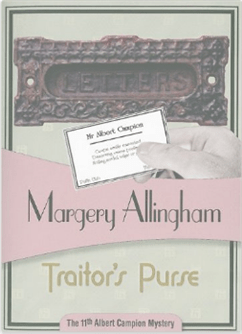
Day 949: Traitor’s Purse

Cover for Traitor's PurseA man awakens in a hospital to realize that he remembers nothing about who he is or what has happened to him. Then he overhears a nurse and policeman talking. Someone has killed a policeman. Thinking they are talking about him, he escapes in the outfit of a fireman.

We soon learn that the escaping man is Albert Campion. Although he is picked up outside the hospital by his fiancée Amanda, he soon realizes that something important is happening and everyone is looking to him for instruction. He must stop something from happening, but he doesn’t know what.

This mystery, which is set during World War II, has to do with a plot to destroy the foundations of the country. All Campion knows is that it involves the mysterious Institute of Bridge, an organization called the Masters, and the number 15.

In this novel, we understand a little more about Campion’s thinking, precisely because he’s not behaving in character. I believe he is normally supposed to be somewhat inscrutable, because he’s frequently described as “wooden-faced.” Because of the unique situation of the novel, it is truly suspenseful.

Related Posts

The Tiger in the Smoke

The Singing Sands

At Bertram’s Hotel

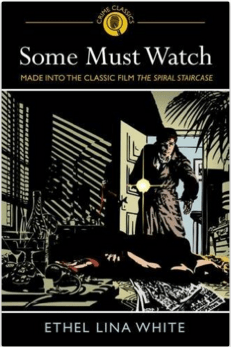
Day 904: Some Must Watch

Cover for Some Must WatchSome Must Watch is the novel that inspired the thrilling old movie The Spiral Staircase. Ethel Lina White, the author, was one of the early women mystery writers, another novel of hers being the basis of the movie The Lady Vanishes.

This novel centers around an isolated country house, the home of Professor Sebastian Warren, his mother, sister, son, and daughter-in-law. The main character is Helen Capel, a servant in the household.

At the beginning of the novel, Helen is coming back to the house at dusk. She is worried because she must pass through a desolate landscape and young women have been murdered in the district. Her way takes her through a plantation, but she changes direction because she thinks she sees a man lurking among the trees.

The novel takes place in the space of one night during a violent storm. At the beginning of the evening, everyone becomes alarmed because another dead woman is found dead near the local pub and Dr. Parry thinks she was killed in the same plantation where Helen saw someone. The house is full of people, so the Professor decides that they should all stay inside during the storm and not admit anyone, and they will be safe.

However, as the evening continues, one incident after another occurs that causes the people to leave the house. After a while, it seems to Helen as if some intelligence is working so that she will be alone to face the killer.

In some ways, this novel seemed rather crude, especially in the interactions between characters and the dialogue. I have run into this before with novels of a certain vintage and am not sure if it reflects people’s actual behavior and way of speaking at the time, the expectations of the genre, or simply the ability of the writer. Not very much attention is given to character development either. The focus is squarely on the plot. Still, I think the novel is interesting as representative of an early thriller.

Occasionally I comment on the publication quality of a book. I believe that my copy is an on demand publication by Between Things (not the one pictured above). Its biggest eccentricities are the starting of chapters on the left page and a typographic oddity of placing an underscore before and after phrases that I assumed were in italics in the original. There were a few other careless errors but not as many as I have noticed lately in some other regular press runs. Still, I am beginning to avoid on demand printing, if I recognize it ahead of time.

Related Posts

Murder at the Manor

The Z Murders

The Tiger in the Smoke

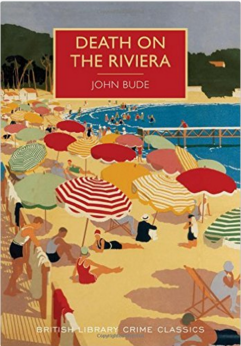
Day 878: Death on the Riviera

Cover for Death on the RivieraDetective-Inspector Meredith and Sergeant Freddy Strang are on an unusual mission. They are following up clues that a British counterfeiter, “Chalky” Cobbett, is operating a counterfeiting ring on the Riviera. Since Meredith has encountered Chalky before, the French police hope the D. I. can help find and identify him. Meredith cautions Strang that they are working undercover, but not before they meet a tourist named Bill Dillon.

Nesta Hedderwick is a rich, middle-aged British woman with a villa in Menton who sometimes patronizes young, handsome men. Currently, she has two living with her in addition to her niece Dilys. Tony Shenton, in Dilys’ opinion, has been sponging off her aunt for far too long. He has no employment and orders the servants around as if they were his. His aunt has even given him a sports car. Even worse, he has invited a girl to stay, Kitty Linden, who is clearly infatuated with him.

Paul Latour is the other man. He keeps odd hours and spends most of his time in his room, painting. But when Dilys goes to an art show, she recognizes some of his work—with someone else’s name on it.

At the show Dilys meets Freddy Strang, who introduces himself as John Smith. Later, he is embarrassed when they run into Bill Dillon, who has come looking for Kitty, and Dilys finds out he is using a false name.

link to NetgalleyThe murder mentioned in this novel doesn’t occur until fully halfway through the book. Instead, we follow the details of the investigation into the counterfeiting ring and Freddy’s romance with Dilys. This atmospheric novel is one of the more enjoyable of these Poisoned Pen class reprints. There isn’t a great deal of characterization, but in general that is common with these older mysteries.

Related Posts

The Singing Sands

Thirteen Guests

Antidote to Venom

Day 843: Murder at the Manor

cover for Murder at the ManorMurder at the Manor is another collection of classic mystery short stories published by Poisoned Pen Press. Each of these stories is set at a country manor.

This collection features writers the likes of Arthur Conan Doyle, G. K. Chesterton, Margery Allingham, and Ethel Lina White. Some of the stories are ingenious, and one is an amusing satire of the genre.

The satire was the story that most stood out, “The Murder at the Towers” by E. V. Knox. Just the first sentence gives a sense of it:

Mr. Ponderby-Wilkins was a man so rich, so ugly, so cross, and so old, that even the stupidest reader could not expect him to survive any longer than Chapter 1.”

And he doesn’t. Mr. Ponderby-Wilkins is found hanging from a tree, suspended by a muffler. His guests decide to “go on playing tennis as reverently as possible” until the detective arrives. When the detective, Bletherby Marge, arrives, he is described as a person who is sometimes mistaken for a baboon. The story continues on to turn the genre on its head.

“The Copper Beeches” by Arthur Conan Doyle is the only story I had previously read. Miss Hunter comes to consult Sherlock Holmes about an unusual offer of employment. She has been offered a job as governess at an inflated wage under the condition she bob her hair. Holmes advises her to take the position but promises to come immediately to her assistance if she summons him. She soon does and explains she has been asked to put on a certain blue dress and sit with her back to the window. Holmes immediately realizes he can prevent a crime.

“The Problem of Dead Wood Hall” by Dick Donovan is another early mystery. This case refers to two mysterious deaths, two years apart, of first Mr. Manville Charnworth and then Mr. Tuscan Trankler. Although no cause of death can be determined, both men show signs of having died the same way. Unfortunately, this story is turgidly written, and the method of murder and identity of the killer are easy to guess.

“Gentlemen and Players” by E. W. Hornung is a Raffles mystery. Raffles takes his friend Bunny along on a weekend at a country house, where they have been invited because Raffles is such a good cricket player. Raffles doesn’t usually rob his hosts, but he resents being invited as if he were an entertainer. And old Lady Melrose has such a nice necklace.

“The Well” by W. W. Jacobs is more of a psychological study than a  mystery. Jem Benson is about to be married. He has a cousin, Wilfred Carr, who continually borrows money from him. But this time Wilfred threatens to tell Jem’s fiancée Olive a disreputable secret if he won’t cough up. The two men walk out to the woods near a disused well and only one of them comes back.

“An Unlocked Window” by Ethel Lina White raises a lot of suspense when two nurses are left alone with their patient. A maniac in the neighborhood has been murdering nurses. Nurse Cherry suddenly realizes she left a window unlocked.

link to Netgalley“The Mystery of Horne’s Copse” by Anthony Berkeley is quite entertaining, about Hugh Chappell, who stumbles over the corpse of his cousin Frank late one night on the way home from dining with his fiancée’s family. Only the body isn’t there when he brings the police back, and Frank and his wife are on vacation at Lake Como. This is an odd state of affairs, but then it happens again and again until the last time the body is indeed Frank’s, and Hugh is wanted for murder. In this story, I particularly enjoyed Hugh’s spunky fiancée Sylvia.

All in all, I found the collection mixed in quality but enjoyable. Some of the stories are truly suspenseful, and some present a good puzzle.

Related Posts

Silent Nights

Thirteen Guests

The Hog’s Back Mystery

Day 806: Silent Nights

Cover for Silent NightsSilent Nights is a collection of classic mystery stories set at Christmastime. Represented are well-known writers such as Arthur Conan Doyle, G. K. Chesterton, and Dorothy L. Sayers as well as writers who are not as well known now, such as Ethel Lina White and Leo Bruce. At least, I am no expert, but I have not heard of them before.

Like most mystery short stories I’ve read, these are more concerned with posing a puzzle. They are not long enough for much serious characterization or detailed plotting. Still, I found some of them surprisingly effective.

In “Waxworks” by Ethel Lina White, for example, atmosphere is created in a story of a female reporter who decides to spend the night in a haunted wax museum. She is stalked there by a jealous coworker.

“Stuffing” by Edgar Wallace has an ending reminiscent of “The Gift of the Magi” in which the ill-gotten gains from a robbery that are hidden in the crop of a Christmas turkey end up in the hands of a poor, innocent couple about to depart for Canada. They think both the turkey and the money are gifts from the woman’s rich uncle.

In “The Unknown Murderer,” H. C. Bailey’s detective Dr. Reggie Fortune figures out the game of a pathological murderer. In “Cambric Tea” by Margery Bower, a jealous man tries to frame two innocent people for murder.

link to NetgalleyNot all are that successful. “A Problem in White” by Nicholas Blake doesn’t tell the solution (which I guessed) unless you turn to the back of the book. “The Name on the Window” by Edmund Crispin depends its puzzle on which side of the window the victim supposedly wrote the name of his attacker. Yet for this solution, we must suppose that the victim was stabbed and then walked around a building and down a long hallway for no apparent reason than that he could collapse on the other side of the window. Not, I think, the behavior of a dying man. (And, typically, he didn’t just write the name of his attacker; he hinted at it.)

In any case, this collection made me interested in looking for some of the longer works by some of these authors.

Related Posts

The Santa Klaus Murder

Thirteen Guests

The Hog’s Back Mystery

Day 771: The Santa Klaus Murder

Cover for The Santa Klaus MurderIt’s Christmas time at the home of the overbearing Sir Osmond Melbury, and the entire family is gathered together for the holidays at his bidding. Sir Osmond is a mean old man who uses the promise of his fortune—or the threat of disinheritance—to keep his family in line.

Sir Osmond has arranged a visit from Santa Klaus and is disappointed when the Santa suit he ordered doesn’t appear on time. But the store sends out another suit and Sir Osmond presses a guest, Oliver Whitcombe, into putting it on and delivering gifts to the children. While the children are playing with Christmas crackers, Sir Osmond is shot to death in his study and Oliver finds the body.

Colonel Halstock, the investigating constable, establishes that Sir Osmond did not commit suicide. He also finds that Sir Osmond planned to rewrite his will, leaving his property in different proportions to his family and his secretary than originally planned. He did not execute the will, so did the murderer kill him to prevent the change, or did he think the new will was already in effect?

Colonel Halstock is left with a house full of suspects who all seem to be hiding something. At the suggestion of Kenneth Stour, a former suitor of Sir Osmond’s daughter Lady Evershot, he asks several of the guests to write up their accounts of the days leading up to Christmas and the event itself. These accounts form the first chapters of the novel.

link to NetgalleyThis is a complex mystery mostly because of the number of people in the house at the time of the murder and the effort of keeping track of where they all were. It is almost completely dependent on opportunity, as all of the characters have the same basic motive. I had a hard time keeping some of the characters straight, and only a few distinct personalities emerge. Still, the tone of this novel is not as distant as that of some of the other Golden Age mysteries I’ve read lately, and I enjoyed it. It will be available October 6 from Poisoned Pen Press.

Related Posts

Antidote to Venom

The Hog’s Back Mystery

The Z Murders

Day 760: The Z Murders

Cover for The Z MurdersIn general, serial killer mysteries are a more modern invention, but that does not mean none were written in the Golden Age. Margery Allingham’s The Tiger in the Smoke is one example, although that killer’s victims are not as arbitrarily chosen as those in The Z Murders.

The main character of this novel is Richard Temperley, who has been traveling all night on a train when we meet him. His companion in the compartment, an elderly man, has been annoying him by snoring for hours. His train arrives at Euston Station at 5 AM, and he is perplexed about what to do with himself until a decent hour when the porter recommends the smoking room at a hotel across from the station.

When Richard arrives at the hotel, he is dismayed to pass his elderly railway companion in the hallway. In the room, he notices a beautiful young woman by the fire and thinks he will sit by the window. However, first he has an impulse to check on his baggage. When he returns, he finds the young woman emerging from the room looking upset. The elderly man is now sitting by the window, so he takes the woman’s seat by the fire. He is dozing off when he realizes the old man isn’t snoring. Sure enough, he is dead.

While Temperley is being quesioned by the police, he finds himself omitting information about the woman, particularly that he has found her purse in the seat of the chair he’s sitting on. The elderly man has been shot by a silenced pistol from the open window, the seat Temperley originally chose until he decided to check his baggage. A metal Z is next to the victim on the window sill.

Although Detective Inspector James doesn’t believe Temperley was involved in the crime, he thinks he knows more than he is saying. So, he puts a tail on Temperley. Temperley has found a card in the woman’s purse identifying her as Sylvia Wynne. He goes directly to her house and, finding no one there, is able to get in with a latch key. Richard finds a metal Z in the front hallway under the letter slot. A moment later, Sylvia comes through the window.

Of course, Richard has been smitten at first sight, but he is only able to speak with Sylvia briefly and give her his sister’s phone number before Inspector James is at the door. When he turns around, she is gone again.

link to NetgalleyThe resulting adventure/mystery involves a cross-country chase that reminds me a little bit of The 39 Steps without the espionage. The novel has a complicated plot, but the characters of Temperley and a cab driver named Diggs are nicely drawn. Although Sylvia is pretty much reduced to a damsel in distress, of the Golden Age mysteries I’ve been reading lately, I think I like Farjeon best.

Related Posts

Thirteen Guests

The Hog’s Back Mystery

Antidote to Venom


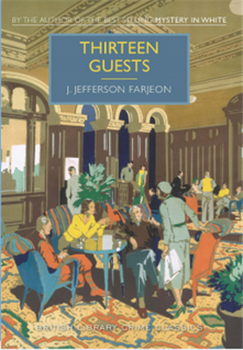
Day 757: Thirteen Guests

Cover for Thirteen GuestsJohn Foss is a young man running away from London at the end of a failed love affair when he injures his foot jumping off the train at a small station. Guests bound for the house of Lord Aveling take him to the doctor’s house only to find that the doctor is away treating Mrs. Morris, Lord Aveling’s mother-in-law. Nadine Leveridge, a beautiful widow, insists on bringing John along to Lord Aveling’s, the unwitting thirteenth guest at a house party.

Lord Aveling’s guests feature a cricket player, an actress, a member of Parliament, a society painter, a gossip columnist, and a novelist, but there are also some more unusual guests, a vulgar sausage king and his family and a shady couple, the Chaters. Some odd things happen almost immediately. Someone throws paint on Leicester Pratt’s painting of Lord Aveling’s daughter Anne, and an odd confrontation takes place between Zena Wilding, the actress, and a strange man at the train station. Mr. Chater seems to be around sticking his nose into everything.

After John’s foot is treated, he is parked on a sofa in an anteroom. Late that night, he hears a dog barking outside, several exchanges in the hallway, and some glass breaking. The next morning it is obvious that someone broke out of the studio that Pratt locked after he discovered his ruined painting, and the dog has been stabbed to death. Later, the strange man from the station is discovered dead at the bottom of a nearby quarry.

Of course, when Detective-Inspector Kendall arrives, he finds that many of the house’s inhabitants have something to hide. And the man no one seems to know is not the only one to die.

link to NetgalleyAlthough this Golden Age mystery involves time tables, the solution is fairly straightforward but hard to guess. Agatha Christie was a great admirer of Farjeon, who I think gives a good sense of his characters, enough to help me distinguish one from the other when there were so many of them.

Related Posts

Antidote to Venom

The Hog’s Back Mystery

Behold, Here’s Poison

Day 737: The Hog’s Back Mystery

Cover for The Hogs Back MysteryThe Hog’s Back Mystery is another Golden Age mystery featuring Inspector French. This mystery is much more elaborate than Antidote to Venom, the other Crofts mystery I read, featuring four murders, and is set in rural Surrey.

Ursula Stone has arrived at the railroad station in Ash to visit Julia Earle and her sister Marjorie Lawes, her schoolmates from long ago. The first part of the novel is from Ursula’s point of view, and she is surprised to see how distantly Julia treats her husband James, a retired doctor. She is also a little shocked to see how casually Julia behaves with an infatuated neighbor, Reggie Slade.

Ursula is off visiting her friend Alice Campion when James Earle disappears. Both sisters testify that he was settled down in his den for the evening when they last saw him. He was dressed only in thin shoes suitable for inside and did not take his overcoat.

Inspector French is called in when James doesn’t reappear and no one can discover a trace of him. Soon afterwards, French finds that a nurse also went missing around the same time. Her name is Helen Nankivel, and French at first supposes Earle and the nurse have run off together. But the people who know Helen Nankivel insist that she wouldn’t do such a thing. However, she did meet Dr. Earle when they both attended the last illness of Mr. Frazer, a wealthy old man.

French explores many theories, but he is just about to decide that Earle ran off with Nurse Nankivel when Ursula Stone disappears, under remarkably similar circumstances. She was upstairs in her room at the Earles’ while Julia and Marjorie entertained the Campions downstairs. Later, when summoned for dinner, she was nowhere to be found. But Mr. French finds evidence that someone was standing behind a bush outside the den and finds blood in Earle’s den.

link to NetgalleyLike many Golden Age mysteries, The Hog’s Back Mystery a complicated solution. In fact, it is so complicated that it must be explained in a 20-page last chapter, which makes the novel lose quite a bit of impetus. Still, I was able to guess the broad strokes of the solution very early on by simply paying attention to what her friends said about the nurse. It took French a good hundred pages to catch up with me. So, not the best of these reprinted mysteries by Poison Pen Press, but I love the cover.

Related Posts

Antidote to Venom

The Tiger in the Smoke

Brat Farrar