Day 731: Antidote to Venom

Cover for Antidote to VenomIn this Golden Age mystery written in 1938, Freeman Wills Crofts had the goal of showing both the murder and the investigation. The result is a fascinating psychological mystery.

The first section of the book shows how George Surridge becomes involved in a murder. A mental degradation begins because of monetary difficulties caused by gambling and his attraction to a young woman who is not his wife. He is his elderly aunt’s heir, but when the thought occurs that it would help if she died faster, he pushes that idea out of his mind, thinking that he doesn’t wish her harm.

When his aunt, Miss Lucy Pentland, dies, he feels his troubles are over. His girlfriend loses her job as a companion around the same time, so he anticipates his legacy by buying her a cottage. By coincidence, his aunt’s affairs are being handled by David Capper, the nephew of an old gentleman doing research on snake venom at the Birmingham Zoo, where George is director. But when George visits Capper to find out about his inheritance, Capper admits to having stolen it and lost it all.

George is ready to go to the police, but Capper tells him then he won’t ever see his money if he does so. However, if George would help him with one little thing, the murder of his own uncle, he will get his money. All George has to do is steal a venomous snake from the zoo.

link to NetgalleySo, we see how George is slowly drawn into being an accomplice to murder. The rest of the novel shows how Chief Inspector French first recognizes that the crime is a murder and then solves it.

Although the murder involves a complicated device I couldn’t make hide nor hair of, for a Golden Age mystery it is fairly uncomplicated. I enjoyed this introduction to Croft’s work.

Related Posts

Behold, There’s Poison

At Bertram’s Hotel

Unnatural Death

Day 674: In a Lonely Place

Cover for In a Lonely PlaceWhat makes this post-World War II noir crime novel stand out is that it was written by a woman and the crime is solved by two sharp women. Although there are plenty of women mystery writers, it is less common to find women writing noir mysteries at that time. Reminiscent of The Killer Inside Me, In a Lonely Place tells the story of a serial killer of women from the point of view of the killer.

Dix Steele is an ex-pilot being supported by his uncle in Los Angeles while he pretends to write a novel. He is living in a posh apartment of an old Princeton friend, wearing his clothes and driving his car and telling everyone his friend is in Rio. About once a month he picks up a girl at a bus stop or some other lonely place and strangles her.

Dix decides to get in touch with an old friend from the military, Brub Nicholai, but is taken aback to find Brub is now a police detective. Brub has also married, and his wife Sylvia doesn’t like Dix.

Dix meets an attractive redhead, Laurel Gray, who lives in the apartment complex and is divorcing her wealthy husband. Soon they begin a torrid romance.

This novel was convincing in its depiction of a serial killer. Although we see things from Dix’s point of view, we are not drawn into his dilemmas as we are, say, for The Talented Mr. Ripley. We want him to be caught and worry about Laurel or about the next time he is going to find the need to kill.

Related Posts

The Killer Inside Me

The Talented Mr. Ripley

Roseanna

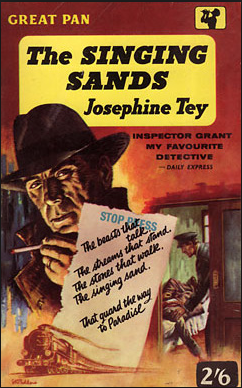
Day 638: The Singing Sands

Cover for The Singing SandsEvery once in awhile, I like to read a classic mystery, and I have only read a few by Josephine Tey. Tey’s novels acted as a bridge between the Golden Age of mysteries and the modern mystery, when the genre moved toward more realism.

The overworked Inspector Grant is on his way to a holiday in Scotland and is concerned because he has developed a debilitating claustrophobia. Upon leaving the train at Euston station, he comes across a porter trying to rouse an apparently inebriated passenger. Grant sees right away that the man is dead. When he examines the body, he drops some of his own papers, and while picking them up, accidentally removes the dead man’s newspaper.

Relaxing at his cousin’s house in the Highlands and preparing to go fishing, Grant checks the paper the next day to see what it says about the dead man. His face has stuck in Grant’s mind. He finds that the man has been identified as a Frenchman named Charles Martin. He has already discovered the man’s newspaper, with some verse scratched on it referring to animals that talk, streams that stand, stones that walk, and singing sand. He recognizes the man’s handwriting as the unformed style learned by British schoolboys, and he can’t imagine that the dead man was French. So, he decides to look into the death a bit more.

Except for The Daughter of Time, Tey’s most well-known book, I have only read a couple of Tey’s one-off novels, not her Inspector Grant mysteries. After reading this one, I think I’ll look for more. Inspector Grant is interesting and likable, as are the relatives he visits. The mystery is involving without being so overcomplicated as to be unlikely, as Golden Age mysteries often are. When Grant travels to the island of Claddagh (referred to as Cladda in the novel) in search of the singing sands, we also get to explore a new landscape.

Day 448: The Tiger in the Smoke

Cover for The Tiger in the SmokeI have only read one other Albert Campion novel, and that was so long ago that all I can remember is not having much of a sense of Campion. I can say the same thing after reading this novel, although it has other qualities. Perhaps one can only get an understanding of Campion through reading the series.

In this post-World War II novel, we get a feel for the effect of the war on London. The wealthier households no longer have servants, shoddy neighborhoods have sprung up near where service men used to gather, the ruins of bombed buildings are everywhere, as are groups of unemployed veterans. To this setting Allingham adds the further atmosphere of a heavy fog that persists over the course of the novel. This fog is vividly described and is almost a character in the novel.

Meg Elginbrodde, a young war widow, has recently announced her betrothal to Geoffrey Levett, a wealthy businessman. Beginning directly after the announcement, however, Meg receives poor-quality street photographs of someone who looks like her husband, Martin Elginbrodde, supposedly blown to bits during a battle. No message has arrived explaining these photos, and when we meet the engaged couple, Geoffrey is dropping Meg off for a rendezvous that Campion has arranged as a trap for the culprit.

Meg is to walk into the train station to meet the man, where Campion and the police will capture him. However, when Meg sees the man at a distance, his resemblance to Martin is so strong that she shouts his name and runs toward him, startling him away. Campion eventually captures him, and Meg is embarrassed and puzzled to find that close up, the man doesn’t look like Martin at all. He turns out to be a low-level criminal named Duds Morrison.

Campion and Detective Charlie Luke are fairly confident that someone hired Duds for the impersonation, but what was it meant to accomplish? Duds isn’t talking; in fact, he seems terrified, and rightly so. Within an hour of his release, he is found stabbed to death in an alley.

Campion notices one thing that helped Meg mistake Duds for her husband. He is wearing Martin’s distinctive coat. When Campion repairs to the unusual household of old Canon Avril, Meg’s father and Campion’s uncle, to investigate, he finds the coat was recently in the house. How could it have fallen into the imposter’s hands?

Soon the police find a connection between this case and the escape from jail of a very dangerous man, who calls himself John Havoc. Havoc murdered an eminent physician to escape and subsequently killed three people trying to break into the law office that handled Martin Elginbrodde’s estate. He did not escape, though, early enough to have killed Duds.

In the meantime, Geoffrey Levett is missing.

The plot of this novel, like many of those from the Golden Age of Detective Fiction, is absurd. However, the novel is notable for its strong and vivid characterizations—of one of fiction’s first sociopaths as well as of the many unusual and delightful characters living in Canon Avril’s house. Campion himself remains a quiet character instead of being a presence such as Lord Peter Wimsey or any of Christie’s detectives.

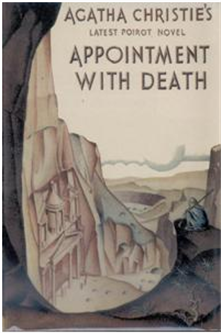
Day 387: Appointment with Death

Cover for Appointment with DeathHercule Poirot is in his hotel room in Jerusalem when he overhears two people discussing a murder. He finds that these two people, Raymond Boynton and his sister Carol, are discussing their stepmother, a sadistic, manipulative, demanding head of a wealthy family. The family is part of the expedition Poirot is taking to Petra.

All of the family are traumatized by their mother’s behavior. Raymond and Carol are eager to escape from their stepmother’s control. Their sister Ginevra is barely attached to reality. Lennox, the oldest son, rarely speaks, and his wife Nadine is threatening to leave him.

Poirot finds the rest of the party in the camp at Petra interesting. Sarah King is a studying psychiatrist who is romantically interested in Raymond, but Raymond does not have the courage to tell his mother. Dr. Gerard is a famous French psychiatrist. Lady Westholme is a well-known politician, and she is accompanied by her friend Miss Pierce.

When Mrs. Boynton dies, the cause is not clear. She was overweight and in poor health. Did she die of natural causes, or was she murdered? If she was murdered, there are plenty of suspects in their party, most of them in her own family. Colonel Carbury, an official assigned to the case who is known to Poirot, asks him to help.

This novel is not one of Christie’s best, even though she continues to deftly draw believable characters. It is marred by some silly psychobabble that was probably popular at the time. Perhaps Christie was trying to reflect then-modern topics of conversation, or perhaps she was writing dialogue that would be typical of the two psychiatrists. In addition, she pulls one of her tricks, making the solution depend upon information that is not possible for the reader to know.

Day 360: 4:50 from Paddington

Cover for 4:50 from PaddingtonWhile traveling by train, Miss Marple’s friend Elspeth McGillicuddy witnesses a murder on another train along a parallel track. The police find no trace of a victim, so they are inclined to think Mrs. McGillicuddy imagined the incident. Miss Marple knows her friend, however, and imagination is not her strong suit.

Jane believes the body must have been thrown off the train near an estate called Rutherford Hall. She sends her friend Lucy Eyelesbarrow in as a housekeeper to investigate, and Lucy eventually finds the body, not lying somewhere in the bushes along the track, but hidden away.

The money from the estate will eventually be divided among the grown children of Luther Crackenthorpe, a semi-invalid widower, while the house will go to his eldest surviving son. But does that have anything to do with the murder? All of the children seem to have their secrets. Cedric is a bohemian painter who lives in Ibiza, Harold is an aloof banker, Alfred is engaged in shady business deals, and Emma is a spinster who is in love with Dr. Quimper, Luther’s doctor.

The biggest puzzle is to identify the body. Who is the woman murdered on the train, and why does Lucy find her in a sarcophagus among a bunch of antiques in the stables? Soon Miss Marple is on the scene visiting Lucy at tea time. The solution will soon be divulged, we feel.

Christie is great at drawing convincing characters, and Lucy is one of her most attractive. We wish we could see more of her. 4:50 from Paddington is yet another entertaining mystery from Christie.

Day 346: Behold, Here’s Poison

Cover for Behold Here's PoisonAlthough Georgette Heyer’s Regency romances are some of the best historical fiction around, also entertaining are her few mystery  novels, set in the time period in which they were written (this one in 1936). The only problem with many of them is that the murderer is frequently the only unlikeable character (except the victim, usually) and therefore highly identifiable. However, Heyer’s novels are character driven, and her lifelike and amusing characters are what make them so enjoyable.

There are plenty of characters to dislike in Behold, Here’s Poison. Gregory Matthews is found dead at his country home. His family assumes the death is because of his bad heart, but the police find traces of nicotine poisoning.

Suddenly, all of the surviving Matthews are suspects, including the domineering Aunt Gertrude, hypocritical Zoë Matthews, and malicious nephew Randall. Inspector Hannasyde and Sergeant Hemingway find that one big stumbling block is their difficulty in figuring out how the poison was administered.

The dialog is especially witty in this novel and the characters lively. As always, Heyer is a brilliant writer.

Day 319: Murder on the Orient Express

Cover for Murder on the Orient ExpressMurder on the Orient Express is Agatha Christie’s classic mystery featuring Hercule Poirot. Everyone has of course seen the lush 1974 movie featuring a flock of movie stars and Albert Finney as Poirot.

Hercule Poirot is visiting Istanbul when he unexpectedly receives a telegram prompting him to cancel his plans and book a seat on the Orient Express leaving that night. He is able to book a compartment in first class, but only after some difficulty.

Poirot’s fellow passengers include a Russian princess, a Hungarian count and countess, a Swedish missionary, a British colonel, an annoying American widow, and other unusual characters. As always with Christie, her characters are expertly and colorfully drawn.

On board the train, Poirot is approached by the repellent Mr. Ratchett, an American businessman who believes his life is being threatened, asking for protection. Poirot dislikes Ratchett and declines his offer.

After a disturbed night, during which Poirot is awakened by a cry and spies a woman in a lurid silk kimono walking down the hall, Ratchett’s body is found dead in his compartment. He has been stabbed 12 times. The railroad executive traveling on the train begs Poirot to attempt to solve the crime before the train reaches Yugoslavia.

It begins to look as if an intruder disguised in a railway uniform broke into Ratchett’s compartment and murdered him then escaped out into the snow. Poirot’s investigation turns up a suggestion that Ratchett was the leader of a gang who kidnapped and killed the child Daisy Armstrong (a crime based upon that of the Lindbergh kidnapping), resulting in much tragedy for the family. He also begins finding links between some of the passengers and the Armstrongs.

This particular mystery is famous not only for its exotic locales but also for the unusual solution to the murder. Despite my familiarity with the plot, it made enjoyable reading.

Day 291: Brat Farrar

Cover for Brat FarrarI have only read a few mysteries by Josephine Tey and have had mixed reactions to them. I really enjoyed The Daughter of Time, but disliked The Franchise Affair. Brat Farrar is completely different from either of those novels, and I enjoyed reading it.

Patrick Ashby, the 13-year-old heir to the Ashby fortune, disappeared three years go. This novel isn’t a mystery about whether Brat Farrar is an imposter–we know that from the beginning–but about what actually happened to Patrick.

Brat, an orphan who bears a surprising resemblance to the Ashbys, is talked into impersonating Patrick, despite his better instincts, by a ne’er-do-well cousin of the Ashby’s. This cousin has carefully coached him for his part, with the understanding that after Brat inherits, he will pay the cousin a pension. Once Brat arrives at the house, he feels surprisingly at home with the place and the family, except for Simon, his supposed twin brother.

The characters are likeable, and the story keeps your attention, even though I figured out the solution to the mystery fairly early on.

Day 280: Death in the Stocks

Cover of Death in the StocksIf you enjoy Georgette Heyer’s Regency novels but have never read any of her mysteries, you’re in for a treat. I’m not saying they are hard to guess, because she is so good at creating lovable characters that usually the murderer is the only character you don’t like (although in Death in the Stocks there are several unlikeable characters). But her mystery novels are funny and full of eccentric personalities. In addition, in true Golden Age form, the victim is often someone who deserves his or her fate.

A dead man is found murdered on Ashleigh Green, locked in the stocks. The victim turns out to be Arnold Vereker, a wealthy man with plenty of enemies, including most of his family members. Vereker used his local cottage as a nest where he entertained loose women.

When Superintendent Hannasyde goes to investigate the cottage, he does find a woman there, but she is Vereker’s half-sister Antonia. She has come down from London to argue with him about his having forbidden her marriage, as he was her guardian.

The list of suspects extends to Antonia’s brother Kenneth, who is the heir, his girlfriend Violet, Antonia’s shady fiancé, and Leslie, a friend of the family. Finally, the victim’s long-lost brother Roger reappears and claims his fortune.