Review 2127: The Mystery of a Butcher’s Shop

The Mystery of a Butcher’s Shop is the second Mrs. Bradley mystery, published in 1930. It is written in a flippant, comic style and depicts Mrs. Bradley, a psychoanalyst (very 30s), as all-knowing.

When Rupert Sethleigh’s solicitor appears at his house about a will, his cousin, Jim Redsey, says he left unexpectedly for America. No one else in the household seems to be aware of Sethleigh’s departure, and Jim Redsey behaves in a suspicious manner. Then human remains are discovered, dismembered in the local butcher’s shop but lacking a head. Inspector Grindy soon assumes that the body belongs to Sethleigh, but they have no way of proving it.

So much confusing activity goes on in this novel that, after a while, I stopped paying attention. The head appears and disappears, someone in a Robin Hood outfit almost kills Mrs. Bradley with an arrow. A suitcase disappears and reappears. Clothing of the dead man is worn by several people. Some curtains are burned.

One of the events is impossible. The skull is found and taken to an artist, Cleaver Wright, for reconstruction. It returns looking like Sethleigh but constructed on a coconut. The skull is lost again. But you can’t do facial construction on a coconut. Nor, if you’ve finished it on a skull, could you remove it and put it on a coconut. It’s just silly.

The next-to-last chapter is Mrs. Bradley’s notebook, with which we are expected to correlate her comments with the appropriate chapter of the book. I didn’t bother.
Related Posts

Seven Keys to Baldpate

The Mayor’s Wife

The Iron Clew

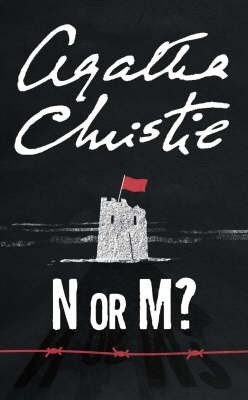
Review 2125: N or M?

Agatha Christie said she liked Tommy and Tuppence best of her protagonists, so I decided to read them all in order. N or M? is the third. Unfortunately, they tend to be espionage novels, which are not her best even though Tommy and Tuppence are fun.

It’s 1940, and both Tommy and Tuppence are frustrated because no one wants them to help in the war effort. Tommy at 49 is considered too old for intelligence work. However, shortly after he makes another attempt, he’s called on by a Mr. Grant who has an independent operation for Tommy only.

England has become infiltrated by Nazi sympathizers in all levels of government, which is why Mr. Grant wants someone from the outside. He has information that either N or M—both German spies, one male and one female—is at the San Souci rooming house in Leamington. Tommy is to pretend to have got a boring job in Scotland then go to Leamington and check into the San Souci. He does so, only to find one of the guests is Tuppence, who has eavesdropped on his meeting with Mr. Grant. So, pretending they don’t know each other, the two begin investigating the household.

I thought that Tommy and Tuppence were a little dense about the identities of the spies. I knew who one was almost immediately. However, this was the usual romp with some adventure and risk to our hero.

Related Posts

The Secret Adversary

Partners in Crime

The Man in the Brown Suit

Review 2122: The Mysterious Mr. Badman

The Mysterious Mr. Badman starts out with an intriguing premise. Athelstan Digby is on holiday in Keldstone waiting for his nephew, Jim Pickering, to be free for a walking trip through Yorkshire. His landlords have to attend a funeral, so Digby offers to watch their bookstore. During the afternoon, three men come in at separate times looking for John Bunyan’s Life and Death of Mr. Badman—the rather shifty looking Reverend Percival Offord, a foxy looking man, and a genial chauffeur. Shortly after Digby has disappointed them, a boy comes in with books to sell, including Life and Death of Mr. Badman.

Naturally, Digby takes the book home. Later that night, someone breaks into the bookstore. Digby confides in his landlord, Mr. Lavender, who suggests they put a note in the bookstore window asking the person who accidentally took the book to return it. That will prevent further break-ins.

The boy who brought the books in says they were given to him by Miss Diane Conyers. Before Digby and Jim have a chance to talk to her, Digby finds a letter in the book that brings to mind a recent crime. A man named Neville Monkbarns was to be hung for murder but he was reprieved and sent to a mental hospital. However, the letter shows that Neville Monkbarns is actually the estranged son of the Home Secretary, Sir Richard Mottram. Sir Richard is Diane’s father, and it’s clear that the letter was going to be used to blackmail him.

Then, the body of the foxy looking man is found on the moor.

If you ignore the unlikelihood that any of the unsavory characters would know about the letter, this situation kicks off a lively and adventurous investigation, with Digby and Jim trying to help Diane protect her father. The main characters are likable and interesting, the dialogue is often amusing, and the book is light and fast-moving. I would like to read more of Digby’s adventures.

The cover explains that the original novel has been exceedingly rare, so I’m glad British Library Crime Classics chose to reprint it.

I received this book from the publishers in exchange for a free and fair review.

Related Posts

Death of a Bookseller

The Murder of My Aunt

The Iron Clew

Review 2097: Death in the Tunnel

I have enjoyed reading the Golden Age crime novels published by British Library and Dean Street Press, but many of them put a complicated plot ahead of the development of character and motive. At some point, I think many of these puzzle-driven novels get too tangled in their clues to be enjoyable. One of these is Death in the Tunnel, which actually faces us with two puzzles—how the crime was committed and how another crime got it started.

Sir Wilfred Saxonby gets on the train home from London one evening and asks for a private compartment. When the train is midway through a tunnel, the driver sees a signal to stop and slows almost to a halt before getting the green light to speed up again. When the train gets to its destination, Sir Wilfred is found dead, shot by a small-caliber pistol. Everything Inspector Arnold can discover seems to point to suicide. But there is that strange halt and other anomalies. Arnold’s friend Desmond Merrion is inclined to suspect murder. But the locked train compartment amounts to a locked room mystery.

First of all, let me just say that it’s a good thing Desmond Merrion is around, because Inspector Arnold has got to be one of the dumbest cops in history. For example, as soon as the tunnel’s ventilation shaft was mentioned, I knew it was important, but it takes another day and Merrion’s suggestion for them to look at it and still Arnold has to have the car tracks that lead to it pointed out to him. Later again he fixates on a poor old man when it is obvious he has been framed.

The murder itself isn’t hard to understand, but a crime that kicked it off had my head reeling with details about when checks were signed. And that leads me to the things I didn’t buy at all: (1) that a man could tell immediately the brand of typewriter used to type something (with comparisons to samples, yes, but not at one glance) and (2) that “experts” could tell by looking at a check whether it had been endorsed when it was written or later.

So, all in all, I didn’t enjoy this one as much as some others. By the way, there was no discussion of motive at all.

Related Posts

Jumping Jenny

The Lost Gallows

Death of a Bookseller

Review 2091: Final Acts: Theatrical Mysteries

British Library Crime Classics’ latest collection of mystery short stories has some connection to the theater. Some stories are only peripherally connected—feature an opera singer, perhaps—while others are set there and show a deep knowledge of that environment. As usual, the stories are ordered chronologically, beginning with a 1905 story by Baroness Orczy and ending with one from 1958 by Christianna Brand.

Baroness Orzcy’s “The Affair at the Novelty Theater” is a complicated story about the disappearance of some priceless pearls.

“The Affair at the Semiramis Hotel” by A. E. W. Mason is one of the super-complicated crime stories common in the earlier years involving people in costumes, a robbery, and a burglary.

“In View of the Audience” by Margarite Steen is a creepy one about a young man who gets on the wrong train and ends up accompanying a strange man to a derelict theater, where he hears about an old unsolved murder.

“Blood Sacrifice” by Dorothy Sayers leaves the reader to decide if there is a crime or not. Young playwright John Scales is furious with Mr. Drury, who has bastardized Scales’s play to make it a success. Then an accident places Drury in Scales’s power. This is the first story in the book in which characterization plays much of a role.

“The Blind Spot” by Barry Perowne is about a playwright who had a brilliant idea for a locked room mystery when he was drunk but can’t remember it sober.

“I Can Find My Way Out” by Ngaio Marsh probably shows the most knowledge of the theater, as a leading man is murdered in his dressing room.

“The Lady Who Laughed” by Roy Vickers is a strange story about a clown who murders his wife for finding him funny.

I enjoyed the satisfying surprise ending of “The Thirteenth Knife” by Bernard J. Farmer.

In “Credit to William Shakespeare” a poisoning onstage is solved through a man’s knowledge of Hamlet.

I think my favorite story was “After the Event” by Christianna Brand, where her detective, Inspector Cockrill, ruins the Great Detective’s favorite story by explaining how he got it wrong.

I received this book from the publishers in exchange for a free and fair review.

Related Posts

The Christmas Card Crime and Other Stories

The Edinburgh Mystery and Other Tales of Scottish Crime

Silent Nights

Review 2089: The White Priory Murders: A Mystery for Christmas

Although The White Priory Murders is not explicitly set at Christmas, it has a nice, snowy setting. I received this novel just recently and thought I’d post my review in time for Christmas.

Carter Dickson is a pseudonym for John Dickson Carr, who was known for locked door mysteries. I confess to not being big on them, but this one is a different sort from the usual very cerebral locked door mystery and has some moments of true suspense.

James Bennett is the American nephew of Sir Henry Merrivale, an amateur sleuth. He has traveled to England with a group of people in the movies and is concerned about an attempted poisoning, so he consults Merrivale. The people concerned are centered around Marcia Tait, a glamorous actress who was ignored by the British acting establishment but has since made it big in America, so she is determined to star in a historical play in England. With her are Rainger, a director; John Bohun, a theatrical presenter; Jervis Willard, an actor who will play opposite Marcia; Emery, her publicist; and Louise Carewe, the daughter of a potential investor, Lord Canifest, who wants to marry Marcia. Someone has sent Marcia a box of chocolates, and Emery was slightly poisoned after eating one. Merrivale says the attempt was not serious.

Later, though, the entire group goes to stay at the White Priory, a centuries old house owned by John Bohun’s brother Maurice and also occupied by his niece, Katherine. Bennett arrives very early in the morning to find that John Bohun has just discovered Marcia’s body in the pavilion where she insisted on spending the night. She has been beaten around the head, but the biggest mystery is the fresh snow around the pavilion, unbroken by any footprints except John’s, going in. According to the events established during the night, she must have been murdered after the snow began falling.

Everyone has secrets, and soon there is a series of attempted murders, attempted suicides, and successful murders, as Inspector Masters summons Merrivale to help him figure it all out.

I received this novel from the publishers in exchange for a free and fair review.

Related Posts

The Seat of the Scornful

The Lost Gallows

Death of Jezebel

Review 2080: Death on the Down Beat

Conductor Sir Noel Grampion is shot in the heart during a concert. Because of the angle of the shot, most of the orchestra members are suspects. Since Sir Noel was disliked by most of them and known as a womanizer, the list of suspects is a long one.

D. I. Alan Hope is assigned the case. Possibly wanting to try something new, Sebastian Farr tells the story in letters from Hope to his wife. Aside from the ethical and legal considerations of a husband telling everything about the ongoing case to his wife, let alone in writing, the device is an unfortunate one, for in trying to make the letters seem real, Farr expands the novel to include all kinds of unnecessary information, even things that don’t make sense. For example, he includes a long description of the house he was staying in before the murder. Since he writes to his wife at least once a day, surely he would have done that at the beginning of his visit, especially as the place has nothing to do with the murder.

Next, we’re subjected to maps of the orchestra and a complete list of players. No doubt about it, this is a puzzle mystery, in which readers are swamped with information, even some pages of the score.

Unbelievably, not a single member of the orchestra is interviewed by the police. Instead, Hope asks them to write about themselves. So we have to read page after page of mostly colorless letters that all say, “I don’t know nuttin’,” which in itself is hard to believe. Farr seems to think that musicians are either looking at the score or the conductor. The reality is that they are usually looking at both at the same time, so it’s hard to believe that no one could have seen who shot him. These letters start around page 90 and before that, we have no details about any of the suspects, although we have read several concert reviews to little purpose. After the letters, Hope goes back through one by one and makes comments on the individuals, forcing us to flip back and forth if we care to pair up the letters with Hope’s remarks. I didn’t.

When the second set of letters began, because Hope/Farr hasn’t eliminated more than a few of the many (about 60) suspects, nor do most of them have anything about them that distinguishes them from anyone else, I threw up my hands and skipped 50 pages to the last letter. There I read the identity of the killer and the name meant nothing to me. I started to read the explanation, and I got so bored I just quit reading.

I understand Sebastian Farr is a pen name for a renowned music critic of the time. I commend the novel in a small way for originality but believe he should have stuck to reviews.

I received this book from the publisher in exchange for a free and fair review.

Related Posts

The Lost Gallows

Antidote to Venom

The Red House Mystery

Review 2079: Partners in Crime

I decided to read all of the Tommy and Tuppence novels in order when I read that they were Christie’s favorite sleuths. Partners in Crime is the second book in the series, set six years after the first.

Tuppence is beginning to be bored when Mr. Carter, Tommy’s boss, asks him to take six months off his work in the Secret Service to reopen the Blunt Detective Agency, which the department believes is connected with espionage. They are to look for a Russian blue stamp on a letter and further contacts.

Partners in Crime is not exactly a collection of short stories, but it is about a series of crimes Tommy and Tuppence solve in between tussles with the bad guys. Each case takes up one or two chapters. The book also has a running theme of either Tommy or Tuppence taking on the persona of a different detective from literature in each case. Unfortunately, I didn’t know who most of the detectives were, so I missed some jokes.

Some of the mysteries are laughably obvious, but others are more difficult. The novel suffers slightly from the problem I find with short detective fiction—not a lot of time to develop plots, red herrings, and characters. However, Tommy and Tuppence are funny and charming, so I enjoyed the book.

Related Posts

The Secret Adversary

The Man in the Brown Suit

The Seven Dials Mystery

Review 2071: Death of Jezebel

Seven years before the action of the novel, Isabel Drew essentially pimped out innocent Perpetua Kirk to Earl Anderson by helping him get her drunk. Perpetua’s fiancé, Johnny Wise, broke in upon them and then drove his car into a tree.

Now the three people involved are working on a pageant. Inspector Cockrill is in town for a conference when Perpetua tells him she has received a threat to her life, blaming her for Johnny’s death. Later they learn that Isabel and Earl have also been threatened. It’s odd that so many of the people involved in the pageant knew and loved Johnny.

The pageant calls for 11 knights to ride out in front of a tower, from which Isabel, as the queen, comes and gives a speech. But Isabel falls from the tower and is found to be strangled.

Death of Jezebel is an example of the Golden Age puzzle novel, where the detectives concentrate on how the murder was done instead of who did it. My problem with this type of mystery is that the murders are usually ridiculously complicated and we have endless discussions involving the action of the knights and the backstage participants.

I received a copy of this book from the publishers in exchange for a free and fair review.

Related Posts

Green for Danger

Jumping Jenny

Death of a Bookseller

Review 2068: The Secret Adversary

I decided to read all of Christie’s Tommy and Tuppence novels after learning that they were her favorites of all her sleuths. There are unfortunately only a few of these novels, and The Secret Adversary is the first.

Tommy and Tuppence are old friends who haven’t seen each other for a while when they meet again after World War I. They are both broke and have been looking for work, so they decide to band together to look for jobs, calling themselves Young Adventurers, Inc. On leaving the café where they have been lunching and discussing this plan, Tuppence is approached by a man who overheard them and says he thinks he has a job for them, but when he asks her name, she says, “Jane Finn,” a name she heard mentioned in the café. He reacts indignantly and leaves.

After placing an ad, Tommy and Tuppence are contacted for work and find that the job oddly involves Jane Finn, who was a passenger on the Lusitania when it was sunk five years before and is believed to have been the recipient of a package important to the government. Tommy and Tuppence are hired to find Jane Finn.

The search brings with it many adventures, during which their steps are dogged by a mysterious Mr. Brown, apparently a criminal mastermind. This novel has a silly Cold War plot before the Cold War, and the slang spoken by an American millionaire seems completely unlikely. I think Christie must have watched too many gangster movies. However, Tommy and Tuppence are delightful and resourceful, so this was a fun reading experience.

Related Posts

By the Pricking of My Thumbs

The Seven Dials Mystery

Destination Unknown