Review 2068: The Secret Adversary

I decided to read all of Christie’s Tommy and Tuppence novels after learning that they were her favorites of all her sleuths. There are unfortunately only a few of these novels, and The Secret Adversary is the first.

Tommy and Tuppence are old friends who haven’t seen each other for a while when they meet again after World War I. They are both broke and have been looking for work, so they decide to band together to look for jobs, calling themselves Young Adventurers, Inc. On leaving the café where they have been lunching and discussing this plan, Tuppence is approached by a man who overheard them and says he thinks he has a job for them, but when he asks her name, she says, “Jane Finn,” a name she heard mentioned in the café. He reacts indignantly and leaves.

After placing an ad, Tommy and Tuppence are contacted for work and find that the job oddly involves Jane Finn, who was a passenger on the Lusitania when it was sunk five years before and is believed to have been the recipient of a package important to the government. Tommy and Tuppence are hired to find Jane Finn.

The search brings with it many adventures, during which their steps are dogged by a mysterious Mr. Brown, apparently a criminal mastermind. This novel has a silly Cold War plot before the Cold War, and the slang spoken by an American millionaire seems completely unlikely. I think Christie must have watched too many gangster movies. However, Tommy and Tuppence are delightful and resourceful, so this was a fun reading experience.

Related Posts

By the Pricking of My Thumbs

The Seven Dials Mystery

Destination Unknown

Review 2061: The Seat of the Scornful

In the first scene of The Seat of the Scornful, we meet Justice Ireton, who really believes that an innocent man cannot be found guilty in his court. He lets a convicted man leave the court thinking he is going to be hanged when the justice intends to sentence him to life, as if that’s not punishment enough.

Later, his daughter Connie comes to see him at his seaside retreat, bringing along her fiancé, Anthony Morrell, a flashy dresser of Italian extraction whom Ireton immediately distrusts. Morrell, once alone with the justice, accepts an offer of £3000 to leave Connie alone.

The next night, the girl at the telephone exchange receives a call asking for help at the justice’s cottage followed by a gunshot. The justice is discovered seated at his desk holding a gun with Morrell’s body on the floor, shot in the head. Ireton claims to have been cooking in the kitchen when he heard a shot and came in to find the body and the gun.

Carr’s ungainly amateur detective, Gideon Fell, works with Inspector Graham to figure out what happened. Early the next morning Morrell’s lawyer explains that Morrell is actually a wealthy man with his own candy company who intended to give Ireton the £3000 as a gift for Connie to teach him a lesson.

Although the actual solution to this murder is very simple, it is followed by a series of fairly unbelievable events. However, I have a much bigger problem, without saying too much, with how Fell wraps up the case. Let’s just say that the victim, who was obviously not a nice guy but wasn’t the creep Ireton thought him, is not regarded at all. The introduction to the British Library edition says that other readers have questioned the book’s ethics. Let me say that I think the ending is extremely classist, that if Morrell had been a different type of person, the ending would have been different. Edwards states that Carr, Agatha Christie, and Anthony Berkeley were all pondering whether any murder is justified. Well, this one isn’t.

I received a copy of this book from the publishers in exchange for a free and fair review.

Related Posts

The Lost Gallows

Jumping Jenny

Murder on the Orient Express

Review 2057: The Man in the Brown Suit

The Man in the Brown Suit is one of Agatha Christie’s early novels, and it isn’t quite like any of her others. Although it has a mystery of sorts, it’s not really one readers can figure out. Instead, it’s more of a romance/adventure story. The only thing that links it to some of her other novels is the presence of Colonel Race.

Anne Beddingfield has led a boring life, so when her father dies, the first things she wants is adventure. It seems obvious to her that she should go to London. While she is standing at the end of the train platform with another man, he looks up behind her and sees something that makes him back up quickly and fall off the platform in front of the train. When a man claiming to be a doctor checks him, Anne notices that he doesn’t check him correctly and in fact takes something from his pocket. She follows him out of the station and picks up a paper that he drops.

The man had been wearing a brown suit, and when Anne hears that a man in a brown suit is suspected of murdering a woman in a vacant house belonging to Eustace Pedler, she connects the two. She also figures out that the paper indicates an assignation to take place on a ship bound for South Africa, so she buys a passage on the ship.

The novel is written in such a jaunty style that it’s hard to take its dangerous situations seriously, and Anne has a rather primitive idea of a romantic partner (as are the ideas she expresses about men and women), but the novel is entertaining, as Anne falls into one predicament after another. She ends up with proposals from three different men, and although I think she picks the wrong one, Christie has had an exercise in fun.

Related Posts

The Seven Dials Mystery

Death on the Nile

Destination Unknown

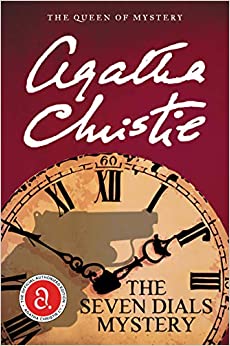
Review 2052: #1929 Club! The Seven Dials Mystery

It seems like whatever year is chosen for this club, this time 1929, there is an Agatha Christie book to be read. This time, it’s one of her earlier books that does not feature any of her well-known sleuths and is more of a satire on thrillers than a real mystery. This book also qualifies for R. I. P. XVII.

The young people staying at the home of Lord Coote decide to play a joke on Gerry Wade, who is known for sleeping late. They go to town and buy a bunch of alarm clocks to sneak into his room overnight and set to go off in the morning. However, in the morning Gerry is found dead of an apparent overdose, and seven of the eight clocks are arranged on the mantelpiece instead of on the floor, where they had been left.

Even though Gerry is known as a deep sleeper, the inquest brings in a verdict of accidental death, but Jimmy Thesiger thinks otherwise and gets “Bundle” Brent, Lord Caterham’s daughter, to help investigate. Their friend Ronny Devereux, who works in the foreign office, seems to have some idea of why Gerry might have been killed, but then he is shot to death.

Jimmy and Bundle get on the trail of a secret society known as the Seven Dials that is based in a hidden room in a nightclub. The crimes may revolve around plans to be leaked to the Germans.

The Seven Dials Mystery is Christie’s tongue-in-cheek answer to the thrillers that were popular in its time. Think The Thirty-Nine Steps. It is not entirely effective, but it has some witty dialogue and a few twists.

Related Posts

By the Pricking of My Thumbs

Destination Unknown

Sleeping Murder

Review 2044: Crook O’Lune

Crook O’Lune is named for a crook of the Lune River in the remote fells of Lancashire. Here, Chief Inspector Robert Macdonald has chosen to take his holidays, staying with his friends Giles and Kate Hoggett. Macdonald is looking for a farm to buy for his retirement.

For his part, Gilbert Woolfall has just inherited his uncle’s farm at High Glimmerdale, called Aikengill, and is trying to decide what to do with it. His commonsense tells him to sell it, since his career is in Leeds, but he wants to keep it.

Almost as soon as he settles down to examine some old papers, he has a series of visitors. Betty Fell wants to marry Jock Shearling, but they don’t want to live with her parents. She asks if she and Jock can look after the house for him, but in Gilbert’s mind, that depends on the housekeeper, Mrs. Ramsden, who can’t decide whether to return to her family or stay. Then the Rector, Mr. Tupper, arrives indignant that Gilbert’s uncle left nothing to the church. Gilbert knows that his uncle felt there was something suspicious about an ancient grant by the family to the local school and church that was reappropriated for another community, so he is not inclined to help Mr. Tupper. Finally, his neighbor, Daniel Herdwick, wants to buy some property.

Although it seems that we’re never to learn much about Macdonald (except that he wants to own dairy cows), I enjoy Lorac’s books because they focus a little more on characters than the usual Golden Age mysteries do and because the crimes aren’t over-complicated and unlikely. This one also has a lot of descriptions of this area of England, enough to make me want to go there. In that respect, It reminds me of some of the Molly Clavering books and their setting in the Scottish borderlands.The night after Gilbert returns to the city, two things happen: there is a fire in his cellar that kills Mrs. Ramsden, who was supposed to be away for the night, and some sheep are stolen from the valley.

Macdonald begins investigating certain aspects of the case, like who the stranger seen in a wild area of the fells might be or which way the sheep could have been driven out of the area.

I received this book from the publisher in exchange for a free and fair review.

Related Posts

Fell Murder

Murder in the Mill-Race

Post after Post-Mortem

Review 2032: The Edinburgh Mystery and Other Tales of Scottish Crime

The Edinburgh Mystery and Other Tales of Scottish Crime is the latest British Library collection of crime short stories, edited by Martin Edwards. These stories are either set in Scotland or written by Scottish writers, like the first, “Markheim,” by Robert Louis Stevenson. They are arranged in chronological order by publication date, ranging from 1885 to 1974.

Some of the stories, like “The Field Bazaar” by Sir Arthur Conan Doyle, are simple puzzles. In this one, Sherlock Holmes explains to Watson how he knows what is in the letter he just received. Others, like “The Running of the Deer” by P. M. Hubbard, are about the supposition of crime. “Madame Ville d’Aubier” by Josephine Tey tells the story of the heavy atmosphere emanating from a woman at a bakery and how later this woman murdered her sons and husband. In “Footsteps” by Anthony Wynne, a man figures out the connection between apparently ghostly footsteps and an attempted murder.

I liked some of the stories more than others, but they altogether make an enjoyable collection for an escapist evening.

I received this book from the publisher in exchange for a free and fair review.

Related Posts

Murder at the Manor

Deep Waters

The Tuesday Club Murders

Review 2026: Checkmate to Murder

In a bare studio on a foggy night during the Blitz, five people are occupied. An artist, Bruce Manaton, is sketching an actor, André Dalaunier, dressed as a cardinal. On the other end of the big room, two men, Robert Cavendish and Ian Mackellon, are playing chess. Rosanne Manaton, the artist’s sister, looks in occasionally from the kitchen and once steps outside to check the blackout.

A Special constable arrives at the door with a Canadian service man in tow. He claims that the old man in the house next door, Mr. Folliner, has been murdered and he caught the service man fleeing the scene. The soldier, Neil Folliner, says he went to visit his uncle and found him shot dead. The Special wants the people in the studio to guard Neil while he goes to call the police.

When Inspector Macdonald’s team begins investigating, they learn there is a rumor that the old man was a miser, although Mrs. Tubbs, his charwoman, had been bringing him food for fear he would starve. The house itself is absolutely bare, but there is an empty strongbox in the bedroom where the murder was committed.

Questioning a soldier who stood at the corner for a long time waiting for his girlfriend reveals that the only people who passed him on the street at the relevant time were Mrs. Tubbs, Neil Folliner, and the Special. It would seem that the people in the studio, all but Rosanne, alibi each other. But Inspector Macdonald doesn’t take anything for granted, and he is also interested in the studio’s previous tenants, who spread the rumor about the old man being a miser.

This mystery presents an interesting puzzle, although one not as complex as is sometimes found in Golden Age crime novels, for which I was thankful. On the other hand, I’m not sure if I think the solution isn’t a bit far-fetched. Also, it didn’t seem as if Lorac paid as much attention to characterization as she usually does, perhaps because there are quite a few characters. Still, I think her novels are some of the better ones in this series in general.

Related Posts

Murder by Matchlight

Fell Murder

Two-Way Murder

Review 2016: Post after Post-Mortem

The over-achieving Surray family is getting together for a birthday when oldest brother Richard learns that both his sister Ruth and his youngest sister Naomi may be involved romantically with the same man—a famous mountain climber named Keith Brandon. He knows Brandon for a womanizer but warms Naomi away on other grounds.

Later the Surrays have a small house party that includes Vernon Montague, Ruth’s publisher; Geoffrey Stanwood, a writer for whom Ruth helped get recognition; and Charlton Fellowes, an essayist. The next morning Ruth is found dead in bed, an apparent suicide.

After the inquest rules the death a suicide, Richard receives a letter from Ruth that she mailed the night of her murder showing she was in good spirits. Richard goes to Inspector Robert Macdonald hoping he will look into it unofficially. Macdonald refuses to do it unofficially but ends up assigned to the case.

He finds the case frustrating because he has an idea that the death is a murder but isn’t getting any cooperation from the witnesses, who are more concerned about protecting Ruth’s legacy than finding her killer. Fellowes said at the inquest that he had heard no one moving around the house after he went to bed but confesses to Stanwood that he thought he heard Montague talking to Ruth downstairs. Macdonald learns that Fellowes lied, but Stanwood refuses to repeat what he said and then Fellowes is injured after having a talk with Montague. Montague also refuses to say what Fellowes said.

Macdonald thinks someone cut a page from the end of a short story that Ruth was writing and then trimmed it to look like a suicide note written on her notepaper. But finding proof is difficult. He also hasn’t lost sight of Keith Brandon, who proves to have been in the area that night and has lied about his relationship to Ruth.

This novel is one of the best of the British Library Crime Classics series that I’ve read so far. It has an intriguing setup and interesting characters. The solution was difficult to guess. If I have any critique, it’s that the motive was fairly unbelievable. However, the novel is interesting and cleverly written.

I received this book from the publisher in exchange for a free and fair review.

Related Posts

Two-Way Murder

Fell Murder

Murder in the Mill-Race

Review 2011: Green for Danger

The details of an operating military hospital during World War II are meticulously recounted in Green for Danger. The novel begins with the postman, Higgins, delivering six letters about the writers’ postings to the hospital. The readers then learn that one of the six people will become a murderer.

The military hospital in the Kent countryside is busy one night, because an air raid in the nearby town has caused the hospital in town to send some civilians there. Among them is Higgins, the postman, who is also a member of the local rescue, most of whom have just been killed or injured.

Higgins’s femur is due to be set in surgery the next morning. It’s a relatively straightforward procedure that shouldn’t be dangerous, but as soon as he starts to go under the anesthetic, he dies. The operating team is shocked.

What seems to be an unusual but unsuspicious death from the anesthetic has Inspector Cockrill wondering. However, there seems to be no way that the canisters containing oxygen, which are black and white, could have been switched for the green carbon dioxide canisters, and no poisonous substances could be forced into a canister. If the death was murder, only the six people in the operating room could have done it.

That evening, Sister Bates, who is jealous of womanizing surgeon Gervase Eden, has a little snit during which she announces that she knows the death was a murder and she has evidence. Later, she is found dead in the surgery, stabbed and wearing a surgical gown and a mask.

This mystery is purposefully claustrophobic and quite suspenseful at times, although the explanations at the end are a bit long. I thought I knew the motive and the murderer all along, but I was fooled! I am happy to be seeing more and more women writers represented in this crime series.

I received this book from the publisher in exchange for a free and fair review.

Related Posts

The Tiger in Smoke

Death Has Deep Roots

Juggernaut

Review 2002: Water Weed

American Virginia Carew has been living and traveling in Europe when she meets an old friend, Glenn Hillier, who has been in England studying architecture. Glenn makes a date to meet her and her father for lunch but then cancels. He seems to be in the party of a wealthy and beautiful but much older widow, Mrs. Fenmore, whose friends call her Cuckoo.

Glenn keeps missing appointments, and then Mrs. Fenmore’s daughter Pam invites Ginny to stay. Ginny observes that Glenn is madly in love with Cuckoo and being kept in line by her ill health.

But shortly after Ginny goes to stay with her English cousins, Cuckoo is found strangled. Glenn is missing and presumed to be the murderer. Only Ginny is certain he is innocent.

I’m really enjoying these Alice Campbell mysteries. I liked this mystery even better than Juggernaut. It has a persistent, feisty heroine and a clever plot. I was only disappointed by Ginny’s ultimate romantic choice. She should have stuck to the reporter!

I received this book from the publisher in exchange for a free and fair review.

Related Posts

Juggernaut

Some Must Watch

The Iron Clew