Day 678: Castle Dor

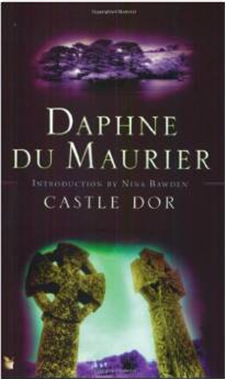
Cover for Castle DorIt is clear from the number of books Daphne du Maurier set in Cornwall that she found the region inspiring. In the case of Castle Dor, a book I had not heard of until recently, she actually finished a book begun by Sir Arthur Quiller-Couch, which is a retelling of the ancient Cornish legend of Tristan and Iseult. The novel also features another interest of du Maurier’s, the unexplained.

Dr. Carfax is the observer of this story set in the early 1800’s. He has a theory that he shares with a French visitor, elderly Monsieur Ledru, that the events of the old legend took place in the area of Cornwall where he lives. Monsieur Ledru has in fact traveled there to investigate just that subject. Ledru has also taken an interest in a young French onion-seller named Amyot Tristane and helps him free himself from his abusive ship’s master and get a job on the Bosanko’s farm.

It is the doctor who begins to feel an eerie familiarity in the behavior of Amyot once he unfortunately encounters Linnet Lewarne. Linnet is the most beautiful woman in the region, and she has at 18 married a much older man, the innkeeper Mark Lewarne. After Amyot meets Linnet, he seems to be aware of the history of the area in a way that is unlikely for the unsophisticated foreigner that he is. As Dr. Carfax views certain events and sees in them the similarities to the legend, he begins to fear the same fatal result for Amyot.

Linnet, although she is also presumably taken over by the strong forces of the past, is depicted unsympathetically, as ambitious and remorseless. As in the legend, there is a potion, but instead of being a love potion, it is poisonous.

The characters in this novel are rather one-sided, but it is the atmosphere and the legend that are important in the novel, set in the vicinity of the legendary Castle Dor. However, this is not one of du Maurier’s best, and for a retelling of the legend, I prefer Dorothy Robert’s The Enchanted Cup.

Related Posts

Daphne Du Maurier: The Secret Life of the Renowned Storyteller

Neverland: J. M. Barrie, the du Mauriers, and the Secret Life of Peter Pan

Bellman & Black

Day 665: The Sleep Room

The Sleep Room In this atmospheric novel set in the 50’s, Dr. James Richardson is a young psychiatrist when he accepts what appears to be an exciting opportunity to work with the world-famous Dr. Hugh Maitland. Maitland has just opened a clinic in rural Suffolk where he will be employing some experimental therapies and hires Richardson as a doctor for the facility. Richards is surprised to find he’ll be the only doctor on staff with just weekend relief.

When Richardson begins work at the clinic, he is surprised that Maitland will not let him examine the patient records. One of Maitland’s beliefs is that mental problems are chemical and need chemical solutions, not psychotherapy. In the Sleep Room,  one of his experimental therapies is keeping six women asleep for months.

Although Richardson has some twinges of doubt about Maitland’s ideas, he defers to him as the expert. Soon he has other things to think about. He becomes very busy with his work and is also romantically involved with a nurse, Jane Taylor.

Small odd things happen beginning almost with his arrival, though. He thinks someone is behind him when no one is. He hears sounds when no one else is in the room. Things disappear and reappear in places where they shouldn’t be. Richardson begins thinking that the stately home housing the clinic has a poltergeist.

The Sleep Room is a difficult book to review because it slowly builds up quite a bit of suspense, but then I found the explanation for the events absurd. Yet, there is a reason for that and I can’t really get into it without giving away too much. Let’s just say that after an apparent climax there is a long, boring explanation followed by a short, apparently aimless follow-up, and then everything gets turned upside down.

One problem is that the final twist isn’t signaled well enough by the rest of the novel and actually doesn’t make sense in terms of the total of the novel’s narrative style. I can think of another book that employed a very similar trick but much more successfully. So, although I was captured by this book, I find that it ultimately doesn’t work.

Finally, the novel is only adequately written and poorly edited. In particular, I noticed loads of unnecessary passive voice and several instances of confused homophones: “knave” instead of “nave” and “taught” instead of “taut,” for example. These problems were with the published book. I was not reading an advance reading copy.

Related Posts

The Solitary House

Your Presence Is Requested at Suvanto

Andrew’s Brain


Day 656: The Mysteries of Udolpho

Cover for The Mysteries of UdolphoI valiantly strove to finish The Mysteries of Udolpho, but with about 80% of it read (frustratingly hard to tell with a collection on Kindle), I just couldn’t take it anymore. Although the book is a classic gothic novel, it is extremely long and slow moving, and my mild curiosity about the secrets of the castle could not overcome my feeling that the novel was never-ending.

Radcliffe was known for writing novels that were more realistic than those that had come before in the gothic genre. That is, the events, however unlikely, might actually happen. Heroines are kidnapped, not squashed to death by a giant foot.

Emily St. Aubert’s troubles begin with her father’s death, but not before the two of them take a leisurely several-hundred-page trip through Provence. There she and her father meet the handsome Valancourt, alas only a younger son.

After her father dies, Emily finds she is left destitute except for her estate and goes to live with her fashionable and shallow aunt Madame Cheron. Madame Cheron eventually marries an Italian lout, Count Montoni. Once Emily and her aunt are in his power, he expends all his energy first in trying to force Emily to marry one of his dupes and then in trying to get both women to hand over all their property in France.

About halfway through the nearly 800-page book, Montoni takes them to his castle, Udolpho, in the Italian alps. Here I was expecting things to heat up, and they do a little, with a disappearing previous owner, secret passageways, unnamed but horrible sights, and odd lights on the battlements. On the other hand, Emily spends most of her time looking at the scenery—described in excruciating detail and admired while she is in peril of her life—and painting watercolors. Oh, also writing poems at the drop of a hat that we get to read.

To modern audiences, Emily seems a bit insipid, but her role is to demonstrate the feminine virtues under duress. So, instead of investigating where the secret passage from her bedroom goes or looking at the contents of the heavy chest or trying to escape, she faints and runs away. She does, however, do what she thinks is right most of the time.

So far, although the most famous, The Mysteries of Udolpho is not my favorite of the “horrid mysteries” mentioned in Northanger Abbey that I reported I was reading in a collection. (This novel wasn’t mentioned but is included in the Horrid Novels collection for completeness.)

Related Posts

The Castle of Wolfenbach

Northanger Abbey

Dracula

Day 649: The Death of Bees

Cover for The Death of BeesBest Book of the Week!
It may take some fortitude for readers to get past the foul language and bad behavior at the beginning of this novel. But I think most readers will feel it is worth it to have read this dark, funny, and ultimately touching little modern gothic novel.

Marnie and her younger sister Nelly find themselves with a problem. Their parents are dead, and they have already once experienced the joys of the foster care system. So, the two girls bury their mother Izzy in the back garden and hide their father Gene in the shed.

Izzy hung herself, but it is not altogether clear for quite some time what happened to Gene. The couple were terrible parents in any case, Izzy a self-obsessed, neglectful addict and Gene also an addict and molester of his own daughters. The two girls will do their best to take care of themselves until 15-year-old Marnie can do it legally.

Lennie, the old man next door, is a social outcast. After the death of his long-time partner, the lonely Lennie was once tempted by a male prostitute, only to be arrested and charged because the prostitute was a minor. Lennie doesn’t see that well anymore, so although he knew the man was young, he didn’t know how young and feels thoroughly ashamed. Despite his poor eyesight, Lennie is the only person who notices that the two girls are on their own. Soon, he is inviting them over and feeding them, happy to have someone to cook for.

The meat of the novel is the characters of these three. Marnie is brash, foul-mouthed, and smart. She is determined to protect her unworldly sister. But she is more vulnerable than she seems.

Nelly speaks like someone out of a Jane Austen novel and seems strangely clueless for a girl growing up in a tough Glaswegian neighborhood. She has a tendency to see only what she wants to.

Lennie misses his partner. He is meticulous but still ready to open his house to the two teenage girls.

Marnie’s world is populated with drug dealers, butch girlfriends and unreliable boyfriends, a best friend who was ready to run off with her father, and other difficult personalities. As Lennie’s dog Bobbie insists on digging up the bones in the garden and the girls evade questions about their parents, they both learn who they can love and depend upon.

Related Posts

NW

All the Birds, Singing

Mercy Snow

Day 627: Mercy Snow

Cover for Mercy SnowBest Book of the Week!
On an icy Thanksgiving eve outside Titan Falls, New Hampshire, a school bus with children who had been to the movies in the nearby town plummets off the road, killing one girl and incapacitating the bus driver. Readers know that a car passed the bus at a dangerous place, causing the driver to lose control. Up the road from the bus, the sheriff finds the wrecked truck of Zeke Snow, a young man from a backwoods family of ill repute. No one knows exactly what happened, but the sheriff decides it must have been Zeke’s fault.

June McAllister, the mill owner’s wife, soon finds evidence that her husband Cal may know more about the accident than he’s admitting. Her reaction is to close family ranks. After all, the Snows have never been anything but trouble.

Zeke is hiding in the woods, but he has told his sister Mercy that he did not see the bus the night that he wrecked his truck. He ran when the police arrived because he’s known nothing but trouble from them.

Mercy knows that her brother occasionally shows poor judgment, but his main instinct has always been to protect her and their little sister Hannah. While eking out an existence for herself and Hannah and living in a battered old trailer, she decides she must somehow prove Zeke innocent. For her part, June is trying to drive the Snows out of the area, where they have returned to their grandmother’s property after years of a rough and nomadic existence.

This novel may sound like a mystery, but it is not. We know fairly early on what happened to the bus. Instead, the novel is an examination of themes like discrimination against the poor, the exercise of power, the complexity of people’s reactions to tragedy, and the close-mindedness of small, closely knit communities. It also includes a hint of the supernatural. The novel is disturbing and well written. Although I thought I knew where it was going, the novel turned out to be unpredictable.

Day 616: The Rathbones

Cover for The RathbonesBest Book of the Week!
The Rathbones is a strange and wonderful novel, part gothic mystery, part magical realism, about a whaling family in the 18th and 19th centuries. Mercy Rathbone is a girl, the last of a mysterious family. She lives in a massive house only partially built that used to house dozens of people. Now only her aloof mother lives there with her and her cousin Mordecai—who stays in the attic and acts as her tutor—and a few servants.

Mercy has vague memories of a brother that her mother and cousin tell her never existed. She has not seen her father for more than ten years, although packages from him occasionally arrive. She is curious about the family portraits in a gallery, all with the names removed. She knows the names of her mother and father but has no idea who her grandparents were, or how they related to Moses, the patriarch of the family.

One night Mercy is attracted by the sound of a boy singing and ventures into a part of the house where she is not allowed, the widow’s walk where  her mother goes every night. There she witnesses her mother being embraced by a strange man, and that man chases her through the house. She finds refuge with Mordecai, and the two decide to go to sea to find her father. They flee in a little dory, pursued by the strange man.

So begins a wonderous adventure, where they encounter an island occupied only by old ladies; an island of rich, eccentric cousins with a massive collection of furniture and art; an island of birds occupied by a woman who only speaks bird language. At each stop Mercy learns more about the odd and sometimes grotesque history of her family, many of whom have a magical affinity for the sea.

I do not usually enjoy magical realism, but with this novel I loved never knowing where the story would go. It is an odd one, certainly, and probably not for everyone, but it is imaginative and unusual.

Day 569: The Castle of Wolfenbach

Cover for The Castle of WolfenbachThe Castle of Wolfenbach is one of several “horrid” novels referred to in Jane Austen’s Northanger Abbey. All of these novels, as I reported awhile back, are packaged together in a book for Kindle, so I thought I’d try them out.

This novel begins in the wilds of Switzerland on a stormy night when a mysterious young lady asks for shelter for herself and her servant at a small cottage. The inhabitants of the cottage take the fugitives to the nearby Castle of Wolfenbach for more comfortable accommodations. This castle is not being occupied by its owner but is maintained by two servants, and the castle’s upper floors are reputed to be haunted.

The young lady, Matilda Weimar, is not afraid of ghosts, however. She sleeps upstairs, and although she hears noises and sees lights across from her bedroom window, she goes the next day to explore that part of the castle. There she finds in residence an older lady and her female servant. The castle servant Joseph knows they are there, but his talkative wife does not.

Matilda explains why she is a fugitive. She has never known her parents, but was raised by her uncle. Lately, her uncle has begun showing her attentions that make her uncomfortable. What made her flee was that she overheard the housekeeper advising him to sneak into Matilda’s bedroom at night and claim her for his own.

The older lady, the Countess of Wolfenbach, offers to tell part of her story to Matilda, but Matilda asks her to wait until the next day. However, that night there is a disturbance, and Matilda visits the “haunted” area of the castle the next day to find the countess’s attendant murdered and the countess gone. When Matilda was leaving the countess the day before, however, the countess offered to send a letter to her sister in Paris asking for refuge for Matilda. Soon Matilda is on her way to the Marchioness of Melfort in Paris.

Matilda and her friends have many more adventures, in which Matilda unfailingly demonstrates her purity and honor. The evil Herr Weimar chases after her and tries to remove her from her friends, telling her that he is not actually her uncle but found her by the roadside. A young count falls in love with her, but her scruples about her unknown lineage do not permit her to accept his proposal of marriage. Temporarily, she retires to a convent.

The plot of the novel is quite convoluted and involves several kidnappings, pirates, murders, deathbed confessions, scandalous rumors, defamation of character, and other food for melodrama. Characters are mostly either good or evil, although all the evil people repent. Dialogue is elaborate and ceremonial.

This novel is not terribly scary to modern sensibilities, nor does Parsons do a very good job of creating suspense. But The Castle of Wolfenbach, which was written in 1793, is an early effort in what is essentially a genre of potboilers. Although Matilda is so good and does a lot of fainting, she at least shows some occasional evidence of spunk. Even as scary as its contemporary audiences found it, there is little doubt of a happy ending.

WolfenbachI was disappointed not to find a spooky cover available for this novel, although the one for the collection I am reading isn’t bad, so I attach a picture of this scary castle. It came up on a search for the cover, but I actually have no idea at all where it came from.


Day 552: Dracula

Cover for DraculaHaving experienced other gothic classics of the 18th and 19th century, I was delighted to find Dracula unexpectedly readable. I was also surprised to find how little it resembles its many theatrical and movie productions, even those that attempt to stay closer to the original work.

All versions begin the same, however, with poor Jonathan Harker sent out by his office to Transylvania to complete a property deal with his client, Count Dracula. While staying at Dracula’s castle, he begins to suspect something is badly amiss and eventually fears for his life.

Back in England, his fiancée Mina Murray corresponds with and later stays with her good friend Lucy Westerna at a seaside town. In one day, Lucy has received proposals from three different young men, who all feature strongly in the novel. Dr. Jack Seward is in charge of a local insane asylum. Quincy Morris is a manly, amiable Texan, whom I feared all along was designed for a ghastly death. Lucy’s chosen is Arthur Holmwood, another manly young man who is soon promoted to a lordship by the convenient death of a benefactor. (I don’t think these things work this way, since Arthur is not his benefactor’s relative, but never mind.)

After a freakish storm, a Russian ship arrives unmanned at the port where Mina and Lucy are staying with Mrs. Westerna, who is gravely ill. As it arrives, a large dog jumps off it and runs ashore. Aboard is not a single live human. We horror aficianados know that Dracula has arrived.

While Mina waits for news of Jonathan, Lucy begins sleepwalking and behaving oddly. Dr. Seward makes notes about a patient who eats bugs and babbles about his master. Soon Van Helsing will be needed.

Unlike in most of the spin-offs, except for Jonathan Harker’s experiences at the beginning, Dracula is mostly an unseen menace for much of the novel. I’m guessing that the original readers did not necessarily realize the identity of that bat fluttering outside Lucy’s window.

In any case, the novel covers a lot more ground than does the standard remake. It is epistolary, written entirely as letters and journal entries. It is well written and moves along nicely except for the occasionally long-winded expulsion of pseudo-scientific mumbo-jumbo by Van Helsing or Seward. In the true gothic fashion, it is a classic battle of good versus evil, with the prize the soul of our heroine Mina.

Modern readers may be bothered by the depiction of the two women. Lucy is supposed to be a modern woman—who else would have three suitors at a time? She is both innocent and pure in herself and quite the seductive vamp when under the spell of Count Dracula. The men do a lot of harm to both her and Mina by trying to protect the “little women” from knowledge of what is going on. Again, try to judge the novel’s attitudes by the standards of its own time, when it was simply considered a whomping good tale.

Day 525: Nine Coaches Waiting

Cover for Nine Coaches WaitingIn honor of Mary Stewart’s death earlier this month, here’s a review of another of her classic romantic suspense novels. She was really the master of this genre, writing literate novels with intelligent, plucky heroines and lots of excitement.

Linda Martin arrives in 1950’s France to take up a post as governess to a little boy, Comte Philippe de Valmy. Although Linda has been living in England since her poet father’s death, she has grasped this chance to return to France, where she was born. When the de Valmy’s stress that they want a governess who speaks only English, Linda decides to deceive them in a small way by pretending she does not speak French.

As Linda settles into her life at the Château Valmy, she occasionally feels some disquiet about events or comments she overhears. Philippe is an orphan whose parents died in an automobile accident. Until recently, he was living with his Uncle Thierry, an archaeologist, but Thierry went off to work on a dig. Philippe is a lovable boy, but he seems afraid of his aunt and uncle. Léon de Valmy is confined to a wheel chair. He was once a member of the international social scene, but since his polo accident he has focused his activities on the estate, which belongs by right to Philippe. Although he is a charismatic personality and Linda likes him, she thinks he treats Philippe with undue strictness. His wife Héloïse is beautiful but cool.

Linda has a dramatic meeting with Raoul, the de Valmy’s handsome and worldly son. He seems disposed to admire her, but she cannot believe he is serious. Despite herself, though, she finds herself falling in love.

A couple of disturbing near-accidents happen to Philippe. During a walk in the woods, he is almost shot, apparently by a careless hunter. Later, Linda notices a weakness in the railing of Philippe’s balcony and shoves something across it. This action keeps him from falling to his death when he runs out to the balcony to see who is arriving. Soon she becomes afraid that someone is trying to kill the little boy she has been hired to protect.

Photo of Mary Stewart
Mary Stewart

Stewart knows how to set a scene and build suspense. She is also an extremely good writer who is able to make you care about her characters. Because of its setting in the château, this is one of the more gothic of her suspense novels. It is also one of the most romantic. Nine Coaches Waiting is the first Stewart novel I read, and it has remained one of my favorites.

Day 440: Sleep, Pale Sister

Cover for Sleep, Pale SisterA gothic novel that involves a haunting and characters in opium-fed delirium? What’s not to like? Unfortunately, there is quite a bit not to like in Sleep, Pale Sister, an early book by Joanne Harris.

In Victorian England, Henry Chester is a twisted, hypocritical man who maintains an upright, righteous reputation in society while justifying to himself his own dark secrets. He is an artist who loves to paint romantic pictures of virginal young women.

Henry has been unable to find a wife who meets his fastidious criteria, but one day he spots a young girl of pale, ethereal beauty in the park. He pays her family to allow him to paint her and eventually decides that, even though she is yet too young to marry, he will raise her to be the wife he wants, someone passive, docile, and asexual.

Unfortunately, he is doomed to eventual disappointment, for when he finally weds her, he finds his young wife, Effie, has married him for love, and her very ardor on their wedding night disgusts him. Soon, she is an ailing wife whom he keeps drugged with opium, and he takes his pleasures elsewhere.

Sitting in church one day, Effie finds she can lift herself out of her body at will and look at those around her from above. Whether this is an effect of the opium is unclear, but in these states she seems to see and hear things that she should not know about.

At an exhibition of Chester’s paintings, Effie meets a rival artist, Mose Harper, who is struck by her beauty. Mose is a total scoundrel who dislikes Henry, so he sets out to seduce Henry’s naive wife. Mose soon finds himself with an unexpectedly passionate lover.

These three characters alternate the narration of the novel, but there is a fourth voice, Fanny Miller, the madam of a whore house who has her reasons for wanting revenge against one of her clients. As soon as she is sure which client it is, she will know what to do.

And I also hinted at a ghost.

Almost everyone in this novel is vile. Effie is the most sympathetic character, but she is too submissive to Henry and too naive about Mose to really capture us. Essentially, she has very little dimension to her character, is too easily bent to the will of another to be very interesting.

The setting in the Victorian era gives Henry almost complete control over Effie’s fate, and he is soon planning a way to rid himself of an inconvenient wife.