Day 426: A Fatal Likeness

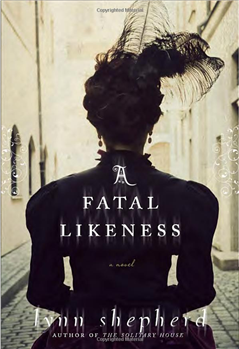
Cover for A Fatal LikenessIn A Fatal Likeness, Lynn Shepherd has created her own gothic horror around the mysteries in the real lives of two fans of the gothic, the poet Percy Bysshe Shelley and his wife, the writer Mary Shelley. It is not only a dark story, but some of it is relatively plausible, given the research Shepherd has done into their lives. Ever since I read Shepherd’s astounding reworking of Bleak House, The Solitary House, I have been a fan of her narrative skills, her writing skills, and her imagination.

Shepherd’s detective, Charles Maddox, is summoned to the home of Percy Shelley, the son of the deceased poet. Shelley and his wife have established a shrine to the poet’s memory and say they are worried about some papers someone is offering to sell them. Mrs. Shelley in particular has been responsible for destroying any papers that would tarnish Shelley’s legacy. They hire Charles to find out what is contained in these papers.

Charles has his own reasons for taking the job, for his beloved great-uncle, also Charles Maddox, the master detective who trained him and is his only family, suffered a stroke upon receiving a calling card bearing the name of his client. Charles learns from his assistant Abel that his great-uncle was employed on a case years before for William Godwin, the brilliant philosopher and Mary Shelley’s father. When the file on this case is located, though, some of the pages have been torn out.

Charles takes a room in the home of the person purveying the papers, whom Charles has been told is an Italian man, and it is not long before he realizes his landlady is Clair Clairmont. Clair, the step-sister of Mary Shelley, infamously ran off with Shelley and Mary when both the girls were only sixteen and Shelley was still married to his first wife, Harriet.

Charles is soon to realize that everyone involved in this case has ulterior motives, those of the Shelleys to find out whether a record of the earlier case still exists, as it certainly contains damaging information. With his great-uncle only slowly recovering, it is up to Charles to discover what mysteries lurk in the Shelleys’ past. As he investigates the earlier case, he finds records of an even earlier encounter with his great-uncle.

The Shelleys’ past is a rat’s nest, with two young suicided women, Shelley’s first wife and Mary’s other step-sister, with several dead infants, with Shelley’s own history of delusions, hallucinations, fits, and obsessions. Each person’s story of the fraught years of the Shelleys’ relationship is different, and it is difficult to know what or whom to believe. It is not long before Charles is to think Percy Shelley was something of a monster.

Doubles are a theme throughout the novel. Shelley is always involved with two women at once, two young women commit suicide, Shelley is obsessed with the idea of a doppelganger and thinks he has encountered a monster with his own face. Charles’ great-uncle was partially deceived long ago by the likeness he perceived between the young Mary Godwin and a lost love.

Shepherd’s writing style is distinctive. She writes in limited third person but overlays this voice occasionally with observations from a more knowing narrator of a later time, perhaps the present. The effect is slightly facetious and ironic in tone.

Her research into this time period and into the lives of the Shelleys is clearly extensive. She impressed me with The Solitary House and here she continues to do so with a fascinating, disturbing tale about some turbulent personalities.
Day 407: This House Is Haunted

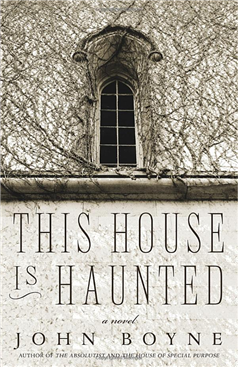
Cover for This House Is HauntedThis House Is Haunted fittingly begins when Eliza Caine and her father decide to attend a reading by Charles Dickens of his ghost story A Christmas Carol. Unfortunately, Eliza’s father takes a chill as a result of this outing and dies.

It is not long before the landlord informs Eliza that, rather than owning the house she has lived in all her life, her father had been leasing it, and the rent is exorbitant, too much for a schoolteacher to afford. Grief-stricken Eliza rather hastily decides that she wants to change her life, so she applies for a job as governess at Gaudlin Hall.

With this Dickensian beginning and the title of the novel, it is no surprise that Eliza will soon find herself living in a haunted mansion.

In fact, things become strange before Eliza even arrives at the house. In the station at Norwich, she feels someone push her in front of a train, and she only survives because a Mr. Toxley pulls her back. When Mr. Toxley and his friendly wife learn of her destination, however, they react oddly.

Eliza is especially taken aback by her reception in her new home. After being dropped at the house by Heckley, the surly and taciturn coachman, she is received by the children, Isabella and Eustace Westerley. No adults but Heckley are anywhere to be seen. She was engaged by an H. Bennet, whom she believed to be the master, but no one by that name resides at the Hall. When she finally gets a chance to talk with the Gaudlin solicitor, Mr. Raisin, he is evasive. The villagers behave oddly when they find out who she is. And the situation soon gets a lot worse.

All of this is a lead-in to a pleasantly creepy ghost story of a Victorian nature, with reminders of Jane Eyre and The Turn of the Screw. The narrative style is convincingly appropriate, more inclined to the descriptive than the conversational and old-fashioned without being difficult for the modern reader.

image for NetgalleyIf I have any complaint at all, it is that the title itself telegraphs a little too much too early. I did not feel the chill that I sometimes feel when a ghost story takes me by surprise. In addition, the style of writing itself promotes a lightness of tone that never led me to dread. In general, though, I found the novel entertaining and endearingly old-fashioned in style and tone.

Day 388: Wise Blood

Cover for Wise BloodFlannery O’Connor stated that she didn’t understand when her works were termed Southern Gothic or grotesque. She continued throughout her life to emphasize that the theme of her works is redemption. Nevertheless, Wise Blood is grotesque.

Hazel Motes has returned from the service after World War II to find his home town in Tennessee deserted and his house crumbling and decrepit, so he goes to live in the city, the fictional town of Taulkinham, Alabama. Having grown up in a fundamentalist environment, he has decided that Jesus was just a man and there is nothing from which to be redeemed. Soon, he is preaching outside movie theaters about the Church of Christ Without Christ.

Haze doesn’t see anything he’s looking at and doesn’t hear anything anyone says to him. He is totally wrapped up in his obsessions about religion. He becomes fascinated by Asa Hawks, an evangelist who supposedly blinded himself for Christ, and can’t see that this man is a con man who is not even blind.

He also meets Enoch Emery, a whining zookeeper who spends his days peeping out of the bushes at the women bathing in the park swimming pool. Enoch tells Haze that his family has “wise blood,” that is, his blood tells him where to go in life and what to do. Enoch’s blood is obsessed with a mummy in the museum, which he thinks would be a Jesus for Haze’s church, not seeming to fully understand the point of Haze’s church. But Enoch doesn’t see or listen either.

In fact, no one in this novel listens to what anyone else says, and all of the characters are incredibly ignorant and uncultured. They are all grotesque, repellent creatures. Although the novel is supposed to be comic, it only made me laugh despite myself, as the situation becomes more and more ridiculous. O’Connor’s humor is brutal.

Everything in this short novel seems significant, is to be paid attention to, even the characters’ names. Both of Hazel Motes’ first and last names refer to the eyes, and Haze can’t see. Enoch Emery is abrasive. Asa Hawks is the “blinded” con artist who can actually see, and his daughter Sabbath Lily is anything but a lily. Hoover Shoats and Onnie Jay Holy try to take over Haze’s church. And speaking of Shoats, keep an eye out for the pig imagery, and think about what pigs are a symbol for in the Bible.

This novel is deemed a work of “low comedy and high seriousness.” Just speaking for myself, the religious theme is not one I find interesting. Yet, when you read O’Connor, you can’t help but be drawn along to the end.

Day 342: The Tryst

Cover for The TrystThe Tryst is an odd book by Michael Dibdin, the author of the Aurelio Zen mysteries. Although billed as a crime novel, it takes some time to get around to the crime. In fact, it misleads us into thinking it is one type of novel when it is actually another.

The novel follows the actions of two characters, a homeless boy and the therapist who is trying to figure out why the boy is pretending to be insane. Gary Dunn has come to the psychiatric hospital where Aileen Macklin works as a psychiatrist requesting institutionalization and insisting that someone is trying to kill him.

We find out that Gary, a glue-sniffing boy who lives with a bunch of junkies, has befriended an old man. Although Gary’s mates would like to rob the man, Gary has become involved in the old man’s long, involved story about a former employer who sees a beautiful woman no one else sees. In the story, the employer follows the woman to his death. This story eventually connects the fates of Aileen and Gary.

Ultimately, the novel doesn’t work that well, because it starts out being a crime thriller and turns into more of a gothic novel/ghost story. It is too much one kind of novel to work successfully as the other kind. Although the novel is well written and interesting, it reads almost as if Dibdin started with an idea and changed his mind in midstream. For a better example of a book that combines a crime story with a ghost story, read Johan Theorin’s fantastic The Darkest Room.

Day 330: Adamtine

Cover for AdamtineAdamtine is the second of Hannah Berry’s moody noirish graphic novels after Britten and Brülightly. Whereas the first novel was a noir crime effort with a wry sense of humor (the detective’s partner is a tea bag), it is not clear to me whether Adamtine is a crime or a horror novel.

Four people who know something about an earlier series of disappearances are traveling home on a train when it stops in the middle of nowhere. At the time of the earlier crimes, a man named Rodney Moon was put on trial, but he claimed to have only passed notes to the victims. There are hints of the involvement of a large corporation.

The story is told with flashbacks to the previous crimes, although it was difficult for me to tell sometimes which scenes are those from the past and which are from the present. It was also unclear to me what exactly happens to the people, but perhaps the atmosphere created is of most importance.

The art is beautiful, with its muted, moody tones. I think this graphic novel is visually interesting and intriguing, but I find it difficult at times to completely understand the parts of the narrative that are told only in pictures.

Day 316: The Keep

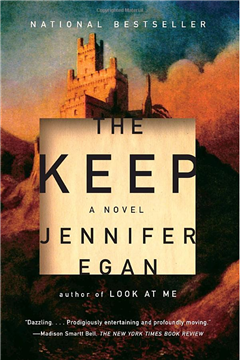
Cover for The KeepI only recently discovered the pleasures of reading Jennifer Egan when I read Look At Me last year. The Keep is another of her very interesting novels. Her most well-known novel, which I have on my list to read, is A Visit from the Goon Squad, which won the National Book Critics Circle Award.

Danny is an aging hipster who has long occupied the edges of power looking for a way to get some for himself. He is on his way to Europe to take up an invitation extended by his cousin Howard to help develop an ancient castle into a hotel.

Danny is anxious about accepting this position because of his guilt and paranoia over a horrible childhood event, when his older cousin talked Danny into abandoning Howard in a deep cave. However, Howard’s invitation comes at a time when Danny urgently needs to get out of New York, so he goes.

After an unsettling arrival at the half-renovated castle, which contains opulence and filth within rooms of each other, Danny meets an almost unrecognizable Howard, his wife Ann and their two young children, his second-in-command and best friend Mick, and other assorted workers. Living in the keep of the castle is a mysterious old baroness who thinks she still owns the castle. A creepy feature of the property is a dark, reeking pool that may be haunted by two twins who drowned in it.

Back in the states, Ray, a prison inmate, is taking a writing class and begins reading aloud his story about a guy named Danny who journeys to Europe to help his cousin develop a castle into a hotel. Discovering the connection between the two stories, and a third one involving the writing class teacher, is part of the pleasure of reading this deeply involving novel. Egan moves the narrative back and forth in time to tell these two parallel stories, keeping the reader’s interest with consummate skill.

Day 312: Castle

Cover for CastleEven from the first moments of reading the unusual Castle, the novel seems to be about more than is on the surface. That notion turns out to be the case.

Eric Loesch returns to the town where he grew up and buys a large piece of property outside of town. Then he starts fixing up the farm house. He almost immediately becomes fixated on a large rock on the property and eventually finds the ruins of a castle behind it.

This activity seems all very straightforward, but something more is going on, we’re sure. Loesch is an unusual man, as demonstrated throughout by his thoughts and actions. His reactions to seemingly ordinary conversational gambits seem extreme. His emphasis on privacy seems excessive. We also feel, although we don’t know why, that he may have a military background.

Castle is a novel that unfolds slowly but keeps your attention throughout. It becomes clear that there are painful incidents in Loesch’s past, but the novel takes its time getting to them, and Loesch seems to be in denial about some of them.

The writing is skillful, particularly in delineating Loesch’s character through his behavior. In fact, I don’t know when I’ve understood the personality of such an unusual character so particularly before without the author actually telling me about it.

The revelations at the end of the novel are not, for the most part, foreseeable, although I could eventually predict at least one important plot point. All-in-all, Castle is a disquieting, dark tale.

Day 286: Await Your Reply

Cover for Await Your ReplyLucinda Rosenfeld with the New York Times was stuck by this novel’s bleakness. I was more struck with its cleverness. In fact, I think I’ll have a hard time conveying what an incredible novel it is.

At first, it seems to be a set of three stories about people who are not connected, but the connections begin to occur to you as you read it. Although the novel plays with time by relating incidents out of order, you eventually understand how the characters and the incidents are related.

Ryan is traveling to the hospital with his severed hand in an ice bucket. He has been holed up in a remote cabin in Michigan with his father Jay, but a violent incident has just occurred. Later, we learn that Ryan was a student at Northwestern University until he was contacted by Jay, who told him he was his real father–that the parents who raised him actually were his aunt and uncle. Ryan, feeling his life is a sham, has abandoned his school and parents and gone to work with his father as an identity thief.

Lucy has run off with her high school science teacher George, who has promised her they are going to make a lot of money. Lucy has been dying to leave her hick life in a hick Ohio town, as she sees it. She is dismayed, however, when they arrive in Nebraska at an abandoned motel shaped like a lighthouse near a dried-up reservoir and take up residence in a creepy old house the description of which reminds me of the one behind the Bates Motel.

Miles has been searching for his twin brother Hayden for ten years. After a period of extreme mental illness in high school, Hayden disappeared. Miles has never been sure whether his brother’s condition was real or faked, because Miles and his brother used to spend a lot of their time creating elaborate fantasies. Now, every once in awhile, his life working in a mail-order magic store is interrupted by a paranoid and semi-coherent letter from Hayden offering Miles clues of his whereabouts, which sends him off in pursuit. Each time he arrives late, after his brother has left the area, and finds that his brother has been using a different name, working a different job. Now Miles is driving to the farthest reaches of Canada to try to find Hayden.

The novel is constructed like a puzzle, providing the pieces, but jumbled up, and building a sense of suspense and dread. You become completely absorbed in reconstructing the events and connecting the stories. You begin to wonder what has happened to some of the characters, who seem to have disappeared.

My only small problem with the novel is a key incident, where a character is lured to Africa by the classic Nigerian Letter scam, which offers a huge amount of money for helping a stranger get a larger sum out of the country. This scam is well known on the Internet, and I in fact ran into it in letter form about 20 years ago. I have always been incredulous that anyone would fall for it, although I realize that people still do. But the character who falls for it in this novel is one who has long used the Internet for identity theft. It seems as if he would be likely to know of the scam, even though his character is one who seems compelled to believe in the fictions he has created.

This novel is about identity and its relationship to death. Various characters take on different identities throughout the book. In doing so, they come to view their old selves as dead. It is almost as though Chaon views identity and selfhood as being entirely fluid–or perhaps his message is that this is a change wrought by our uses of the Internet.

Day 225: The Devil All the Time

Cover for The Devil All the TimeTruly gritty noir seems to come out of rural settings these days instead of the city. Such is the case with The Devil All the Time by Donald Ray Pollock.

Arvin Russell is having a tough childhood in the backwoods town of Meade in southern Ohio. His mother is dying of cancer, and his grief-crazed father Willard has set up a “praying log” where he sacrifices animals and makes Arvin pray for hours on end. When his mother dies, his father commits suicide by hanging himself at the praying log.

Back in Willard Russell’s home town of Coal Creek, Virginia, Brother Roy Laferty is a preacher who eats bugs for the glory of God and travels around with his crippled friend Theodore, a gay pedophile. Roy marries Helen, the woman Willard’s mother wanted him to marry, but later, egged on by Theodore, he murders her. The two start off on a spree of serial killing.

As Arvin grows up in Coal Creek with his grandmother, another couple from Meade haunts the highways of the midwest. Carl and Sandy Henderson pick up hitchhiking men. Carl has Sandy seduce them so that he can murder them and take photographs of Sandy with their bodies.

Lee Bodecker, the policeman who accompanied Arvin back to his father’s body when he was a boy, is now the corrupt sheriff of Meade, Ohio. He knows his sister Sandy is a prostitute but is unaware of her more sinister activities with Carl.

Now grown, Arvin has spent his high school years protecting his unattractive, devout cousin Leonora from the taunts of his school fellows. The town is excited because of the arrival of the new preacher, Preston Teagardin, a nephew of the dedicated Reverend Sykes. But Teagardin is not quite as dedicated as his uncle, and he also has an eye for the young girls. He decides that a naive, religious girl might be a good place to start.

The fates of all these people are soon to converge in a way that won’t be pretty. The flavor of the grotesque and perverse echoes of Flannery O’Connor and other Southern Gothic writers. With hardly a redeeming character to be found, we have to wonder if Pollock is simply revelling in his ability to produce such depravity.

Day 213: The Monk

I don’t usually have problems with the language of the classics or with appreciating a book that is long out of its time, but I had one with The Monk. Although it is considered a classic gothic novel, published in the height of their popularity in 1796, I found it boring. I imagine that for its day it was very shocking.

Ambrosio is a monk at a Capuchin monastery in Madrid. Although he is considered to be almost a saint, he is full of vanity and lust. He becomes sexually obsessed with a woman who is disguised as a boy in the monastery, and succumbs to temptation. Then his eye lights on a pious virgin. Gradually, he becomes more and more debauched until he is completely given up to depravity.

What irritates me is the narrative, which is repeatedly interrupted by long and boring digressions, apparently to further the gothic flavor. An example is the story of the brave Lorenzo, who battles with bandits in the forests of Germany. The novel is also rabidly anti-Catholic, as almost all the representatives of the church are scheming, power-seeking, or just plain evil. Although the general over-the-top quality of the novel should have appealed to me, I found myself just not interested enough to finish it.