Day 188: The Nature of Monsters

Cover for The Nature of MonstersClare Clark seems to be fascinated with shit. Her first book, The Great Stink, featured a mystery during the digging of the London sewer system, and it seemed to revel in descriptions of filth. The Nature of Monsters also spends a great deal of time describing the sanitary conditions of 18th century London.

The novel begins with a description of the 1666 Great Fire of London and the subsequent birth of a disfigured child. This opening is perplexing, and it takes you awhile to figure out the connection to the rest of the novel.

It is 1718, and Eliza Tally has essentially been sold by her mother to a wealthy man’s son, although they first perform a semi-legal marriage ceremony. When Eliza gets pregnant, her mother goes to the man’s father to negotiate a settlement. The results are not what she expects, as Eliza is sold into servitude in London as a maid for an apothecary, whom she thinks is supposed to rid her of her child. But he has other plans.

Eliza is trapped in a bizarre household. She is never allowed to see the apothecary. His wife, Mrs. Black, is intimidating and maintains an iron control over the household. The apothecary has a slimy assistant, and the only other servant is Mary, a mentally handicapped girl. The atmosphere of the house is dark and creepy.

Convinced that he is a scientist and that he is making scientific experiments, the apothecary believes that what a pregnant woman experiences determines the formation of her child. Since he has a handy pregnant woman in his house, he decides to use her for his experiments. Clark has written another disturbing but well-written and suspenseful novel.
Day 169: The Distant Hours

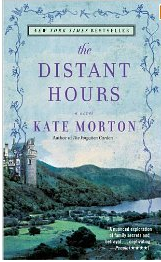
Cover for The Distant HoursKate Morton has been one my favorite authors ever since I read The Forgotten Garden, which is still my favorite of her books. The Distant Hours is another of Morton’s atmospheric novels about family secrets.

When a letter posted in 1941 finally reaches its destination in 1992, Edie Burchill is surprised at the emotional reaction of her usually cool mother. She finds out for the first time that her mother was an evacuee during World War II at the home of Raymond Blythe, the author of Edie’s favorite childhood book, The True History of the Mud Man.

Later, after Edie has been asked to write an introduction for a reprint of Blythe’s classic, she gets lost meeting a potential author and accidentally finds Milderhurst Castle, the once stately but now crumbling home of the Blythes. Living there are the Blythe sisters, Percy, Saffy, and the invalid Juniper. In a way, too, the house is still occupied by the memory of their overbearing father.

The novel alternates between the present time and 1941, as we discover what happened during one night in 1941 that has haunted the family ever since. Morton is deft at creating a compelling atmosphere in the moldering castle and in keeping her readers in suspense.

Morton’s latest book, The Secret Keeper, is due out in October. I can’t wait to get my copy!

Day 136: The Séance

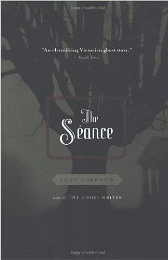
Cover for The SeanceThe Séance is a modern novel that is written like a Victorian gothic mystery. It features narrations by several different characters–a typical Victorian device that was used successfully in Wilkie Collins’s The Moonstone.

John Harwood’s novel is difficult to describe without going too far into the plot, because some important characters do not appear until later in the book. It begins with the story of Constance Langdon’s dreary childhood and young adulthood. Her mother has been depressed and nonfunctional since her sister died, and her father behaves as if he lives alone in the house. When Constance reaches the age of 11, her father withdraws her from school and abandons her and her mother to go live with his sister. Later, a disastrous experiment with spiritualism (very popular in Victorian times) in an attempt to help her mother results in her mother’s suicide.

Constance accepts her uncle’s invitation to live with him in order to avoid being thrust upon a father who doesn’t want her. But shortly after moving in with him, she finds she has inherited Wraxford Hall, an infamous house, old and crumbling, where two boys died; an old man mysteriously disappeared; and Magnus Wraxford was apparently murdered by his wife, Eleanor, who has also disappeared.

The next section of the novel is narrated by John Montague, a lawyer who visits Constance. He was involved in the experiment at Wraxford Hall that ended in the murder of Magnus Wraxford, and he tells the story of the experiment. This visit and Constance’s subsequent agreement to take part in a séance at Wraxford Hall lead us to Eleanor’s story, which is taken up by a diary that Eleanor wrote. Finally, we return to Constance. When she arrives at Wraxford Hall, she finds the experiment is to take place in a spooky gallery occupied by an odd-looking set of armor and a sarcophagus.

The novel is successfully creepy and mysterious. However, by the time of the séance I had figured out one character’s crucial secret identity, which made several other plot points clearer. Some readers may find it takes a long time to get to the crux of the novel, but I enjoyed the journey.

Day 131: The Dark Lantern

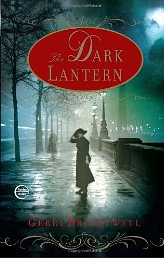
Cover for The Dark LanternI had mixed feelings about The Dark Lantern, Geri Brightwell’s novel of deception and intrigue set in late 19th century London. Although I found myself interested enough in what happens, I also thought that the odds of this much intrigue going on in one house were very low.

Jane Willred arrives in London for her first job in the city as a housemaid. Although Jane is a relatively blameless girl, she immediately finds herself caught in a web of deceit. In trying to put her past as the illegitimate daughter of a murderess behind, she has forged a letter from her mean, self-righteous former employer to omit the remarks the employer made about Jane’s past. In her first day at work, she is further embroiled when she breaks a dish and comes under the obligation of the blackmailing upper housemaid Sarah.

Upstairs all is not well, either. Mrs. Robert Bentley, Mina, newly arrived from Paris because of her mother-in-law’s illness, is hiding a shameful past. While her husband distractedly goes about his work trying to prove that an innovative system of taking body measurements of criminals is preferable to fingerprinting as a means of identification, she hides in the London house trying to avoid being recognized.

Odd things are certainly happening, as a stranger intrudes into the house on Jane’s second day claiming to be Mr. Robert and looks through his papers. How, Jane wonders later, did he know she would answer the door–as the only person in the house who hadn’t yet met Mr. Robert–since it wasn’t her job to do so?

Robert is waiting for the return of his brother Henry from India, hoping Henry will agree to sell the house after their mother’s death, as he and Mina are almost broke. Instead comes news that Henry’s ship has foundered off the coast of France and only his wife has survived–a wife no one knew existed.

Aside from the number of people hiding secrets in this novel, I also felt that few of the characters are likable. Jane is the most sympathetic, but she seems incredibly stupid at times. Nevertheless, the plot kept me interested.

Day 118: The Solitary House

Cover for The Solitary HouseBest Book of the Week!

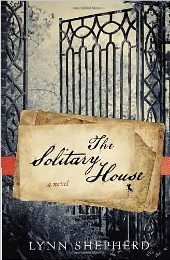
I had an ambivalent reaction to The Solitary House, which is sort of a riff on Bleak House. It is not exactly a retelling of Dickens’s book. Although some story lines are re-interpreted, most of the Dickens characters appear in the background of the novel. My ambivalence is because Bleak House is one of my favorite Dickens novels, and I have not been happy with some of the retellings of classics that have appeared lately, particularly those that seem to miss the point of the original works. I am also a little dismayed by what Shepherd has done to some of my favorite Dickens characters. However, I find I have to admire the masterful way Shepherd has worked the threads of Dickens’s novel into such a different story. On the whole, almost despite myself, I am giving this novel a big recommendation for its originality.

Charles Maddox is a former detective for the London police force who left under undesirable circumstances. He is hired by Edward Tulkinghorn, a mysterious solicitor who has an evil reputation. A client of Tulkinghorn’s has been receiving threatening letters, and Maddox’s assignment is to find out who is sending them. Charles descends into the squalor of London to discover the author of the notes, but when he turns the information over to Tulkinghorn, the author of the notes is brutally murdered.

Thinking that this is not a coincidence, Charles begins investigating Tulkinghorn himself, as well as his client, Julius Cremorne. In doing so, he comes upon evidence of a serial killer. He also runs up against Inspector Bucket, his former police supervisor.

Charles’s story is written in a jokey third-person omniscient narration that often addresses the reader directly and is interlarded with many references to Dickens and some quotes from Shakespeare. Imagine a style that is like a postmodern Dickens. This narration is interleaved with the first-person narrative of Hester, seemingly the same quiet, loving, capable Esther Somerset of Bleak House. It is not until the end of the novel that these two stories merge horribly together.

Ultimately, I am coming down on the side of strong admiration for this book. It is completely absorbing and inventive, well written and literate, and actually convincing as a twisted alternate vision of Bleak House minus the case of Jarndyce vs. Jarndyce. It made me want to return to Bleak House, which I have not read recently, and dig out all the references. It is a gothic novel that becomes a serious creepfest, and you know how I love those.

I see that Shepherd has also riffed on Mansfield Park. As much as I am dreading what she will do to my beloved Jane Austen, I think I’m going to have to read it.

Day 98: The Poison Tree

Cover for The Poison TreeWhat starts out as a seemingly ordinary novel about a young woman who makes a fascinating, exotic new friend builds slowly to the macabre in The Poison Tree by Erin Kelly. This is not a traditional mystery, but more the foreboding story of how several characters’ lives are changed irrevocably by the incidents of a careless summer in 1993.

In a story that begins ten years before the novel’s present, Karen Clarke is a naive but high-achieving linguistics student who is soon to graduate from a college in London. Her academic success has more to do with a natural ability to learn languages than application, and she finds herself unable to decide what to do with her life. After being very focused for years, she is inclined to let her near-term future be decided by fate.

One afternoon near the end of the term she meets the flamboyant, charismatic Biba Capel and is immediately captivated by her and drawn into her circle. Biba lives in a sprawling, ramshackle house with her brother Rex and other assorted people, and they spend most of their time partying.

The novel’s present day begins with Karen picking up her husband, Rex Capel, from prison, where he has served 10 years for murder. With her is their ten-year-old daughter Alice. Karen has been supporting her small family, economically and emotionally, for years, and knows she must continue to do so, as Rex will find it difficult to get work. She is very protective of Rex and Alice and afraid their new life will be ruined if people learn about their past.

How Karen goes from the carefree life she adopts that summer—which she spends with a bunch of irresponsible young people partying all night and sleeping all day—to the fearful present involves the Capels’ tragic history. As she learns about this history and learns more about her friend, she is drawn into tragedy.

Well written and absorbing, the book slowly builds from normalcy to a sense of dread.

Day 96: The Forgotten Garden

Cover for The Forgotten GardenKate Morton’s The Forgotten Garden was one of my big discoveries two years ago. I absolutely love this book.

A four-year-old girl walks off a ship in Australia in 1913 with a little white suitcase. No one meets her. She won’t say who she is or where she came from. The harbor master takes her home, calls her Nell, and adopts her, and she forgets her previous life. When she is 21 and on the verge of marriage, he tells her about it. This information is so shocking to Nell that she breaks with her fiancé and her family and isolates herself, feeling that she has been living a lie.

In 1975, Nell’s irresponsible daughter drops her own teenage daughter, Cassandra, at Nell’s house and drives away, never to return. Nell has other plans, but puts them aside to take care of her granddaughter.

In 2005, Cassandra is mourning Nell’s death. She has inherited Nell’s property but is only vaguely aware of her history. When she looks through Nell’s things, she finds a white suitcase with a book of fairy tales in it. She also finds that Nell never stopped looking for her real family. Continuing Nell’s search, Cassandra ends up in a small Cornish village where she learns she has inherited a small cottage on the Mountrachet estate.

Cassandra finds an entrance into a walled garden, and another one from there to the estate. Eventually, she also discovers the history of her grandmother’s parentage.

The book traces Nell’s history by alternating among these times. The modern story is one of investigating one’s roots, but the older tale is more gothic. Ultimately, it is the story of two cousins, the wealthy Rose Mountrachet and the slum-born Eliza Makepeace, who comes to live with her and be her companion.

A mystery about family secrets, the story is complex and enthralling. Some readers may be daunted by its length, but once you begin reading, you will not be able to stop.

Day 78: The Night Strangers

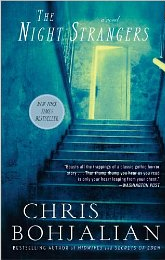
Cover of The Night StrangersIt’s been awhile since I’ve reviewed a real creepfest, but The Night Strangers by Chris Bohjalian is certainly one. The book is a combination of a ghost story and a thriller, and I don’t want to tell you what else.

Chip and Emily Linton move with their twin daughters to a small New Hampshire town after Chip has been traumatized by a horrific accident. As an experienced airline pilot, he tried to make an emergency plane landing on a lake, only to end up killing 39 people. The family moves thinking that Chip will recover sooner if he is away from people who know what happened, but of course that is impossible.

The Lintons purchase a historic house that hasn’t been lived in for awhile. The house has some strange things about it, for one thing a door in the basement that has been sealed with 39 carriage bolts.

Chip becomes obsessed with the door, and then he begins seeing three of his dead passengers. To the reader, it is not clear whether the house is haunted or whether Chip is losing his mind.

Some local women, all herbalists, begin to befriend the family. Some of them show an unusual interest in the twin girls. Soon we become aware that the history of the house is unsavory–and involves twins.

The story is uneven. At some points it seems to be going one way, at others another. Our dread rises, but we don’t know exactly which of two possible horrendous endings will come about or whether the Lintons can escape altogether. But if you appreciate a good psychological thriller and all-around creepy book, you’ll probably enjoy The Night Strangers.

Day 68: The Lace Reader

Cover for The Lace ReaderFrom the very beginning of The Lace Reader, the main character tells us she is a liar. The first time I read this book, I paid attention to that comment, but I could not detect any lies and eventually I forgot about that statement. As it turns out, Towner is not really lying, but Brunonia Barry’s novel is an outstanding example of the use of an unreliable narrator, and a haunting story.

Towner Whitney has not been home to Salem, Massachusetts, for 17 years, ever since her twin sister Lyndley committed suicide and she herself had a breakdown and was institutionalized. Now her brother calls asking her to return home because her great-aunt Eva has disappeared.

Towner’s female relatives are all unusual. She comes from a family of lace readers–people who can read the future in a piece of lace–and although she refuses to read, she is clairvoyant and can read people’s minds. These abilities, which she rejects, make her feel unstable, especially since she has gaps in her memory from electro-shock therapy. Towner’s mother May never leaves the island where she harbors abused women and teaches them how to make lace, and her aunt Emma has brain damage from a history of abuse by her husband Cal.

In Salem again, Towner waits for news of Eva. She learns that one of the police officers, Rafferty, is sure that Cal had something to do with Eva’s disappearance as he has been threatening her and other members of her family.

Salem itself is almost a character with its witch-based tourist industry, and now Cal has formed a group of religious cultists who call themselves Calvinists and who taunt the witches and threaten them with damnation. It’s a bad place for Towner to be, and she is just deciding to leave again when Eva’s body turns up.

The Lace Reader is a wonderful book, layered with secrets, an exploration in the difference between perception and reality. With an atmospheric setting, characters to care about, and a compelling plot, the book is a real page-turner. The last few paragraphs made me re-evaluate everything I had read.

Day 65: Arcadia Falls

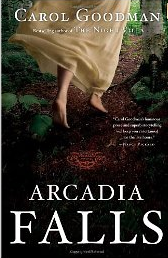
Cover for Arcadia FallsArcadia Falls by Carol Goodman is a gothic novel about a young widow, Meg Rosenthal, who has been left without much money after leading a well-to-do married life. She accepts a job at a remote high school for the fine arts where she has been able to enroll her teenaged daughter. The school was founded by two artists and authors of fairy tales, Vera Beecher and Lily Eberhardt. Lily died under mysterious circumstances by falling into a ravine during a snowstorm. The first night Meg and her daughter are installed in their new home in a secluded cottage on the grounds, one of the students also falls into the ravine.

As Meg’s thesis concerns the school, she begins digging into the death of Lily, especially trying to figure out why the current headmistress, Ivy St. Clare, disliked her so. She is aided by her accidental discovery of Lily’s diary in a hiding place in the cottage.

This book is interesting and engaging, but the solution to all the campus goings-on has a major fault that makes it difficult to accept. It hinges on the identities of three different women. I don’t want to say more, but this problem makes the ending completely unlikely.