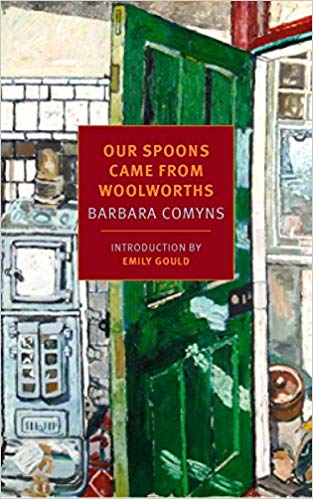
Review 1304: Our Spoons Came from Woolworths

It’s typical of Barbara Comyns that she tells a horrifying story in a disarming, naive style. In Our Spoons Came from Woolworths, her theme is an ill-considered marriage.

Sophie marries Charles at 21 despite considerable opposition from his family. They make it plain that they don’t like her, think she isn’t good enough for Charles and that he shouldn’t marry before he can support a wife. They assume she has tricked Charles into marriage by getting pregnant when in reality she knows nothing whatever about sex. The fact that Charles says nothing in response to his family’s insults to his fianceé should have tipped Sophia off, but she’s not very good at picking up on things.

Charles is an artist, and apparently Sophia is meant to support him on her meager salary as a commercial artist. Although he occasionally picks up a contract, most of the time they are just getting by. Getting by, that is, until Sophia soon finds herself pregnant. Slowly, she learns that she has married a self-absorbed man who feels no responsibility toward her or their life.

This may sound like a depressing story, but there is something about its light, naive tone that lifts it up. Instead, it is a charming and funny story of depression-era poverty and a bohemian lifestyle.

Related Posts

Who Was Changed and Who Was Dead

The Vet’s Daughter

Sisters by a River

Day 700: Some Luck

Cover for Some LuckSome Luck begins in 1920, five months after the birth of Frankie, Walter and Rosanna Langdon’s first child. They have only been settled on their own farm a short while.

This novel is the first of a trilogy about the Langdons, an Iowa farm family. It covers a turbulent 33 years, during which occur the Great Depression, the long drought, and the Second World War.

Most of the novel concentrates on the Langdon children. Frankie is active and always into trouble. He teases his younger brother Joey unmercifully. Joey is gentle and good with animals, dutiful and obedient. Lilian is angelic looking and well behaved, good at taking care of the younger children but a bit prissy. Henry is self-contained and spends as much time reading as possible.

It is hard to describe this novel. It moves constantly from character to character in viewpoint and has no main character, but is more like an ensemble piece. The action that takes place is mostly that of everyday living, although there are births, deaths, and weddings. Rosanna goes through a religious phase after one child’s death and drags the family to a fundamentalist church for several years and then stops.

Smiley’s characters are very human, with faults and foibles. So far, this trilogy is developing slowly, but the family’s lives make interesting reading.

Related Posts

A Thousand Acres

The All-True Travels and Adventures of Lidie Newton

Gilead

Day 671: Lila

Cover for LilaBest Book of the Week!
In Lila, wonderful writer Marilynne Robinson returns to the small Iowa town of Gilead, the setting of her previous novels Gilead and Home. In these novels Lila Ames is not much of a presence. She is referred to as the surprising choice of a wife for the elderly, gentle, and educated pastor John Ames—much younger, rough, and uneducated.

Lila has lived almost her entire life on the tramp, ever since Doll stole her away, a neglected, starving, feverish little mite who lived mostly under the table or was locked out of the house. Doll and Lila joined up with a group of travelers lead by Doane, wandering from job to job, and life was just fine until the long, dark days of the Depression and the Dust Bowl. Years later, Lila has stopped outside Gilead and is living in a shack, walking to nearby farms and houses and asking for work.

Lila knows nothing about religion, but on occasion she has been curious about it and was warned away by Doane, who claims all preachers are charlatans. So, one day she ventures into the church. There she sees and is drawn to John Ames, and he to her. Eventually, they marry.

The action of this novel is mostly interior. Lila is tormented by some of the memories of her previous life and feels unworthy of Ames. She is afraid that he may ask her to leave at any minute. All the same, she occasionally wants to return to the freedom of her old life.

Ames, on the other hand, is happy to have Lila’s company, for he has lived alone ever since the death of his wife in childbirth, years ago. He is afraid she will decide to leave him one day.

As with Gilead and Home, this is a quiet novel, characterized by religious discussions as Lila tries to read and understand the Bible. She has no prior relationship to religion, but she has vowed that John Ames’s son will be brought up praying, as his father does. The discussions in Gilead between the two pastors were way over my head, but these are more fundamental.

I am not particularly interested in religion, but what I like about Robinson’s books is that they are about good people trying to be good. That is a refreshing theme these days. And the writing is superb, the subject matter approached with delicacy. I can’t recommend any book by Marilynne Robinson strongly enough.

Related Posts

Gilead

Home

Housekeeping


Day 561: Lucky Us

Cover for Lucky UsI was enchanted by Away, so I was excited to find that Amy Bloom had another book out. This novel is good but does not live up to the other.

Eva Acton has not met her older half-sister Iris until Eva’s mother dumps her on the front porch of her father’s home. Up until then, Eva worshipped her father, but she begins to see that he has his flaws, a second family being a major one of them. Another is stealing the money Iris wins in talent competitions.

Once Iris has managed to hide enough money from her father, she and Eva take off for Hollywood, where Iris is determined to make it big. At that point, Eva’s formal education comes to a halt, when she is 14.

Iris is beginning to have some success when her chances are ruined by betrayal and scandal. The girls, their friend Francisco, and their father, who has joined them upon premature news of Iris’ success, set off for New York.

This Depression-era novel is written in a light, jaunty tone, narrated mostly from Eva’s point of view punctuated by letters. For after a lot has happened, the girls are eventually separated.

The conflict of the novel is around some choices Iris makes, causing Eva to take on responsibilities and struggles that Iris has initiated. Iris commits several unconscionable acts.

http://www.netgalley.comI cared about what would happen to Eva and some likable friends, but I felt that the end of the novel was too easy on Iris. I also felt that this novel lacked the originality of Away. It is interesting, though, because I was never sure what would happen next, and the narrative style has its charms.


Day 378: Cascade

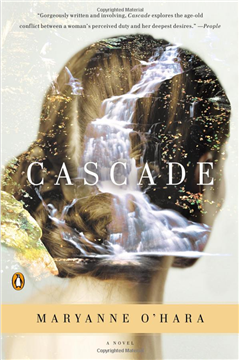
Cover for CascadeIt would be nice to know how much O’Hara expects us to like Desdemona Hart Spaulding, the heroine of Cascade. Unfortunately, I think we may be thrust too abruptly into Dez’s troubles to get to like her.

A promising artist who has studied in Boston and Paris, Dez has already been forced to leave that life when we meet her. The Great Depression cost her father his fortune, and he had to close down the famous theater he founded in the resort town of Cascade and sell his treasured First Folio of Shakespeare. Dez was forced to withdraw from art school and hastily married her childhood friend Asa Spaulding so that she and her father would have somewhere to live. Her father dies soon after, and she is taken aback to find he has left the theater to Asa.

Still, considering she married a man with little interest in or understanding of her drive to create art, Asa has set aside a bright room in their house for her studio, and she paints for several hours on most days. Asa wants a child, though, and Dez fears that her precious painting time would be taken up with child rearing. She is secretly doing what she can to prevent conception.

Two things soon make her dissatisfied with her life. Her art school friend Abby stops by on her way to a new life in New York, and suddenly everything in the depressed town looks shabby, even the beloved playhouse. Dez has also formed a friendship with a Jewish man named Jacob Solomon, who has taken over his father’s peddlar’s route. Jacob, though, is a gifted artist who plans to sell his father’s inventory and move to New York, hoping for a job with the Works Progress Administration. He meets Dez once a week to discuss art, but after a dispute, Asa asks her to stop meeting Jacob.

Asa is concerned because the town is under threat. Cascade is one of two possible towns that may be flooded to create a reservoir that will supply water to Boston. Asa wants to mobilize an effort to save Cascade, and Dez has the idea to paint a series of postcards showing Cascade in the past and present in an attempt to garner public support for the town. She is able to sell this idea to a prominent national magazine. All the while, however, she is secretly hoping the town will lose and she will have an excuse to move to a large city. The agreement she makes with the magazine and other disastrous decisions cause her to betray her husband, her town, and finally even Jacob.

I think O’Hara wants us to sympathize with Dez in her growing ambition to go to New York and take up a career in art. But some of her actions don’t just show poor judgment; they are despicable. As the plot advances, I feel less and less sympathy for her.

A review from the Boston Globe calls Dez complex and says she doesn’t always make the right choices. I think it’s worse than that; the trouble is really with where she places her priorities. The town is in danger of dying, in the horrible economy many people’s welfares are at risk, but Dez puts her future as an artist first and barely gives the other townspeople a thought, in fact, seems to feel superior to them. She supposedly yearns to reopen her father’s playhouse but doesn’t seem to give it much attention when it is threatened, although she eventually makes a deal that saves it. She has married for selfish reasons and is all too ready to give up on her marriage.

Of course, the principal theme of the novel is how much to give up for art, but in this case, it is not Dez who does the sacrificing. I wish I had liked this novel better. I think that if we’d had a longer time with Dez in her art student life and gotten to know her before she began a series of lies, deceptions, and betrayals, I could have felt more sympathy with her struggle.

Day 234: Rules of Civility

Cover for Rules of CivilityBest Book of the Week!
In 1966, the former Katey Kontent and her husband Val are attending an exhibit of Depression Era photographs at the Museum of Modern Art when they spot two pictures of an old friend of Katey’s, Tinker Grey. In one, he appears as a sophisticated, well-dressed banker, and in the other, shabby and unkempt, but lit from within. Val assumes that the man lost his money in the Depression, but Katey says that is not exactly the case.

Back in 1937, Katey and her best friend Eva Ross are two carefree working-class girls trying to have fun in New York on a very limited budget. On New Year’s Eve, they are at a scruffy jazz club when a young, immaculately dressed man comes in to meet  his brother. It is Tinker Grey, a wealthy investment advisor. The girls end up spending the evening with him and then seeing him regularly. From the first, he seems more attracted to Katey than to Eva, but fate takes a hand and links Tinker and Eva, seemingly irrevocably.

Katey and Eva are introduced through Tinker to the life of privileged young New York, entering the highest echelons of society. As Katey’s future life is decided by the people she meets during the next year, she learns to judge appearances more accurately and to hone her own acute moral sense.

Katey is a smart, witty, and engaging heroine with a strong sense of self. I found the novel to be beautifully written and absorbing. Rules of Civility is an impressive first novel from Amor Towles.