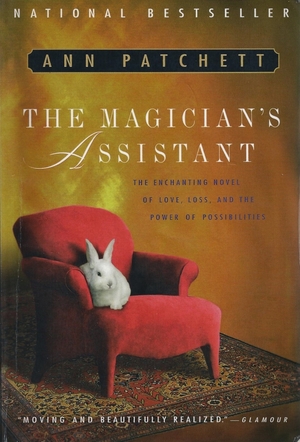
Review 2583: The Magician’s Assistant

Sabine was very much in love with her husband, Parsifal, when he died unexpectedly. A handsome, affectionate, and charismatic man, he was also gay. For Sabine, it was love at first sight, which he hired her as his magician’s assistant.

Sabine lived with Parsifal and his lover Phan before Phan died from AIDS. Parsifal was also diagnosed with AIDS (this was the 90s when it was a death sentence), but he died unexpectedly of a brain aneurysm. Sabine is devastated and finds it hard to get out of bed. Phan was wealthy, so she is alone in a large house with Rabbit.

Although Parsifal had told her he was from Connecticut and had no family, Sabine has a shock coming. He does indeed have a family, a mother and two sisters in Nebraska, and his real name is Guy Fetters. She learns from his lawyer that Parsifal has been sending them money and left them some in his will. Sabine hypothesizes reasons why she has never heard of them but decides to call Mrs. Fetters. Eventually, she agrees to take her and her daughter around a visit of L. A. Sabine’s parents think she should have nothing to do with them.

Sabine likes Dot Fetters and her youngest daughter, Bertie. She begins learning new things about Parsifal. When they are leaving to go home, she agrees to visit them and attend Bertie’s upcoming wedding.

This story is an absorbing and touching one. Sabine learns to deal with her grief and finds out more about Parsifal. His family hears stories from her about their exotic-seeming life. The truth about why he left Nebraska is a difficult one, but Dot Fetters has regretted not trying to find him.

I love this novel. I thought I had read it before when I picked it up for A Century of Books, but it was unfamiliar. Patchett knows a lot about human nature.

Related Posts

The Dutch House

Tom Lake

Commonwealth

Review 2566: Looking for Alaska

The few John Green books I’ve read are aimed at teenagers (although some are excellent adult reading) and address, fairly subtly, an issue. For Looking for Alaska, it’s death and grief.

Sixteen-year-old Miles is miserable in his school. He has no friends, and the level of education is fairly low, so he convinces his parents to send him to a boarding school in Alabama that his father attended. He is hoping this change will initiate what he calls the Great Perhaps.

He is lucky enough to pull as his roommate a stocky kid named Chip (aka The Colonel). The Colonel is at first dubious of him until some other students overdo it with the initiation for new students. The custom is to haul Miles off in the middle of the night and drop him into the lake, but because The Colonel and his friends have lately pranked them, one of them wraps Miles up in duct tape and then they drop him in the lake. He is in danger of drowning, but he manages to float himself to shore and then get the tape off.

The Colonel is outraged by this prank because it was so dangerous. He has a running feud with the Weekday Warriors, rich kids who board there but return home every weekend to their parents’ homes in Birmingham. It was some of those kids who duct-taped Miles because of his association with The Colonel.

The Colonel nicknames Miles “Pudge” because he’s so skinny and introduces him to his friends, a Japanese boy named Takumi and a girl named Alaska. Miles is immediately smitten by Alaska, a cool girl but with an unstable temperament, usually out-going and dare-devilish but sometimes hysterically unhappy.

The group pals around, teaches Miles to smoke and drink and get into trouble, but they also take studying and grades seriously, especially The Colonel, who is on a scholarship and comes from a very poor home.

Then one of the friends dies.

For once, I thought Green got a little of this wrong. Some of the friends’ reactions didn’t read true, or maybe they did and I just don’t know teenagers. For example, throughout the novel, Miles is fascinated by the last words of famous people, so much so that he reads a lot of biographies. When the friend dies, he is upset, but he regrets he didn’t get to hear the friend’s last words. He is supposedly devastated by the death and blaming himself, so that seems like a flippant reaction, but Green mentions it twice.

Otherwise, Green does his usual masterly job of gaining your sympathy for his characters and presenting them with a difficult situation. He writes well, avoiding that stereotypical “teenage voice” that so many adult authors use; has a good sense of humor; and is good at depicting believable teenagers.

Related Posts

The Fault in Our Stars

Turtles All the Way Down

Tell the Wolves I’m Home

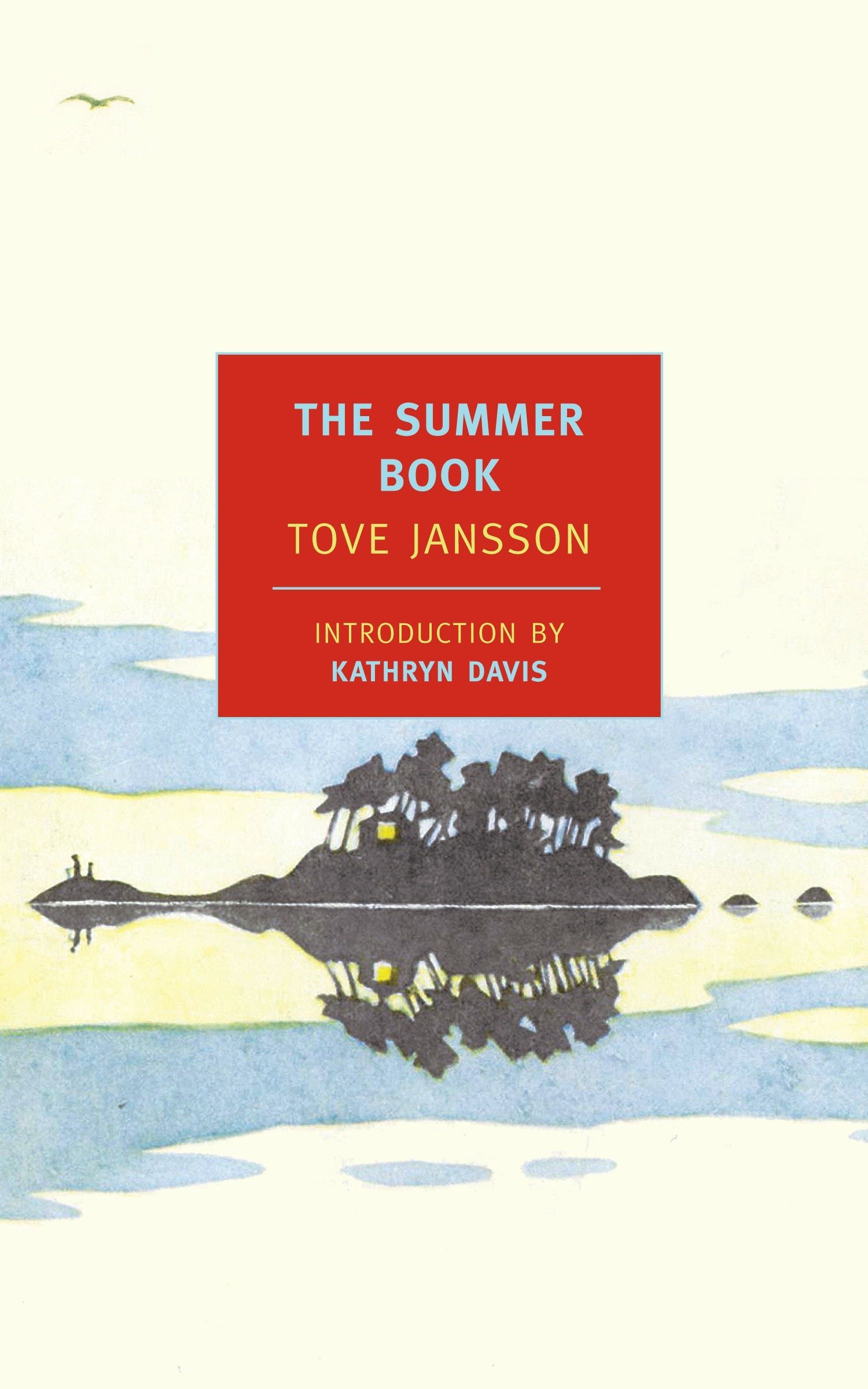
Review 2204: The Summer Book

The event that informs The Summer Book has already occurred before the novel starts—six-year-old Sophie’s mother has lately died. Sophie, her father, and grandmother travel early to an island on the Gulf of Finland where they spend their summers.

There isn’t much plot to his novel, which is mostly centered on Sophie and her grandmother. Sophie is changeable and sometimes anxious. Her grandmother, who is not in good health, is usually wise and responsive but can be irritable. In between tales of a visiting neighbor, the construction of a new road and a large, intrusive house, a haunted bathrobe, an unfriendly cat, the construction of a miniature Venice, and some massive storms, Jansson minutely describes the world of the island—the terrain, the insects and birds, the plants.

This is a lyrical novel that implies—most of them are unstated—some truths about life, death, and love.

Jansson spent most of her summers on such an island. She wrote this novel shortly after the death of her mother.

Related Posts

Moominsummer Madness

The True Deceiver

Abigail

Review 1673: Writers & Lovers

Ever since reading Euphoria, I’ve been wondering what else Lily King can do. Let’s just say that Writers & Lovers did not disappoint.

Casey Peabody is having a rough time. At 31 she is still waiting tables and trying to work on her novel. Her mother died recently, and she is grief-stricken. She just wasted a spot in a writing workshop on an affair instead of writing, and now she hasn’t heard from the man she spent so much time with. She lives in what used to be a gardening shed, and her landlord frequently belittles her. Finally, she has a crushing student loan debt, and she is working double shifts just to be able to afford to live in Cambridge, Massachusetts.

As if all this isn’t stressful enough, she finds herself dating two very different men. She is supposed to go on a first date with Silas when he abruptly leaves town with no explanation. Then she meets Oscar, a middle-aged, established writer with two delightful young boys. Soon, she is going on outings with the three of them. But then Silas shows back up.

This is an intimate and engaging story of a few months in a complicated woman’s life. This description almost makes it sound like a romance novel, but it is much more than that. I found it absolutely compelling.

Related Posts

Euphoria

Monogamy

Four Letters of Love

Day 1197: Literary Wives! The Headmaster’s Wife

Cover for The Headmaster's WifeToday is another review for the Literary Wives blogging club, in which we discuss the depiction of wives in fiction. If you have read the book, please participate by leaving comments on any of our blogs. Be sure to read the reviews and comments of the other wives!

Eva of Paperback Princess
Kate of Kate Rae Davis
Lynn of Smoke and Mirrors
Naomi of Consumed By Ink
TJ of My Book Strings

My Review

In trying to rate The Headmaster’s Wife, I again became frustrated with Goodreads’ inflexible five-star system. The novel was more ambitious and better written than many run-of-the-mill novels I’ve given three stars to, but it wasn’t good enough to get four stars, which I give to books I like a lot but don’t think are wonderful. There was just something lacking in it, and 3 1/2 stars would have been perfect.

Arthur Winthrop, the headmaster of a private prep school,  is found wandering naked in the park. He tells the police his story about having an affair with a student forty years younger than him, an event ending in a crime.

But halfway through the book, we find it is not about what we think it is. Arthur turns out to be an unreliable narrator. At this point, the focus changes to Betsy, the girl in the headmaster’s story, sort of. There’s not much more about the plot that I can say without major spoilers.

The prep school world is one that I’m not familiar with, but everything about this novel could have taken place in the 1950’s instead of the current times. I found the world of the book scarily insulated from the events of the real world.

Overall, I found this novel unsatisfying. The first half of it I found distasteful, especially in these Me Too days. But the novel, as I said before, isn’t really about what it seems. The second narrative is unsatisfying because we only actually see Betsy in her relationship to the males in her life—her boyfriends, her son, her lovers. It’s as if she has no actual life. Which, of course, leads us into our Literary Wives discussion.

What does this book say about wives or the experience of being a wife?

First, I didn’t believe in Betsy as a character except in Arthur’s narrative. In her own section, we have no sense of her day-to-day life. She doesn’t seem to exist. Maybe that was the intention of the author, but maybe he is just really bad at depicting women. While Arthur shuffles papers and attends board meetings, she does literally nothing except have one conversation with an acquaintance.

At the beginning of Arthur and Betsy’s relationship, when Arthur sees she is cooling off, he plays a nasty trick to get rid of a rival. Betsy is fully aware of it. Yet, we are to believe that she went ahead and married Arthur, presumably to have a place at Lancaster forever. I didn’t believe it.

Then, we see Betsy, as I mentioned before, only in relationship to the males in her life and mostly in reference to sex. That is, when she looks back at her own life, it’s one sex scene after another, except for her memories of her son, and even those are somewhat eroticized. Even her desire to become good at tennis involves an affair with her tennis instructor. All I can say is, guess what guys? Sex isn’t the only thing women think about.

The central theme of the novel is supposed to be about grief, but characters in this novel don’t deal with their grief or even really face it. I feel that Greene meant for this novel to be meaningful, but it doesn’t really make it.

Related Posts

The Bookman’s Tale

The Possibilities

The Year of Magical Thinking

Day 1081: Days of Awe

Cover for Days of AweIsabel is struggling. It is almost a year since the death of her beloved friend, Josie. Her husband, Chris, has moved out, and her 12-year-old daughter, Hannah, blames her for it. She has become alienated from her childhood friend, Mark, who was Josie’s husband, because of his romantic choice.

This novel is a character study more than anything else, of Josie and of Isabel, as Isabel revisits memories and tries to deal with the sadness in her life. As Isabel grows to understand that she was missing cues from Josie, she slowly learns to handle Josie’s death.

I enjoyed this novel. It is well written, with funny dialogue. Both Isabel and Josie express themselves with imagination and humor. We learn to care for Isabel, with all of her foibles.

Related Posts

The Sense of an Ending

The Goldfinch

Tell the Wolves I’m Home

Day 1041: Enon

Cover for EnonEnon is the second novel by Paul Harding and it follows the story of the same family as in his first novel, Tinkers. That novel was about George Crosby and his memories of his epileptic father. Enon is about George’s grandson, Charlie Crosby, and his life in the village of Enon.

At the beginning of Enon, Charlie’s beloved 13-year-old daughter Kate is killed when her bicycle is hit by a car. Soon after, without much attempt to work anything out, Charlie’s wife Susan returns to her parents’ home and he never hears from her again. Charlie begins a downward spiral into grief, anger, and an addiction to pain killers.

In some respects, Enon is a little more accessible than Tinkers. It is characterized by the same beautiful prose, especially in the descriptions of nature. Further, the setting in the old New England village with its sense of history is fully imagined.

Yet, I wasn’t so interested in watching Charlie fall apart, nor did I enjoy his hallucinogenic dreams about Kate, where she turns to obsidian, for example. I’m starting to realize I don’t enjoy reading about dreams in fiction.

I was also nonplussed by Charlie’s relationship to Susan. No wonder their marriage fell apart. Although they seem to be a happy family at the beginning of the novel, Susan is always somewhere folding clothes while Charlie and Kate go off on adventures. I was surprised when she left just a few days after Kate’s death, but it became clear she wasn’t important to her own family.

So, if this subject matter attracts you, you might enjoy this book more than I did.

Related Posts

Tinkers

The Snow Queen

Pastoral

Day 988: H Is for Hawk

Cover for H Is for HawkBest Book of the Week!
I never gave too much thought to what is involved in falconry until I read H Is for Hawk, a memoir by Helen Macdonald, English naturalist, writer, and Affiliated Research Scholar at Cambridge University. But Macdonald’s memoir covers more ground than just that. It is also an examination of what is revealed about the writer T. H. White in his nonfiction book Goshawk and a recollection and examination of Macdonald’s grief over the death of her father.

As such, H Is for Hawk has many layers. It is a literary work, both in its examination of White’s book and in its eloquent writing style. It is an unflinching memoir. It is also deep psychologically in its examination of the forces that drove White and that drive Macdonald. Finally, it is a journal of falconry.

I was deeply interested in the story of Helen and her hawk Mabel. I was particularly surprised by some details about the personality of the hawk. This book contains some beautiful, almost poetic descriptions of the natural world. It is certainly worth reading. Highly recommended.

Related Posts

The Rural Life

My Life in Middlemarch

The Bird: A Natural History of Who Birds Are, Where They Came From, and How They Live

Day 668: The Sea

Cover for The SeaIn this contemplative novel, recently widowed Max Morden returns to the small Irish seaside resort where his family used to live when he was a boy. It was there he met and became fascinated by the Grace family, much above his own in social strata.

Max’s memories are assisted by his residence as a boarder at The Cedars, the house where the Graces stayed that summer. The Cedars has become a boarding house that is now managed by Miss Vavasour.

The young Max became the companion of the Grace’s oddly feral twins, Chloe and Myles. They are two very unpleasant children who torment their teenage nanny Rose. At first infatuated with the voluptuous Mrs. Grace, Max eventually turns his attentions to the spiky Chloe.

Through his memories of the extraordinary events of that summer and his feelings about his wife’s death, Max eventually gains some self-knowledge. Looking back, he also gains some understanding of the dynamics between people that he did not grasp as a child.

The Sea is stylistically exquisite, with its sussurating and rhythmic prose a striking meditation on death, grief, and memory. Although I guessed one of its revelations much earlier than intended, that did not take away from the power of the prose.

Related Posts

The Sense of an Ending

Bridge of Sighs

Nora Webster


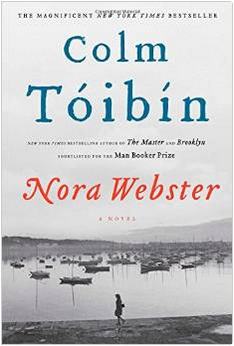
Day 650: Nora Webster

Cover for Nora WebsterIt took me awhile to place Nora Webster in time. Irish readers may be quicker to identify its setting from some events, but I am not familiar enough with recent Irish history. Finally, I identified the novel as set in the late 60’s and early 70’s. It wasn’t long after gaining that knowledge that I began to wonder how autobiographical the novel is. Since then, I have read that it is indeed autobiographical, as details about Nora’s husband match those of Toíbín’s father.

Nora Webster is in her 40’s a recent widow. She is finding it difficult. Not only does she miss her husband Maurice, but she finds the attention paid to her as a widow painful. She feels comfortable only with a few people, those who stayed with her and Maurice during his painful death.

Making things more difficult is the fact that she is left with little money. One of the first things she is forced to do is sell the holiday cottage where the family stayed every summer. She finds it hard to return there, especially under those circumstances.

She also has her children to worry about, particularly her two young sons. Donal has begun stammering since his father’s death, and when her Aunt Josie comes to call, it is immediately clear to Nora that all did not go well when the boys stayed with Josie while their father was dying.

Soon Nora is forced to return to her old job at Gibney’s, where she has not worked since she married 20 years before. She must report to Mrs. Kavanaugh, a woman she disliked when they were girls at work there together and who bullies the office staff.

There are no big events in this novel, which is more of a character study. It is about grief and the act of making a new life after a major event.

Nora is an interesting character. She doesn’t say much of what she thinks, so is sometimes misunderstood. She does not listen to other people’s opinions of who she should like or what she should do. She is intensely private and does not discuss things with her family, even things that she should perhaps discuss. She is also fiercely protective of her family.

This is a quiet, contemplative book and is not for those who read only for plot.

Related Posts

The Master

The Year of Magical Thinking

The Gathering