Review 2072: To Paradise

After reading Yanagihara’s deeply touching second book, A Little Life, I couldn’t wait to plunge into To Paradise. While reading the first section, though, I was afraid I was going to be disappointed, especially as it is of the genre speculative fiction, which is not one I’m usually interested in. But Yanagihara knows how to spin a tale.

The novel is split into three books, each set 100 years apart, starting in 1893. Although I’ve seen the novel described as a history of a family, let’s just say that names and personas repeat through the book, only with characters taking different roles. All of the books are set in New York City. They also feature strangely inert main characters.

This New York, though, is different from the one we know. After a civil war, the United States is fractured into pieces, one of which, called the Free States (in which New York resides), believes in freedom of religion and marriage between any two adults. David Bingham belongs to a family whose members are all in same-sex marriages. He is from a wealthy old family, and he is the eldest, but he has been a disappointment to his grandfather. He is subject to bouts of debilitating depression and seizures, and he has shown no interest in pursing any kind of career.

Another characteristic of the Free States is the prevalence of arranged marriages. David’s grandfather has been trying to arrange one for him, and the current candidate is an older man named Charles Griffith, whom David has at least agreed to meet. He likes Charles, but then he meets Edward Bishop, a poor musician. David falls for Edward, a man he knows his grandfather would consider a fortune hunter.

In 1993, David Bingham is a young Hawaiian who has left his home and his heritage as a native prince and with an incomplete law degree is working in a law firm. He is living with the wealthy older head of the firm, Charles Griffith, and although he loves Charles, because of this relationship, he spends most of his time with older men. AIDS is making its way through the community.

Also part of this book is a long narrative by David’s father, who is obsessed by his friendship with Edward Bishop, a Hawaiian nationalist with a dream of a return to a Hawaiian monarchy. Although this action causes a bit of a lull in the novel’s forward motion, we come to understand David’s alienation from his family.

In 2093, Charlie Griffith is a young woman living in a dangerous and autocratic society, the controls of which are designed to limit the spread of a deadly series of infectious diseases. Charlie herself is limited mentally and emotionally because she was a victim of one of these viruses when she was a child.

Her grandfather has arranged a marriage for her, but has traded a possibility of a loving marriage for a secure one with a gay male. Her husband has vowed to care for her in exchange for the appearance of a heterosexual marriage because homosexuality is becoming illegal. Then Charlie makes a friend named David.

This novel has many overarching themes, that of family, particularly relationships with grandparents, as none of the protagonists have functioning parents; sexuality in society; sickness and disease; and self-actualization. I was at first taken aback by the extreme passivity of its protagonists and in fact thought the first David Bingham was selfish and immature. Still, Yanigihara’s narrative pulls you in, and I found this novel completely absorbing. Some readers will be disappointed by Yanagihara’s decision to leave endings open, but I think that’s one of the things that makes this ambitious novel more interesting.
Related Posts

A Little Life

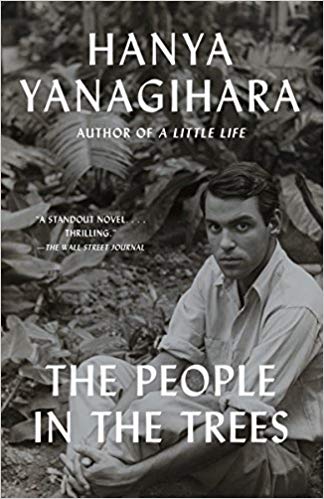
The People in the Trees

American War

Review 1413: The People in the Trees

Best of Ten!
When everyone was reading The People in the Trees a few years ago, I didn’t think it sounded like something I’d be interested in. Then I finally read Yanagihara’s fabulous A Little Life. That made me pick up this book when I saw it again.

The novel begins with documents written by Ronald Kubodera, a coworker and acolyte of Dr. Norton Perina, a renowned scientist who won the Nobel Prize and now has been imprisoned for child molesting. Kubodera convinces Perina to write his memoir, telling his side of the story.

Just out of medical school, Perina is wondering what to do with himself. He has no intention of becoming a medical doctor, and his graduate school lab work he finds boring. He has managed to offend his laboratory boss, so he is surprised when the man recommends him for a position accompanying Paul Tallent, an anthropologist, to a remote Micronesian island.

Perina’s prize-winning work is based on what he observes on that island. Tallent takes him to the U’Ivu U’ivu Islands, an archipelago of three islands. One of them, Ivu’ ivu, is forbidden, but there are rumors of a strange animal-like people on that island. Tallent hopes to discover an unknown tribe.

The first people they discover are in a state of extreme senility, some almost totally dehumanized. When they find the village, these other people are much like other U’Ivu islanders, only there are no older people in the village.

Perina’s discovery is to figure out that the people of Ivu’ ivu can live almost eternally after eating the meat of the opa’ ivu’ eke turtle, found only on Ivu’ ivu. The downside is that something in the meat also causes increased senility. The older islanders remain physically fit but eventually lose speech and all semblance of humanity.

Perina breaks a taboo to capture an opa’ ivu’ eke turtle and smuggle it out of the country for study. He also takes with him some of the elders, whom he calls dreamers.

This novel is about the abuse of power and what it can lead to. Perina is not a sympathetic character, although he states justifications for his own actions. His view is that any scientist would have taken the turtle even though his action results in the death of a guide whom he likes. Removing the dreamers from their familiar surroundings to a lab increases their decreptitude, but Perina seems to feel no remorse or even responsibility. He is more concerned with the inevitable destruction of the lifestyle on the islands once he publishes his paper.

This is a fascinating character study of a man so driven by ambition and his own needs that he doesn’t even notice the results of his actions. Even the structure of the novel speaks to this theme of power, for Kubodera’s footnotes abound, and he cuts out an important passage from the original manuscript, included at the end of the book. Kubodera’s comment is that it shouldn’t matter. He himself is such a hero worshipper that he’s ready to excuse Perina anything. Perina attempts to tell the truth about his life, but he is so self-deluded that he becomes an untrustworthy narrator.

Yanogihara has blown me away with another terrific novel.

Related Posts

A Little Life

State of Wonder

Euphoria

Day 1161: A Little Life

Cover for A Little LifeBest of Five!
For me, anyway, it often happens that a novel gets a lot of hype, with reviewers raving about it, and when I finally read it, it is unable to live up to its reputation. Such is not the case, however, with Hanya Yanagihara’s A Little Life. I found it to be thoroughly absorbing, all 800+ pages of it.

It begins with four young men who all roomed together in college—Willem, Jude, J.B., and Malcolm. The novel, which covers roughly thirty years, begins when they are all struggling to make their way in New York City. Willem and Jude still share a tiny apartment while Willem works as a waiter and auditions for acting parts, and Jude works as a lawyer for the district attorney’s office. Malcolm is poorly paid and given boring work in the office of a prestigious architectural firm, and J.B. is working on his art.

In at first a very subtle way, though, the novel centers around Jude. For some time, Jude remains a mysterious presence in the novel. He was severely injured when he was young, but he never speaks of that incident or any other in his past. But Jude’s life, we eventually find, is ruled by his past, during which he was repeatedly abused.

Since college, Jude believes that he has been pretending to be a different person than he is, and that if his friends found out who he really is, they would leave him. He is full of self-hatred.

This novel is extremely powerful and deals with some heavy issues. But it is beautifully and empathetically written. It makes us love some of the characters, and the others seem fully realized. I may not have read it if it hadn’t been on my Booker Prize project list, but I’m glad I did.

Related Posts

The Brief Wondrous Life of Oscar Wao

The Fall of Princes

The Art of Fielding