Review 2190: Bleeding Heart Yard

Detective Inspector Harbinder Kaur has transferred to London, where she is just meeting her two flatmates and her new team. Then she gets a high-profile case—while attending a school reunion, Conservative MP Garfield Rice, called Gary by his friends, has died of an apparent cocaine overdose. The only thing is, his friends say he doesn’t take drugs.

Attending the reunion are some notable figures—Isabelle Ister, a famous actress; Kris Foster, a rock star; Henry Skep, Labour MP—who used to belong to a popular group in school called The Group. Also members of The Group were Anna Vance, a teacher now living in Italy who is in London caring for her dying mother, and Cassie Fitzberbert, Harbinder’s Detective Sergeant. We know right from the beginning that Cassie believes she killed a boy when she was in school.

Of course, it turns out that Gary was murdered by an injection of insulin. His friends find it hard to believe, because Gary was liked by everyone.

There turns out to be more than one line of inquiry. Gary had received several anonymous letters featuring a bleeding heart, and he was regularly meeting other Conservative leaders at a restaurant in Bleeding Heart Yard. Also, the team learns that during exam week before the reunion attendees graduated years ago, a boy named David died when he fell in front of a train, and Gary was the principal witness. Harbinder wonders if David was actually pushed.

The book alternates narrators with members of The Group in first person and Harbinder in third person. I don’t remember if Griffiths used this form of narration in the other Kaur novels, but it began to irritate me. First, the first-person narrators should each sound different, but they don’t. More importantly, with the narration skipping around across very short chapters, the novel started to feel choppy.

So far, I have enjoyed the Harbinder Kaur series, but I didn’t like this one as much, despite it having an unpredictable ending. I still like Griffiths’ Ruth Galloway series best.

Related Posts

The Stranger Diaries

The Postscript Murders

The Locked Room

Review 1789: The Postscript Murders

This second Harbinder Kaur novel begins with the apparently natural death of 90-year-old Peggy Smith. Peggy was a sprightly old lady with an interest in crime fiction who used to record everyone who passed her apartment.

Her carer, Natalka, thinks there might be something wrong about Peggy’s death. When she and a neighbor, Benedict, are packing up some of Peggy’s things, they notice that several mystery writers have thanked Peggy for her help. Then someone holds them up with a gun and takes a copy of an old murder mystery.

Dex Challoner is one of the writers who thanked Peggy. Natalka, Benedict, and Peggy’s friend Edwin talk Harbinder into attending a book event for Dex, and he admits that Peggy used to help him come up with interesting murders. He makes an appointment to meet with them later, but the next day he is found dead, shot in the head in his home.

This novel was certainly a page turner, so much so that I read most of it in one day. It has a light cozy feel to it, and clues galore. I found it an enjoyable read.

The Stranger Diaries

The Stone Circle

The Dark Angel

Review 1571: The Stranger Diaries

Here’s a final book for RIPXV!

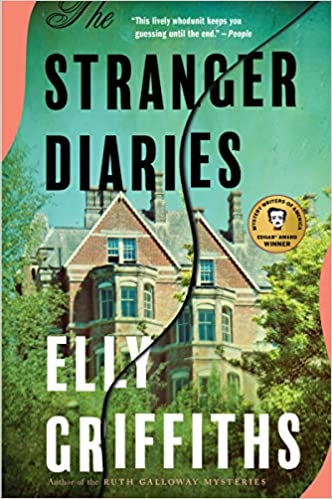
I have been following Elly Griffiths’ Ruth Galloway mysteries, which I enjoy, but Galloway’s homage to the gothic novel, The Stranger Diaries, is something else again. I thought it was a stand-alone, but Goodreads has it marked as Harbinder Kaur #1, so perhaps there will be more.

Clare Cassidy is a schoolteacher who is writing a book about R. M. Holland, a Victorian gothic writer whose home is now occupied by Clare’s school. He was also the author of a horror story called “The Stranger.”

When she arrives at school, Clare is horrified to discover that her friend Ella was murdered in her home. Later, when Detective Sergeant Harbinder Kaur comes to interview her, Clare learns that a piece of paper with “Hell is empty” was found with the body. Although Clare tells the police that the quote is from The Tempest, she does not say that it is also used in “The Stranger.” Another thing that Clare doesn’t tell police is that Ella had a one-night stand with Rick Lewis, their married department head.

Later, when Clare goes to check her diary to see what she wrote about Ella and Rick, she finds that someone has written a message in her diary. When the handwriting is compared to that of the note by the body, it is the same.

This tribute to gothic literature is atmospheric and truly scary at times. I thought it was terrific.

Related Posts

The Fifth Petal

The Crossing Places

The Janus Stone