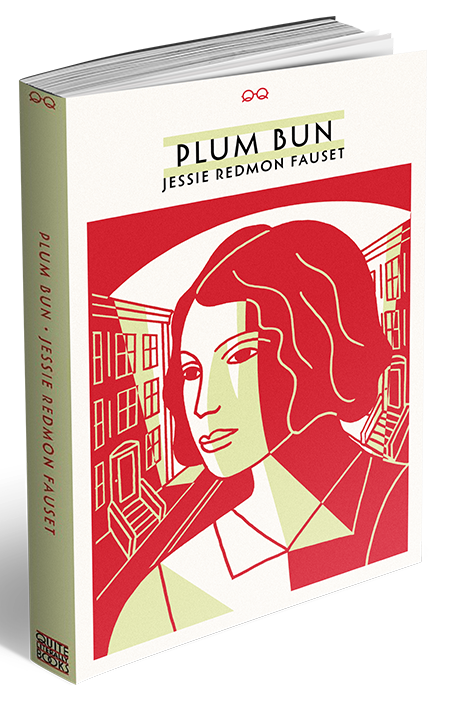
Review 2629: Plum Bun

I hadn’t heard of Jessie Redmon Fauset before, but according to the Preface of my Quite Literally Books copy, she was one of the most prolific writers of the Harlem Renaissance. Her novels were later critiqued for centering on the Black middle class, labeled as “bad fairytales,” a problem that doesn’t seem to have been resolved since then, if I can go by Percival Everett’s Erasure.

Angela and Virginia Murray are two sisters living in Philadelphia at the beginning of this novel. Their working-class parents have worked hard to purchase their house and provide them a comfortable life. Jinny appreciates this and loves her life, but Angela doesn’t want a life like they have. Unlike, Jinny, she looks White, and the only situations in which she has been made uncomfortable have been when White people discovered she was a Negro, to use the novel’s own terminology.

As young adults, the sisters lose both parents and inherit the house. Angela decides to sell her half to Jinny and study art in New York City, where no one knows her and she can pass as White. She wants to meet someone with money, so she can lead a carefree life. Girls just want to have fun.

In her art class, she meets Anthony from Brazil. She is drawn to him, but he is very poor, and when he asks her if she could live a poor life to be with someone, she says no. Then she meets Roger, a wealthy young man from a good family. He pursues her, and she comes to believe she can get him to propose. Unfortunately, she is being naïve and doesn’t seem to understand that he has no intention of marrying her, as she does not have the right social and economic background. She also ignores signs of racial bigotry.

But this book isn’t just about Angela’s relationships with men. It’s about the compromises and deceits involved in Angela’s decisions. It’s about her development from a selfish young girl to a woman who has learned empathy. It’s about what should underlie one’s life decisions. And it’s about the insidiousness of racism. It’s another time, so be prepared for some nasty attitudes that were okay at the time to express.

I didn’t like Angela for quite some time—she’s too cold and calculating, too selfish. But through strife, she learns to understand the feelings of others. I enjoyed this book very much.

I want to thank the new imprint, Quite Literally Books, for sending me the beautiful package that contained this book, in exchange for a free and fair review.

Related Posts

Erasure

Go Tell It on the Mountain

The Big Sea

Review 2156: #1940 Club! The Big Sea

I know nothing about Langston Hughes except he was a Black poet, novelist, and playwright associated with the Harlem Renaissance. For the 1940 Club, I thought it would be interesting to read The Big Sea, his autobiography.

Hughes had a pretty interesting life. Although he was in some ways from distinguished stock and his father was wealthy, his parents split up when he was young and he was very poor for much of his life.

Hughes’s parents split for good after his father took the family to Mexico, and almost immediately there was a big earthquake, so his mother took Langston and left. He was raised mostly by his grandmother in Lawrence, Kansas, while his mother traveled here and there trying to make a living. When his grandmother died, he went to some of her friends, rejoining his mother and stepfather as he got older.

Race is a major theme of Hughes’s life. Most of it was during the Great Migration, so housing for Black people was very expensive and scarce. I didn’t realize that at the time Jim Crow laws were all over the United States, not just in the South. The famous Cotton Club in Harlem, for example, was, as he put it, for white people and gangsters.

Hughes’s book opens when, after a year at Columbia University, he signs on with a freighter as a mess boy. He is excited to set foot in Africa, which he sees as a sort of spiritual home. But he is astonished to find that the Africans don’t consider him, a light-skinned man, to be Black.

Hughes seemed to have no fear and went his own way much of the time, traveling fearlessly, quitting good jobs because he didn’t like them and taking menial ones, splitting from a mentor. The book is interesting, written mostly as a series of anecdotes, but it does not tell much about his personal life. That is, it tells what he does but not much about how he feels or anything about very personal subjects. For example, late in the book, he has a break with Zora Neale Hurston that at least partially has to do with a woman he’s seeing (and partially about differences around a play they wrote together), but he does not otherwise mention this woman or any romantic life.

A few chapters about the Harlem Renaissances are a little boring, just mentioning lots of names, many of which mean nothing to us anymore. Here, he is often too general. For example, he recalls a party where amusing stories were told about the Queen of Romania. Of course, we want to know what they are, but he doesn’t tell us.

Considering when the book was written, there are lots of terms used that for our times are cringe-worthy, especially the constant use of “Negro.” He explains why “Black” (which became more socially acceptable during the 70’s) was not acceptable at the time.

I enjoyed most of this novel, but sometimes the descriptions of things that were popular then, some events, and the wording of things made me squirm. It just reads as very outdated.

Related Posts

The Warmth of Other Suns: The Epic Story of America’s Great Migration

I Know Why the Caged Bird Sings

The Yellow House