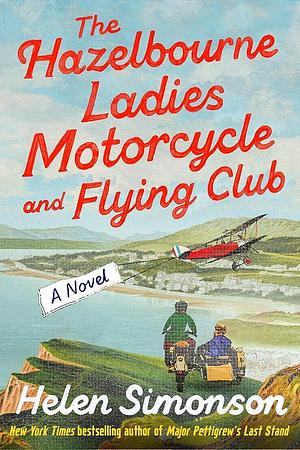
Review 2671: The Hazelbourne Ladies Motorcycle and Flying Club

Constance Haverhill has an uncertain future post-World War I. She and her mother helped out her mother’s school friend, Lady Mercer, for years, and she took them in after the death of Constance’s father, a farmer. However, now that her mother has died, Lady Mercer has made it clear there is no place for her. She is giving her the summer as a companion to her mother, Mrs. Fog, who is recovering from serious illness at a seaside resort. A problem is that, with the end of the war, young men are returning to the work force, so young women are losing their jobs.

In the lobby of the hotel, Constance encounters Poppy Wirral, who runs her own business transporting people around the seaside town in the sidecars of motorcycles. She has ridden there to meet her mother, Lady Wirral, for lunch, but she has forgotten to bring proper dress. Constance ends up lending her a skirt, and Poppy invites her to lunch with her mother and brother, Harris, an ex-RAF pilot who lost a leg in the war.

It’s obvious from the beginning where the relationship between Constance and Harris will go, although there are impediments. Most of the novel is about the remaining effects of the war, particularly upon women and disabled soldiers. Harris, for example, tries to get work as a flight instructor and failing that, a promised job in his late father’s bank, but everyone just assumes he can take up the job of running his estate. But the estate needs money. Poppy has been employing only women motorcyclists in her transport business, but then she is told that a new law by the labor board will require her to employ only men. Constance, although she ran the Mercer estate during the war, faces sex discrimination and worse when she tries to find a job as an accountant or bookkeeper.

Of course, the problem with all this is the predictable romantic finish. It’s all very well to write a book protesting the problems of women trying to make a living, but that message is undercut somewhat when the heroine’s problems are all going to be solved by marriage. (I don’t think this is going to be a surprise for anyone, so I didn’t warn about spoilers.) I commented on this same thought in a recent review of a contemporary novel from the same period.

Another theme is snobbishness and racism, as embodied by Lady Mercer and her daughter’s fiancé, an American named Percival Allerton. It was actually hard for me to imagine that a man in the diplomatic services would behave the way he does. Part of this theme involves Mrs. Fog’s reunion with old school friends, Mathilde de Champney and her brother Simon. Mrs. Fog’s family has repeatedly separated her from them, as they are of mixed blood.

Another thread in this theme concerns Mr. Pendra, an Indian representative of one of the states of India, whom Constance and the Wirrals befriend.

My final criticism hints around at a spoiler. Harris’s and Constance’s insipient romance is disturbed by the intervention of a spiteful character. However, this problem is resolved in about two pages, and then (spoiler, really!) Constance gets to run into his arms for that blissful finish. Only if it was me, after what happened, he’d have a lot more ‘splainin’ to do.

Related Posts

The Summer before the War

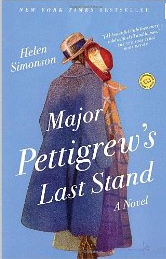
Major Pettigrew’s Last Stand

The Lie

Day 871: The Summer Before the War

Cover for The Summer before the WarBest Book of the Week!
I, for one, have been waiting for Helen Simonson’s second novel ever since I read the first one. And here it is!

Hugh Grange is preparing to pick up the new schoolteacher from the station at the beginning of The Summer Before the War. His Aunt Agatha has been instrumental in the school board’s controversial decision to hire a woman as the school’s new Latin mistress. Agatha has supported the hire because the woman was the most qualified applicant, but she is aware that her position as well as the teacher’s is precarious and that the mayor’s wife, Bettina Fothergill, is up to something.

So, Beatrice Nash arrives to take the position unaware that it is already threatened. She has been eager to leave the home of her father’s relatives, where she has lived since her father’s death. She soon finds that he has bargained away her freedom by agreeing to put her money into trust in return for being allowed to return home to his estranged family. Beatrice’s trustees start right out by assuming that she is mishandling her money.

Hugh is a medical student who is working under Dr. Ramsey, a well-known Harley Street physician. Hugh is a careful person whose future is neatly charted out. He will qualify in a year and then marry Dr. Ramsey’s daughter and join his practice. But the Great War breaks out, and Dr. Ramsey pressures him to accompany him to the front. Hugh wants to finish qualifying first, but Lucy Ramsey threatens to give him a white feather if he doesn’t join up.

Hugh’s cousin Daniel is a poet, and he plans to open a journal in London with his good friend Craigmore, Lord North’s son. But after Lord North sees Daniel and Craigmore together at the local hops festival, he makes Craigmore join the air corps. Daniel joins the Artists’ Rifles in reaction.

link to NetgalleyThis description doesn’t do much justice to the novel, which is about how all the characters’ lives are affected by the war. Aside from the same kind of class and town politics featured in Simonson’s delightful Major Pettigrew’s Last Stand, we meet a handful of characters who are genuinely likable and we get very involved in several subplots.

Simonson evokes a bustling town of Rye in 1917, with it occupants becoming involved in their various war activities. Belgian refugees arrive, and the town begins to experience the first horrors of war. This novel makes an absorbing second effort that is at times very touching.

Related Posts

Major Pettigrew’s Last Stand

The Daughters of Mars

Goodbye to All That

Day 27: Major Pettigrew’s Last Stand

Cover for Major Pettigrew's Last StandBest Book of Week 6!

A touching love story, Major Pettigrew’s Last Stand is also a wry and witty jibe at small village life in England. Major Pettigrew is a proper widower who leads a life of quiet and habit, comfortable in his village and local golf club. Still suffering from the loss of his wife, he has just learned about his brother’s death and he is so shaken by this that he has a dizzy spell. Mrs. Ali, the widow of a Pakistani grocery store owner, has come to his house collecting for charity and helps him recover. The two begin a friendship based around discussions of books.

Besides missing his brother and wife, Major Pettigrew has other worries. He is concerned about his son, who seems only interested in money and prestige, and at times lacks gentility and honor, for which Major Pettigrew cares deeply. He is also concerned about his brother’s greedy wife and daughter, who do not seem likely to honor his father’s request that two valuable heirloom shotguns given to each of the sons be reunited when one of them dies.

Mrs. Ali is having her own battle with relatives. Her husband’s family wants her to give over her store to her religious fundamentalist nephew while she takes her expected widow’s place as a family servant.

Major Pettigrew must navigate the murky waters of village and family disapproval of his relationship because of racism and class snobbery and decide how much he wants to keep his quiet life. Mrs. Ali must in turn decide how much duty she owes to her family.

This novel is charming and delightful, one of my favorite books of 2011. Major Pettigrew’s dry and clever comments amused me throughout. The novel is beautifully written. I have been eagerly waiting to see what Ms. Simonson does next.