Review 2005: Rose Nicolson

It’s 1575. Mary Queen of Scots has been ousted from the throne of Scotland in favor of her young son James and a series of regents. This revolution has been mostly a religious one, with Queen Mary a Catholic and James (referred to as Jamie Saxe) being raised Protestant. But there is also a struggle between the Calvinists and milder forms of Protestantism.

This struggle is reflected in the home of young William Fowler, whose father is a Calvinist and whose mother, with contacts in Queen Mary’s court, is French and Catholic. However, William’s father is accidentally killed during a siege on Embra. Now William is off on the Sonsie Quine to school at St. Andrews. On the ship, he meets a red-haired boy who asks to borrow his dirk. This meeting proves fateful, as William finds out years later that the boy is Watt Scott of Buccleuch. (For Dorothy Dunnett readers, I believe this is the grandson of the man of the same name in the Lymond chronicles.)

William has an affinity for poetry, and at school he befriends another scholar, Tom Nicolson. He struggles within himself over the religious issue as he feels pressure to commit one way or the other. He also falls in love with Rose Nicolson, Tom’s beautiful sister, a fisher girl with a remarkable mind.

As the King gets older, the Catholics and Protestants compete to control him. The country remains Protestant with the Calvinists gaining power while the Catholic side gains strength at court with the arrival of a favorite from France.

As he approaches graduation, William wants to marry Rose, but she is betrothed to a fisherman with the influence to protect her. She needs this protection because her remarks have been misunderstood as evidence of witchcraft.

William, despite himself, is forced closer to deciding between the two religions and finally decides that Protestantism is the least bad alternative. He also meets Scott again and is drawn into political intrigue.

This is not dry stuff. Greig is great at depicting the realities of living in this difficult time and place. I was fascinated from page one. This novel became part of my Walter Scott prize project by getting on the shortlist, but being a fan of Greig, I had already read it.

Related Posts

Fair Helen

The Ringed Castle

When They Lay Bare

Review 2003: The Museum Guard

I have been a big fan so far of Howard Norman’s quirky novels. However, I had a slightly more mixed reaction to The Museum Guard.

DeFoe Russet has lived in the Lord Nelson Hotel in Halifax ever since his parents died in a freak Zeppelin accident when he was eight. As a boy, he was cared for by his uncle Edward, if you can call it that. Edward is an irresponsible, gambling, drinking womanizer with a lot of opinions.

DeFoe works as a museum guard in the small Glace Hotel, where his uncle also works when he bothers to show up. DeFoe is very much in love with Imogen Linny, the caretaker for the local Jewish cemetery. However, although they are lovers, Imogen is difficult and seems often to tolerate DeFoe.

DeFoe doesn’t seem to realize how stuck he is in his life. He has no plans except to continue working as a museum guard and to persist with Imogen. He is interested in listening to the tours of the museum given by Miss Dello, a local professor, and likes to think about the paintings.

Edward has been making himself obnoxious about DeFoe’s relationship with Imogen, whom DeFoe has kept from meeting Edward. But Imogen has recently become fascinated by a painting in the museum, Jewess on a Street in Amsterdam by Joop Heijman. Then there is a fateful meeting between Imogen and Edward in the museum. Imogen essentially dumps DeFoe and begins spending a lot of time with Edward, who without permission lets her into the museum at night to be with the painting. Soon, the novel takes a bizarre turn as Imogen begins to believe she is the woman in the painting.

The novel is set mostly in 1938 and 1939 against the background of what is happening in Nazi Germany. DeFoe tells us on the first page that he steals the painting for Imogen, and the novel is about what causes him to do that and what happens afterwards.

I guess this novel is about stepping out of ordinary life. However, a lot of time is spent on DeFoe’s obsession with Imogen, maybe a bit too much, and the novel just gets weirder as it goes along. I’m not saying I disliked it, just that it wasn’t one of my favorites of Norman’s novels.

Related Posts

The Bird Artist

The Haunting of L.

The Northern Lights

Review 1999: Edith Trilogy Read-Along: Dark Palace

The Edith Trilogy Read-Along calls for the second book to be read during July. This second book, Dark Palace follows Edith and the fate of the League of Nations from 1931 through the end of World War II. Although most of it is set in Geneva, Edith also visits Australia and the United States.

This novel begins roughly one year after the close of Grand Days. Edith and Robert have been married about a year, but Edith feels she has misunderstood Robert’s character. For one thing, he is not really dedicated to the success of the League, and she sometimes finds him crass. She takes the opportunity of Ambrose Westwood’s return to Geneva and Robert’s departure to cover the Spanish Civil War to rekindle her unusual affair with Ambrose.

At the League, she is considered an expert on protocol but still does not have an official title. At the beginning of the novel, she and other League officers are excitedly preparing for the conference on disarmament they are hosting.

This novel, like many middle novels in a trilogy, has a less focused plot than the first. Edith, at one point, considers moving back to Australia and visits the newly founded Canberra to fish for a job. But Canberra barely exists, and her fellow Australians don’t seem impressed by her accomplishments. The novel skips in an episodic way through several events during the war.

There are times in the novel when Edith’s didacticism is really annoying. What the novel does have, however, is a deeply affecting conclusion.

Related Posts

Grand Days

A Town Like Alice

All the Light We Cannot See

Review 1897: The Metal Heart

On the Orkney Islands in 1942, a German U-boat attack on Scapa Flow leads the British to fortify the seaway’s defenses using Italian prisoners of war as labor. The Italians are located on the small island of Selkie Holm, one avoided by the islanders because of its evil reputation. However, twin young women, Con and Dot, also live there, having moved to a ruined bothy after events on Kirkwell that are not at first explained. Con is afraid, though, of Angus MacLeod.

When the Italians arrive, one falls overboard, and Dot dives in to save him. His name is Cesare, and he begins working in the camp commander’s office and trying to find ways to help the girls. However, he is stopped by the brutality of guard Angus MacLeod.

I liked Lea’s The Glass Woman, and I also like her apparent preference for placing novels in remote northern locations. However, I just wasn’t feeling it here. I felt as if the characters were being put through their paces, not as if the story evolved naturally. I also felt a certain sense of manipulation. Although I was interested to find out why the girls’ parents had vanished, I wasn’t very interested in the love story. I read about half the book, then stopped.

Related Posts

The Glass Woman

The Tolstoy Estate

The Girl from the Channel Islands

Review 1895: The Magician

Although I’ve only read one work by Thomas Mann, I still found The Magician, based on Mann’s life and writings, interesting. Although Mann himself often seems inert in this novel, he lived in interesting times, during both world wars.

The novel covers Mann’s life from a young man who is dispossessed by his father to his relocation from California to Switzerland in his 70’s. It examines the thinking behind his greatest works and although fairly meditative in tone, has some excitement during the Mann’s flight from Nazi Germany.

In some ways The Magician is reminiscent of The Master, Tóibín’s novel about Henry James, with Mann fantasizing about young men but never acting on those fantasies after a couple of abortive encounters. The difference is that James seemed almost unaware of his own proclivities. Mann still managed to have a long, successful marriage with his wife Katia.

Tóibín’s biographical fiction always seems intuitive and thoughtful to me. I enjoyed this one despite my lack of knowledge about its subject. I read this novel for my Walter Scott Prize project.

Related Posts

The Master

Nora Webster

Lady Gregory’s Toothbrush

Review 1892: Rizzio

The Scots mystery writer Denise Mina is still concerned with crime, but with this novel, she has turned to historical true crimes. Rizzio is a novella that deals with the 1566 murder of David Rizzio, a musician and favorite of Mary, Queen of Scots.

The murder has been engineered by Lord Lennox and Lord Ruthven, with the aid of Henry Darnley, Mary’s worthless husband. Darnley thinks the shock will cause his hugely pregnant wife to miscarry, most likely causing her to die. Then, he can be king. This is what came of their love match of the year before. To Lennox, Darnley’s father, this outcome would put him in power over his weak son. Lord Ruthven, almost dead already, is the tool of a group of aristocrats about to be dispossessed by parliament.

The novella is mostly description with little dialogue, but it has deep insight into the thoughts and personalities of its characters. It is mostly concerned with the activities of one night, March 9, 1566, in Edinburgh.

It is fast-paced and interesting. Mina has made no attempt to reflect the language of the time, and in fact wrote using modern idioms. Hence, perhaps, the lack of dialogue.

Note: At the time I reviewed this novel, I was unaware that it is one of the Darkland Tales, a series of re-imagined tales from Scotland’s history, written by well-regarded contemporary Scottish authors.

Related Posts

Conviction

The Less Dead

Queen’s Play

Review 1890: Harlem Shuffle

Colson Whitehead is certainly a story teller. In Harlem Shuffle, he tells the story of Ray Carney, whom he describes as “only slightly bent when it comes to being crooked.” Carney’s father broke knees for a living, and Carney hated him, so Carney has earned a degree in business and has worked hard to keep his furniture store going. He only occasionally deals in suspect merchandise.

However, Carney’s cousin Freddie, who grew up like a brother, is the type of guy who is always up to something and it never turns out well. In the first section of the book, Freddie is planning a heist with some guys, and when they need a fence, he suggests Carney. Carney knows this is way above his head, so he says no. He is tipped off that Freddie is in trouble when he gets a call from some men working for Chink Montague, a notorious criminal, looking for something that belongs to Chink. It turns out Freddie has not conveyed Carney’s refusal to the gang, and soon Carney finds himself in possession of a large emerald necklace that is part of the robbery of a hotel vault.

This novel is set in late 50’s and 60’s Harlem, and vividly depicts the events of this period at the beginning of the Civil Rights movement. Whitehead is clever about earning the readers’ sympathy for Carney despite his misdeeds. He makes it clear how difficult it was during this time for an African-American who starts with nothing to make a success of himself. Aside from Freddie’s plots, Carney has to deal with the slights of his in-laws, who think their daughter married beneath herself, as well as paying off both the thugs and the police, being cheated by supposedly respectable businessmen, and so on. Another absorbing novel by Whitehead.

Related Posts

The Nickel Boys

Jack

Meridian

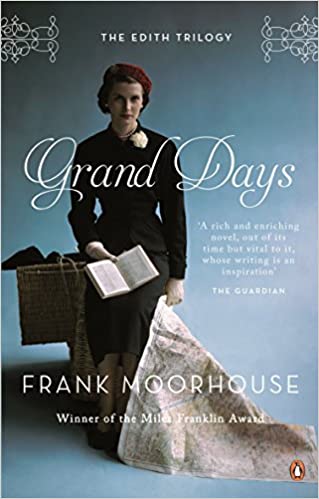
Review 1887: Edith Trilogy Read-Along: Grand Days

I decided to participate in the Edith Trilogy Read-Along hosted by Brona of This Reading Life, but my copy didn’t arrive until June 29th, so I am late for the first one, which was to be read in June. I hope to be on time for the second in the series. This series introduces me to Frank Moorhouse, a highly regarded Australian writer.

On a train from Paris to Geneva to work at the newly created League of Nations, Edith Campbell Berry meets Major Ambrose Westwood, who will be a more senior officer in another section of the League. Edith is naïve and dedicated, a quirky person who has her Ways of Going but is determined to become more cosmopolitan than her Australian roots have made her so far. On the train, she and Ambrose share a kiss.

Edith and her coworkers are excited to be working for this important organization with its worldwide focus and its aim to prevent war. Edith conscientiously studies diplomacy from Ambrose and other senior officers and makes contributions of her own, enough to attract their attention and mentorship.

She does not always make the right choices and finds herself in some ridiculous situations. She also begins an affair with Ambrose, whose unusual proclivities lead her in unexpected directions.

At first, I wasn’t sure how much I liked Edith, particularly her habit of listing and examining what she thinks she knows and her almost aggressive questioning of ideas until she’s sure she understands them. I also noticed that she seemed not to pay much attention to events developing in Europe toward the end of the 20’s. But eventually I was charmed by her.

There were some pages toward the middle of the book when she was enumerating ideas that I skipped after reading several paragraphs, and shortly thereafter, when she was contemplating her poop, a scene I know was supposed to be funny, I was not amused. Still, I’m interested to read Cold Light, the next novel, especially because the book cover description contains a detail that I hope is wrong.

Related Posts

A Town Like Alice

Midnight in Europe

The Gustav Sonata

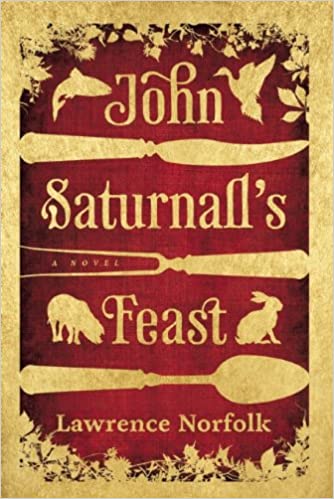
Review 1884: John Saturnall’s Feast

It’s 1625 when young John Saturnall and his mother are chased up into Buccla’s Wood by religious zealots who term her a witch. She is not a witch but a wise woman with ancient knowledge and stories of a magnificent feast that happened centuries before.

When John’s mother is dying in the wood, she sends him to Buckland Manor in the Vale, the home of Sir William Freemantle. There he learns that his mother worked in the manor before she became pregnant with him. He is taken into the kitchen, where he shows promise of becoming a great cook.

Just as John is becoming a Master Cook and Sir William’s daughter Lucretia is reluctantly betrothed to a wastrel in an attempt to save the Vale, the Civil War breaks out. As the Freemantles are supporters of King Charles I, the household has years of suffering before it.

At the beginning of each chapter is an excerpt from The Book of John Saturnall, written using the culinary language of the times. The novel is lushly written, full of the details of running a 17th century kitchen and household.

I was less interested in the unlikely romance, perhaps partly because Lucretia as a character is poorly defined. However, overall I found this novel deeply interesting.

By the way, the Grove Press edition is beautifully presented, with heavy paper, two colors of ink, and gorgeous woodcut-style illustrations.

Related Posts

Corrag

Merivel: A Man of His Time

Salt: A World History

Review 1882: After the Fire, A Still Small Voice

After the Fire, A Still Small Voice is Evie Wyld’s debut novel about how family trauma can pass down the generations. In alternate chapters, it follows Frank Collard in the present time and Leon 40 years earlier. Maybe I was dense, but it took me a while to realize that Leon is Frank’s father.

Frank has just split up with his girlfriend when he decides to restart his life. He leaves Canberra and drives to a shack on the eastern coast that his grandparents purchased years ago and where he spent holidays as a boy. He gets an occasional job loading boats. It’s a primitive life, and the loneliness starts to get to him.

Leon trains under his father to be a pastry chef and takes over the bakery after his father, in gratitude for the country that took in himself and his wife, World War II Jewish refugees, volunteers for the Korean War. Leon’s father returns damaged, unable to work, so his parents leave Leon, ending up in the beach shack. Then Leon is conscripted for Vietnam and has his own damaging experiences.

I can’t come up with the reference for this, but I remember several years ago reading a post by someone complaining about women writing like men. The implication was that they were doing so to be taken more seriously by male editors and publishers. In particular, Evie Wyld’s All the Birds, Singing was mentioned with the remark that you didn’t even know if the main character was male or female for some time. I didn’t agree that (1) just because you don’t know the sex of the main character means that the author is writing like a man (look at The Towers of Trebizond) or (2) Wyld was writing like a man in All the Birds, Singing. I certainly didn’t have that impression. However, the feel of After the Fire, a Still Small Voice is very masculine, which makes sense with her male protagonists.

The only other observation I have about the novel is that it seemed a bit all over the place for me. Perhaps this is because of my initial confusion about the relationship between the two main characters. I guess I wasn’t paying attention to last names, and Leon’s isn’t mentioned right away. In any case, for a long time I wondered where the novel was going. Also, I didn’t much like either Frank or Leon, although Leon was okay until Vietnam. But Frank’s problem isn’t really explained, and he has major anger issues.

Related Posts

All the Birds, Singing

The Bass Rock

The Towers of Trebizond