Sixteen-year-old Rye Dolan and his older brother Gig are wanderers through the Northwest, among thousands of other men looking for work when they can get it, in 1909. Indeed, the town of Spokane is teeming with them. It is a thriving town that has grown rapidly, and at first glance it seems to consist only of fabulously wealthy mine owners and the destitute.
The mine owners only accept workers through corrupt employment agents. Men pay a dollar, a day’s pay, for a referral for a job they may not get, and most of the money gets kicked back up the chain to the employer. Gig is a member of the IWW, or Wobblies, who are trying to recruit members to their union during a Free Speech Day that protests against the employment agents, the poor pay and working conditions, and the corrupt Spokane police department.
Rye isn’t so sure he believes in the union, but on Free Speech Day when the police begin beating and arresting the protesters, he is inspired to jump on a soapbox next to Gig and sing the union songs. So, he and Gig are arrested and thrown into jail along with 500 other men, into packed cells and brutal conditions.
Rye, because of his age, gets out of jail early with the help of a lawyer and Elizabeth Gurley Flynn, a crusading 19-year-old union firebrand (an actual historical figure). However, Rye sort of unwittingly makes a deal with Lem Brand, a mine owner, to give him information in exchange for getting Gig out of jail.
This novel vividly depicts the kinds of conditions that made unions evolve in the first place and the fight the unions had to stay in existence. Does that sound unexciting? Well, this novel has an appealing center around the two brothers, features a historical figure we should know more about, and is full of intrigue, action, and skullduggery. It is harrowing at times, alternating narrators among several characters who don’t always end up alive at the end of their narratives. I was enraptured.
Max Ravenscar is exasperated when his aunt, Lady Mablethorpe, comes to consult him about Adrian, his young cousin for whom he is a trustee. She reports that Adrian has fallen in love with a girl from a gambling den and means to marry her. Ravenscar assumes the girl will have to be bought off.
When he meets her in her aunt’s home, which has indeed been converted into a gambling den, he is surprised at her well-bred appearance and demeanor. However, when he makes his offer, he finds she has turned into a termagant.
Deb Grantham, for her part, has no interest in entrapping naïve young men into marriage. Nor is she interested in Lord Ormskirk, who unfortunately holds some of her aunt’s debts and the mortgage to her aunt’s house. However, she is so angered by Ravenscar’s proposals that she decides to pretend she wants to marry Adrian and to behave as vulgarly as possible.
Even though this is not one of my very favorite Heyer novels, it is still great fun. It has some potentially melodramatic twists to it that are saved from seriousness by a feisty heroine who is not to be defeated.
This final novel in the Old Filth trilogy gives us the last pieces in the puzzle of the complex relationships described in the first two books. It tells of the origins of Terry Veneering, the lifelong rival of Edward Feathers (known as Old Filth) who finally became a friend.
Last Friends begins in the same place as Old Filth, with the memorial service for Edward Feathers. Much of this novel is presented through the eyes of two minor characters in the trilogy, Dulcie and Fiscal-Smith. Veneering is a mysterious figure in the other two books of the trilogy, his origins unknown but subject to many rumors. It turns out that Fiscal-Smith has known him from boyhood in a northern manufacturing town, the son of a schoolgirl and a Russian dancer rumored to be a gentleman, who was badly injured as a young man and had to be supported by his wife.
This final tale is enthralling and brings a fitting ending to this great trilogy.
It’s the mid-1950’s, and Lexie Sinclair has already made arrangements to leave her family home in Devon when she meets Innes Kent. He is a stylish magazine editor whose car has broken down on their road. When she tells him she is coming to London, he asks her to look him up. Instead, he looks her up.
Lexie takes up an exciting life as part of the Soho art scene. She and Innes are the loves of each other’s lives even though he is married. His wife has, however, taught her daughter Margo to hate Lexie even though she and Innes have been split up for years.
In present-day London, Elina and Ted have just had a baby. The birth was difficult, and Elina is having a hard time coping with the pressures of motherhood. At the same time, Ted, whose memory is notoriously poor, has begun having flashes of memory that do not correspond to what he understands of his life. Slowly, these two stories connect.
Maggie O’Farrell is always wonderful, I find, but this novel had me sobbing. It is beautiful and tragic as it explores the themes of motherhood and family secrets.
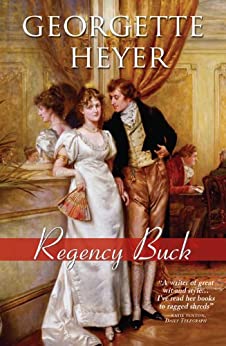
On her way to London with her brother Peregrine, Judith Taverner mistakenly stops in a town hosting a prize fight and has an unfortunate encounter with a man in a curricle. When the siblings reach town and call on their guardian, Lord Worth, they find that he is the man in the curricle. Their father mistakenly designated their guardian as the fifth Earl instead of his friend, the fourth, who has died.
Judith is headstrong and determined to make a splash in London society. Although Lord Worth gives them assistance with suggestions and introductions, he and Judith continue to clash. Judith’s cousin Bernard Taverner warns her that Lord Worth may have designs on her fortune, which is large enough in itself but even larger if something happens to her brother Perry. Then Perry is first challenged to a duel and later his carriage is attacked. Judith and Worth are getting along better, but does someone have designs against Perry?
Most of Heyer’s Regency romances tend to either be funny or have an element of mystery (although they all have amusing dialogue). RegencyBuck is one of the latter, with an engaging heroine, a mysterious plot, and as usual, perfect period detail.
The Man in the Wooden Hat is the second novel in the Old Filth trilogy. Old Filth examines the entirety of the life of its main character, Edward Feathers, while this novel takes a closer look at his marriage with Betty. As with Old Filth, The Man in the Wooden Hat appears to be straightforward, but there is a kick at the end.
At the beginning of the novel, Eddie has sent a letter containing a marriage proposal to Betty, who is vacationing in Hong Kong while Eddie has been working in London. Betty accepts his proposal when he arrives in Hong Kong, where he makes only one condition, that Betty never leave him.
Only hours later, Betty meets Eddie’s rival, Terry Veneering, and falls immediately in love with him, although he is married with a son, Harry. She also falls in love with nine-year-old Harry. She is determined to marry Eddie; however, she spends a night with Terry before the wedding. Unfortunately, he leases a house for their rendezvous from Albert Ross, Eddie’s best friend, a Eurasian dwarf. Ross finds her purse there. He does not tell Eddie but returns the purse to Betty and tells him she must never leave Eddie. He knows of all the loss in Eddie’s life.
So begins their marriage. I did not dislike Betty despite her infidelity; in fact, I liked her, although it’s hard to decide what to think about Veneering. The novel follows the entirety of their marriage, which is reticent and notable for Eddie’s absences for work. Betty, who was born in China and subject as a child to detention by the Japanese, finds she cannot have children.
It’s hard to explain how this sort of everyday novel can be so absorbing. We think we know everything about the Featherses. But Gardam tilts everything slightly in the final chapter.
If you’re not familiar with the plot of The Bride of Lammermoor, you might be wondering why I picked it for the Classics Club Dare 2.0, Time to Get Your Goth On. It’s not a gothic horror story common for the time but one of Sir Walter Scott’s historical novels about a doomed love. However, the ending, which I’m not revealing, puts it in a more appropriate category as do the dark local legends and prophesies of withered old dames (perhaps witches), not to mention the ruined tower.
Edgar, Master of Ravenwood, is from a proud Scottish family of distinguished lineage. His profligate father, however, did his best to waste the family estate and finished things off by fighting on the wrong side of the revolution. With other parties in power, lawsuits filed against the estate by William Ashton, Keeper of the Great Seal of Scotland, have resulted in almost all of the Ravenwood property being turned over to Ashton and in an early grave for Ravenwood’s father. The impoverished Master has sworn vengeance against Ashton.
Ashton, however, is a politician, and he hears that the political situation is changing. Things may be looking up for the Marquis of A___ and thus for his relative, the Master. After the Master saves Ashton and his beautiful daughter Lucy from a wild bull, Ashton tries to befriend him, even encouraging him to spend time with Lucy and Ashton himself considering the benefits of a marriage between the two. Against the Master’s better judgment (and supernatural warnings), he begins to fall in love with Lucy. They become betrothed, but Lucy wants it kept secret from her family.
Some meddling from a neighbor who is not a friend of the Master’s leads Lady Ashton, staying with friends away from home, to hear the rumors that her daughter is engaged to him. She is his implacable enemy, so she swoops home to Ravenwood Castle just as the Marquis of A___ comes for a visit. The Master has been residing there at Ashton’s invitation, but Lady Ashton unceremoniously throws him out. He has already agreed with Lucy, however, that he will consider himself betrothed until she herself releases him. Then he goes off to make his fortune.
This novel was quite hard going for me at times, particularly in the sections and whole chapters that are in Scottish vernacular. These are the parts concerning the common people, and some of them are supposed to be funny, especially the ones about the machinations of Caleb Balderstone, the Master’s only servant, as he tries to hide what everyone already knows—that his master is destitute. I just felt they slowed down the action as well as being hard to understand and not that funny.
The action, however, eventually gets going and really picks up toward the end of the novel. I read the second half twice as quickly as the first.
When I was selecting a book to read for the 1976 Club, I realized I had read only one book by Gore Vidal and that so long ago I could barely remember it. So, I picked 1876.
Vidal’s sometime-narrator Charles Schuyler is returning to America after almost a lifetime in Europe, where he was documenting European events for the American press. He is accompanied by his daughter Emma, the widowed Princess d’Agrigente. Their circumstances are dire. Schuyler’s fortune was wiped out in the Panic of ’73, and when d’Agrigento died unexpectedly, Schuyler was shocked to find that the Prince’s debts exceeded his fortune. So, Schuyler has come back to America with two goals—to help get Governor Tilden elected as President in the next election so that he will be granted a post and to find a wealthy husband for his daughter.
They first return to New York. It is the Gilded Age, and they are at once drawn into the opulent but vulgar world of robber barons, the Astors and others, who now that they are loaded are trying to become the heads of society. Vidal uses this section to draw sketches and repeat gossip about many of these figures. The first section of the novel reminded me very much of Edith Wharton’s The Age of Innocence. I recognized some characters, although here they go by their real names.
I was about 100 pages into this social whirl, observed with a great deal of snark, when I began to wonder where the plot of the novel was. It eventually emerged, with almost creaking slowness, as the events of the election of 1876, told with a great deal of bias.
Now, I’m not an expert on this period, but I recently read Ron Chernow’s biography of President Grant. In it, he made the point that Grant’s ruined reputation was partially a result of the number of Southern historians who predominated from the post-Civil War years up well past World War II. Well, Vidal has certainly read them, for he does his best to continue trashing Grant. Governor Tilden is running as a Democrat, but not once do his characters mention, for example, the dire results for the South if a Democrat was elected that year. At this time, Federal troops were still posted in the South because people—particularly black men—were still being murdered years after the war. Vidal glancingly mentions but shrugs off suggestions that people were being “discouraged” from voting Republican and says that Grant dispatched troops to some Southern cities to meddle with the vote. Grant sent troops to avoid more deaths and to allow people to vote the way they wanted to. In any case, the result of the election for the South was the same, because the Republican candidate, Rutherford Hayes, promised the removal of troops from the South to get more votes, thus ending Reconstruction and setting the South back years in its recovery and in civil rights.
The 1876 election was stolen from Tilden, and the story of it might have been interesting if more impartially handled. Instead, Vidal makes Tilden the only honest politician in a country riddled with corruption (it was, but I doubt Tilden was the only honest man) and plays down the skullduggery engaged in by the Democrats.
Further, there are too many characters in this novel to keep track of and they are too lightly characterized. Vidal seems more interested in relating scandalous tidbits and making up epigrams.
Then there’s the description on the novel cover, which should have tipped me off about how I was going to feel about it. I know that authors don’t write the blurbs, but it’s he that calls his historical novels “Narratives of Empire.” Now there’s a guy who takes himself seriously. The cover says, “With their broad canvas and large cast of fictional and historical characters, the novels in this series present a panorama of the American political and imperial experience as interpreted by one of its most worldy, knowing, and ironic observers.” Oh, man.
From his birth and continuing through his adolescence, Edward Feathers was abandoned or taken away from every person he loved. As an adult, he was a still, stiff man unable to love.
After the death of his wife, Betty, Sir Edward, or Old Filth as he is known in the world of law where he is a prominent lawyer, begins re-examining the events of his past. He also makes attempts to connect with people important to him, but these attempts are abortive. Slowly, all the things he has never spoken of are revealed.
Written in sterling prose, Old Filth is a mesmerizing story about the Raj Orphans, children who were shipped to England at an early age from the Far East. The novel is touching and completely gripping. And for those who loved it like I did, hooray! It’s the first of a trilogy.
Having reviewed the last book from the 2020 Walter Scott Prize for Historical Fiction shortlist, it’s now time for my feature where I decide whether the judges got it right. Frankly, 2020 was an odd year, with several books that, while interesting, really didn’t do it for me. In fact, quite a few of them cultivated distance between the reader and the work.
As I often do, I’ll start with the books I liked least. One is The Parisian by Isabella Hammad. This novel covers the beginning of the fight for Arab nationalism and the First World War, so it should have been interesting. However, Hammad writes it from the point of view of a man who distances himself from the action by the persona he invents for himself.
Another distancing book was The Narrow Land by Christine Dwyer Hickey, which was the winner for 2020. It is about the relationship between the artist Edward Hopper and his wife Jo. It is slow moving and mostly a character study about a self-absorbed man who seemed to live his life in the interior of his own mind. I felt that although Jo was depicted as jealous and demanding, she was upset about something understandable—her career coming so much secondary to his and in fact his disdain of her work.
To Calais, In Ordinary Time by James Meek is a little more experimental than the other nominees. It is about a 14th century journey from the Cotswolds to Calais, and it is written only in words in use at the time. It also reflects, in tone and plot, its medieval inspirations. However, Meek doesn’t do much with his characters, so I had difficulty becoming involved in the novel.
The Redeemed by Tim Pears was the third book in his West Country Trilogy, and it is set during the last years and the aftermath of World War I about a man who has to make his own way after becoming homeless as a boy. Having spent three books with these characters, I found the conclusion of the trilogy anti-climactic. I actually thought the first book was best.
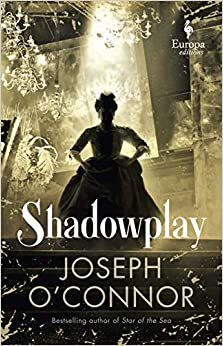
Joseph O’Connor has written a novel about 30 years in the life of Bram Stoker, with Shadowplay. I found this novel involving and interesting. It’s about Stoker’s work with the Lyceum Theatre and his relationship with two famous actors, Ellen Terry and Henry Irving. It even has just a bit of a supernatural influence.
Although it took me a while to get into A Sin of Omissionby Marguerite Poland, I found it absolutely heart-rending by the end. It is based on the life of a native Anglican missionary to South Africa, about a man whose upbringing sets him apart from his own people as well as his English white patrons. This novel is my choice for the 2020 award.







 What? Me Read?