Review 1409: Brookland

Prue Winship grows up the oldest daughter of a gin distiller in 18th century Brooklyn. Her father having failed to have sons, he brings her into the distillery as an apprentice when she is 14, and she learns to run it. She doesn’t expect, though, that her father’s early death will leave her and her sister Temperance in charge of it.

Despite the preoccupations of running a business, Prue has another dream—to build a bridge across the East River into New York. Many have tried to design one, but nothing has been proposed that would not obstruct water traffic for hours. Prue thinks she has an idea that would work.

This seems like it would be a book I would enjoy, but I could not get going in it. I gave it an effort, but after six days of reading, I still wasn’t into it and hadn’t reached the halfway mark. (Usually six days is enough for me to read most works of fiction, no matter how long. Often in six days I have read two or three novels.) I still had about 300 pages to read when I decided to stop. I couldn’t put my finger on my problem. The novel was well written and on an interesting subject. However, it was very slow moving and kept relating the heroine’s dreams. There is nothing more boring than a dream in fiction, I think. Finally, I dimly remember reading a book on this same subject, the distillery and the bridge, years ago, although I am fairly sure it was not this one. So, not the book for me despite its good reviews in the press.


Related Posts

Golden Hill

Seven Locks

Parrot and Olivier in America

Review 1408: Love Is Blind

Although generally speaking, I love William Boyd, I should have known better than to read a book named Love Is Blind. Even from the title, I could tell it was about a man who falls in love with a woman who is trouble, a plot that I hate. Although men love to write books upon this subject, most of the women incarcerated in the United States are there because of a man. Of course, it happens for both sexes, but a man enthralled by a lethal siren is the least of it and, for me, not interesting.

In 1894 Edinburgh, Brody Moncur is a piano tuner of significant skills. He is offered a position of assistant manager in his company’s Paris office which he takes, determined to get away from his controlling father.

In a promotional effort, Brody makes a deal with John Kilbarron, a famous pianist, to play only his company’s pianos. Soon, he has fallen in love with Lika, Kilbarron’s mistress, who is an opera singer. They begin an affair, and his life becomes a series of efforts to win her away safely from Kilbarron.

Disturbingly, we get very little sense of what Lika is like as a person. She serves pretty much as Boyd’s MacGuffin. The novel just focuses on Brody’s obsession and its consequences. It’s obvious that Lika has her secrets, and to me, it was even obvious what the major one was.

As well written as it is, I simply didn’t enjoy the theme of this book. As with Boyd’s other recent books, it takes in a sweep of history and visits many places while it meanders to its denouement.

Related Posts

Sweet Caress

Euphoria

The True Heart

Review 1403: Washington Black

Best of Ten!
Washington Black is a twelve-year-old field slave on the Barbados plantation of Faith in 1830 when a new master arrives. Masters are to be feared, but it soon becomes clear that the new master is cruel and thinks nothing of the death of a slave.

Washington and his protector, the old woman named Kit, are alarmed when one evening they are summoned to the master’s house. They are expected to wait table while the master entertains his brother, Christopher, although they have no training. After the dinner, the brother asks for Washington to wait on him personally.

Christopher, or Titch, as he asks to be called, is a man with a scientific mind. He is working on an airship he calls Cloud Cutter, which he plans to launch from a mountain at the top of the plantation. Once Titch sees how exactly Washington draws, he begins to involve him in his experiments.

The master is away when Titch’s cousin Philip arrives. He brings some news that disturbs the plans of both Titch and the master. Then a terrible event occurs. Because Washington is present for it, he knows it means his death. Titch knows it, too, and the two flee the plantation in the Cloud Cutter.

Washington’s life becomes one of adventure overshadowed by fear. Although during the novel he travels to the Arctic, Upper Canada, England, and eventually Morocco, for years he fears being recaptured.

This novel is part adventure story, but it has the more serious aim of exploring the bonds between the exploiter and the exploited. Titch is a mystery to Wash, a seemingly compassionate man who yet abandons him in the Arctic. For years, Wash believes him to be dead, but then he hears he is alive. This sends him on more journeys to try to find and understand his mentor.

I thought this novel was fascinating, especially the descriptions of sea creatures when Wash begins studying them in Upper Canada. Later on, he begins to build the world’s first public aquarium.

I liked Edugyan’s Half-Blood Blues, but I was really caught up in the story of Wash’s life. This novel applies to my Man Booker Prize project, but I would have read it anyway.

Related Posts

Half-Blood Blues

The Known World

The Good Lord Bird

Review 1401: The Muse

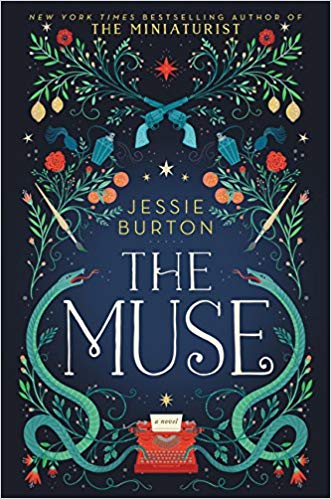
In 1967 London, Odelle Bastien has been making her way with difficulty. Although she is well educated, her race and origins in Trinidad are keeping her from getting a job. Then she gets a break. Marjorie Quick hires her as a secretary in an art institute and makes friendly overtures.

Odelle finds Quick mysterious. She asks Odelle about herself but tells her nothing. She does, however, encourage Odelle to write.

Odelle has also met Laurie Scott, a young man who is interested in being more than her friend. His mother has just died, leaving him only an unusual painting. To support himself, he intends to try to sell it. Odelle encourages him to bring it to the Skelton Institute, her workplace. When Quick sees the painting, she has a strong reaction to it.

In 1935, Harold Schloss, an art dealer, has fled Vienna with his family. Unfortunately, he has chosen Spain, which will soon be little safer, to flee to. His daughter Olive has been accepted at Slade, but she hasn’t told her father. He believes that women can’t be artists, just dabblers.

Olive meets Isaac Robles, an artist, and his sister Irene. Both are servants for the house the Schlosses are renting. Olive is struck by Isaac’s good looks and begins painting in a new style with vibrant colors.

The novel follows these two time threads as it explores the mystery of the painting. Who painted it, and how did it end up in London? How does Quick know about it?

I was struck by Burton’s weird and wonderful The Miniaturist, so much so that as soon as I finished reading it, I bought this book. I found The Muse to be a bit more mundane, with few surprises. For a long time, I was much more interested in Odelle’s section than Olive’s, particularly because Olive makes a decision about her art that I found shocking and unbelievable. In theme, this novel is similar to The Blazing World, and in an action taken by an artist, but with a crucial difference.

Also, like some other bloggers, I am wearying of the dual time-frame format. I am beginning to think it is a little lazy. After all, it seems easier to write half a book about two historical time periods (or one depending upon the time chosen for the more recent period) than a whole book about one. One of the delights of The Miniaturist was how it immersed me in the period. This novel doesn’t really do that.

Mind, it’s not a bad novel, and many people will like it. I just found it a disappointing follow-up to Burton’s first book.

Related Posts

The Miniaturist

The Blazing World

The Clockmaker’s Daughter

Review 1399: The Mermaid and Mrs. Hancock

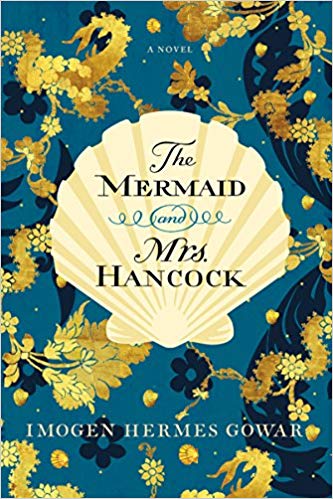
In 1785, Jonah Hancock is a merchant who is waiting for his ship to arrive. It is delayed, and he has heard nothing for a long time, but such is the life of a merchant. Finally, his captain arrives but without his ship, which he has sold to purchase, of all things, a mermaid.

Mr. Hancock doesn’t quite know what to do with the wizened, grimacing creature with the fish tail, especially as it is dead and Captain Jones has sold his ship for £2000 less than it is worth. But the Captain blithely believes the mermaid will make his fortune—he should exhibit it.

Angelica Neal’s protector recently died, leaving her with nothing. Her friend, Mrs. Frost, worried about their household expenses, urges her to return to the house of Mrs. Chappell, the bordello owner, but Angelica is hoping to attract a protector rather than to fall back in debt to Mrs. Chappell. Unfortunately, she falls in love at the party Mrs. Chappell gives to exhibit Mr. Hancock’s mermaid, with a young lieutenant who doesn’t come into his fortune for years.

I enjoyed this peculiar novel, which seems solely a historical novel but contains a whimsical dash of the supernatural. I was interested in both Angelica and Mr. Hancock as characters, as well as some of the others. There is an odd subplot about a girl who runs off from Mrs. Chappell that, while not unfinished, takes some part of the narration and then vanishes from the book until the end. I wasn’t sure of the point of that story line.

In fact, the entire novel sort of meanders past the point where you think it will end, making for an unexpected last 100 pages.

Related Posts

Viper Wine

The Mermaid’s Child

Pure

Review 1394: Mothering Sunday

Best of Ten!
It’s a warm day in the spring of 1924, Mothering Sunday, a day when servants are released from their duties to visit their mothers. Jane Fairchild is a young maid in the home of the Nivenses, but she has no mother. She plans to curl up with a good book until she receives a phone call from her long-time lover.

Her lover is Paul Sheringham, the only son left after World War I to a neighborhood family. Although he is to be married in two weeks, he sets up a tryst with Jane in his own home while his parents and the servants are out.

Jane is to revisit these hours spent with her lover for the rest of her life. For something happens that afternoon that changes the course of her life.

This is a remarkable novel. It is very short, but it somehow covers the course of Jane’s entire life while minutely examining one scene, the meeting with her lover. It touches on every action and word, considers them from several sides just as the mind does as it re-examines an event. At the same time, it examines what qualities make a writer and what a writer attempts to do when writing. This is an excellent novel I read for my Walter Scott Prize project.

Related Posts

Toby’s Room

C

Solace


Review 1391: The Persian Boy

Bagaos, the son of an old Persian family, is ten years old when his family is murdered because his father kept faith with the new king, Arses. Bagaos is sold into slavery and made a eunuch.

Bagaos’s owner rents him out to anyone he wants a favor from, but the news of the boy’s beauty attracts a buyer. Bagaos is being trained for better things and eventually finds himself serving Darius, the new king.

When Bagaos joins the court, Darius has already been defeated once by a Macedonian barbarian named Alexander. So, Darius sends his generals to beat him. Bagaos is grateful for the relatively easy life he leads with Darius but soon finds Darius is no general.

Bagaos must suffer the confusion and savages of war until a Persian general takes him in and then presents him to Alexander as a gift. Bagaos is horrified at the uncouth behavior of the Macedonians, especially toward their king, but he soon finds himself devoted to Alexander.

The Persian Boy is the second book in Mary Renault’s Alexander the Great trilogy. It is faithfully researched and covers some of the many events of Alexander’s life as he conquered the Persian Empire and much of the known parts of Asia. (At the time, the Indian Ocean was considered the edge of the world by the Greeks.)

This is a convincing portrait of Alexander and a character study of Bagaos. Although I felt Renault nailed the psyche of a boy raised as Bagaos was, I did not enjoy this novel as much as the last because of that point of view. During the novel, Bagaos must learn to throw off the effect of the poisonous Persian court.

Related Posts

Fire from Heaven

House of Names

The Silence of the Girls

Review 1385: The Miniaturist

Best of Ten!
I so enjoyed The Miniaturist that I was only disappointed at knowing all its secrets, since I had first seen it televised on Masterpiece. Jessie Burton’s novel is set in the 17th century, and what a difference from the previous novel I read (Widdershins) also set in the 17th century. Burton’s novel evokes the bustling city of Amsterdam, ruled by commerce but also by a harsh Calvinism, a city where people are constantly watched for misbehavior.

Nella arrives from the country to take up residence with her new husband, Johannes Brandt, a wealthy merchant. Although she brings a good family name to the marriage, she brings nothing else, for her father was a poor businessman.

Nella isn’t warmly received. Johannes’s sister Marin is cold, and Johannes hasn’t bothered to be home. When, after a few days, Johannes hasn’t consummated the marriage and Marin continues with the housekeeping, Nella fears that she has no role in her new life.

Johannes’s marriage gift to her is a miniature copy of their house that she can furnish. Although Nella thinks he is treating her like a child, she eventually sends a note to a miniaturist asking for three items: a lute, because Marin will not allow her to play the ones in the house; a block of marzipan, because Marin disapproves of sugar; and a marriage cup, which Nella should have received from Johannes but did not. When the items arrive, they are exquisite, but she also receives things she did not order. And more arrive. They so closely match what is going on in the house that Nella first thinks the family is being spied upon, later that the items foretell the future.

This novel is really good. The story and characters are compelling. Life both within the claustrophobic household and the city is evocatively evoked. It has a delicate touch that reminds me very much of Tracy Chevalier’s The Girl with a Pearl Earring. And there is that tantalizing touch of the supernatural.

Related Posts

The Last Painting of Sara de Vos

Corrag

The Weight of Ink


Review 1382: The Sport of Kings

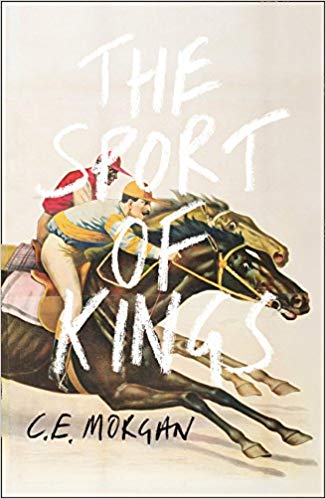
To paraphrase Sophia Brownrigg, a reviewer from The Guardian, The Sport of Kings is about horse racing like Moby Dick is about whales. It is ambitious—attempting to tell the history of Kentucky through that of two families—one white, wealthy, elitist, and bigotted, the other black, poor, and beleagered. It is sometimes magnificent in its prose and sometimes overblown. It is Southern Gothic, focussing on the ramifications of slavery and bigotry.

Henry Forge is the only son of a proud Kentucky family. As a youngster, he was brutalized by his father and lectured about his place in history. We have some sympathy with him until, in his teens, he commits an unforgivable act.

He rebels against his father by turning the family corn plantation into a horse farm, but the nut doesn’t fall far from the tree. When his wife leaves him, his daughter is nine. He takes his daughter out of school and teaches her himself, all his lessons revolving around horses and breeding and including much out-of-date or just plain incorrect information. He is as elitist as his father—and worse.

Henrietta grows up with a talent for working with horses and a keen, cold intelligence. She also likes to pick up men for sex. Then she meets Allmon Shaughnessy, the new African-American groom, fresh from a prison program for working with horses.

Up to that point, the novel seems mostly a multigenerational saga, occasionally discoursing on geology, genetics, or history in the interludes. But after that it becomes wildly overblown at times, reminding me of the characteristics of Moby Dick that I disliked.

Like one other reader on Goodreads, every time I picked up this novel I wanted it to end. It is about deeply unpleasant characters; the least at fault—Allmon—whines his way through the novel. Its long asides are often irritating. It is sometimes beautiful and very dark, but it is often annoying.

Last year I read an essay—I can’t remember who wrote it—complaining about what I call “books only men like,” usually the ones that win awards. (I read this one for my James Tait Black prize project.) This essay commented that because a certain type of book gets attention and wins awards, now some women are beginning to write like men, using All the Birds, Singing as an example. I did not agree with the writer’s example but couldn’t help thinking of this essay while I read this novel.

Related Posts

Mother of Pearl

Wise Blood

Horse Heaven

Review 1379: The Nightingale

I wasn’t impressed by the only other Kristin Hannah novel I read, but my brother recommended The Nightingale so strongly that I decided to give her another chance. I know I’m probably in the minority.

The novel begins with an old lady living in Oregon in 1995 who is moving into a retirement home and is sorting through old papers with her son. Her son finds the identity papers of Juliette Gervaise, a person he’s never heard of. This launches most of the rest of the novel, set in France during World War II.

The two Rossignol sisters are very different women. Vianne is a mother, wife, and schoolteacher. When the Nazis arrive in the village, she is careful to follow orders and try to stay out of trouble. Isabella, however, is a rebellious teenager who runs away from school and immediately begins distributing fliers for the Resistance.

As Vianne fights to survive and protect her daughter, Sophie, she eventually finds that she can’t always follow the rules. In the meantime, Isabella’s involvement with the Resistance becomes more dangerous. Obviously, one of hooks of the novel is to find out which sister becomes the little old lady in Oregon.

It took quite a while, but I did become involved in this novel. It’s an interesting story, based on a real one. I still, however, consider the writing mediocre and trite and the characterization flat except for a few characters. I found the novel affecting, though.

Related Posts

Winter Garden

Life After Life

The Women in the Castle